- Dental office vending machines are usually a poor fit. Patients come for an hour, many cannot eat afterward, and most practices have fewer than 15 people on staff.
- The exception is a large or multi-doctor practice, a dental service organization (DSO) office, or a surgery center with a real staff room.
- The ADA says 27 percent of dentists under 10 years out of school were DSO-affiliated in 2024, so a corporate office may decide for the building.
- Sell to the staff, not the chair. Water, coffee, protein and sugar-free picks do better than a candy row in a waiting room.
- Walk in with a free machine and a quote you can leave behind, and ask for a staff-room spot, not the lobby.
Dental office vending machines are the one healthcare placement where the honest answer is usually no. The office is small, patients stay about an hour, and half of them cannot eat afterward. But a handful of practices are different, and those are worth a morning of your time. If you can tell which is which in ten seconds from the parking lot, you save yourself a lot of walk-ins that go nowhere.
Part of our complete guide: how to find vending machine locations.
Are dental offices good vending machine locations?
Mostly not. A typical dental office has a front desk, a few hygienists, a dentist or two and some assistants. That is often under fifteen people. Machines in small spaces do not turn their stock fast enough to cover your trip, and the rows go stale.
The condition that decides it is headcount on the clock plus a staff room. A dental office with four or more dentists, a staff of thirty, and a break room with a table can carry one small machine. A single-chair practice cannot.
Patients are a poor audience too. After a filling or an extraction, many are told to wait before eating. Children go in with a parent who is telling them not to have candy. The waiting room is the wrong place for a snack row.
What VendBuddy's Lead Finder shows for dental offices
From VendBuddy's own Lead Finder data as of October 4, 2026: the 326 dentists our Lead Finder has scored carry a median of 275 Google reviews and an average rating of 4.7, across 192 cities and regions. High reviews mean busy chairs, so a lot of these are healthy practices, but busy does not mean many people on staff.
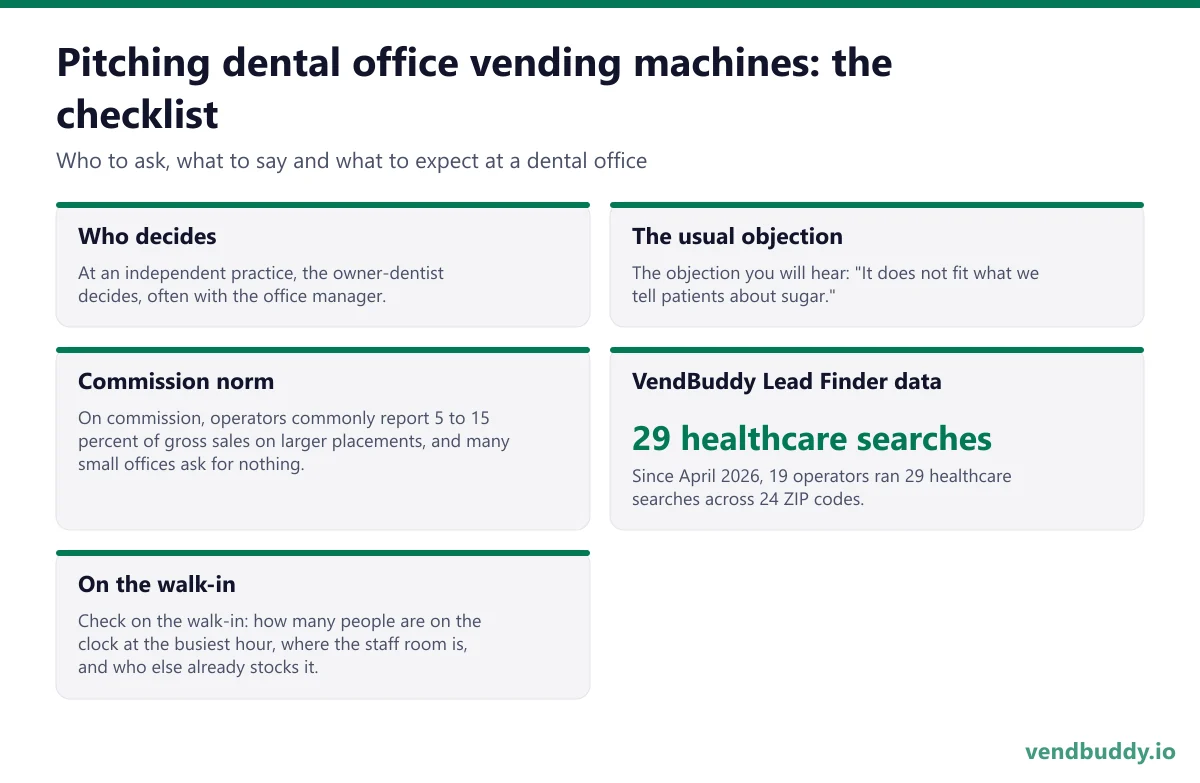
Healthcare as a whole is a modest search for operators. Since April 2026, 19 operators ran 29 healthcare searches across 24 ZIP codes. Lead Finder starts dental offices at its default score of 55, then adjusts for each business. That is a fair signal: a middle-of-the-road lead, one to qualify before you invest.
Picture the machines paying you while you sleep
That’s the real promise of vending — income that doesn’t cost you your time, and a life on your own terms. VendBuddy turns this guide into a step-by-step plan so you actually build it instead of just reading about it. Start free today.
Start building free →Who owns the office, and why it matters
Dentistry is shifting toward group ownership. The American Dental Association's Health Policy Institute reports that 27 percent of dentists fewer than 10 years out of dental school were affiliated with a dental support organization in 2024, up from 24 percent in 2023. Among dentists more than 25 years out, only 9 percent were (ADA Health Policy Institute, June 2025).
For you, that splits the market in two. An older, solo practice has an owner you can talk to in person. A newer office may belong to a DSO, and the office manager will tell you purchasing runs through a regional or corporate team. In that case the answer to your pitch is a form, a vendor list and a delay of months.
How a dental office runs
- Hours. Mostly weekdays, 8 a.m. to 5 p.m., sometimes one evening and a Saturday. Nobody is there at night, so there is no 24/7 sale.
- Who is inside. Patients in 45 to 90 minute blocks, plus the team: front desk, assistants, hygienists, dentists. Parents wait with kids.
- What they already buy. Staff bring lunch and coffee. A lunch spot next door usually wins any craving.
- What competes. A coffee machine, a water cooler, a fridge in the break room, and a very short lunch.
- The rule. A dental office is a clinical setting. Most owners do not want food and candy in the waiting room. A staff-only placement, away from patients, is usually the only one that gets approved.
Stocking for a dental office: the rows that move
If a practice is big enough, put a compact unit or a countertop smart fridge in the staff room and keep it quiet. A card reader matters more than a coin slot, because staff pay with a phone.
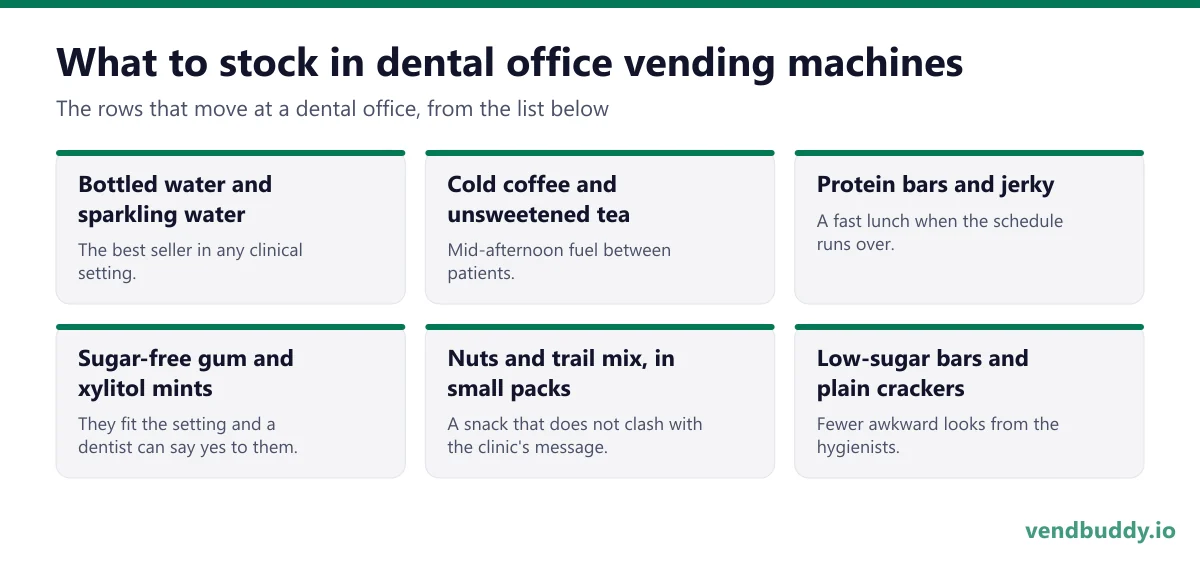
- Bottled water and sparkling water. The best seller in any clinical setting.
- Cold coffee and unsweetened tea. Mid-afternoon fuel between patients.
- Protein bars and jerky. A fast lunch when the schedule runs over.
- Sugar-free gum and xylitol mints. They fit the setting and a dentist can say yes to them.
- Nuts and trail mix, in small packs. A snack that does not clash with the clinic's message.
- Low-sugar bars and plain crackers. Fewer awkward looks from the hygienists.
- A few real meals. A sandwich or salad in a smart fridge covers the staff lunch gap.
Leave out gummies, caramels and sugary drinks. A dentist will not sign off on them, and they are the first thing to get you asked to leave.
Getting the yes from a dental office
At an independent practice, the owner-dentist decides, often with the office manager. At a group practice, ask for the office manager first and the regional operations contact second. Lead Finder does not have a dedicated title list for dental, so ask at the front desk: “Who handles vendors and the staff room?”
A two-sentence opener: “I put free machines in staff rooms for local employers. If your team would use a healthy-leaning machine with water, coffee and protein, I will install it, stock it and send you the report.”
The objection you will hear: “It does not fit what we tell patients about sugar.” The answer is that the machine is for staff, it holds no candy, and the owner can approve every product. Offer to take it out if it does not fit.
On commission, operators commonly report 5 to 15 percent of gross sales on larger placements, and many small offices ask for nothing. See vending machine commission rates and run the numbers in the vending ROI calculator before you offer. On a small office the math often says no, and it is better to know before you drive.
Check on the walk-in: how many people are on the clock at the busiest hour, where the staff room is, and who else already stocks it. If the answer is eight people and a mini fridge, thank them and go.
How to find dental offices near you
Use the Lead Finder with the venue pre-selected: Find dental offices near you in Lead Finder. Sort for the ones with high review counts, then check staff size on their website.
Two free routes also work. In Google Maps, search “dental group practice” and “dental surgery center near me”, and skip single-name offices. Then do a drive-by test: count cars in the staff lot at lunch. More than 15 cars means a team big enough to carry a machine.
Lead Finder adds the owner or manager contact, the score and a radius so you can sweep several towns at once. For the full method, see how to find vending locations. And if you need a name to ask for, our guide to finding business owner contact information covers it.
A dental group with a staff of thirty and a quiet break room can be a good, low-drama location. The trick is to filter hard and only pitch the big ones. Find dental offices near you in Lead Finder and start with the ten largest.
Frequently Asked Questions
Are dental offices good vending machine locations?
Usually not. Most dental offices have fewer than fifteen staff and patients who cannot eat after treatment. A large group practice, a DSO office or a dental surgery center with a real staff room can support one small machine. Qualify by headcount before you pitch.
What sells best in a dental office vending machine?
Bottled water, cold coffee, protein bars, sugar-free gum, xylitol mints and nuts. Staff buy those, and a dentist can approve them. Avoid gummies, caramels and sugary drinks, which clash with what the office tells patients.
How much commission does a dental office expect?
Operators commonly report 5 to 15 percent of gross sales, but most dental offices ask for none because the machine is a small staff amenity. Offer a monthly sales report and product approval instead, and leave the commission as a fallback.
Can I put a vending machine in a dental waiting room?
Rarely. Most owners do not want food and candy in the patient area, and sugar-heavy snacks send the wrong message. A staff-only placement in a break room is the one that usually gets approved.
What is selling, which buildings say yes, and the numbers before you buy a machine. Free, confirm from your inbox, unsubscribe in one click. Refer one friend and get 25 VendBuddy credits.
Walk-ins and cold emails find locations. A small site with your own machine photos and a request-a-machine form lets the next one find you. Around machine three to five, an AI builder drafts it in an evening. Wix is the mature site builder; Base44 also builds working tools like a quote form. Start with the AI website walkthrough or Wix vs Base44.
General information, not legal, tax or financial advice. Rules change, so check the official source. Revenue and income figures are examples, not promises. See our terms.