- Community center vending machines can work when the building runs steady programs: after-school kids, leagues, classes and weekend events.
- The deciding condition is who owns the building. A city or county rec center needs a procurement path, while a nonprofit center often has one director who can say yes.
- Expect healthy vending rules in youth areas. Plan a mix of water, low-sugar drinks and snacks that fit a written standard.
- VendBuddy’s own searches (since 2026-04-10): 1 community center search and 2 rec center searches, so few operators work this venue.
- Ask for the executive director or facilities manager, and ask for the bid process in writing.
Community center vending machines are a slower yes than a car wash or a gym, but they are a steady one. A rec center on a Tuesday at 4 p.m. has kids coming off a bus, parents waiting in the lobby and a pickleball group in the gym. Most operators ignore these buildings because they assume a city contract is a maze. The condition that decides it is who runs the building, because that tells you whether you will talk to one director or fill out a bid packet.
Part of our complete guide: how to find vending machine locations.
If you want a venue where a signed agreement tends to stay signed for years, this is one. Buildings like this change vendors rarely, and they notice when a machine is stocked and clean.
What VendBuddy sees in this venue
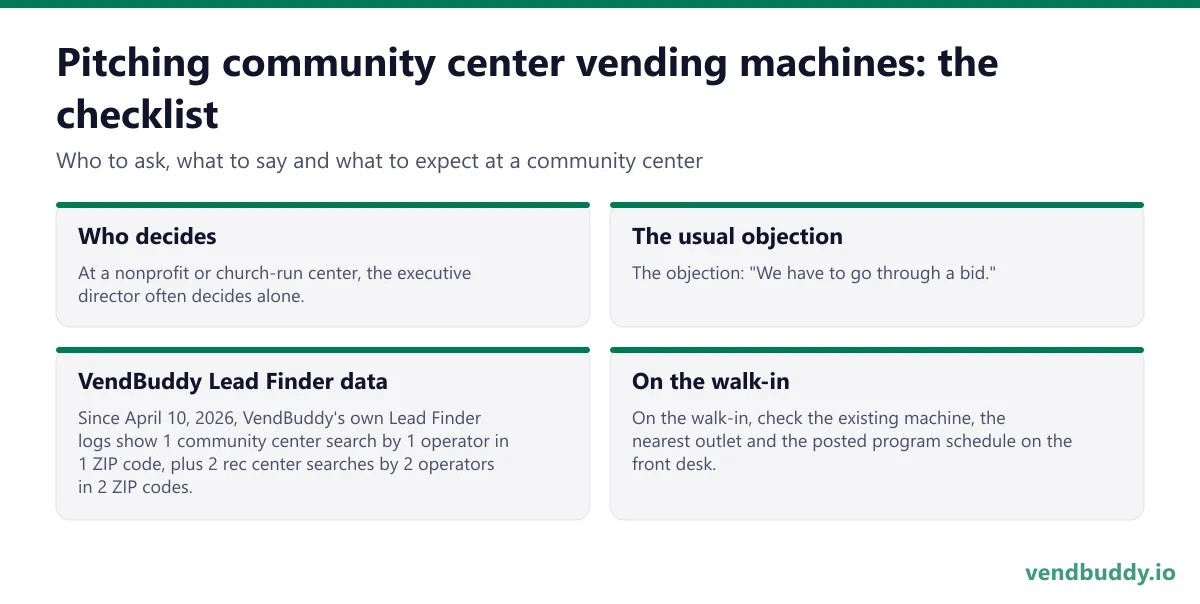
Few operators are working community centers yet. Since April 10, 2026, VendBuddy’s own Lead Finder logs show 1 community center search by 1 operator in 1 ZIP code, plus 2 rec center searches by 2 operators in 2 ZIP codes. That is a small sample, and it tells you mostly that this venue is wide open.
Lead Finder starts community venues at a base score of 64 out of 100 (as of 2026-10-04), which is a little above offices and below gyms. We do not yet have a Places-cache count specific to community centers, so we are not quoting a review median here. A rec center’s score will move with review volume, program size and how close it is to you.
There is no single public count we trust for the number of community centers nationwide, so we will skip one rather than guess. The way to size your own market is to search your county on Google Maps and count the parks and recreation buildings within a 20-minute drive.
How a community center runs
Plan around the calendar before you sign. Summer camps, school breaks and league seasons change foot traffic a lot, so ask the director for last year’s busiest and slowest months. A building that is full in September and half empty in July can still be a good machine, but you should know that before you promise a restock schedule.
Weekday hours usually start early with senior fitness and adult classes, go quiet at midday, and then fill from 3 to 8 p.m. with youth programs, leagues and evening classes. Saturdays are busy with tournaments, birthday parties and rentals.
The people inside are mixed. Children and teens come for after-school programs and camps. Parents wait in lobbies. Older adults come for fitness and card games. Staff eat in a back room. Dwell time is long for programs and short for drop-in gym visitors.
Many centers already have a machine, often old, from a vendor with a contract that auto-renewed. Ask what is there and when the agreement ends before you pitch. Some centers sell snacks at a concession window during leagues, and a concession can be exclusive.
Rules are the other half. City and county buildings often follow a healthy food policy for youth areas, which usually means limits on sugary drinks and requirements for water and lower-calorie options. Some require a competitive bid for any contract above a set dollar amount, and some require a certificate of insurance. Ask for the policy by name. A rule you know about is a selling point, because most vendors do not read it.
Picture the machines paying you while you sleep
That’s the real promise of vending — income that doesn’t cost you your time, and a life on your own terms. VendBuddy turns this guide into a step-by-step plan so you actually build it instead of just reading about it. Start free today.
Start building free →Which machine fits a community, and what goes in it
Pick a machine that makes it easy to meet a written standard. A glass-front or smart cooler with a clear price display is easier to defend to a parks board than a plain cabinet. Outdoor-rated machines are needed only if the unit sits by a field, so check the location before you quote.
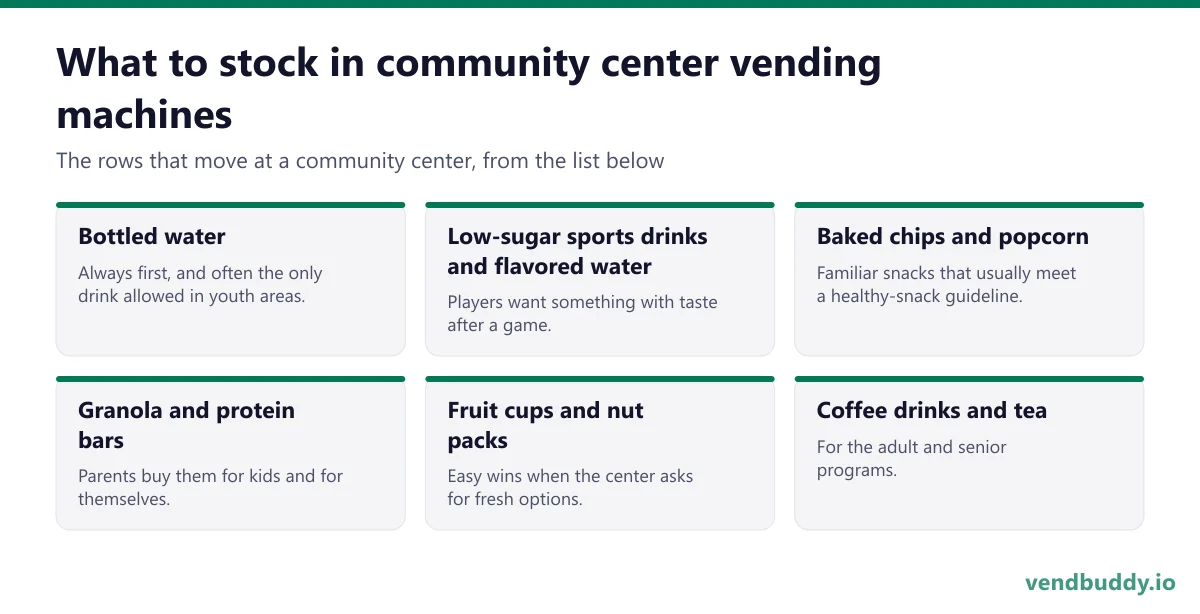
For the rows, think about a mix of kids, teens, parents and seniors:
- Bottled water. Always first, and often the only drink allowed in youth areas. See bottled water vending.
- Low-sugar sports drinks and flavored water. Players want something with taste after a game.
- Baked chips and popcorn. Familiar snacks that usually meet a healthy-snack guideline.
- Granola and protein bars. Parents buy them for kids and for themselves.
- Fruit cups and nut packs. Easy wins when the center asks for fresh options.
- Coffee drinks and tea. For the adult and senior programs.
For a full list that fits a school-style policy, see vending machines for schools, which covers similar nutrition rules.
The pitch and the paperwork
Lead Finder looks for these titles in the community family: Executive Director, Facilities Manager, Director and Manager. At a city rec center, the facilities manager or a recreation supervisor is the first call, but expect that the city purchasing office signs the contract. At a nonprofit or church-run center, the executive director often decides alone.
Most first agreements are two pages, not twenty. The contracts walkthrough lays out the clauses that actually matter for the contract, including the termination language operators forget about until they need it.
An opener you can use: “I’d like to put a healthy vending machine in your lobby at no cost to the center. It meets your nutrition policy and it can pay the program a share of sales.”
The objection: “We have to go through a bid.” Answer that you are happy to, and ask for the bid calendar, the insurance minimum and the scoring criteria. Then show up when it opens. Many operators lose these deals only because they did not know the process existed.
On commission, centers often ask for a share that goes to youth programs. Operators report a wide range; see vending machine commission rates. Run your numbers in the vending ROI calculator before you agree to a percentage, because a slow lobby on a weekday is a different machine from a tournament weekend.
On the walk-in, check the existing machine, the nearest outlet and the posted program schedule on the front desk. The schedule tells you more than the director will: a full wall of classes means a full building.
A city-run community center is public property, and vending there often goes through the parks department or a bid. Vending machines in government buildings walks through that process step by step.
How to find community centers near you
Find community centers near you in Lead Finder lists community and recreation centers by ZIP with a score and the right title.
Free options: search Google Maps for community center and recreation center and look at the programs on each website. Or do a drive-by test at 4:30 p.m. on a weekday; a full lot means a busy building.
What Lead Finder adds is the contact name, the score and a radius filter. See finding the business owner’s contact information for the manual route.
Start with the easy ones
Begin with nonprofit and church-run community centers, where one director can say yes in a week. Use that machine as your reference when the city asks who else you work with. Keep a folder with your insurance certificate, a one-page product list and a photo of a clean, stocked machine, so the next request takes ten minutes instead of a week. Find community centers near you in Lead Finder and rank by score.
Frequently Asked Questions
Are community centers good vending machine locations?
They can be, when the center runs steady programs like after-school care, leagues and classes. The deciding factor is who runs the building. A nonprofit director can say yes quickly, while a city center may require a bid, insurance and a healthy food policy.
What sells best in a community center vending machine?
Water first, then low-sugar sports drinks, baked chips, granola and protein bars, fruit cups and coffee. Many centers limit sugary drinks in youth areas, so a mix that fits a written standard sells and keeps you in good standing.
How much commission does a community center expect?
It varies a lot. Some centers want a share that funds youth programs, and others want none. Operators report a wide range, so see our commission rates guide and check your costs in the ROI calculator before agreeing.
Do I need a bid to put a machine in a city rec center?
Often yes, above a dollar threshold set by the city or county. Ask the facilities manager or purchasing office for the bid calendar, insurance requirements and any healthy vending policy before you spend time on a pitch.
What is selling, which buildings say yes, and the numbers before you buy a machine. Free, confirm from your inbox, unsubscribe in one click. Refer one friend and get 25 VendBuddy credits.
Walk-ins and cold emails find locations. A small site with your own machine photos and a request-a-machine form lets the next one find you. Around machine three to five, an AI builder drafts it in an evening. Wix is the mature site builder; Base44 also builds working tools like a quote form. Start with the AI website walkthrough or Wix vs Base44.
General information, not legal, tax or financial advice. Rules change, so check the official source. Revenue and income figures are examples, not promises. See our terms.