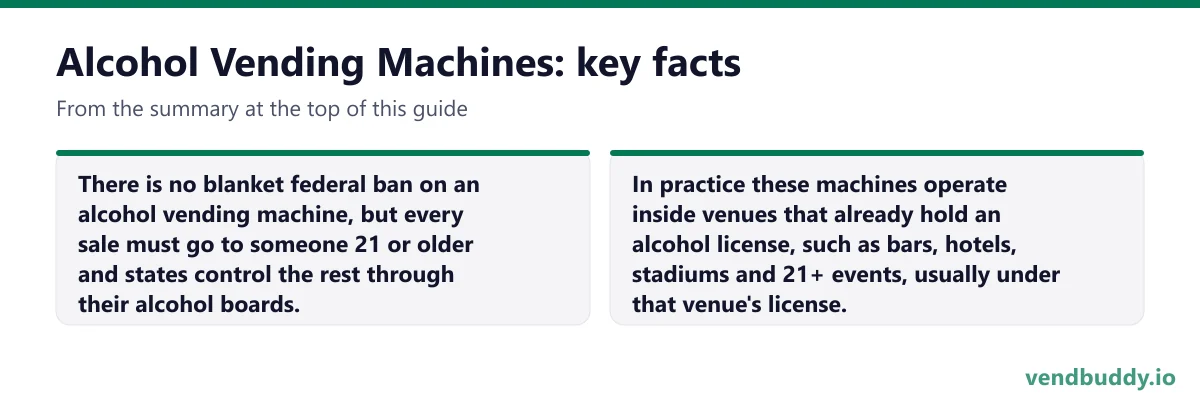
- There is no blanket federal ban on an alcohol vending machine, but every sale must go to someone 21 or older and states control the rest through their alcohol boards.
- In practice these machines operate inside venues that already hold an alcohol license, such as bars, hotels, stadiums and 21+ events, usually under that venue's license.
- Machines sold for this use add ID scanning, sometimes facial matching, cashless payment and remote logs.
- State rules range from allowed with conditions to effectively banned, and license fees run from a few hundred dollars to five figures a year depending on the license type.
- For a new operator, the realistic play is a partnership with a licensed venue, not a machine you own and license yourself.
An alcohol vending machine is legal in parts of the United States, but not in the way most people picture. You won't be putting a beer machine in an apartment lobby. These machines live inside places that already sell alcohol, under rules written by each state's alcohol board, with ID checks on every sale. If you came here wondering whether it's a business you could start, the honest answer is: maybe, as a partner to a licensed venue.
Part of our complete guide: how much does a vending machine cost.
This guide sticks to what's legal. Alcohol rules are strict for a reason, and the penalties for getting them wrong fall on you and on the location that trusted you.
The federal baseline: 21, sealed and labeled
The federal picture is simple. The legal drinking age is 21 in every state, set through the National Minimum Drinking Age Act of 1984, so every sale has to go to someone 21 or older. Packaged alcohol also has to meet federal labeling and distribution rules. Beyond that, the federal government leaves alcohol retail to the states. As one machine seller puts it on its product page, there's no federal prohibition on alcohol vending, but state alcohol control boards govern unattended sales (VTM Vending, a machine seller).
State rules decide everything
Each state's Alcoholic Beverage Control agency decides whether a machine can sell alcohol and under what license. A 2026 compliance guide from VMFS USA, which sells these machines, groups states roughly like this (VMFS USA):
- Allowed with conditions: it cites Florida approving wine vending with ID checks and proper permits, Nevada allowing machines in venues that already serve alcohol, and local exceptions in Texas under specific permits.
- Restricted to licensed venues: it lists California, Pennsylvania and New York as tying machines to on-premise licenses, ID scanning and monitoring.
- Effectively banned: it names Utah, Alabama and South Carolina.
Treat any list like that as a starting point, not an answer. It comes from a company that sells machines, state rules change, and cities and counties add their own layer. The only answer that counts is the one from your state ABC office for the exact address you have in mind.
Picture the machines paying you while you sleep
That’s the real promise of vending — income that doesn’t cost you your time, and a life on your own terms. VendBuddy turns this guide into a step-by-step plan so you actually build it instead of just reading about it. Start free today.
Start building free →What licenses look like
Alcohol licenses come in a few broad types, and the machine has to sit under the right one:
- On-premise: drinks consumed where they're sold, such as bars, restaurants and hotel lounges.
- Off-premise: sealed containers to take away, such as retail stores.
- Beer and wine only: a narrower and usually cheaper permit.
- Temporary event permits: for festivals and events with gated 21+ areas.
The same VMFS guide puts fees anywhere from about $300 a year for a beer and wine permit to more than $14,000 a year for full liquor licenses, and notes some states require seller training. That range is why almost every working machine sits under a license the venue already holds.
Where alcohol vending machines actually work
- Stadiums and arenas: self-serve beer stations cut lines at halftime, inside an already-licensed concession operation.
- Hotels: lobby or guest-floor machines restricted to adult guests, under the hotel's license.
- Bars and nightclubs: self-pour or canned options that free up bartenders on busy nights.
- 21+ events: inside gated areas, under the organizer's temporary permit.
Notice the pattern. The machine isn't the business; it's a tool for a venue that already sells alcohol and wants faster service. That shapes how an independent operator can fit in.
What the machines include
Machines sold for alcohol add layers most snack machines don't have: government ID scanning, sometimes a camera that matches the buyer to the ID, cashless-only payment, locked cabinets, and remote transaction logs so the venue can show compliance. Expect them to cost well above a standard drink machine, and confirm the age-verification method is one your state accepts before you buy anything.
Can an independent operator make this work?
Realistically, the path in is a partnership. You bring the machine, stocking and service; the licensed venue sells under its license, controls the door, and splits the revenue with you. Some states won't allow even that structure, so the agreement needs to be checked against your state rules before anything is signed. Our vending license and permit guide covers the general vending side, and the same approach applies to nicotine products, which we cover in the tobacco vending machine laws guide.
If what you really want is a machine business that earns while you're with your family, there are far more open doors elsewhere. Thousands of offices, gyms, apartments and laundromats need a snack, drink, coffee or novelty machine, with none of the alcohol licensing. Our ranked list of alternative vending businesses compares the options.
Questions to answer before you spend a dollar
If a hotel, arena or bar asks you about an alcohol machine, work through these with the venue and your state ABC office first. Each one can end the project, and it's far cheaper to find out now than after a machine arrives.
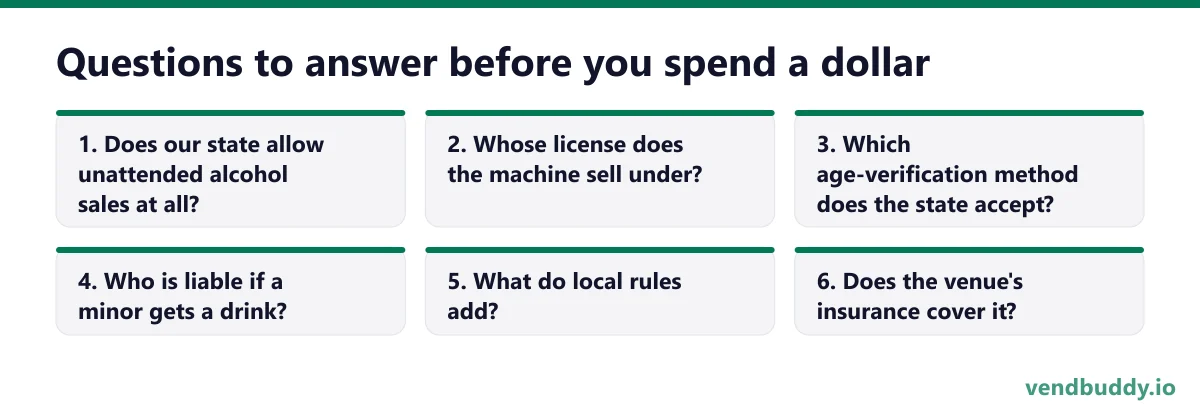
- Does our state allow unattended alcohol sales at all? Ask the ABC office directly and get the answer in writing if you can.
- Whose license does the machine sell under? Usually the venue's. Confirm the license type covers the product (beer and wine versus spirits) and the setting (on-premise versus sealed take-away).
- Which age-verification method does the state accept? ID scan, camera match, staff release, or a combination.
- Who is liable if a minor gets a drink? Put it in the agreement, along with who restocks, who holds keys and who can shut the machine off.
- What do local rules add? Cities and counties can restrict hours, locations and signage.
- Does the venue's insurance cover it? Liquor liability policies sometimes need an update for self-serve equipment.
Keep notes from every call: who you spoke with, the date, and what they said. Rules get interpreted differently by different staff, and a written record of what the regulator told you is worth having if questions come up later.
If the answers are clean, the machine choice comes last. Buying first and asking second is how operators end up with a very expensive drink cooler.
Your first step
Most operators started without knowing any of these rules. They picked a lane, learned what applied, and focused on one good location. Whichever lane you choose, finding a venue that fits and the person who can say yes is the work that moves you forward. VendBuddy shows you which nearby businesses fit your machine and who decides there. Search your area free.
This article is general information, not legal advice. Alcohol laws vary by state, county and city and change often; confirm with your state Alcoholic Beverage Control agency or an attorney before placing a machine.
Frequently Asked Questions
Are alcohol vending machines legal in the US?
In some places. There is no blanket federal ban, but buyers must be 21 or older and each state alcohol board decides whether and how machines can sell alcohol. Some states allow them in licensed venues with ID checks, and some effectively ban them.
Where can you put an alcohol vending machine?
Almost always inside a venue that already holds an alcohol license, such as a bar, hotel, stadium or a gated 21+ event, and usually under that venue's license. Public, all-ages locations are not an option.
Do alcohol vending machines check ID?
Machines sold for alcohol typically scan a government ID and some add a camera match to the ID. Your state decides which verification methods are acceptable, so confirm before you buy.
How much does an alcohol license cost?
It depends on the state and license type. One seller's 2026 guide cites about $300 a year for some beer and wine permits and more than $14,000 a year for full liquor licenses, which is why most machines operate under a venue's existing license.
What is selling, which buildings say yes, and the numbers before you buy a machine. Free, confirm from your inbox, unsubscribe in one click. Refer one friend and get 25 VendBuddy credits.
General information, not legal, tax or financial advice. Rules change, so check the official source. Revenue and income figures are examples, not promises. See our terms.