- School vending machines in K-12 must sell only products that meet USDA Smart Snacks standards during the school day. That is a federal rule, not a choice.
- The decision usually sits with the district: a food service director, a business office or the school board. A principal alone rarely signs.
- Universities are different. Most buy through a dining contract, so your best door is a department, residence hall or athletics facility. See our colleges guide.
- Stock compliant snacks, water, low-calorie drinks and, for staff lounges, coffee and protein. Check each product against the Smart Snacks calculator.
- Treat K-12 as a long, compliance-heavy sale. Treat staff lounges, private schools, trade schools and community colleges as the faster wins.
School vending machines are a real business, but the rules are different from any other location. A K-12 machine has to follow federal nutrition standards, a university buys through a dining contract, and neither door opens to a cold walk-in. If you want a steady spot with built-in foot traffic, this is one, but you have to know which kind of school you are pitching before you pick up the phone.
Part of our complete guide: how to find vending machine locations.
Are schools good vending machine locations?
It depends on the kind of school. K-12 is slow and rule-heavy: the district decides, the products are restricted and the school day is short. Universities and trade schools are bigger and open longer, but they usually lock vending into a dining contract. Private schools, charter schools and staff lounges are the easiest way in.
The condition that decides it is who controls the contract. If it is a district office, you need a bid or a pilot. If it is a campus dining partner, you need a subcontract or a department with its own budget. If it is a principal at a private school, you may only need a meeting.
The numbers behind schools
This is VendBuddy's own Lead Finder data as of October 4, 2026. Education is the seventh most searched venue type on VendBuddy: 12 operators ran 19 education searches across 13 ZIP codes since April 2026.
The Places data explains why the work is uneven. Lead Finder has scored 463 schools with a median of 45 Google reviews and a 4.42 rating, 112 secondary schools with a median of 26 reviews, and 337 universities with a median of 210 reviews and a 4.3 rating. Low review counts on schools mean review volume says little about traffic here. Check enrollment instead. Education starts at Lead Finder's default score of 55, then adjusts for each business.
Picture the machines paying you while you sleep
That’s the real promise of vending — income that doesn’t cost you your time, and a life on your own terms. VendBuddy turns this guide into a step-by-step plan so you actually build it instead of just reading about it. Start free today.
Start building free →The rule that applies: USDA Smart Snacks in K-12
The USDA says that all foods sold at school during the school day must meet nutrition standards. The Smart Snacks in School rule covers foods sold a la carte, in the school store, in vending machines, and anywhere else food is sold to students (USDA Food and Nutrition Service, Smart Snacks in Schools).
In plain terms, a snack generally needs a fruit, vegetable, dairy or protein food as its first ingredient, and it has to stay inside limits on calories, sodium, fat and sugar. Drinks are restricted by grade level. States and districts can be stricter than the federal rule, so ask for the local wellness policy before you load a single product.
A practical rule: use the USDA's own product guide and calculator, not a vendor's claim that something is compliant. Keep the label on file for each product, because the district will ask.
The rule is about students. A machine in a staff lounge that students cannot reach is a different conversation, and you should confirm it with the district. Many operators start there.
How schools run, by type
- Elementary. Rarely worth it. Most districts do not allow vending for young children, and kids do not carry money.
- Middle and high school. Machines sit near gyms and commons. The sales window is tight: before school, between classes, after school and at games. The Smart Snacks rule applies, and athletics booster clubs often compete with you.
- Community colleges and trade schools. Longer hours, evening classes, adult students who bring money. A good second step.
- Universities. Residence halls, libraries, athletics buildings and student centers. Dining contracts usually cover them. The pitch is a department, not the campus. Our guide to getting vending machines into colleges covers it, so we will not repeat it here.
The rows that sell at a school
In K-12, a machine with a compliant product list is the entire game. For staff lounges and colleges, a regular combo or a smart fridge opens up more of the range.
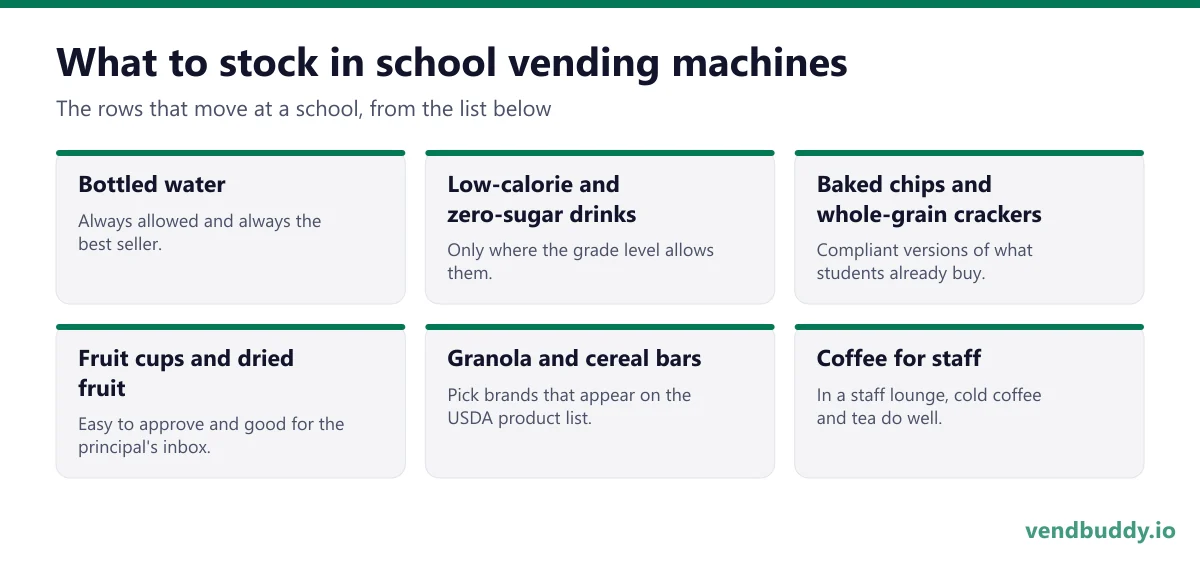
- Bottled water. Always allowed and always the best seller.
- Low-calorie and zero-sugar drinks. Only where the grade level allows them.
- Baked chips and whole-grain crackers. Compliant versions of what students already buy.
- Fruit cups and dried fruit. Easy to approve and good for the principal's inbox.
- Granola and cereal bars. Pick brands that appear on the USDA product list.
- Coffee for staff. In a staff lounge, cold coffee and tea do well. Keep energy drinks out of anything students can reach.
- Protein bars and jerky for athletics and colleges. Coaches and lifters buy them.
Pitching the school: the opener and the objection
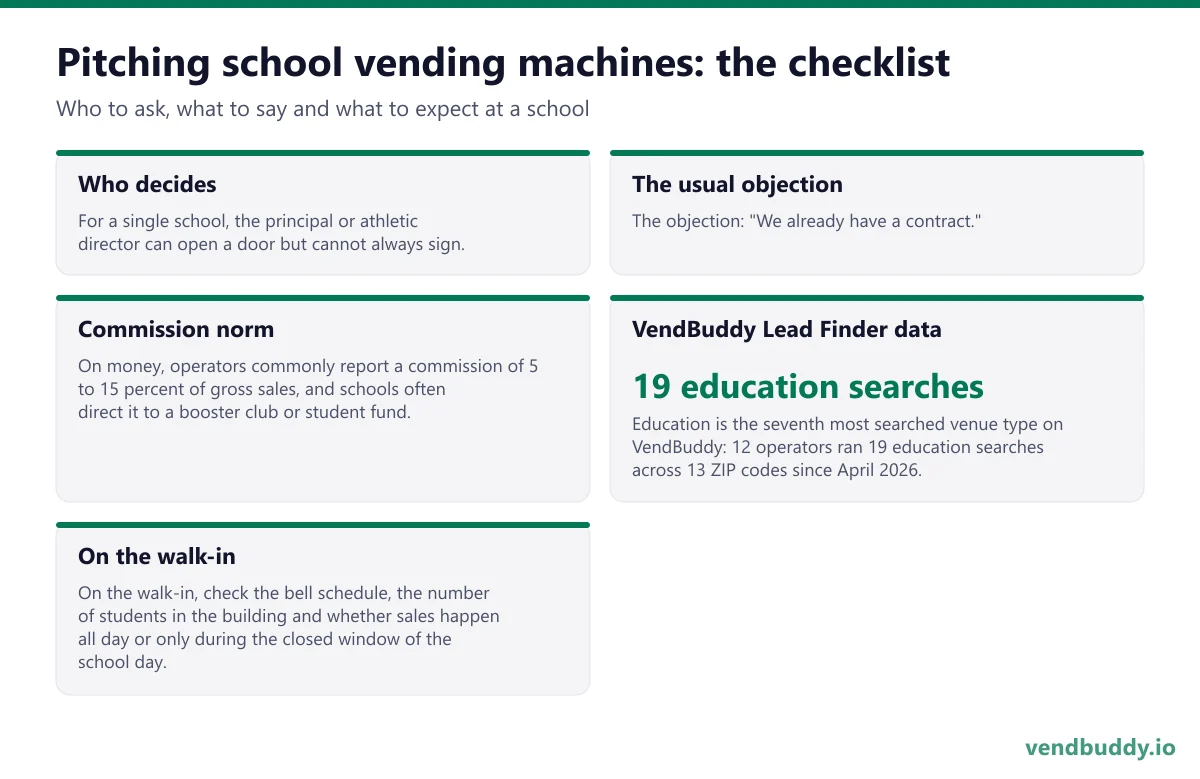
At a district, start with the food service director and the business office. For a single school, the principal or athletic director can open a door but cannot always sign. At a university, start with the facilities manager or the department head who controls the building. Lead Finder does not have a dedicated title list for education, so ask who handles vendors.
Opener: “I run a small vending service. Every product I stock meets USDA Smart Snacks, and I will send you the label list. I would like to pilot one machine in the staff lounge and share a percentage of sales with your wellness fund.”
The objection: “We already have a contract.” Ask when it ends and who handles locations outside the main contract, like gym lobbies and staff lounges. See school vending machine contracts and book vending machines for schools for what the paperwork looks like.
On money, operators commonly report a commission of 5 to 15 percent of gross sales, and schools often direct it to a booster club or student fund. See vending machine commission rates and the vending ROI calculator for the math.
On the walk-in, check the bell schedule, the number of students in the building and whether sales happen all day or only during the closed window of the school day.
How to find schools near you
Lead Finder can pre-select this venue type: Find schools near you in Lead Finder. It scores each school and gives you a contact when it has one.
Two free ways work. In Google Maps, search “private high school near me” and “community college near me”, and put public districts on a separate list. Then do a drive-by test: visit at dismissal and look at the lot, the gym and the student center. Many students plus an empty lobby is a placement that needs a machine.
What Lead Finder adds is the contact, the score and a radius, so you can sweep several districts in one session. For a general method, see how to find vending locations.
Start with the one that says yes fastest, a private school or a staff lounge, and use it as your reference at the district office. Find schools near you in Lead Finder and begin with five.
Frequently Asked Questions
Are schools good vending machine locations?
They can be, but each type works differently. K-12 requires USDA Smart Snacks products and district approval. Universities usually sell through dining contracts. Private schools, community colleges, trade schools and staff lounges are the faster entry points.
What sells best in a school vending machine?
Water is the top seller. After that, compliant baked chips, granola bars, fruit cups and low-calorie drinks sell to students, while coffee and protein bars sell in staff lounges and colleges. Check every product against the USDA Smart Snacks standards.
How much commission does a school expect?
Operators commonly report 5 to 15 percent of gross sales. Many schools direct it to a student fund, athletics or a wellness program. A district may set its own rate in a bid, so ask before you quote.
What are the Smart Snacks rules for school vending?
The USDA requires that all foods sold to students during the school day meet nutrition standards. The rule covers vending machines, a la carte lines and school stores. Snacks need to meet limits on calories, sodium, fat and sugar. States may be stricter.
What is selling, which buildings say yes, and the numbers before you buy a machine. Free, confirm from your inbox, unsubscribe in one click. Refer one friend and get 25 VendBuddy credits.
Every operator we talk to wants fewer cold calls. The ones who get there have a Google Business Profile and a simple site a manager can check before replying. AI builders make that an evening job now. Wix is the mature site builder; Base44 also builds working tools like a quote form. Start with the AI website walkthrough or Wix vs Base44.
General information, not legal, tax or financial advice. Rules change, so check the official source. Revenue and income figures are examples, not promises. See our terms.