- NAMA 2026 was a smart-cooler show. One operator counted 25–30 different smart coolers on the floor. That is the headline, and it is a supply signal as much as a demand one.
- The launches were software, not machines. Nayax launched an account product, an AI tool and a management platform; Cantaloupe showed AI aimed at theft and route efficiency. The competition has moved off the hardware.
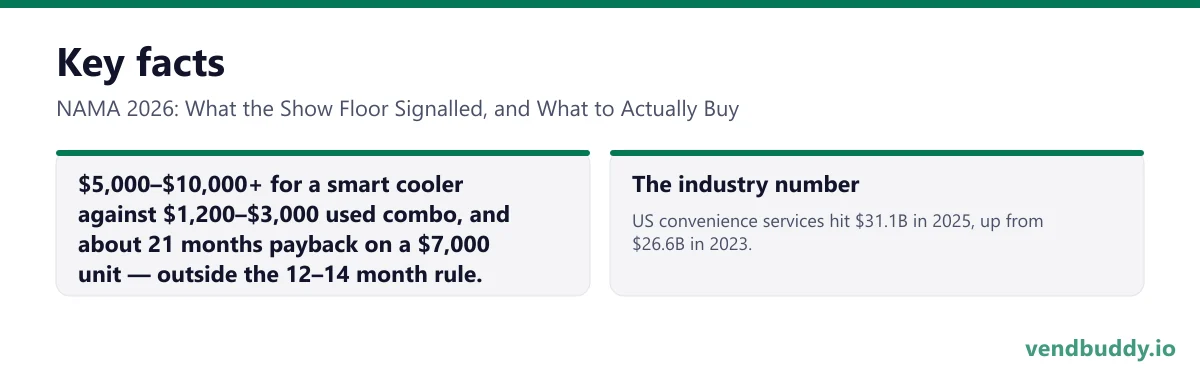
- The margin math has not moved with the hype. $5,000–$10,000+ for a smart cooler against $1,200–$3,000 used combo, and about 21 months payback on a $7,000 unit — outside the 12–14 month rule.
- Buy the building, not the booth. Smart formats do 2–3× the revenue where traffic and venue justify them, and lose badly where they do not.
- The industry number: US convenience services hit $31.1B in 2025, up from $26.6B in 2023. The growth is real; most of it is not in traditional snack machines.
The NAMA Show ran 22–24 April 2026 at the Los Angeles Convention Center: more than 400 exhibitors, 140 of them new, over 5,000 attendees, roughly 30% of them there for the first time, and a keynote from Ron Howard. It was four months ago. Which makes this the useful moment to write about it rather than the exciting one — the launch noise has cleared, the equipment decisions operators made in May have had a season to perform, and you are probably choosing machines for next year right about now.
So: what actually mattered on that floor, what to buy this year versus what to let mature, and how to make a purchase in 2026 that is not obsolete in 2028.
1. What mattered on the floor — and what it costs
Smart coolers, in quantity that is itself the story
The single most quotable observation from the show came from an operator rather than a vendor. Peter Virnig of Taher Inc., speaking on a Vending Market Watch podcast from the show, counted “25 to 30 different smart coolers here.”
Read that as a supply signal before you read it as a demand one. Two dozen vendors building variants of the same product category means the category is being commoditised in real time — which is good news for prices and bad news for anyone paying a premium today for a feature that will be standard in eighteen months. It also means the field will thin, and some of those two dozen will not be servicing machines in 2029.
The margin math has not moved as fast as the marketing. Using the same figures we publish everywhere else on this site:
| Used combo machine | Smart cooler / AI machine | |
|---|---|---|
| Purchase price | $1,200–$3,000 | $5,000–$10,000+ |
| Revenue at a suitable site | Baseline | 2–3× the combo, where traffic and venue justify it |
| Net on $1,200/month gross | About $330 after 40–50% COGS and a 25–30% net margin on what is left | |
| Payback at that net | 4–9 months | ~21 months on a $7,000 unit, before interest |
| Against the 12–14 month rule | Comfortably inside | Outside — and outside any 0% intro window |
None of that says do not buy one. It says the machine has to be justified by the room. The head-to-head comparison is where the revenue premium is real, and our critical SandStar review is where we found what actually goes wrong when the format meets an ordinary building.
The launches were software
The most telling thing about the 2026 exhibitor announcements is what they were not. Nobody won the show with a better mechanical vender.
- Nayax (booth 1929) used the show to launch its Yellow Account, MoMa AI and VendCore Pro — a banking-adjacent account product, an AI layer and a management platform. Our operator-level take on what their monthly fee actually buys is in the Nayax review.
- Cantaloupe showed smart-store configurations, hot food, and AI software aimed at theft detection and route efficiency — the two places where software can defend a real dollar figure rather than a feeling.
- VendTech showed its VendXone software alongside kiosks and coolers.
For a small operator the implication is concrete and slightly uncomfortable: the industry is moving toward equipment sold with a monthly fee attached. That converts a one-time capital decision into a recurring-cost decision, and recurring costs are the line operators are least practised at auditing. Before you sign anything with a monthly on it, price the fee against what it replaces — if telemetry saves you four drives a month, it is cheap; if it saves you nothing because your route is three buildings on one street, it is a subscription to a dashboard.
The most useful stat from NAMA 2026 was not on a slide. One operator counted 25 to 30 different smart coolers on the floor — which tells you the category is being commoditised in real time.
2. Hype versus buy: what to actually do this year
| Worth buying into now | Worth letting mature | |
|---|---|---|
| Cashless and telemetry | A telemetry-grade reader is table stakes, and the reason is operational as much as commercial: it is what lets you stop driving to machines that did not need servicing. Reader comparison here. | Nothing to wait for. This decision was over years ago. |
| Smart coolers | At a site with 150+ daily traffic, a large on-site population and a host who wants grab-and-go. The revenue premium is genuine there. | At an ordinary office or small apartment building. Two dozen vendors competing means better hardware at lower prices within two years. |
| AI loss-prevention and route software | Where shrink or drive time is a measured problem you can put a dollar figure on. | Where it is a feeling. Software that optimises a route you have not yet measured optimises nothing. |
| Hot food and fresh formats | In captive, multi-shift buildings with no cafeteria — the same profile that produces every outlier placement. | Anywhere spoilage risk has not been modelled. Fresh is an inventory business wearing a vending machine. |
| Micro markets | Inside a building that already trusts you. It is step two of a good placement, not a way to open one. The comparison is here. | As a first placement, or in any building where the host will not commit to the footprint. |
The same table, sorted by how many machines you run
Because the honest answer to almost every question above changes with route size, and a show floor is designed to make that distinction disappear.
At three machines, ignore essentially all of it. A smart cooler costs several times a used combo and carries a monthly fee whether the machine sells anything or not. Below roughly 150 daily visitors that fee alone can eat the difference. Route software optimises a route that is three buildings on one street, which is to say it optimises nothing. The one exception is cashless, which is not a 2026 innovation and is not optional — put a telemetry-grade reader on every machine you own and stop thinking about it.
At about fifteen, run one of something — not a fleet. Pick the single building on your route with the highest daily traffic and the most price-tolerant crowd, put a smart cooler in it, and compare it against its own prior six months. That is the only test that tells you anything, because the uplift is enormously site-dependent: real money in premium apartment buildings and Class A offices, close to nothing in a standard gym where people came to work out and leave. One controlled experiment at fifteen machines is worth more than any case study a vendor will show you.
At thirty and up, the software layer starts to earn its fee on drive time alone, and micro markets become a genuine second product line rather than an aspiration — though the gate there is population, not money. Under about 75 employees the ceiling kills a market no matter how well you run it.
The technology is not the hype. The claim that it works at every scale is the hype.
Picture the machines paying you while you sleep
That’s the real promise of vending — income that doesn’t cost you your time, and a life on your own terms. VendBuddy turns this guide into a step-by-step plan so you actually build it instead of just reading about it. Start free today.
Start building free →The fastest revenue lift: add a card reader
Across operator surveys and our own route data, adding cashless lifts per-machine revenue 30–50% within 60 days — cash-only machines are functionally invisible to most customers under 30. Nayax is the reader most multi-machine operators standardize on: reliable hardware, strong telemetry, and wide machine compatibility — it is also the one live reader integration inside VendBuddy. Our full breakdown of what the monthly fee buys, and when to skip it, is in the Nayax review for operators.
3. Future-proofing your next machine purchase
Five questions to ask a vendor before you buy anything shown in Los Angeles — all of them aimed at the same risk, which is that you are buying into a category with two dozen competitors and a coming shakeout.
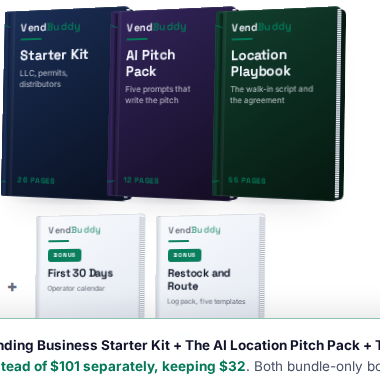
If you get to the end of this and the answer is yes, the kits are the shortcut past the blank page: a 26-page starter kit for the paperwork, a 55-page Location Playbook for the walk-in script and the agreement, and a 12-page AI Pitch Pack. Bought once, from $27, and you keep the files.
Look inside the kits →Who the industry recognised
Worth a line, because the award list is a decent proxy for what the trade currently values. NAMA named April Cathcart Person of the Year, Seventh Wave Refreshments Operator of the Year, and 365 Retail Markets its Allied Member of the Year — the last of which is itself a signal, given that 365 sells the self-checkout technology behind a large share of micro markets.
One thing we are deliberately not reporting: several roundups referenced innovation-award winners for 2026 that we could not confirm against a primary source, so they are not on this page. If a product claim matters enough to spend $7,000 on, it matters enough to be sourced.
The number behind the noise
US convenience services revenue reached $31.1 billion in 2025, up from $26.6 billion in 2023 — an average growth rate of about 8.1% — according to industry figures released in March 2026. That covers vending, micro markets, office coffee and pantry service together rather than vending machines alone, which matters, because most of that growth is happening in the newer formats rather than in traditional snack machines.
Which is really the summary of the whole show. The industry is growing, and it is growing sideways into screens, sensors and unattended stores. That is an opportunity for a small operator and it is not a mandate: the fundamentals of this business are still a good building, a fair commission and a machine that suits the room. Whether AI machines are worth it and the ranked AI machine list with real prices are the two pages to read next if the answer for your building is yes.
Every recommendation on this page collapses into one question: is the room good enough to justify the machine. VendBuddy scores real venues near you by traffic, headcount and category, gives you the best contact on file for each, and models what a machine would net there before you commit - which is the only honest way to know whether a smart cooler is an upgrade or an expensive mistake. Five free credits, no card required.
Related reading: AI vending machines ranked, with real prices, our critical SandStar smart cooler review, smart vending machines for sale, smart versus traditional, head to head, and the 2026 card reader comparison. Machine specs and prices are in the Machine Finder.
Frequently Asked Questions
What was shown at the NAMA Show 2026?
Smart coolers, overwhelmingly. One operator on the floor counted 25 to 30 different smart cooler products across the hall, which is the single clearest signal the show produced. Beyond the coolers, Cantaloupe showed smart-store configurations, hot food and AI software aimed at theft and route efficiency; Nayax used the show to launch its Yellow Account, MoMa AI and VendCore Pro products; and VendTech showed its VendXone software alongside kiosks and coolers. The show ran 22 to 24 April 2026 at the Los Angeles Convention Center with more than 400 exhibitors, 140 of them new, and over 5,000 attendees.
When and where was the NAMA Show 2026, and where is 2027?
NAMA 2026 ran 22 to 24 April 2026 at the Los Angeles Convention Center, with a keynote from Ron Howard and roughly 30 percent of attendees there for the first time. The 2027 show moves to New Orleans. For a small operator deciding whether to attend, the first-timer share is the useful number: this is not a show that only makes sense once you run fifty machines.
Are smart coolers worth it for a small operator in 2026?
At the right site, yes, and at the wrong one they are the most expensive mistake available. Smart coolers and AI machines commonly do two to three times the revenue of a traditional combo head to head, but only where traffic and venue justify the format. The arithmetic is unforgiving: a smart cooler runs $5,000 to $10,000-plus against $1,200 to $3,000 for a used combo, and a machine grossing $1,200 a month nets roughly $330, which puts a $7,000 unit at about 21 months of payback before interest. That is outside the 12 to 14 month rule most operators use and well outside any 0 percent intro window. The format earns its premium at 150-plus daily traffic with a large on-site population and a host who actually wants grab-and-go.
You can run the payback period on your own numbers in the revenue calculator instead of borrowing ours. It asks for property type and headcount, which is where nearly all of the difference comes from.
What does the NAMA 2026 show floor tell you about where vending is going?
Three things. Unattended retail is consolidating around screens, sensors and remote data rather than around better mechanical vending. The software layer is where the vendors are competing now - the launches at the show were accounts, AI tools and management platforms rather than new machines. And the hardware is increasingly sold as part of a service relationship with a monthly fee attached, which changes the buying decision from a one-time capital question into a recurring-cost question that operators are not always in the habit of asking.
How big is the vending and convenience services industry in 2026?
US convenience services revenue reached $31.1 billion in 2025, up from $26.6 billion in 2023, an average growth rate of about 8.1 percent, according to figures released by the industry association in March 2026. That covers vending, micro markets, office coffee service and pantry service together rather than vending machines alone, which is worth remembering when the number gets quoted as if it were the vending machine market by itself.
Should I buy a smart cooler or a traditional machine for my next placement?
Let the building decide rather than the show floor. If the site has 150-plus people passing daily, a large on-site population and a host who wants a grab-and-go format, a smart cooler is a defensible purchase and the revenue premium is real. If it is an ordinary office of 60 people, a used combo at a quarter of the price will out-earn it per dollar invested every time. The failure pattern is buying the newer machine and then hunting for a location good enough to justify it, which is the same mistake as buying any machine before a building has said yes.
Do smart coolers really have 41% operator adoption?
That figure appeared in one 2026 show report and we have not been able to corroborate it against a second source, so treat it as an estimate rather than a fact. What is directly observable is less precise but harder to argue with: a single hall contained 25 to 30 competing smart cooler products, and vendors do not build that many variants of something operators are not buying. The direction is clear even where the percentage is not.
What is selling, which buildings say yes, and the numbers before you buy a machine. Free, confirm from your inbox, unsubscribe in one click. Refer one friend and get 25 VendBuddy credits.
General information, not legal, tax or financial advice. Rules change, so check the official source. Revenue and income figures are examples, not promises. See our terms.