- Non-traditional machines win by matching the machine to the psychology of the location — a coin pusher in a laundromat works because everyone in the room is holding quarters with 40 minutes to kill.
- Claw machines are the proven heavyweight: $50–$300+/week at family-food locations on ~30–40% product cost.
- Legal first: coin pushers sit near gambling law in many states — cash or high-value payouts can make them illegal gaming devices. Merchandise-only, check your state, get it in writing.
- Same rule as snacks: the location decides everything. Match dwell time + audience + spare change to the machine type.
Snack and drink machines are the index funds of vending. The non-traditional machines — pushers, claws, sticker flats, ice, bait — are the small caps: weirder, lumpier, and in the right spot, quietly spectacular. The whole game is matching the machine to the psychology of the room it sits in.
Part of our complete guide: best cash flow businesses.
Read this before buying a coin pusher
Coin pushers live next to a legal line. In several states a pusher that pays out cash or high-value prizes is an illegal gambling device, full stop; in others, quarter pushers are legal as amusement machines when winnings are merchandise or the game leans on skill. Enforcement varies county to county, and machines DO get seized. The safe pattern: merchandise/amusement configurations only, check your state’s amusement-device statute (and your county), and get the location owner’s sign-off in writing. This paragraph is the difference between a great niche and a confiscated asset — treat it as step one, not fine print.
The coin pusher × laundromat play
Here is why this pairing is genuinely clever rather than gimmicky: a laundromat is the one retail environment where everyone is already holding quarters, has 30–60 minutes of enforced boredom, and visits weekly. Dwell time + correct currency + repeat traffic is the entire non-traditional formula in one room. Pushers there commonly clear what a mediocre snack machine does, on a machine that costs $600–$2,500 used. Adjacent spare-change habitats: car washes with vacuum bays and arcades. Pitch the owner the same way you pitch snacks — free entertainment amenity, revenue split, zero work for them (the pitch script works verbatim).
Picture the machines paying you while you sleep
That’s the real promise of vending — income that doesn’t cost you your time, and a life on your own terms. VendBuddy turns this guide into a step-by-step plan so you actually build it instead of just reading about it. Start free today.
Start building free →The non-traditional menu, ranked by evidence
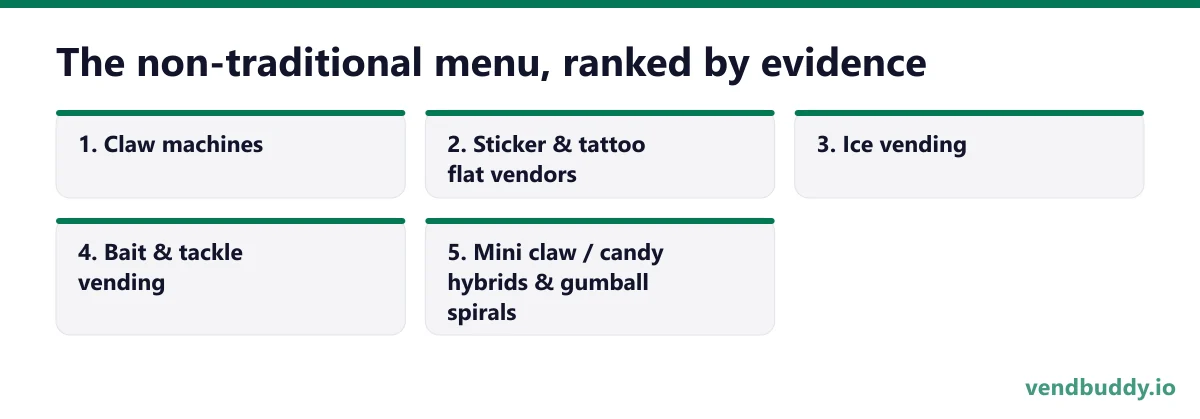
- Claw machines — the proven one. $1,500–$4,000 used, plush cost 30–40% of revenue, and family-food locations (pizza, buffets, diners, bowling) reliably produce $50–$300+/week. Kids are the demand engine; parents are the wallet. Win-rate settings are a retention lever, not a greed lever — machines that never pay out stop earning within weeks.
- Sticker & tattoo flat vendors — $150–$500 machines, 70%+ margins, nearly indestructible, perfect kid-height add-ons beside a claw or in kid-service waiting rooms.
- Ice vending — the capital-intensive outlier ($20k–$120k) that behaves like real estate: pick the corner right (boat ramps, campgrounds, hot-climate arterials) and it prints; pick wrong and you own a very expensive freezer. Utilities and water lines are real line items.
- Bait & tackle vending — refrigerated bait at ramps and marinas, selling at 5am when every bait shop is closed. Niche, seasonal, devoted repeat customers.
- Mini claw / candy hybrids & gumball spirals — $150–$400 each, $10–$40/month apiece, but placeable literally anywhere with a countertop; some operators run 40 of them as a paper route with quarters.
Placement logic: the three-question filter
For any non-traditional machine, ask: (1) Dwell time — are people waiting with nothing to do? (2) Audience match — kids for claws/stickers, quarters-holders for pushers, coolers-in-truck-beds for ice? (3) Why here, why this — does the machine solve boredom, spare change, or a closed-store gap? Two of three = test it. All three = move fast. And measure the location’s traffic before hauling anything — the same scoring that works for snack placements works here, because foot traffic is foot traffic.
Frequently Asked Questions
Are coin pushers legal?
It depends entirely on your state and configuration. Cash-payout pushers are illegal gambling devices in many states; merchandise/amusement configurations are legal in others. Check your state amusement-device statute and county rules before buying — machines get seized.
How much does a claw machine make per month?
$200–$1,200+/month at good family-food locations, against ~30–40% plush cost. Location quality and sane win rates drive the range.
What is the cheapest non-traditional machine to start with?
Sticker flats and gumball spirals ($150–$500) — tiny per-unit income but near-zero risk and the fastest way to learn placement dynamics with real money.
Keep going: the placement guide, the startup budget, and the Machine Finder for specialty machine economics.
What is selling, which buildings say yes, and the numbers before you buy a machine. Free, confirm from your inbox, unsubscribe in one click. Refer one friend and get 25 VendBuddy credits.
Want the free 38-page Ultimate Vending Guide too? Get the guide
General information, not legal, tax or financial advice. Rules change, so check the official source. Revenue and income figures are examples, not promises. See our terms.