- The best crypto credit card for most owners is the Gemini Credit Card for fuel-heavy and food-heavy spending, or Fold for flat spending.
- All the major crypto rewards cards are personal cards, so they do not build business credit or separate business spending.
- The clean setup: a business card for business expenses, a crypto card for household spending, both paid in full every month.
- Gemini lets you earn bitcoin or more than 50 other cryptos; for a long-term holding, most owners pick bitcoin.
- Withdraw rewards to a wallet you control on a schedule. Not financial advice.
The best crypto credit card for a business owner is one that pays crypto on spending you would do anyway, sits beside your business card rather than replacing it, and never carries a balance. For most owners in 2026 that means the Gemini Credit Card for fuel, dining and groceries, or Fold's card for flat everyday spend.
Part of our complete guide: best cash flow businesses.
Read this before any of the numbers. This is not financial advice. Bitcoin is volatile: it fell roughly 84% from its 2017 peak and roughly 77% from its 2021 peak before recovering. Rewards are only worth anything if you pay the statement in full every month. Gemini's purchase APR runs 16.74% to 34.74% according to its cardholder agreement, so one carried balance erases years of 1% to 4% rewards.
Why owners look at crypto cards at all
A traditional rewards card pays in points or miles. Points are a promise from the card company, and the program terms almost always say they have no cash value and can be changed or taken away. A crypto rewards card pays in an asset you can withdraw and hold yourself. For an owner who already sets aside part of the profit for bitcoin, that turns ordinary spending into a small automatic contribution to the same holding.
The appeal is simple. If you are going to spend $3,000 a month on fuel, meals and groceries regardless, earning 1% to 4% of it in bitcoin costs you nothing extra, as long as you pay the statement in full.
The cards worth comparing
| Card | Bitcoin back | Catch | Issuer |
|---|---|---|---|
| Gemini Credit Card | 4% gas, EV and transit (first $300 of that spend a month, then 1%), 3% dining, 2% groceries, 1% everything else | Rewards land in a Gemini Exchange account; you move them out yourself | WebBank, Mastercard World Elite |
| Fold Bitcoin Credit Card | 1.5% on everything, no cap; up to 4% on the first $2,000 a month if you also buy bitcoin through Fold | Rewards lock for 30 days after posting; rewards balance capped at $10,000 | Celtic Bank |
| Coinbase One Card | 2% to 4%, set by how much you hold on Coinbase; boosted tiers capped at $10,000 of purchases a month | Needs a Coinbase One membership (from $49.99 a year) | First Electronic Bank, American Express network |
The Gemini Credit Card is the one most owners end up with because its categories match real life. Fuel, EV charging and transit earn 4% on the first $300 a month, restaurants earn 3% and groceries earn 2%, with no annual fee and no foreign transaction fee. You pick the reward asset: bitcoin or one of more than 50 others on Gemini, changeable at any time. For a long-term holding, most owners stick with bitcoin and ignore the rest.
Fold's 1.5% flat rate is the better fit when spending does not cluster. The Coinbase One Card can reach 4% but ties the rate to how much you keep on Coinbase and needs a paid membership. The detailed rundown is in the best bitcoin credit card in 2026.
Picture the machines paying you while you sleep
That’s the real promise of vending — income that doesn’t cost you your time, and a life on your own terms. VendBuddy turns this guide into a step-by-step plan so you actually build it instead of just reading about it. Start free today.
Start building free →Personal card, business money: the line to hold
All three crypto cards are personal cards. That causes three problems if you run the business through one:
- Your books blur. Business and personal charges mixed on one statement are a headache at tax time and a red flag if you are ever audited.
- No business credit. Spending on a personal card does nothing for the company's own credit file, which matters when you want equipment financing later.
- Your personal utilization jumps. A big inventory or equipment charge can push your personal credit utilization up and your score down.
The setup that avoids all three: a business card for business purchases, and a crypto card for household spending. Our guide to the best business credit card for a vending business covers the business side. Owners who drive for work often find that personal fuel and meals alone are enough to hit Gemini's monthly 4% cap.
What it adds up to
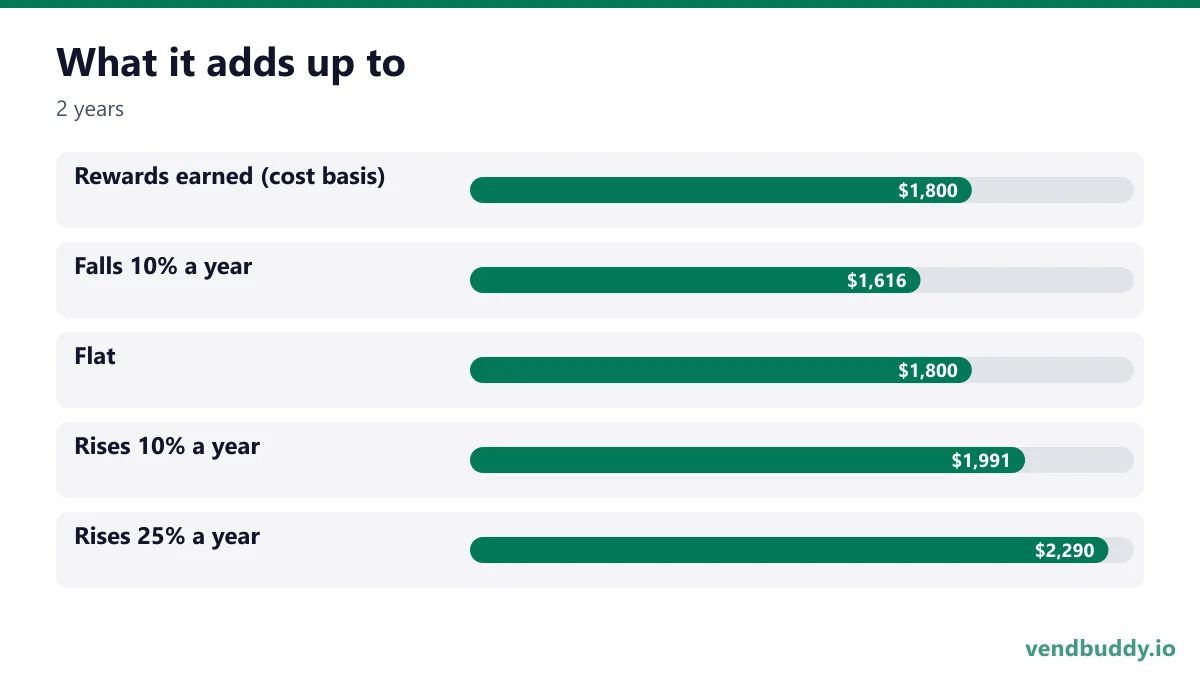
Take an owner with $5,000 a month of ordinary household and personal spending at a flat 1.5% back, the way Fold's base rate works. That is $75 a month in bitcoin. Here is what the stack could be worth under different price paths. These are scenarios, not predictions:
Operators who run this play usually set it up on Coinbase, because you can buy and borrow against the same balance without a credit check. Rates are variable and pledged collateral can be liquidated, and none of this is financial advice. Affiliate link, so we may earn a commission at no extra cost to you.
| Bitcoin price path (assumption) | 1 year | 2 years | 5 years | 10 years |
|---|---|---|---|---|
| Rewards earned (cost basis) | $900 | $1,800 | $4,500 | $9,000 |
| Falls 10% a year | $850 | $1,616 | $3,483 | $5,539 |
| Flat | $900 | $1,800 | $4,500 | $9,000 |
| Rises 10% a year | $948 | $1,991 | $5,788 | $15,109 |
| Rises 25% a year | $1,018 | $2,290 | $8,352 | $33,842 |
Look at the first and last rows together. In a bad decade the rewards can be worth less than the cash back you gave up. In a good one they can be worth several times more. That spread is the honest summary of a crypto card: you are swapping a certain small cash reward for an uncertain bitcoin one. Our article on whether a bitcoin rewards card is worth it goes through the smaller-spend version and the custody routine.
Keep the rewards where only you control them
Crypto card rewards sit on the issuer's platform until you move them. Gemini holds card rewards in your Gemini Exchange account. Its help center says closing the card does not touch rewards you have already earned, but closing the exchange account closes the card. Fold locks rewards for 30 days after posting and caps the rewards balance at $10,000.
A simple routine: once rewards reach a set amount, withdraw them to a hardware wallet such as a Ledger device and record the date and amount for taxes. Owners who also buy bitcoin on a schedule often use River for recurring buys, which offers hourly, daily and weekly schedules with zero fees after the first 7 days and an auto-withdraw option to your own wallet. River's own pages are the source for those features, and it is worth reading them before you sign up.
Where this fits in the bigger plan
A crypto card is the smallest piece of a bitcoin plan, not the plan. The order of operations still matters: operating cash, a reserve, taxes and debt come first, as laid out in dollar cost averaging business profits into bitcoin and where to keep business cash. If you run a vending route, the numbers that decide whether there is any surplus at all live in the route itself, and VendBuddy's profit tracking is built for that.
When to skip a crypto card
Skip it if you sometimes carry a balance, if bitcoin's swings would push you to sell at a loss, or if you would spend more just to earn rewards. Any of those makes a plain no-fee card the better choice. For everyone else, the Gemini Credit Card is a reasonable place to start.
Frequently Asked Questions
What is the best crypto credit card for business owners?
For most owners the Gemini Credit Card fits best because its 4% gas/EV/transit (first $300 a month), 3% dining and 2% groceries categories match common spending. Fold pays a flat 1.5%. Both are personal cards, so keep business expenses on a business card. Not financial advice.
Can I use a crypto credit card for business expenses?
You can, but these are personal cards. Mixing business and personal charges complicates bookkeeping and builds no business credit. Most owners keep a business card for the company and use a crypto card for household spending.
Which crypto should I choose for rewards?
Gemini lets you choose bitcoin or more than 50 other cryptos. Owners using the card as a slow long-term holding usually pick bitcoin. Whatever you choose, it can fall sharply in value.
Do crypto card rewards count as income?
Purchase rewards are generally treated as a rebate on spending rather than income, but referral bonuses can be treated differently, and selling the crypto later can create a gain or loss. Ask a tax professional about your situation.
General information, not legal, tax or financial advice. Rules change, so check the official source. Revenue and income figures are examples, not promises. See our terms.