- A bitcoin rewards credit card is worth it if you pay in full, spend no more than you would anyway, and can hold the bitcoin through large drops.
- At $2,000 a month and about 2% back, you earn about $480 a year in bitcoin; over 10 years that could be worth about $3,000 to $18,000 depending on the price path.
- Points can be devalued or forfeited under program terms; bitcoin withdrawn to your own wallet is outside the issuer's control.
- Withdraw rewards to a hardware wallet on a schedule. Card rewards do not leave the issuer's platform automatically.
- Not financial advice. Bitcoin has fallen more than 75% peak to trough more than once.
Is a bitcoin rewards credit card worth it? Yes, if three things are true: you pay the balance in full every month, you only put spending on it that you would do anyway, and you can hold the bitcoin through a fall of half or more without selling. If any of those is shaky, a plain cash back card is the better tool.
Part of our complete guide: best cash flow businesses.
Read this before any of the numbers. This is not financial advice. Bitcoin is volatile: it fell roughly 84% from its 2017 peak and roughly 77% from its 2021 peak before recovering. Rewards are only worth anything if you pay the statement in full every month. Gemini's purchase APR runs 16.74% to 34.74% according to its cardholder agreement, so one carried balance erases years of 1% to 4% rewards.
The idea in one paragraph
You already spend money on fuel, food, groceries and bills. A normal rewards card pays you 1% to 2% of that in cash or points. A bitcoin card pays the same kind of percentage in bitcoin instead. Nothing about your spending changes. The difference is what the reward turns into over time, and who controls it.
The 1, 2, 5 and 10 year math
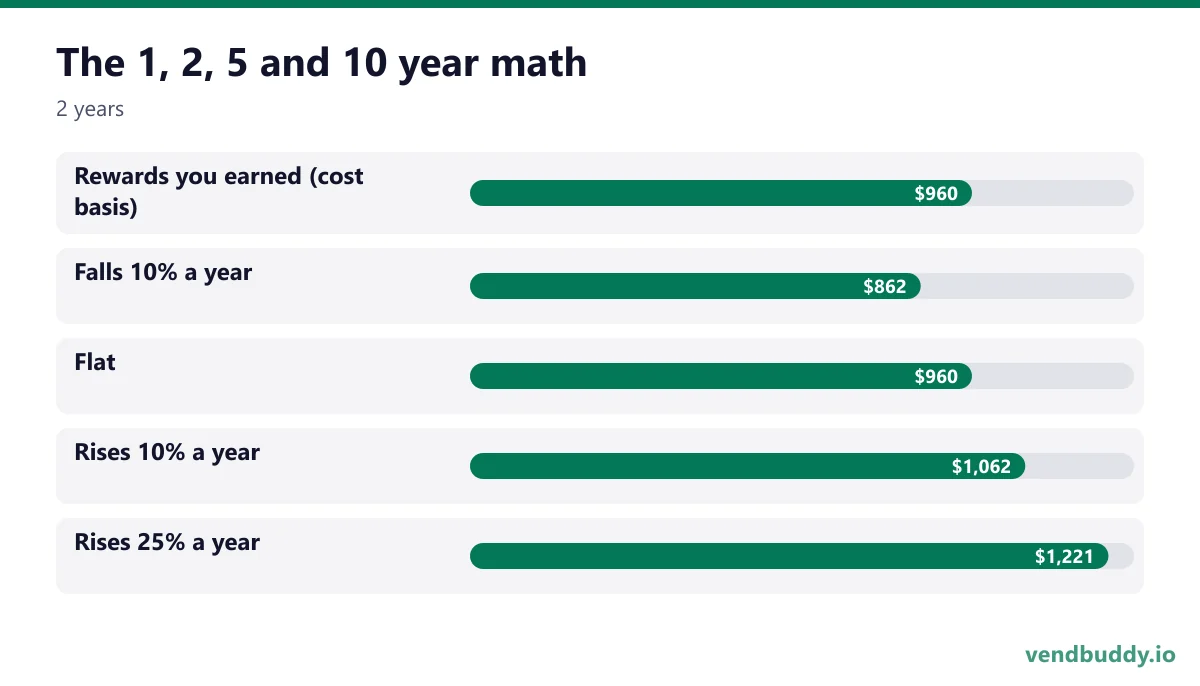
Here is a household spending $2,000 a month on a card that pays about 2% back in bitcoin. That is $40 a month, $480 a year. The table shows what the stack could be worth under four simple price paths. None of these is a forecast. They are there to show the range.
| Bitcoin price path (assumption) | 1 year | 2 years | 5 years | 10 years |
|---|---|---|---|---|
| Rewards you earned (cost basis) | $480 | $960 | $2,400 | $4,800 |
| Falls 10% a year | $454 | $862 | $1,857 | $2,954 |
| Flat | $480 | $960 | $2,400 | $4,800 |
| Rises 10% a year | $506 | $1,062 | $3,087 | $8,058 |
| Rises 25% a year | $543 | $1,221 | $4,455 | $18,049 |
Three things stand out. First, the reward amount itself is small. Nobody gets rich on 2% of groceries. Second, over a long holding period the price path matters far more than the reward rate. Third, the bad path is real: if bitcoin falls steadily, the rewards end up worth less than the cash back you could have taken. Gemini's own marketing says its bitcoin rewards held at least a year appreciated an average of 277%, and its footnote notes that this covers a specific window and that past performance does not predict future results. Take that seriously.
A business owner with higher spending sees the same shape at a bigger scale. Our guide to the best crypto credit card for business owners runs the numbers at $5,000 a month.
Picture the machines paying you while you sleep
That’s the real promise of vending — income that doesn’t cost you your time, and a life on your own terms. VendBuddy turns this guide into a step-by-step plan so you actually build it instead of just reading about it. Start free today.
Start building free →Why some people prefer bitcoin to points
Points and miles live inside a program the card issuer runs. The terms usually say the issuer can change earn and redemption rates, and that points can be forfeited when an account closes or is closed by the bank. Card issuers can and do close accounts, sometimes with little explanation. When that happens, an unredeemed points balance can go with it.
Bitcoin rewards are different only after you move them. While they sit on the issuer's platform, they are subject to its terms too. Fold's terms describe rewards as a program benefit that is not property until redeemed. Gemini's help center says card rewards sit in your Gemini Exchange account, that closing the card does not affect rewards already earned, and that closing the exchange account closes the card. The protection people talk about, "not your keys, not your coins", only kicks in once the bitcoin is in a wallet where you hold the keys.
A custody routine that takes ten minutes a month
- Pick a withdrawal threshold. Network fees make tiny withdrawals wasteful, so wait until the balance is worth it, monthly or quarterly.
- Withdraw to a hardware wallet. A device such as a Ledger wallet keeps the keys offline. Write down the recovery phrase on paper or metal and store it somewhere safe. Never type it into a website.
- Log it. Record the date, amount and value of each reward and each withdrawal. Tax software or a simple spreadsheet works.
- Do not trade it. The point is a slow, long-term holding, not a trading account.
None of the major bitcoin cards advertise automatic withdrawal of card rewards to a personal wallet, so this is a habit, not a setting.
Pairing the card with a recurring buy
People who want more than card rewards usually add a scheduled purchase. River offers zero-fee recurring buys after the first 7 days, on hourly, daily, weekly, twice-monthly and monthly schedules, and an auto-withdraw feature that sends bitcoin to your own wallet. It also has a feature it calls supercharged recurring buys. Per River's help center, you choose a multiplier of 25%, 50%, 100% or 200%. At each scheduled buy, if the price is at least about 1% below its moving average (7 days for hourly, daily and weekly schedules), River buys the larger amount instead. A $10 buy with a 100% multiplier becomes $20 on a dip.
That is a rules-based way to buy a bit more when the price is lower, not a way to time the market. On an hourly or daily schedule funded from a bank account, River debits a week of potential buys up front and rolls unused cash forward. Make sure the buffer is money you will not need. The broader case for and against regular buying, and the order to fund things in first, is in dollar cost averaging business profits into bitcoin.
Which card to use
For category-heavy spending, the Gemini Credit Card pays 4% on gas, EV and transit for the first $300 a month, 3% on dining, 2% on groceries and 1% on everything else, with no annual fee. New cardholders who use a referral link get $50 in crypto after approval, activation and one eligible purchase in the first billing cycle. For flat spending, Fold's 1.5% uncapped base rate is simpler. The full comparison is in the best bitcoin credit card in 2026 and Gemini vs Fold.
When it is not worth it
- You carried a balance at any point in the last year.
- A 50% drop in the rewards' value would upset you enough to sell.
- You notice yourself spending more to earn more.
- You would leave the rewards on the exchange forever instead of moving them.
If none of those apply, a bitcoin card is a low-effort way to build a small long-term position from spending that was happening anyway. If you run a business, keep its spending on a business card and its numbers somewhere you can see them. For vending operators, that is what VendBuddy's profit tracking is for.
Frequently Asked Questions
Is a bitcoin rewards credit card worth it?
It can be, if you pay in full every month, only put normal spending on it, and can hold bitcoin through large drops. At $2,000 a month and about 2% back you earn about $480 a year in bitcoin. If you carry balances or would panic-sell in a crash, a cash back card is the better choice. Not financial advice.
The account side of bitcoin is the boring part: Coinbase is where most people do it, since the buy and the borrow sit in one place. This is not financial advice, and a position that gets liquidated does not care that the route was fine. Affiliate link, so we may earn a commission at no extra cost to you.
How much bitcoin can you earn from a credit card?
At about 2% back on $2,000 a month, roughly $480 a year at the time it is earned. Over ten years that is $4,800 of rewards at cost, which could be worth roughly $3,000 to $18,000 under the falling, flat and rising price scenarios in this article. These are illustrations, not forecasts.
What does not your keys, not your coins mean for card rewards?
Rewards sitting on the card issuer's platform are subject to its terms. Once you withdraw them to a wallet where you hold the private keys, such as a hardware wallet, the issuer can no longer freeze or claw them back. Card rewards are not withdrawn automatically, so it takes a regular habit.
What are River supercharged recurring buys?
A River feature where you pick a 25%, 50%, 100% or 200% multiplier. At each scheduled recurring buy, if bitcoin is at least about 1% below its moving average, River buys the multiplied amount instead of your normal amount. River lists zero fees on recurring buys after the first 7 days.
Are bitcoin rewards taxable?
Purchase rewards are generally treated as a rebate rather than income, but selling or spending the bitcoin later can create a capital gain or loss, and referral bonuses may be treated differently. Keep records and ask a tax professional.
General information, not legal, tax or financial advice. Rules change, so check the official source. Revenue and income figures are examples, not promises. See our terms.