- Dollar cost averaging business profits into bitcoin means buying a fixed dollar amount on a schedule from true surplus, never from operating cash or the reserve.
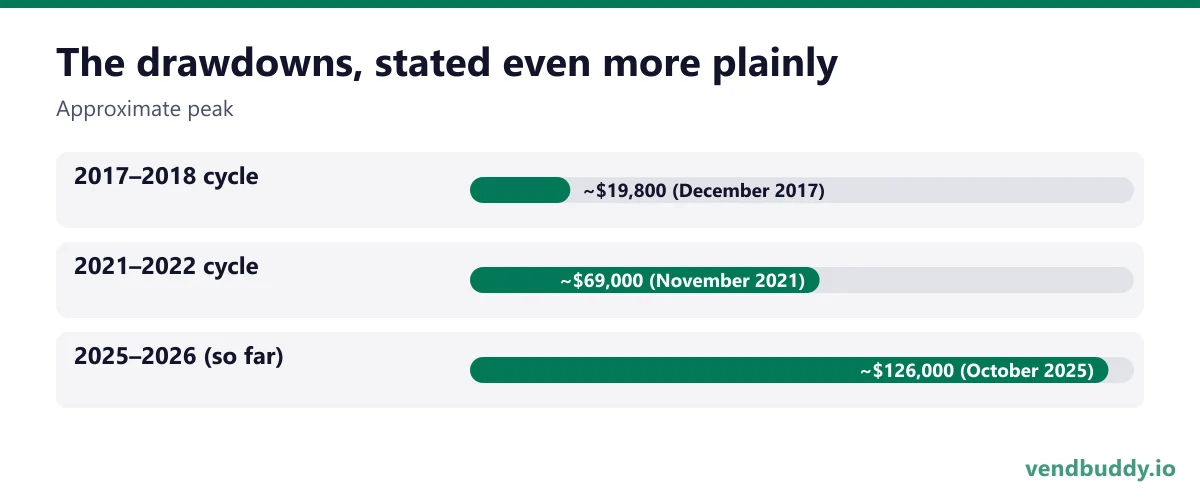
- Bitcoin has fallen roughly 84% (2017 to 2018) and 77% (2021 to 2022) peak to trough, and sat about a third below its October 2025 high of about $126,000 in late September 2026.
- Fund things in order: operating float, reserve, taxes, high-interest debt, reinvestment in cash-flowing assets, then a small fixed percentage of what is left.
- Every recurring buy is a separate tax lot; use tracking software and plan custody before the balance matters.
- This is a thesis, not financial advice. Size it so a 75% drop would be unpleasant, not dangerous.
Dollar cost averaging business profits into bitcoin means sending a fixed dollar amount of true surplus, money the business will not need for years, into bitcoin on a regular schedule, no matter the price. Some owners do it because they believe bitcoin will hold value better than dollars over decades. It is a thesis, not a plan to copy: bitcoin has fallen more than 75% from its peak more than once, it produces no cash flow, and it belongs at the very end of the line, after the business itself is funded.
Part of our complete guide: best cash flow businesses.
This is not financial advice. We are not advisors, and nothing here tells you to buy anything. It lays out why some operators do this, what can go wrong, and the order of operations that keeps a bitcoin crash from ever touching the business that pays for it.
The thesis, stated plainly
The case people make for holding some bitcoin comes down to supply. There will only ever be 21 million bitcoin. New supply is cut in half roughly every four years in an event called the halving; the most recent, in April 2024, cut the reward for mining a block to 3.125 bitcoin. No central bank or company can issue more. People who hold bitcoin long term usually believe that dollars in a bank lose purchasing power over decades, and that an asset with a fixed supply is a better place to store the portion of wealth they will not need for a long time.
For a business owner, the thesis has a specific shape. Your business converts hours and locations into dollars. Some owners want a slice of those dollars converted into something they see as harder to dilute, without selling anything or timing anything. A small, fixed, automatic buy from each month’s profit is the simplest version.
That is the whole argument. It could be wrong. Bitcoin could be regulated harshly, displaced, or simply stop rising. You should hold the thesis loosely and size it accordingly.
The drawdowns, stated even more plainly
Anyone who talks about bitcoin without talking about this part is selling something. Rough peak-to-trough declines in past cycles:
| Cycle | Approximate peak | Approximate trough | Decline |
|---|---|---|---|
| 2017–2018 | ~$19,800 (December 2017) | ~$3,200 (December 2018) | ~84% |
| 2021–2022 | ~$69,000 (November 2021) | ~$16,000 (November 2022) | ~77% |
| 2025–2026 (so far) | ~$126,000 (October 2025) | Dipped under $75,000 intraday on September 15, 2026 | ~41% at that low; about a third below the peak near $85,700 on September 23, 2026 |
Earlier cycles were steeper still. Recoveries have taken years, and there is no rule that says the next one will happen at all. A position that falls 80% needs to rise 400% just to get back to even.
Three other risks that have nothing to do with price:
- No cash flow. A vending machine pays you every month. Bitcoin pays you only if someone later pays more for it. It does not cover a loan payment or a slow month.
- Custody. Lose your keys or get phished, and there is usually no bank to call.
- Behavior. The real danger for most people is not holding bitcoin; it is buying more when it is exciting and selling in a panic when it is down 70%.
Picture the machines paying you while you sleep
That’s the real promise of vending — income that doesn’t cost you your time, and a life on your own terms. VendBuddy turns this guide into a step-by-step plan so you actually build it instead of just reading about it. Start free today.
Start building free →The order of operations
If you do this at all, it goes last. Here is the order we would use for any route or small service business:
- Operating float. About one month of outflows in checking.
- Reserve. Three to six months of fixed expenses plus one big repair, in savings or T-bills. Our guide to how much cash reserve a small business should keep walks through the sizing.
- Tax set-aside. A fixed percentage of every deposit. Spending the tax money is the most common way small businesses get into trouble.
- High-interest debt. A 12% loan paid off is a 12% return with no volatility.
- Reinvestment. A new machine at a secured location usually beats every other use of surplus while you are growing.
- Owner pay. The business exists to pay you.
- Then, and only then, a fixed percentage of what is left into long-term assets, which might include index funds and, if you hold the thesis, bitcoin.
If you run Profit First, this fits cleanly: the bitcoin buy comes out of the Profit account after its quarterly distribution, never out of Operating Expenses. The full framework for sorting business cash by job is in where to keep business cash.
Sizing: what a slice of profit actually looks like
A hypothetical route netting $3,000 a month after the first six steps are fully funded. The last column shows what the stack would be worth at the bottom of a 75% fall from your average cost. The numbers are illustrations, not projections.
| Share of surplus | Monthly buy | Invested over 2 years | Value after a 75% drawdown from average cost |
|---|---|---|---|
| 5% | $150 | $3,600 | ~$900 |
| 10% | $300 | $7,200 | ~$1,800 |
| 20% | $600 | $14,400 | ~$3,600 |
Look at the last column and ask one question: would that number change any decision in the business? If a 75% drop would make you delay a machine, skip a reserve contribution or sell in a panic, the slice is too big. For most owners starting out, 5% to 10% of true surplus is a size they can hold through a bad year.
How to set it up
Decide who owns it
You can buy through the business or take an owner distribution and buy personally. Many small operators do the second, because it keeps the business books simple and the bitcoin clearly separate from equipment and inventory. Buying inside an LLC or corporation has accounting and tax consequences that depend on your structure; ask your CPA before the first purchase, not after the hundredth.
Automate the buy
The point of dollar cost averaging is to remove decisions. Pick a day, pick an amount, and set a recurring purchase.
- River is a bitcoin-only brokerage built around recurring buys, with no altcoins to distract you.
- Coinbase offers recurring buys too, and it is where many people already have an account. Compare fees before you start; small, frequent purchases through a simple buy screen can carry higher spreads and fees than you expect.
Let ordinary spending add a little
A separate, smaller stream comes from a bitcoin rewards credit card on personal spending you already do. The Gemini Credit Card, for example, pays 4% back on gas, EV and transit for the first $300 of that spend each month, 3% on dining, 2% on groceries and 1% on everything else, with no annual fee, per its card page. It only helps if the statement is paid in full every month. The best bitcoin credit card in 2026 compares it with Fold and Coinbase One.
Plan custody
Leaving a small balance on a reputable exchange is a tradeoff many people accept while the amount is small. As the stack grows, many holders move it to a hardware wallet such as a Ledger, which keeps the keys offline. That shifts the risk from the exchange to you: write down the recovery phrase on paper or metal, store it somewhere safe, never type it into a website, and make sure someone you trust knows how to find it if something happens to you.
Track every lot
Each recurring buy creates its own cost basis. Buy weekly for three years and you have more than 150 lots. When you eventually sell or spend, the gain is calculated per lot, and short-term gains are taxed as ordinary income. Brokers began issuing Form 1099-DA for digital asset sales starting with 2025 transactions, but your own records still matter, especially if coins move between platforms or into a hardware wallet. Software like CoinLedger pulls your transactions together and produces the gain and loss reports your tax preparer needs.
What the path looks like
An illustrative example, not a real operator. Priya (illustrative) starts with two machines at an apartment complex and a gym. For the first two years every spare dollar goes to three things: an equipment loan, a credit card balance she carried from before, and the next machine. No bitcoin.
By year three she has eleven machines, the card is gone, the equipment loans are paying themselves down from route cash, and her reserve is full at about five months of fixed costs. The route nets roughly $2,500 a month after her own pay. She sets 10% of that, $250, to buy bitcoin every other Friday in two $125 purchases, and moves the balance to a hardware wallet once a quarter.
In the first year of buying, the price falls hard and her stack is worth well under what she put in. Nothing in the business changes. The route still pays her, the reserve is still full, the next machine still gets bought. That is the point of the order of operations: the bitcoin can be down 60% and the business does not care.
Over time, some operators with a larger stack use it as collateral rather than selling it, borrowing conservatively against it to fund the next machine. That strategy has its own liquidation risk, covered in bitcoin-backed loans and the cash flow flywheel. It is optional, and it is never where you start.
Where it actually starts
Every version of this plan depends on one thing that has nothing to do with bitcoin: a business that throws off surplus. For a route business, surplus starts with a location. VendBuddy finds apartment complexes, offices, gyms, hotels and other businesses in any ZIP code with the contact details of the person who decides on placements, and credits are available one pack at a time with no subscription. Get the locations, fund the first six steps, and the question of what to do with the surplus becomes a good problem to have.
Frequently Asked Questions
Should a small business owner put profits into bitcoin?
Only after the business is fully funded: operating cash, a reserve of three to six months of fixed costs, tax set-asides, high-interest debt payoff and reinvestment come first. Some owners then put a small fixed percentage of true surplus into bitcoin as a long-term thesis. Bitcoin has fallen more than 75% peak to trough more than once, so size it so a crash would not change any business decision. This is not financial advice.
How much of my business profit should go into bitcoin?
There is no correct number, and we are not advisors. Many owners who do this keep it to 5% to 10% of surplus after everything else is funded. A useful test is to multiply your planned stack by 0.25, the value after a 75% fall, and ask whether that loss would make you delay a purchase or sell in a panic. If it would, the slice is too big.
Is it better to buy bitcoin through my LLC or personally?
Many small operators take an owner distribution and buy personally, which keeps business books simple and the asset clearly separate. Buying inside an LLC or corporation is possible but has accounting, tax and custody consequences that depend on your entity type and state. Talk to a CPA before the first purchase.
How do I track taxes on recurring bitcoin buys?
Every recurring purchase is a separate tax lot with its own cost basis, so a few years of weekly buys can mean hundreds of lots. Brokers issue Form 1099-DA for digital asset sales starting with 2025 transactions, but moves between platforms and wallets can break the trail. Crypto tax software that imports all your accounts produces the gain and loss reports your preparer needs.
What is the worst bitcoin crash in recent history?
In the last two full cycles, bitcoin fell roughly 84% from about $19,800 in December 2017 to about $3,200 in December 2018, and roughly 77% from about $69,000 in November 2021 to about $16,000 in November 2022. Earlier cycles fell even further. In September 2026 it traded about a third below its October 2025 high of roughly $126,000.
General information, not legal, tax or financial advice. Rules change, so check the official source. Revenue and income figures are examples, not promises. See our terms.