Most vending operators finance the same three ways: a vendor rent-to-own contract at 10–30% effective, a personal loan in the high teens, or a business card they promise themselves they will pay off before the promo ends. There is a fourth path almost nobody in this industry talks about, and in 2026 it lives inside a Coinbase account: borrow dollars against bitcoin you already own, at roughly 5% APR at the time of writing, with no credit check and no due date. It is cheaper than everything above it. It is also the only one where the lender can sell your collateral out from under you.
Educational content, not financial advice. Bitcoin is volatile and pledged collateral can be liquidated — that is not a footnote, it is the entire risk of this strategy. Never borrow money you cannot afford to have called against a falling asset. Talk to a licensed financial advisor and a tax professional before acting on anything in this article.
What a bitcoin-backed loan actually is
A bitcoin-backed loan is a secured loan where the collateral is bitcoin instead of a house or a truck. You pledge coins you already hold, you receive dollars (in practice, USDC, a dollar stablecoin you can move to a bank account), and the coins sit locked until you pay the balance back. At no point do you sell.
That distinction is the whole product. Selling bitcoin to buy a vending machine converts an asset you believe in into an asset that depreciates, and it hands a slice of the difference to the IRS on the way out. Borrowing against it leaves the position intact. If bitcoin doubles while your loan is outstanding, you keep the doubling. If it halves, you keep the coins — provided you sized the loan correctly, which is the part most people get wrong.
The closest familiar analogue is a home equity line of credit. Nobody sells the house to renovate the kitchen; they borrow against it. The difference is that a house does not fall 40% in a quarter, and a bank does not liquidate your kitchen at 3am on a Sunday. Bitcoin does, and the protocol will.
The Coinbase mechanics, specifically
Coinbase offers USDC loans against bitcoin through the Morpho protocol on Base. The parameters that matter to an operator:
- Size: borrow up to $5,000,000 USDC against bitcoin collateral. Practical route budgets sit in the low five figures, so the ceiling is irrelevant to most readers — it matters only because it signals this is not a toy product.
- Rate: variable, set by supply and demand on Morpho, and it moves block by block. At the time of writing it was roughly 5% APR. That is not a promise and not a contract. Check the current rate before you draw and assume it can move.
- Opening LTV: up to 75% loan-to-value at origination. You can open at far less, and you should.
- Liquidation: automatic if LTV reaches 86%. The protocol sells collateral to cover the debt and applies a penalty in the neighborhood of 4.38%.
- Repayment: no fixed schedule and no maturity date. You choose when to pay down.
- Availability: US customers except New York.
- Credit: no credit check. The collateral is the underwriting.
Read the liquidation line again. There is no phone call, no thirty-day cure period, no relationship manager who knows your route is seasonal. The position closes itself.
Picture the machines paying you while you sleep
That’s the real promise of vending — income that doesn’t cost you your time, and a life on your own terms. VendBuddy turns this guide into a step-by-step plan so you actually build it instead of just reading about it. Start free today.
Start building free →LTV discipline is the entire skill
Loan-to-value is your debt divided by the market value of your collateral. It is the only number that decides whether this is a cheap financing tool or an expensive way to lose bitcoin.
Work an example. You hold $80,000 of bitcoin and you borrow $20,000 to fund three machines and their opening inventory. Your LTV is 25%.
Liquidation triggers at 86%. With $20,000 of debt outstanding, 86% LTV means your collateral has fallen to about $23,300. Bitcoin would have to drop roughly 70% from where you opened before the protocol touches you. That is not a comfortable buffer — it is a buffer that has been breached in living memory — but it is a buffer measured in years of bad news, not days.
Now open the same loan at the 75% maximum. You borrow $60,000 against the same $80,000. Liquidation arrives when collateral falls to about $69,800, which is a drop of roughly 13%. Bitcoin does 13% in a bad week without anything unusual happening. Same product, same rate, same platform — one is financing, the other is a coin flip with a fee attached.
Two more things follow from the math. First, LTV moves on its own: your debt is fixed in dollars but your collateral is not, so a falling market raises your LTV without you doing anything. Second, you can move the line back at any time by paying the balance down or adding collateral. Route cash flow does exactly that, every month, automatically, which is the mechanism behind the 5% refinance play.
The advantage nobody prices in: no maturity date
Every other financing path on this list has a calendar attached. The SBA loan has a term. The vendor contract has 36 monthly payments. The credit card promo expires on a specific day and reprices to something ugly. Those dates are the lender terms, and they do not care whether your best location lost its anchor tenant in month nine.
A bitcoin-backed loan has no maturity date. Interest accrues against the balance and you decide when to reduce it. In practice that means you can run interest-only for as long as your LTV stays healthy, then dump a strong month into principal, then run light through a slow January. On $20,000 at roughly 5% at the time of writing, the interest is on the order of $85 a month — a number a single healthy machine covers.
The catch is that accrued interest adds to the balance, which raises LTV over time if you never pay anything. Flexible does not mean free. Set your own schedule, then keep it like it came from a bank.
What can go wrong, in order of how badly it hurts
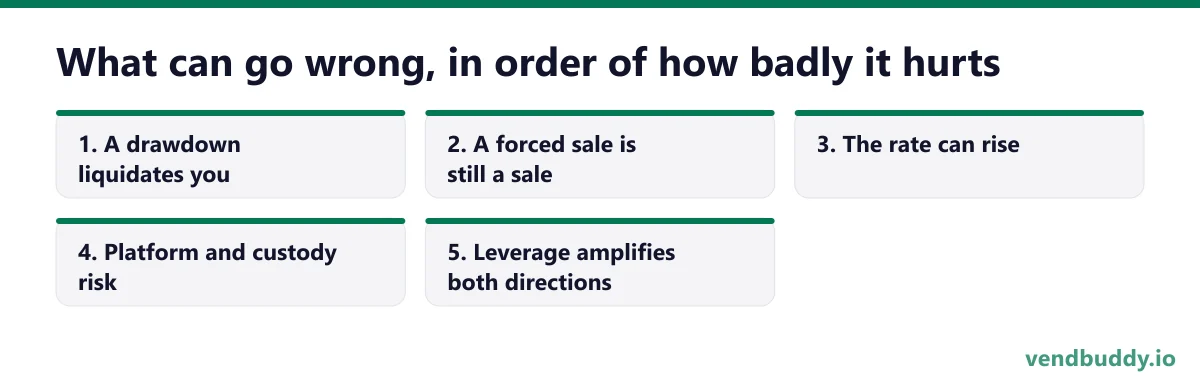
- A drawdown liquidates you. If bitcoin falls far enough to push LTV to 86%, collateral is sold automatically with a penalty around 4.38%. You lose the coins at the worst possible price, in the worst possible tape, and you do not get to wait for the recovery. This is not theoretical: bitcoin has drawn down more than 70% peak to trough on multiple occasions, most recently through the 2022 cycle. That is historical fact, and it is exactly the scenario your LTV has to survive.
- A forced sale is still a sale. Borrowing does not trigger a capital-gains event, but a liquidation sells your bitcoin, and a sale generally is a taxable event — one you did not choose, in a year you may not have planned for. Talk to a tax professional before you pledge appreciated coins.
- The rate can rise. Roughly 5% at the time of writing is a market-clearing rate, not a fixed one. Supply and demand on Morpho set it, and it can move against you while your balance is outstanding. Model the deal at a rate meaningfully above today, because you are not underwriting today.
- Platform and custody risk. You are relying on an exchange, a protocol, and a network at the same time. Smart-contract risk, custody risk, and regulatory risk are all real and none of them are covered by anything resembling FDIC insurance.
- Leverage amplifies both directions. A machine bought with borrowed money against appreciating collateral is a very good trade. The same machine bought against falling collateral is two losses stacked on one balance sheet. Leverage does not create returns, it multiplies whatever was already happening.
How it stacks against the loans operators actually use
| Path | Typical rate | Credit check | Maturity | Collateral | Biggest risk |
|---|---|---|---|---|---|
| Bitcoin-backed loan | ~5% APR variable at the time of writing | None | None — you choose | Your bitcoin | Automatic liquidation at 86% LTV plus penalty |
| Unsecured personal loan | High teens to 25%+ APR | Yes, hard pull | Fixed, typically 3–7 years | None | Payment is due whether the route earns or not |
| Business credit card | 0% promo, then roughly 20%+ | Yes, hard pull | Revolving, promo has a hard end date | None, personal guarantee typical | The promo expires and the balance reprices against you |
| Machine financing / rent-to-own | 10–30% effective | Usually | Fixed term | The machine itself | Repossession, and the rate eats per-machine margin |
Rates are indicative and move. Verify current terms with each provider before committing capital.
The honest read: a bitcoin-backed loan is cheaper than unsecured debt if you keep LTV low and accept volatility risk that the other three rows simply do not carry. It is not safer than a bank loan. It is a different risk, priced differently. The full head-to-head scoreboard works through where each one actually wins.
Who should not do this
- Anyone without an emergency fund. If a broken compressor forces you to touch the collateral, the strategy is already broken.
- Anyone who may need to sell the bitcoin inside the loan horizon. Pledged coins are locked. A down payment coming up in eighteen months is a reason to keep the coins liquid, not to collateralize them.
- Anyone who cannot watch a 50% drawdown without acting. If a red month makes you unwind positions, leverage will find you.
- Anyone who does not already own bitcoin. Buying bitcoin specifically so you can borrow against it stacks two bets: the asset thesis and the leverage. Those are separate decisions and should be made separately.
- New York residents. The product is available to US customers except New York.
If any of those describe you, the conventional paths in the vending machine financing guide are the right read instead. There is no prize for using the exotic instrument.
FAQ
How much can I borrow against my bitcoin?
Coinbase allows up to 75% LTV at origination, with a ceiling of $5,000,000 USDC. What you should borrow is a different question: 25–30% LTV keeps roughly a 65–70% price drop between you and the 86% liquidation line, which is the buffer a 2022-style drawdown would actually have required. On $80,000 of collateral that is a $20,000–$24,000 loan, not a $60,000 one.
What happens if bitcoin crashes?
Your debt stays fixed in dollars while your collateral shrinks, so your LTV climbs. Nothing happens until 86%, at which point the protocol automatically sells collateral to cover the debt and applies a penalty around 4.38%. You can prevent that at any time by paying the balance down or adding collateral — but only if you are watching, and only if you have the cash. Assume you will be watching during the exact week you least want to.
Do I owe taxes when I borrow against bitcoin?
Borrowing is not a sale, so the loan itself does not generally trigger a capital-gains event — that is a large part of the appeal versus selling coins to fund machines. A liquidation is a different story, because collateral is actually sold. Tax treatment depends on your situation and your state, so talk to a tax professional before you pledge appreciated coins.
Related reading: the 5% refinance play for scaling a route, the cash-flow asset flywheel, bitcoin loans versus traditional business loans, and the full vending machine financing guide. When you know your budget, the free Machine Finder matches it to machines that fit your property type.
Where operators actually set this up
Coinbase is the mainstream on-ramp for this play: you buy bitcoin and borrow USDC against it inside the same account, with no credit check and no fixed repayment schedule — you pay the balance down when route cash flow says so, not when a servicer says so. Rates are variable and set by supply and demand, so check the current number before you draw. The quiet part is the recurring auto-buy: every weekly purchase raises the collateral base, which raises how much you could borrow later without ever selling a coin.
What is selling, which buildings say yes, and the numbers before you buy a machine. Free, confirm from your inbox, unsubscribe in one click. Refer one friend and get 25 VendBuddy credits.
Want the free 38-page Ultimate Vending Guide too? Get the guide
General information, not legal, tax or financial advice. Rules change, so check the official source. Revenue and income figures are examples, not promises. See our terms.