Nobody quits a job because of a machine. They quit because of a spread. Every vending route that stalls out at four or five machines stalls for the same reason: the financing costs more than the operator admits, and the interest quietly eats the margin that was supposed to fund machine six. Fix the cost of capital and the same route funds itself. In 2026 the cheapest legitimate refinance available to a small operator is not a bank — it is a loan against bitcoin you already hold, running at roughly 5% APR at the time of writing.
Educational content, not financial advice. Bitcoin is volatile and pledged collateral can be liquidated. Never borrow money you cannot afford to have called against a falling asset, and never stack leverage on a business that is not yet paying for itself. Talk to a licensed financial advisor and a tax professional before acting on anything here.
The financing gap that caps most routes at five machines
A snack and drink combo in a decent office does $250–$400 a month gross. Cost of goods takes roughly half. Commission, fuel, and card fees take another bite. Call it $90–$150 of clean monthly margin per machine on a healthy placement.
Now attach financing. Vendor rent-to-own and equipment contracts commonly land somewhere between 10% and 30% effective once fees and term are accounted for. On a $4,000 machine over 36 months, the difference between 10% and 25% is not academic — it is roughly $30–$40 a month, every month, out of a $120 margin. At the top of that range a third of the machine profit is going to the lender before you have restocked anything.
That is the gap. Not location quality, not product mix, not restocking discipline — the cost of capital. An operator paying 25% needs three machines to net what an operator paying 5% nets on two. Compound that across a growth year and the low-cost-of-capital operator is a route ahead. This is the same lever the financing guide covers from the conventional side; what follows is the aggressive version.
The refinance play
The mistake is thinking of this as an either-or. Vendor financing and 0% promotional terms are genuinely useful — they get equipment on the floor before you have the cash, and a vendor who finances is a vendor who wants the machine to work. Use them. The play is what you do at the end.
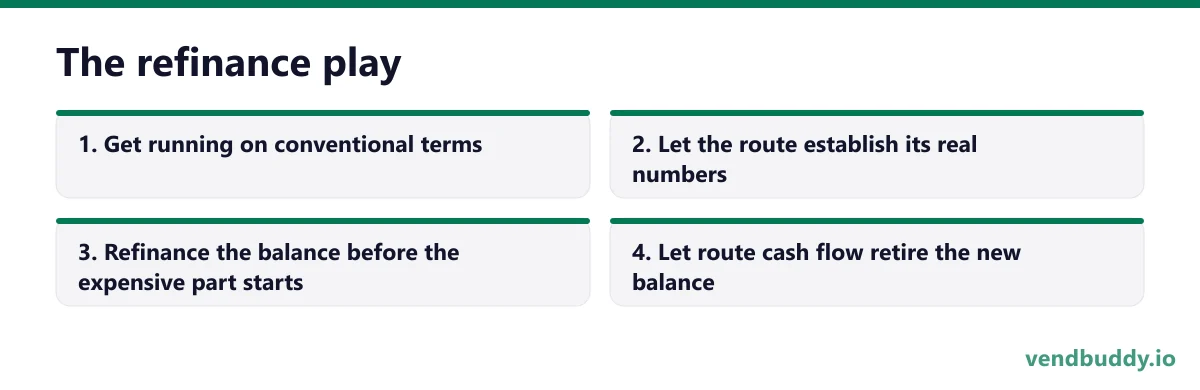
- Get running on conventional terms. Vendor financing, an equipment loan, or a 0% intro business card. Buy machines, place them, prove the locations.
- Let the route establish its real numbers. Three to six months of restocking tells you what each placement actually produces, which is the only honest input to any of this.
- Refinance the balance before the expensive part starts. When the 0% promo window closes or the high-rate contract has run its useful life, draw a bitcoin-backed loan and retire that balance. You are swapping a 20–30% obligation for one running roughly 5% at the time of writing.
- Let route cash flow retire the new balance. Every payment now reduces principal instead of feeding interest, and every reduction lowers your LTV, which pushes the liquidation line further away. The paydown and the risk reduction are the same action.
Two things make this work that a bank loan cannot replicate. There is no maturity date, so a slow month does not become a default. And there is no credit check, so refinancing does not cost you a hard pull at the exact moment you want your credit clean for something larger.
Picture the machines paying you while you sleep
That’s the real promise of vending — income that doesn’t cost you your time, and a life on your own terms. VendBuddy turns this guide into a step-by-step plan so you actually build it instead of just reading about it. Start free today.
Start building free →The credit-card stack
The second layer is boring and it is where a lot of quiet margin lives. Business cards commonly pay around 2% cashback on spend. Machines, inventory, fuel, and card-processing hardware are all spend.
The sequence:
- Buy on the card. Machine purchases and cost of goods go on a 2% cashback business card. On a $4,000 machine that is $80 back — a real discount on the equipment, not a points gimmick.
- Pay the card off with the bitcoin loan. Before the statement can revolve at 20%+, retire the balance with the drawn USDC. You never carry card interest.
- Let the route retire the loan. Machine cash flow pays down the bitcoin-backed balance on your schedule, and your LTV improves every month you do it.
Net effect: you bought the machine at roughly a 2% discount, you never touched a 20% rate, and the debt that remains is the cheapest one available to you. Ordering matters — the card is a payment rail and a rebate, never a place to carry a balance. Operators who reverse those two steps end up with a 25% balance and a bitcoin loan, which is the worst of both.
Worked numbers on a small route
Take an operator with eight machines carrying about $1,000 a month in combined equipment payments — a mix of vendor contracts and a card balance that has come off its promo rate. Roughly $20,000 of principal remains.
Refinanced against bitcoin at approximately 5% APR at the time of writing, the interest on $20,000 runs on the order of $85 a month. There is no required principal payment and no maturity date, so the mandatory outflow drops from about $1,000 to about $85.
That is roughly $900 a month of freed cash flow, and it has exactly two good homes:
- Pay down the loan. Sending the full $900 at principal retires $20,000 in under two years and cuts LTV every single month on the way, which continuously widens the gap to the 86% liquidation line.
- Fund the next machine. $900 a month is a new placement roughly every four to five months at typical used-machine pricing, without a lender and without a new application.
The disciplined answer for most operators is a split: most of it at principal until LTV is comfortably under 25%, the rest at growth. The undisciplined answer — taking the full $900 as income because the loan has no due date — is how a flexible instrument becomes a trap. Model both paths against your actual per-machine numbers before you decide; the ROI calculator inside VendBuddy will do it against your real placements.
The part where this goes wrong
Be precise about what is happening here: you are borrowing against a volatile asset to service or replace a business loan. That is leverage on top of leverage. It is cheaper leverage, which is genuinely better, but cheaper leverage is still leverage, and a 70%+ bitcoin drawdown is a documented historical event, not a tail risk somebody invented for a disclaimer.
Hard rules, and they are not suggestions:
- Keep LTV under 30%. The maximum opening LTV is 75% and liquidation is at 86%. Neither of those numbers is a target. At 30% LTV, bitcoin has to fall roughly two thirds before the protocol is anywhere near you.
- Size the payments so your day job alone could cover them. If the route goes to zero — a location closes, a machine dies, a host sells the building — the loan does not care. Your paycheck has to be able to carry it.
- Never collateralize coins you might need to sell. Pledged collateral is locked. If there is any chance you need that bitcoin inside the loan horizon, it is not collateral, it is savings.
- Assume the rate rises. Roughly 5% at the time of writing is a variable market rate set by supply and demand. Underwrite the deal at a meaningfully higher number and see if it still clears.
- Do not do this before machine one is profitable. Leverage multiplies a working business. It also multiplies a broken one.
If reading that list made you uncomfortable, that is the list working. The conservative path — reinvesting cash flow with no debt at all — is covered in starting a vending business with no money, and it is a completely legitimate way to build a route.
Getting started
Order of operations: prove one machine, then read the full financing comparison so you know what you are refinancing away from, then read how bitcoin-backed loans actually work before you draw a dollar. If you want the wider strategic frame — borrowing against assets rather than selling them — that is the cash-flow asset flywheel, and the honest scoreboard against bank debt is the counterweight.
When the capital question is settled, the free Machine Finder matches a budget to machines that actually fit the property type you have signed.
Where operators actually set this up
Coinbase is the mainstream on-ramp for this play: you buy bitcoin and borrow USDC against it inside the same account, with no credit check and no fixed repayment schedule — you pay the balance down when route cash flow says so, not when a servicer says so. Rates are variable and set by supply and demand, so check the current number before you draw. The quiet part is the recurring auto-buy: every weekly purchase raises the collateral base, which raises how much you could borrow later without ever selling a coin.
What is selling, which buildings say yes, and the numbers before you buy a machine. Free, confirm from your inbox, unsubscribe in one click. Refer one friend and get 25 VendBuddy credits.
Want the free 38-page Ultimate Vending Guide too? Get the guide
General information, not legal, tax or financial advice. Rules change, so check the official source. Revenue and income figures are examples, not promises. See our terms.