There is a pattern that shows up everywhere money compounds, and almost nowhere in the advice given to people starting out. Wealthy families do not sell their assets to buy things. They buy assets, borrow against them, and buy more — and the base never gets sold. Vending is one instance of that pattern. So is real estate. So is a taxable brokerage account. The instrument changes; the loop does not.
Educational content, not financial advice. Bitcoin is volatile and pledged collateral can be liquidated. Never borrow money you cannot afford to have called against a falling asset. Every version of this loop breaks the same way — too much leverage into a drawdown. Talk to a licensed financial advisor and a tax professional before acting on anything here.
The pattern wealthy people already use
The instinct most people are taught is linear: earn money, save money, spend savings on the thing you want, start over at zero. Every purchase resets the base. It is a treadmill with a receipt at the end.
The alternative is circular. You acquire an asset that produces cash flow. The cash flow buys the next asset instead of buying consumption. The asset base grows, and because the base is collateral, the amount you can borrow grows with it. Borrowed money buys more assets, which produce more cash flow. The base is never sold, so it never resets.
You can see the same loop in three completely different asset classes:
- Real estate. Buy a rental, collect rent, and pull a HELOC or a cash-out refinance against the appreciated equity to fund the down payment on the next one. Nobody sells the first house to buy the second.
- Securities. A taxable brokerage position can be borrowed against directly. The dividends and the appreciation stay yours; the margin or securities-backed line funds the purchase. Most people build this base layer in a low-cost brokerage — Schwab is a standard one for broad index funds you borrow against later rather than trade. (Referral link — we may earn a bonus, at no cost to you. Not investment advice.)
- Vending. A machine produces monthly cash flow with no tenant, no closing costs, and a four-figure entry price instead of a six-figure one. It is the smallest working unit of the same idea.
Same loop, three wrappers. What changed in 2026 is that the borrowing layer got dramatically more accessible for anyone holding bitcoin.
The flywheel
Five nodes, one rule: the base is never sold. Every turn of the loop makes the next turn cheaper.
The loop is only as strong as its weakest node, and for most people the weak node is step five. They own assets and they collect cash flow, but the borrowing layer is closed to them — a house needs an appraisal and thirty days, a brokerage line needs a specific account type, and a vending route is not collateral anybody will lend against. So the loop degrades into simple reinvestment, which works, just slowly.
Picture the machines paying you while you sleep
That’s the real promise of vending — income that doesn’t cost you your time, and a life on your own terms. VendBuddy turns this guide into a step-by-step plan so you actually build it instead of just reading about it. Start free today.
Start building free →Why bitcoin works as the base layer
Bitcoin is a mediocre cash-flow asset — it produces none. What it is unusually good at is being the collateral node, and that is a different job:
- It is liquid 24/7. There is no closing, no escrow, no business day. Collateral is valued continuously.
- No appraisal, no underwriting. Coinbase runs USDC loans against bitcoin through the Morpho protocol on Base with no credit check. The collateral is the underwriting.
- Minutes, not weeks. A draw is an in-account operation, not an application. When a location says yes on a Friday, that matters.
- No maturity date. There is no fixed repayment schedule. You decide when to pay down, which means the loop is paced by your cash flow rather than a servicer calendar.
The trade for all of that convenience is the liquidation mechanic: up to 75% LTV to open, automatic liquidation if LTV reaches 86%, with a penalty around 4.38% and collateral sold to cover the debt. The full mechanics are in how bitcoin-backed loans work. Rates are variable and were roughly 5% APR at the time of writing — check the current rate before you draw.
Running one full turn of the loop
Concretely, with small numbers, in the order they actually happen:
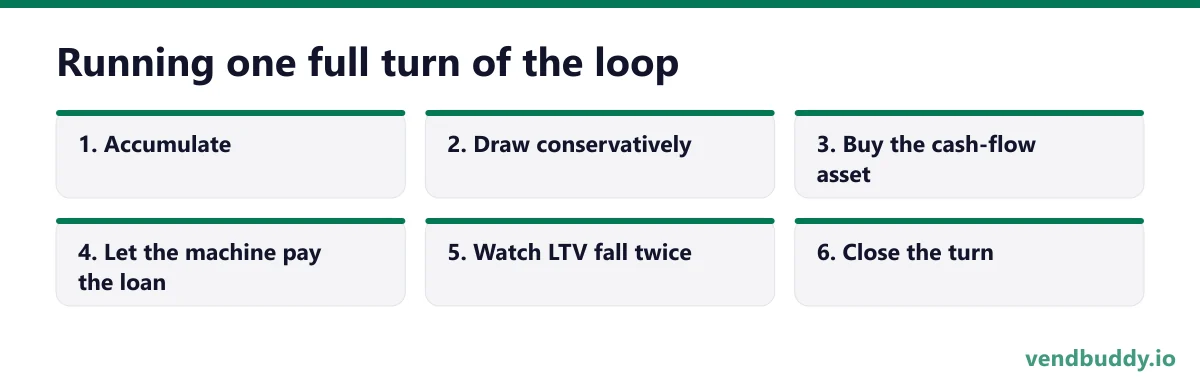
- Accumulate. A recurring weekly auto-buy into bitcoin. This node is boring and it is the whole foundation — nothing downstream exists without a base.
- Draw conservatively. At $20,000 of bitcoin, borrow $5,000. That is 25% LTV, which leaves roughly a 70% price decline between you and the liquidation line.
- Buy the cash-flow asset. $5,000 funds a machine and its opening inventory at a location you have already signed. Not a location you hope to sign — a signed one.
- Let the machine pay the loan. A healthy placement clearing $100–$150 a month of margin retires $5,000 in three to four years on its own, faster if you add anything to it. Interest at roughly 5% at the time of writing is around $21 a month on that balance.
- Watch LTV fall twice. Every principal payment lowers the debt. If bitcoin appreciates, the denominator rises too. Both push the liquidation line further away, which means the loop gets structurally safer as it turns.
- Close the turn. When the balance hits zero you hold the machine outright and the bitcoin, unsold, having never triggered a capital-gains event on the collateral. The second the loan is paid you own both the asset and the collateral — and your borrowing power is back, against a bigger base.
That last line is the entire point. In the linear model you would have sold $5,000 of bitcoin, paid tax on the gain, and ended with a machine. In the loop you end with a machine and the bitcoin. The refinance play is what this looks like once there are eight machines instead of one.
What breaks the flywheel
Every failure mode is a variation on the same mistake, which is confusing the loop with a machine that cannot stop.
- Overleverage. Drawing near the 75% maximum turns a 13% price move into a liquidation. The ceiling is a limit, not a target. Under 30% LTV is the operating range.
- Borrowing for liabilities. The loop only compounds if the borrowed dollars buy something that produces cash flow. Borrowing against bitcoin to fund a truck, a vacation, or living expenses is the same instrument running in reverse: the debt grows, nothing pays it, and LTV drifts up on its own.
- A drawdown while maxed out. Bitcoin has fallen more than 70% peak to trough in past cycles — that is history, not a hypothetical. A conservative LTV survives it. A stretched one gets sold at the bottom with a penalty attached, which is the single worst outcome available in this strategy.
- A variable-rate spike. The rate is set by supply and demand and it moves. A loop underwritten at exactly the current rate has no margin for error.
- No cash reserve. If the only way to make a payment is to draw more, the loop has already inverted.
The discipline rules, in one place
- Keep LTV under 30%, permanently. Not at origination — permanently.
- Borrow only for assets that produce cash flow. Never for consumption.
- Size every payment so your income alone could cover it if the assets produced nothing.
- Never pledge collateral you might need to sell inside the loan horizon.
- Hold a cash reserve separate from both the collateral and the business.
- Underwrite at a rate well above the current one, then check the current one anyway.
- Pay down into strength. Falling markets are when you want the buffer, and that is exactly when it is hardest to add.
The loop is not clever and it is not new. It is what a HELOC is, what a margin account is, and what a bank does with your deposits. The only thing that changed is that the borrowing layer is now open to someone with $20,000 and a route, which is why it is worth understanding before you need it.
Related reading: how bitcoin-backed loans work in 2026, the 5% refinance play, bitcoin loans versus traditional business loans, and the conventional vending machine financing guide. To size step three against a real property type, use the free Machine Finder.
Where operators actually set this up
Coinbase is the mainstream on-ramp for this play: you buy bitcoin and borrow USDC against it inside the same account, with no credit check and no fixed repayment schedule — you pay the balance down when route cash flow says so, not when a servicer says so. Rates are variable and set by supply and demand, so check the current number before you draw. The quiet part is the recurring auto-buy: every weekly purchase raises the collateral base, which raises how much you could borrow later without ever selling a coin.
What is selling, which buildings say yes, and the numbers before you buy a machine. Free, confirm from your inbox, unsubscribe in one click. Refer one friend and get 25 VendBuddy credits.
Want the free 38-page Ultimate Vending Guide too? Get the guide
General information, not legal, tax or financial advice. Rules change, so check the official source. Revenue and income figures are examples, not promises. See our terms.