If you manage an apartment community, gym, office, or student housing, a vending machine or micro market is one of the few amenities you can add at zero cost that residents and tenants actually use every day. A local operator installs and stocks it, handles all the service, and often shares revenue with the property. Here is how the arrangement really works, what to expect, and how to vet an operator so you get a reliable amenity instead of a headache.
Part of our complete guide: how to find vending machine locations.
How “free” vending placement works
A vending operator owns the machine, pays for the product, and earns their money from sales. In exchange for a good location with steady foot traffic, they install and maintain everything at no cost to the property. Your side is simple: provide the spot, a standard power outlet, and access for restocking. There is typically no charge to the property and no long capital commitment. If you are still at the stage of working out who to even call, how vending placement works and how to get a machine placed free covers the national-company versus local-operator question first.
Do property managers make money from it?
Sometimes, and it is worth asking. Many operators offer an optional commission — a percentage of gross sales paid back to the property — or a flat monthly fee, especially at higher-traffic buildings. Others offer a charitable-donation option instead. Commission is not guaranteed and depends on volume; at a smaller building the bigger win is usually the amenity itself, not the check. Get whatever is agreed in writing.
Picture the machines paying you while you sleep
That’s the real promise of vending — income that doesn’t cost you your time, and a life on your own terms. VendBuddy turns this guide into a step-by-step plan so you actually build it instead of just reading about it. Start free today.
Start building free →What a good setup looks like
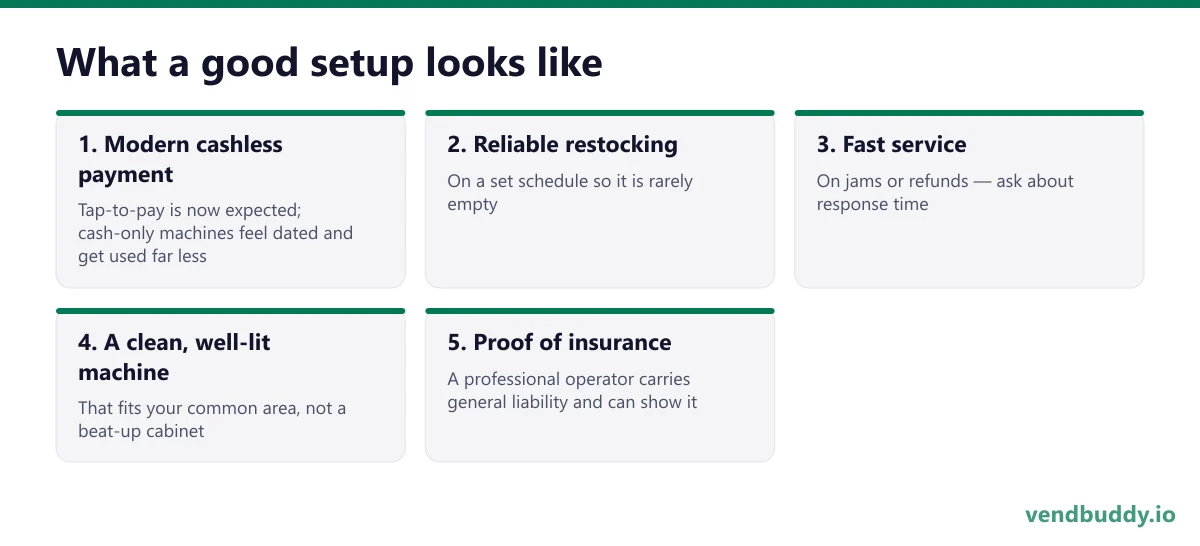
- Modern cashless payment — tap-to-pay is now expected; cash-only machines feel dated and get used far less.
- Reliable restocking on a set schedule so it is rarely empty.
- Fast service on jams or refunds — ask about response time.
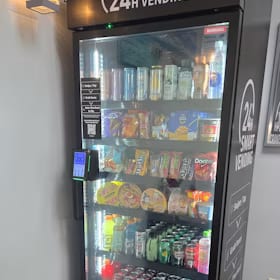
- A clean, well-lit machine that fits your common area, not a beat-up cabinet.
- Proof of insurance — a professional operator carries general liability and can show it.
How to vet an operator (5 questions)
- How often do you restock, and how fast do you respond to an outage or refund request?
- Do you offer a revenue share or monthly fee, and can I see the terms in writing?
- Can you provide proof of general liability insurance?
- What payment methods does the machine accept?
- Can I reach a real person — not a call center — when something is wrong?
A straight, specific answer to all five is the sign of an operator who will still be reliable a year from now.
A fair, simple agreement
Keep it light: a short placement agreement with a 60–90 day initial term, month-to-month after, and a 30-day out for either side. That protects the property without locking you into a machine that is not working out. Avoid anything with a long lock-in or an upfront charge to you — a legitimate operator does not need either.
Tell us about your building and we will help connect you with vending operators in your area who place and service machines at no cost to the property. No obligation — you review the operator and terms before anything is installed.
Request a machine for your property →FAQ
Is it really free for the property?
For the standard arrangement, yes — the operator owns and stocks the machine and earns from sales. You provide the space and power. Be cautious of anyone asking the property for an upfront payment.
What size building do I need?
Foot traffic matters more than size. Buildings with 80–100+ people passing daily — mid-size apartment communities, gyms, offices, student housing — are ideal. Smaller sites can still qualify with the right product mix.
Who handles maintenance and complaints?
The operator does — restocking, repairs, and refunds are all on them. That is the point of the arrangement: an amenity with none of the work on your side.
What if the machine underperforms?
With a month-to-month agreement and a 30-day out, a slow machine can be relocated or removed with no cost or long-term commitment to the property.
Related: get a free machine for your property, and for operators, the apartment pitch template.
What is selling, which buildings say yes, and the numbers before you buy a machine. Free, confirm from your inbox, unsubscribe in one click. Refer one friend and get 25 VendBuddy credits.
Want the free 38-page Ultimate Vending Guide too? Get the guide
Every operator we talk to wants fewer cold calls. The ones who get there have a Google Business Profile and a simple site a manager can check before replying. AI builders make that an evening job now. Wix is the mature site builder; Base44 also builds working tools like a quote form. Start with the AI website walkthrough or Wix vs Base44.
If you run an office, apartment community, gym or school, a local operator can put in a machine and keep it stocked at no cost to you. Check whether your place fits in about a minute, then decide if you want to send it.
Not the one who decides? You can still pass the place on, and the operator will ask who to talk to.
Check my placeSuggest a location →General information, not legal, tax or financial advice. Rules change, so check the official source. Revenue and income figures are examples, not promises. See our terms.