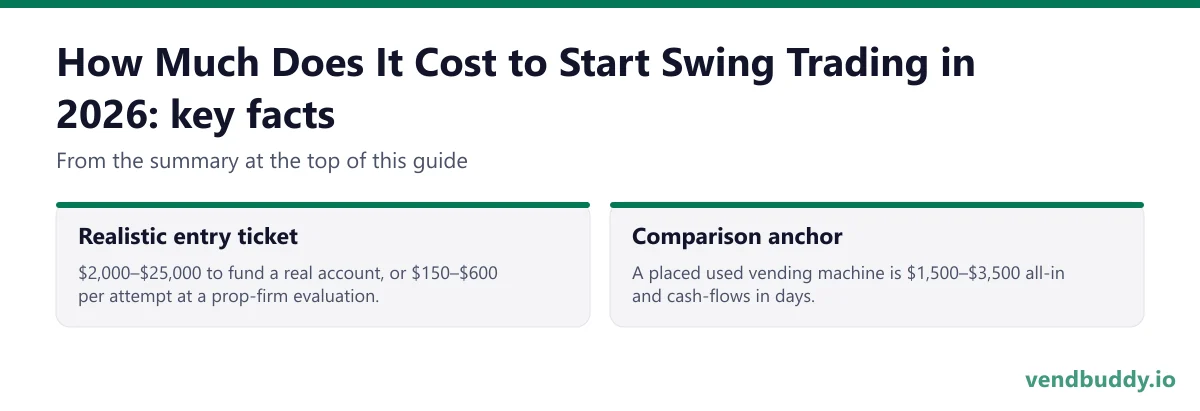
- Realistic entry ticket: $2,000–$25,000 to fund a real account, or $150–$600 per attempt at a prop-firm evaluation.
- Time to first dollar: Days to weeks — a swing position needs time to work, and the first closed trade is as likely to be red as green.
- The line item the thumbnails skip: overnight and weekend gap risk that jumps straight through your stop.
- Comparison anchor: a placed used vending machine is $1,500–$3,500 all-in and cash-flows in days — the full vending cost breakdown.
Pricing the entry ticket is the smartest question in the whole side-hustle space, and we rank side hustle startup costs across every popular model for exactly that reason — most of them die not from bad ideas but from underestimating what it really costs to reach the first profitable month. Here is the honest number for swing trading in 2026: the upfront costs, the ongoing bleed the gurus leave out of the thumbnail, and how long your capital sits at risk before the first real dollar.
The real number
$2,000–$25,000 to fund a real account, or $150–$600 per attempt at a prop-firm evaluation. Margins when running: Not a margin business but an expectancy business: at a realistic 40% win rate you need average winners near 2x your average losers just to clear costs. But the sticker price is only half the answer — the other half is runway: days to weeks — a swing position needs time to work, and the first closed trade is as likely to be red as green, and during that window the costs run whether revenue does or not.
The costs nobody puts in the thumbnail
Overnight and weekend gap risk that jumps straight through your stop; expectancy quietly going negative while the win rate still looks fine; evaluation fees that recur every time a prop-firm challenge blows; and position size drifting up after a good month, so one bad week erases six good ones. Time is the other invisible line item: 5–15 hrs/wk scanning, sizing and journaling — genuinely lighter than day trading, which is the honest appeal — price your hours at anything above zero and the "cheap" models get expensive fast.
Picture the machines paying you while you sleep
That’s the real promise of vending — income that doesn’t cost you your time, and a life on your own terms. VendBuddy turns this guide into a step-by-step plan so you actually build it instead of just reading about it. Start free today.
Start building free →Is the entry ticket worth it?
Swing trading is the most defensible style in this cluster for someone with a job. Fewer decisions, far less screen time, and holding periods long enough that the trading costs which grind day traders down stop being the dominant term. It is still capital-at-risk with the same distribution of outcomes — lighter time cost, identical money cost. With a tested process, a written risk limit and money you can genuinely lose, it is a reasonable use of a slice of a portfolio. It is not an income plan, because income means a number arriving on a date. The full head-to-head against a vending route — margins, hours, exit value — is in vending vs swing trading.
If you want the cheapest REAL entry into monthly income
Among businesses that pay monthly from an owned asset, vending has the lowest honest entry ticket: $1,500–$3,500 per placed machine including initial stock, cash-flowing within days at 40–55% margins, with the machine sellable later at 1–2x annual net. The catch is singular — the location decides everything — and it is the one startup risk you can measure before spending: the complete vending startup-cost breakdown.
VendBuddy scores real vending locations near you by foot traffic and finds the best contact on file — see what a $3,000 machine could earn in your ZIP before spending anything. Five free credits, no card.
Frequently Asked Questions
How much does it cost to start swing trading in 2026?
Realistic entry: $2,000–$25,000 to fund a real account, or $150–$600 per attempt at a prop-firm evaluation. The bigger cost is usually time-to-first-dollar: Days to weeks — a swing position needs time to work, and the first closed trade is as likely to be red as green.
Can you start swing trading with no money?
The "start with $0" pitch is mostly marketing. Every version of swing trading that produces real income needs either capital or a large sustained time investment (5–15 hrs/wk scanning, sizing and journaling — genuinely lighter than day trading, which is the honest appeal) - usually both. Budget for the real number or pick a model whose real number you can afford.
What is a cheaper way to start earning monthly income?
A used vending machine at a measured location runs $1,500-$3,500 all-in and starts producing cash within days of placement at 40-55% gross margins. It is the lowest realistic entry ticket among businesses that pay monthly from an owned asset.
Related: vending vs swing trading, all cash-flow businesses ranked by what $10k buys, and the honest $5k/month math.
What is selling, which buildings say yes, and the numbers before you buy a machine. Free, confirm from your inbox, unsubscribe in one click. Refer one friend and get 25 VendBuddy credits.
Want the free 38-page Ultimate Vending Guide too? Get the guide
General information, not legal, tax or financial advice. Rules change, so check the official source. Revenue and income figures are examples, not promises. See our terms.