- Australia vs US vending comes down to three gaps: labor cost, payments and distance.
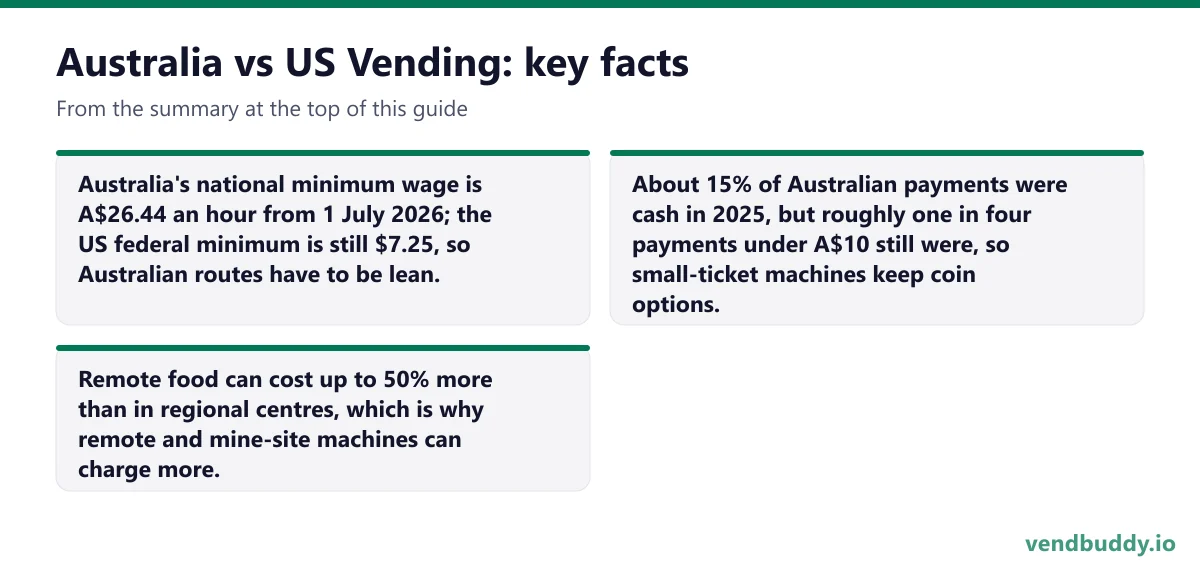
- Australia's national minimum wage is A$26.44 an hour from 1 July 2026; the US federal minimum is still $7.25, so Australian routes have to be lean.
- About 15% of Australian payments were cash in 2025, but roughly one in four payments under A$10 still were, so small-ticket machines keep coin options.
- Remote food can cost up to 50% more than in regional centres, which is why remote and mine-site machines can charge more.
- US lessons: plan routes around fewer, better visits, put a card reader on everything and price remote sites for the distance.
Australia vs US vending looks like the same business on two sides of the Pacific: snack and drink machines in offices, factories, gyms and hospitals. The difference is in the math. Australian operators pay more for every hour on the road, sell to buyers who rarely carry cash and serve sites so remote the next shop is hours away. Each of those pressures forced habits that make US routes more profitable too.
Part of our complete guide: how to start a vending machine business.
Three numbers frame it. From 1 July 2026 Australia's national minimum wage is A$26.44 an hour. The US federal minimum has been $7.25 an hour since July 24, 2009, though many states set higher floors. In Australia, the Reserve Bank's 2025 survey found around 15% of payments were made in cash. And in remote communities a basket of food can cost up to 50% more than in regional centres, with the Northern Territory gap measured at 40% in 2023.
If you want to actually set up a business in Australia (ABN, GST, test-and-tag rules), our guide to starting a vending business internationally has a full Australia section. This piece is about what the comparison teaches an operator running machines in the US.
Labor: why Australian routes have to be lean
When an hour of a driver's time costs several times the US federal floor, every wasted stop hurts. A restock run that finds a machine half full is money spent for nothing. That pushes Australian operators toward:
- Telemetry, so they only visit machines that need stock.
- Fewer, larger machines per site instead of many small ones.
- Dropping low-volume sites faster rather than "giving it another month."
US operators who do their own restocking often ignore the cost of their own hours because no paycheck goes out. It is still a cost. Price your time at what you would pay a helper, then ask which machines earn back that hour. The ones that do not are your Australian-style cuts. Telemetry from readers like Nayax shows sales per machine without opening the door; our Nayax review covers what you get and what it costs.
Cash and cards: what Australian buyers expect
Australians mostly tap. With only about 15% of payments in cash, a coin-only machine there is close to invisible. The US is not far behind: the Federal Reserve found cash was 14% of US consumer payments in 2024, and 78% of US vending sales were cashless in 2025.
The detail worth noticing is small purchases. The RBA found that around one in four payments under A$10 were made with cash, and about 23% of Australians carried no cash at all. Vending sits right in that small-ticket zone. So the Australian lesson is not "go cashless only." It is "never lose a sale because of payment": card and phone on every machine, coins still accepted where the crowd includes kids, students or shift workers paid in cash. Our card reader guide compares the options.
Picture the machines paying you while you sleep
That’s the real promise of vending — income that doesn’t cost you your time, and a life on your own terms. VendBuddy turns this guide into a step-by-step plan so you actually build it instead of just reading about it. Start free today.
Start building free →The remote premium: pricing for distance
Australia is mostly empty space between a few big cities, and the people who work in that space still get hungry. Mine sites, remote roadhouses, outback community stores and fly-in, fly-out work camps all share one trait: the next shop is a long way off. Researchers reviewing remote food costs found prices up to 50% higher than in regional centres.
Machines placed in those settings are priced with the same logic. A buyer at a remote site is not comparing your price with a city supermarket. They are comparing it with a long drive, or with nothing at all.
The US has plenty of remote-ish sites: distribution centers off rural interstates, oil and gas yards, large construction projects, prisons, ski areas, campgrounds, night shifts at hospitals on the edge of town. Many US operators price these the same as their city machines and leave money on the table. Our guide to premium vs budget vending pricing shows how to test a higher price without losing volume, and when to adjust vending prices covers timing.
Heat and long drives: running machines far from base
Much of Australia is hot, and many sites are hours from the operator's base. That leads to two habits worth copying in the hot US states.
Over-spec the cooling. A machine in a non-air-conditioned shed or a sunny breezeway works much harder than one in an office. Australian operators favor units built for heat and check them before summer, not during it. See our summer heat wave strategy.
Stock for the gap between visits. When a site is a long drive away, you fill it for the longest likely gap, favor products with long shelf lives and carry spare parts. A US operator with one machine at a rural plant 60 miles away should think the same way.
An illustrative route-math example
Here is an illustrative example with made-up but typical numbers, to show how an Australian-style operator thinks. Say you have a machine at a small office 45 minutes from your other stops. Each visit takes about two hours door to door once you count driving, restocking and cash or card reconciliation. If you value your time at $25 an hour, that is $50 per visit before fuel. Visit weekly and the machine has to clear well over $200 a month in gross profit just to cover your time.
Most people working on walk-ins start by pulling the list rather than driving the map. The ranks the businesses around your ZIP by type and headcount, and the first five contact reveals are free.
Now put a reader with telemetry on it. If the data shows it only needs stock every second week, you cut the visits in half and the same machine suddenly earns its place. If it shows sales so low that even fortnightly visits do not pay, you have your answer, and you can move the machine to a busier building on an existing loop.
Australian operators run this math by default because their labor costs force it. US operators who run it find the same thing: a few machines carry the route and a few quietly drain it. The fix is rarely a better product mix. It is usually moving the machine.
What a US operator can borrow from Australia
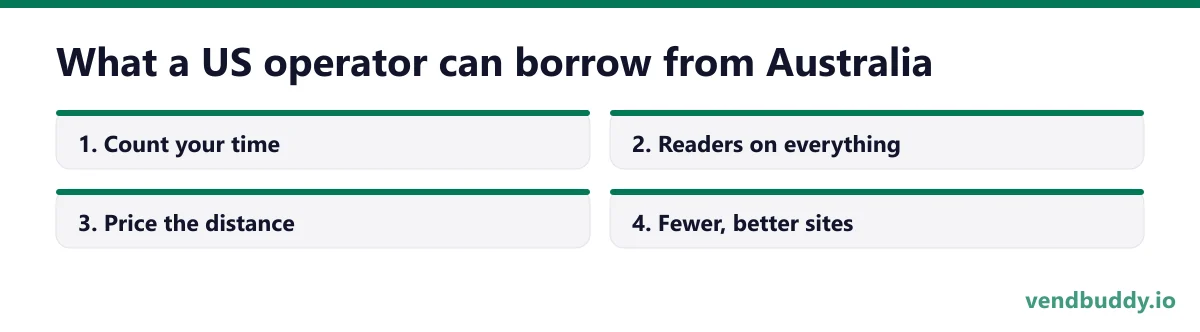
- Count your time. Give every machine a cost per visit, including your own hours, and cut the ones that cannot carry it.
- Readers on everything. With cash under a sixth of payments in both countries, a coin-only machine is a machine with a sales cap.
- Price the distance. Make a list of your sites by drive time to the nearest grocery store. The farthest third are candidates for higher prices.
- Fewer, better sites. One machine at a 200-person plant beats four at 20-person offices once you count the driving.
What does not transfer
Australia's wage floor is not your problem in most US states, and that is an advantage: you can afford more visits per dollar of sales. Do not copy Australian minimum order sizes or the rule of skipping small sites entirely. A 40-person office close to your other stops can be a good US location even if an Australian operator would pass on it.
Also, the US has no single national cash trend that applies everywhere. A cash-heavy factory floor in one state can behave nothing like a tech office in another. Watch your own machine data rather than national averages.
Your next step
The Australian lesson in one line: every visit has to earn its keep, so put machines where people are stuck for hours and the next option is far away. Then charge for that convenience. Finding those buildings is the slow part. VendBuddy shows you the plants, warehouses, hospitals and offices in any ZIP code with the person who can say yes, so you can fill your route with sites worth the drive. For the bigger picture across other countries, start with our guide to vending machines around the world.
Frequently Asked Questions
Is vending more profitable in Australia or the US?
There is no clean answer, because profit depends on the site. Australian operators face much higher labor costs (a A$26.44 hourly minimum wage from July 2026 against a US federal minimum of $7.25) but often charge more, especially at remote sites. US operators have cheaper labor and more dense indoor locations.
Do Australian vending machines still take cash?
Most take cards and phones first. Only about 15% of Australian payments were in cash in 2025, but roughly one in four payments under A$10 still were, so many small-ticket machines keep a coin option.
Why are vending prices higher at remote sites?
Because the next store is far away and freight costs more. Research on remote Australia found a basket of food can cost up to 50% more than in regional centres. The same logic applies to remote US sites like rural plants or work camps: buyers compare your price with a long drive, not with a supermarket.
Where can I learn how to start a vending business in Australia?
Our guide to starting a vending business internationally has a dedicated Australia section covering the ABN, GST, test-and-tag electrical checks, food safety rules and sourcing machines that run on Australian power.
What is selling, which buildings say yes, and the numbers before you buy a machine. Free, confirm from your inbox, unsubscribe in one click. Refer one friend and get 25 VendBuddy credits.
General information, not legal, tax or financial advice. Rules change, so check the official source. Revenue and income figures are examples, not promises. See our terms.