A $4 Smartwater sitting next to a $1.25 Aquafina in the same machine isn't a pricing mistake — it's often the single highest-leverage decision on your planogram. Here's the per-SKU margin math, when premium wins, and when it quietly kills your velocity.
Part of our complete guide: scale a vending machine business.
The margin math: budget vs. premium, side by side
Percent margin is the number most operators fixate on. Dollar margin per unit is the number that actually pays your bills. A budget item can carry a higher margin percentage and still lose to a premium item that nets more real dollars per sale:
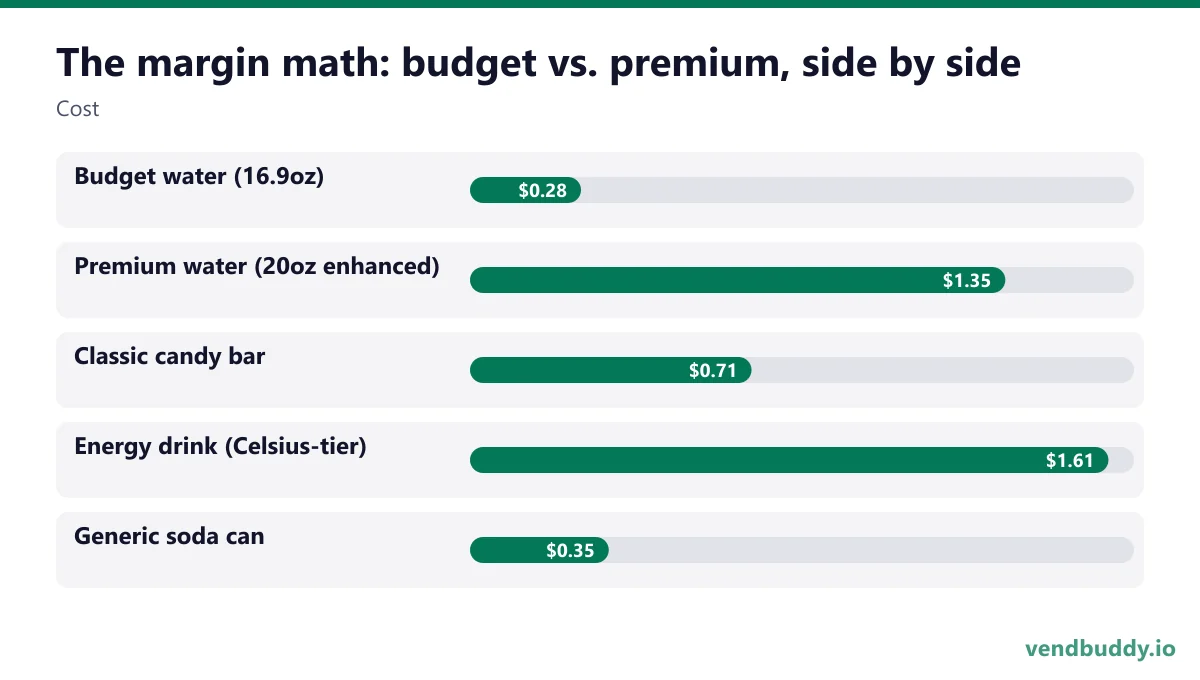
| SKU | Cost | Price | Margin ($) | Margin (%) |
|---|---|---|---|---|
| Budget water (16.9oz) | $0.28 | $1.25 | $0.97 | 78% |
| Premium water (20oz enhanced) | $1.35 | $4.00 | $2.65 | 66% |
| Classic candy bar | $0.71 | $1.25 | $0.54 | 43% |
| Energy drink (Celsius-tier) | $1.61 | $3.75 | $2.14 | 57% |
| Generic soda can | $0.35 | $1.50 | $1.15 | 77% |
The premium water and energy drink carry lower margin percentages than their budget counterparts — but roughly 2–3x the dollar profit per unit sold. One premium sale is worth two to three budget sales.
Run the same 100 units through both columns and the gap compounds fast: 100 budget waters clear $97 in profit. 100 premium waters clear $265 — and premium items in a captive location frequently outsell budget ones once shoppers realize it's the only cold option in the building.
Why the price comparison doesn't work the way you'd expect
Vending customers rarely compare your price to a grocery store shelf. They compare it to their alternatives in that moment: walking to their car, leaving the building, or going without. A captive office worker who won't drive 15 minutes for cheaper water will pay $4 for the convenience — the same psychology that makes $6 stadium bottled water normal. Price sensitivity is a function of alternatives, not the product itself.
Picture the machines paying you while you sleep
That’s the real promise of vending — income that doesn’t cost you your time, and a life on your own terms. VendBuddy turns this guide into a step-by-step plan so you actually build it instead of just reading about it. Start free today.
Start building free →When premium pricing wins
- High-income, captive audiences: luxury apartment high-rises, corporate offices, hospitals — people who value convenience over savings.
- Low competition on site: no cafeteria, no nearby gas station, no micro-market alternative.
- Health- and performance-driven categories: protein bars, electrolyte drinks, and energy drinks carry premium pricing acceptance almost everywhere, not just upscale locations.
When premium pricing backfires
- Price-sensitive, high-volume sites: warehouses, factories, and schools where workers and students are budget-conscious and buying multiple times a day — a $4 water here kills velocity instead of lifting margin.
- Locations with real alternatives nearby: if a break room fridge, cafeteria, or corner store is a two-minute walk, premium pricing pushes people to skip your machine entirely.
- New, unproven locations: without 30 days of sales data, an all-premium mix is a guess. Launch with proven budget staples, then layer in premium test SKUs.
The blended mix that works almost everywhere
Keep 60–70% of your planogram anchored on proven, budget-friendly staples for volume — bottled water, classic candy, standard soda. Use the remaining 30–40% for premium SKUs: energy drinks, enhanced water, protein bars. The budget items also do pricing work for you — a $4 premium item next to a $1.25 classic makes the $1.25 feel like a bargain and the $4 feel earned, without you saying a word.
How to test a premium SKU without wasting a slot
Don't guess your way into a full premium row. Swap one proven budget item for one premium candidate, track velocity for 30 days on the Sales Data Dashboard, and compare dollar margin generated in that slot before and after. If the premium item moves at even half the unit velocity of what it replaced, it's usually still winning on total dollars — that's the math from the table above playing out in real inventory. If it stalls completely, you've learned something about that location's price ceiling for $30, not $300.
Frequently Asked Questions
Should every vending machine carry premium products?
No. Premium pricing works best in captive, low-competition locations with a higher-income or performance-driven audience — offices, gyms, luxury apartments, hospitals. In price-sensitive, high-volume sites like warehouses and schools, a mostly budget mix with a couple of premium test slots performs better.
What's a safe starting ratio of premium to budget products?
Start around 30% premium, 70% budget-proven staples, then adjust based on 30 days of real sell-through data. New, unproven locations should lean even more budget-heavy until you have data to justify the switch.
Does raising prices always lose customers?
Not for the right SKU. Premium versions of products people already want (better water, better energy drinks) usually keep or grow unit sales because the value story is obvious. Raising the price on a commodity item with no upgrade story is where operators lose volume.
Check real margins on your exact SKUs → Open the VendBuddy Catalog & Margins tool
Not sure if a price change is the fix? → Use the price-adjustment framework
Related: the complete product stocking guide, when to adjust vending prices, real income by location type, and the full cost and profit breakdown.
What is selling, which buildings say yes, and the numbers before you buy a machine. Free, confirm from your inbox, unsubscribe in one click. Refer one friend and get 25 VendBuddy credits.
General information, not legal, tax or financial advice. Rules change, so check the official source. Revenue and income figures are examples, not promises. See our terms.