- Five phases, roughly 6–8 weeks start to placed machine: decide your lane, set up the business, find the location, buy and place the machine, then operate the first 90 days.
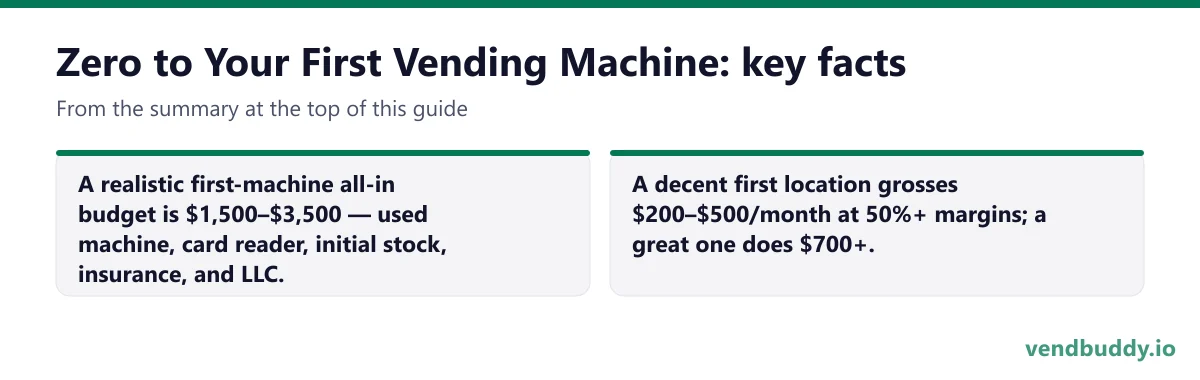
- A realistic first-machine all-in budget is $1,500–$3,500 — used machine, card reader, initial stock, insurance, and LLC.
- A decent first location grosses $200–$500/month at 50%+ margins; a great one does $700+.
- Most routes that fail die from bad locations, not bad machines — which is why this sequence front-loads the location work.
There is a specific order that gets you from zero to a working, earning vending machine with the fewest expensive mistakes — and it is not “buy a machine, then figure out where it goes.” Here is the exact five-phase sequence, condensed from VendBuddy’s full operator guides, with the real math at each step.
Part of our complete guide: how to start a vending machine business.
Phase 1 — decide your lane (days 1–3)
Snack and drink vending is the default starting lane for a reason: proven demand, cheap used equipment, and simple products. Specialty lanes (claw machines, ice, PPE, trading cards) can out-earn standard vending, but each has venue-specific demand — read the niche guides on the VendBuddy blog before committing capital to something unusual. Budget honestly: a realistic first-machine all-in cost is $1,500–$3,500 once you add a used machine, a card reader, initial stock, insurance, and LLC formation.
Phase 2 — set up the business (week 1–2)
Run the legal setup in parallel with location scouting, not before it: LLC, EIN, business bank account, sales tax permit, city license, and liability insurance. It is roughly two weeks of admin, most of it just waiting on filings to process — there is no reason to sit idle during that window. The full week-by-week breakdown is in our getting-started checklist.
Picture the machines paying you while you sleep
That’s the real promise of vending — income that doesn’t cost you your time, and a life on your own terms. VendBuddy turns this guide into a step-by-step plan so you actually build it instead of just reading about it. Start free today.
Start building free →Phase 3 — find the location FIRST (week 2–4)
Use a lead finder or build a list of 30 candidate locations within 15 minutes of home: offices with 25+ staff, auto shops, gyms, laundromats, apartment buildings, warehouses. Work the pop-in script — expect 15–20 visits per yes. A signed agreement for a spot with 50+ daily people is worth more than any machine you could buy; the exact word-for-word script is in our cold pitch guide.
Phase 4 — buy and place the machine (week 4–6)
Match the machine to the location: high-traffic spots want a full-size snack-and-drink pair, a small office wants a combo unit. Buy used-dealer for your first machine — you want cheap mistakes while you are still learning. Add a card reader on day one; cashless now accounts for 50–70% of typical vending sales. Machines weigh 400–800 lbs, so a $150–300 professional move beats a back injury and a cracked cabinet.
Phase 5 — operate the first 90 days
Stock at a 2x–2.5x markup. Service weekly at first, then let telemetry set the cadence once you have data. Track per-product sales and cut the bottom third of slots monthly — a tight, proven mix beats a random assortment by 20–40% on the same foot traffic. Send the location a short monthly check-in — retention is cheaper than acquiring the next location. At 60–90 days of stable sales, start the pop-in loop for machine #2: the second placement is roughly half the work of the first, because you now have a working machine to photograph and a real reference to cite.
The fastest way to test this in your own ZIP is the . Search once, see which businesses sit within a few miles, and reveal five contacts for nothing. It will not tell you who says yes, but it saves the afternoon you would spend building the list by hand.
The math to expect
A decent first location grosses $200–$500/month at 50%+ margins; a great one does $700 or more. Most routes that fail die from bad locations, not bad machines — which is exactly why this sequence puts the location work ahead of the equipment purchase, not after it.
The VendBuddy Full Launch Bundle ($97) is all 10 documents we sell: the setup checklist, distributor list, glossary, pitch script, pitch checklist, contract template, this phase-by-phase launch guide, the moving-companies directory, the supplier & partner directory, and five property-manager follow-up email templates. Everything above, plus the logistics for getting the machine there and the follow-up sequence that turns a maybe into a yes.
See the operator kits & bundles →Want just one phase at a time? The legal setup lives in the getting-started checklist ($27) and the pitch mechanics live in the cold pitch script ($47) — or see every VendBuddy digital product explained to compare all three at once.
Frequently Asked Questions
How long does it take to launch a vending machine business from scratch?
Roughly 6–8 weeks from deciding to start to having a machine placed and earning, if you work location scouting and legal setup in parallel rather than sequentially.
What order should I do things in when starting a vending business?
Decide your lane, set up the business (LLC, EIN, permits, insurance), find the location first, then buy and place a machine sized for that location. Buying the machine before the location is the most common expensive mistake.
How much money do I need to launch my first vending machine?
A realistic first-machine all-in budget is $1,500–$3,500: a used machine, a card reader, initial stock, insurance, and LLC formation.
What should I expect to earn in the first 90 days?
A decent first location grosses $200–$500/month at 50%+ margins; a great location can do $700 or more. Most of the variance comes from location quality, not the machine itself.
Related: the legal getting-started checklist, the cold pitch script that lands locations, every VendBuddy digital product explained, our full vending business startup guide, and how to find and land vending machine locations.
What is selling, which buildings say yes, and the numbers before you buy a machine. Free, confirm from your inbox, unsubscribe in one click. Refer one friend and get 25 VendBuddy credits.
Walk-ins and cold emails find locations. A small site with your own machine photos and a request-a-machine form lets the next one find you. Around machine three to five, an AI builder drafts it in an evening. Wix is the mature site builder; Base44 also builds working tools like a quote form. Start with the AI website walkthrough or Wix vs Base44.
General information, not legal, tax or financial advice. Rules change, so check the official source. Revenue and income figures are examples, not promises. See our terms.