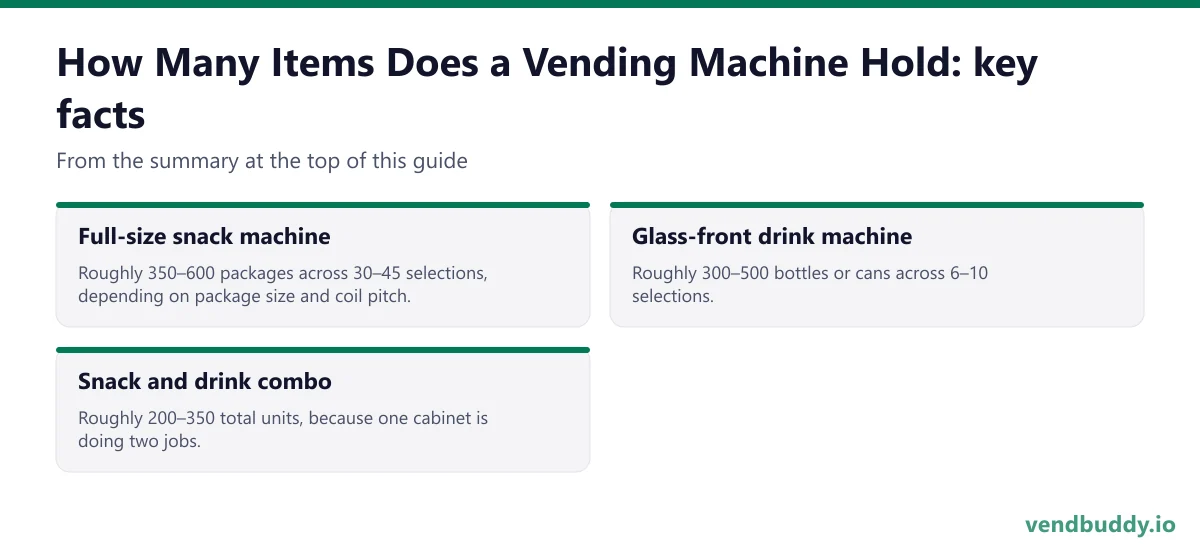
- Full-size snack machine: roughly 350–600 packages across 30–45 selections, depending on package size and coil pitch.
- Glass-front drink machine: roughly 300–500 bottles or cans across 6–10 selections.
- Snack and drink combo: roughly 200–350 total units, because one cabinet is doing two jobs.
- The formula is selections × depth. A spiral holds 8–18 units depending on the package, so a 40-selection machine with 12-deep coils is a 480-unit machine on paper.
- Capacity is a restock-interval number, not a revenue number. It tells you how long you can stay away, not how much you will sell.
This question gets asked two ways and they want different answers. A buyer is asking whether the machine will hold enough to be worth the trip. An operator with a machine already placed is asking why it keeps running out of one thing while three columns sit untouched. Both answers come out of the same arithmetic, so here is the arithmetic, the real ranges by format, and the part that actually determines whether the number matters.
Part of our complete guide: how much does a vending machine cost.
The ranges by machine format
Manufacturers publish capacity as a maximum with an ideal product, which is why the number on the spec sheet is always higher than what you will fit. These are the working ranges operators actually load, and they are wide because package size drives everything:
| Format | Typical capacity | Selections |
|---|---|---|
| Full-size snack machine | ~350–600 packages | 30–45 |
| Glass-front drink machine | ~300–500 bottles or cans | 6–10 |
| Stack drink machine (cans) | ~400–600 cans | 5–9 |
| Snack and drink combo | ~200–350 total units | 20–35 |
| Smart cooler / grab-and-go | ~150–400 units by model | Open shelf, no fixed count |
| Bulk candy head | Measured in pounds, not units | 1–3 |
The math behind the number
Every capacity figure is the same calculation: selections × depth.
A selection is one button, mapped to one product. Behind it sits a spiral, and how many units fit down that spiral is the depth. Depth is set by two things you can see when you open the door: the coil pitch, meaning how far apart the turns of the spiral sit, and the package. A bag of chips is bulky and low-density, so a chip coil might hold eight. A candy bar is flat and rigid, so the same machine on a tighter pitch might hold eighteen of those.
The fastest way to test this in your own ZIP is the . Search once, see which businesses sit within a few miles, and reveal five contacts for nothing. It will not tell you who says yes, but it saves the afternoon you would spend building the list by hand.
So a 40-selection snack machine with an average depth of 12 is roughly a 480-unit machine on paper. In practice you will load less, because you are not going to run 12 deep on a product that sells two a week.
Drink machines work differently. A glass-front cooler stacks in racks and a stack machine drops cans down a serpentine column, which is why both hold far more units across far fewer selections.
Picture the machines paying you while you sleep
That’s the real promise of vending — income that doesn’t cost you your time, and a life on your own terms. VendBuddy turns this guide into a step-by-step plan so you actually build it instead of just reading about it. Start free today.
Start building free →What capacity actually buys you
Capacity is not a revenue number. It is a restock-interval number.
The machine sells what the building wants at the rate the building wants it. A bigger cabinet in the same room does not create demand — the headcount does, and the headcount thresholds are the number to check before you look at any spec sheet. What capacity does is decide how many days you can leave before your top sellers run dry, which is a route-cost question rather than a sales question.
Work it backwards. If your best-selling drink moves 15 units a week and its column holds 45, that column supports a three-week interval. If your best-selling snack moves 20 a week and its coil holds 10, that one product is forcing a weekly trip regardless of the other 39 slots. The binding constraint is always a single fast mover in a shallow slot, which is exactly the problem the restocking guide solves by widening winners across multiple columns.
The capacity mistake almost everyone makes
Beginners buy selections. Experienced operators buy depth on the right six products.
In a typical site, four to six items produce most of the revenue. A 45-selection machine in that room is running roughly 39 slots of long tail: products that turn slowly, tie up cash, occupy space that a winner could use, and quietly age toward the date code. Meanwhile the item everyone actually walks over for is empty by Thursday.
The fix costs nothing. Take your two or three proven sellers and give each of them two or three adjacent columns instead of one. You lose variety nobody was buying and you gain a machine that is full of the right thing when people show up. The product selection guide covers which items earn that treatment; the short version is that the winners are obvious within three restocks and you should act on it immediately.
The corollary matters when you are buying: a full-size 45-selection machine in a 20-person office is the wrong purchase even if it is on sale. Match the format to the site and the capacity takes care of itself — that is the whole argument in what machine to buy for your location.
Capacity only helps where the demand is already there. The free Machine Finder filters current machines by property type so you can see what actually fits a 20-person office versus a 300-person warehouse before you shop on price.
Frequently Asked Questions
How many items does a vending machine hold?
It depends on the format. A full-size snack machine typically holds roughly 350 to 600 packages across 30 to 45 selections. A glass-front drink machine typically holds roughly 300 to 500 bottles or cans across 6 to 10 selections. A snack and drink combo usually lands around 200 to 350 total units because it splits the cabinet. Bulk candy heads hold pounds rather than packages. Treat every number as a ceiling, not a target, because the practical fill is lower.
What is a selection versus a slot on a vending machine?
A selection is one button the customer can press, which maps to one product. A slot or column is the physical spiral behind it. Most snack machines have one selection per slot, so a 40-selection machine has 40 spirals. The useful number is depth: how many units fit down one spiral, which is commonly 8 to 18 depending on package size and coil pitch. Selections times depth is your capacity.
Should you fill a vending machine to capacity?
No. Filling to the last unit ties up cash in inventory that sits, and it guarantees that your slow movers expire before they sell. The practical target is a full face on your top sellers and a deliberately shallow fill on anything unproven. Capacity matters for how long you can go between visits on the items that actually move, not for how much product you can physically stuff into the cabinet.
How many selections does a vending machine need?
Fewer than most beginners buy. In a typical site four to six products produce the majority of revenue, so a 40-selection machine spends most of its slots on long-tail items that turn slowly. The higher-yield configuration is widening your proven sellers to two or three columns each, which cuts stockouts on the products people actually come for and reduces the number of near-dead SKUs you are rotating.
Does a bigger vending machine make more money?
Only where the demand already exists. Capacity does not create sales; it extends the interval between restock visits. A large cabinet in a 20-person office ties up more capital, holds more product that goes stale, and earns the same as a smaller one. Size the machine to the headcount and dwell time of the site, then let capacity decide your route cadence.
What is selling, which buildings say yes, and the numbers before you buy a machine. Free, confirm from your inbox, unsubscribe in one click. Refer one friend and get 25 VendBuddy credits.
Want the free 38-page Ultimate Vending Guide too? Get the guide
General information, not legal, tax or financial advice. Rules change, so check the official source. Revenue and income figures are examples, not promises. See our terms.