- Call center vending machines can be a high-volume placement because agents take short, fixed breaks, sit on site for 8 to 10 hours and often cannot leave the building.
- On VendBuddy, 9 operators ran 18 call center searches across 13 ZIP codes since April 2026 (our data, 2026-10-04).
- Sites with 100 or more agents per shift, a break room on the floor and no on-site cafe are the strongest.
- Pitch HR, facilities or the site operations manager, and sell them on morale, retention and breaks that start on time.
- Stock caffeine, quick calories and hydration: energy drinks, coffee, jerky, instant meals and bottled water.
Call center vending machines can outsell almost any other office placement, and the reason is the schedule. An agent on the phones gets a 10 or 15 minute break at a set time, cannot walk out to a store, and might do it twice in one shift. If a break room holds 60 agents who all hit the floor at once, a well-stocked machine turns over fast. The condition that decides it is whether the center is big enough and whether it already runs a cafeteria or free coffee.
Part of our complete guide: how to find vending machine locations.
Here is how the venue works, what to put in the rows, and who signs. If you have never pitched a workplace, the basics are in getting a vending machine into an office.
Call centers in VendBuddy's own data
Call centers are a small search on VendBuddy. Since April 10, 2026, 9 operators ran 18 call center searches across 13 ZIP codes (VendBuddy’s own Lead Finder data, 2026-10-04). Most operators stop at office buildings and never think about the call center sitting inside a business park. That is the gap.
Lead Finder files call centers in the office family, which starts at a base score of 65 out of 100 before it adjusts for the individual site. The score is a starting point. A call center with 300 agents on a floor beats a better-rated office with 20 people.
How a call center runs
Many centers run in shifts: 7 to 3, 3 to 11, and sometimes overnight. Some are open 24/7, which means your machine sells at 2 am as well as 2 pm. The rhythm is rigid. Breaks are timed so the phones are always covered, and a line at the machine during a 10 minute break is normal.
That has three effects. First, people want something they can grab in under two minutes, so card readers and fast checkout matter more than variety. Second, agents drink a lot of caffeine and water because they are talking all shift. Third, turnover is high in this industry, so you will see new faces every month, which makes a rotating selection pay off.
Ask about the break room rules. Some centers do not allow food on the floor, so all buying happens in one room. Others have a cafeteria run by a large contract caterer. If a caterer holds an exclusive, you will be pitching the caterer and not the site, and it may not be worth the time.
Also ask about security. Many centers handle payment card data and restrict who can come in. A vendor with a badge, a certificate of insurance and a set service window gets approved faster than a stranger with a hand truck.
Picture the machines paying you while you sleep
That’s the real promise of vending — income that doesn’t cost you your time, and a life on your own terms. VendBuddy turns this guide into a step-by-step plan so you actually build it instead of just reading about it. Start free today.
Start building free →Stocking for a call center: the rows that move
Large centers need volume. Plan one snack machine and one cold drink machine for each 75 to 100 agents on a shift, and a second set if the break room serves more than one floor. For 300 or more agents, think about a micro market or a pair of smart fridges for a cleaner, faster checkout. See the smart cooler guide for the cost side.
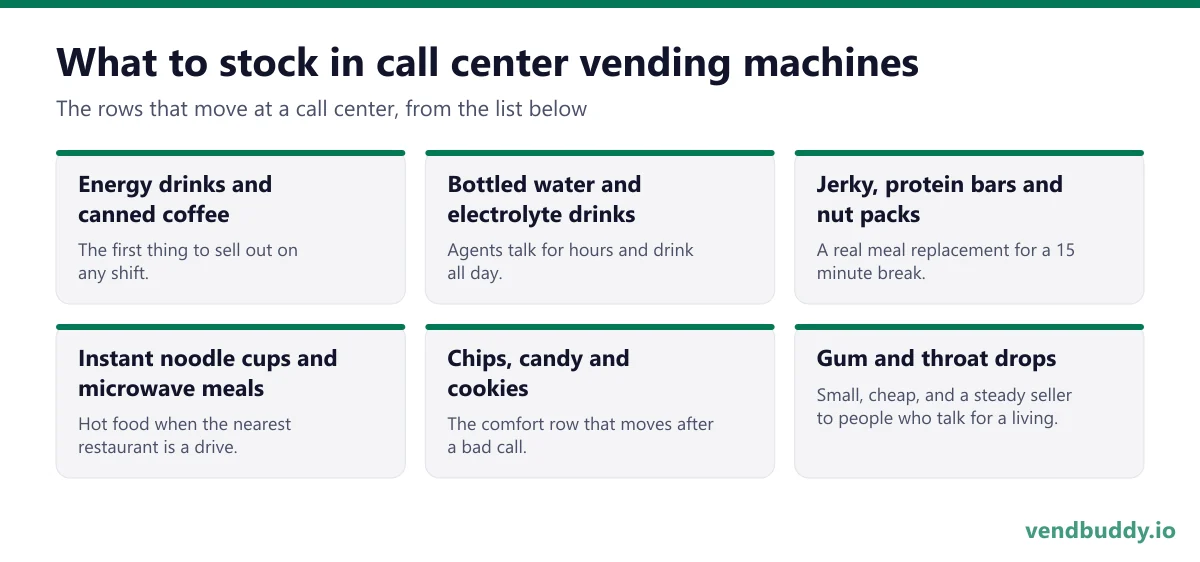
What to stock, and why:
- Energy drinks and canned coffee. The first thing to sell out on any shift.
- Bottled water and electrolyte drinks. Agents talk for hours and drink all day.
- Jerky, protein bars and nut packs. A real meal replacement for a 15 minute break.
- Instant noodle cups and microwave meals. Hot food when the nearest restaurant is a drive.
- Chips, candy and cookies. The comfort row that moves after a bad call.
- Gum and throat drops. Small, cheap, and a steady seller to people who talk for a living.
For overnight shifts, add heartier options like sandwiches, since the cafeteria is closed. More ideas are in vending machine snacks.
Getting the yes from a call center
The decision usually sits with HR, facilities or the site operations manager. Lead Finder looks for Office Manager, Facilities Manager, Property Manager and Operations Manager titles at this kind of site, which gets you to the person who controls the break room. A corporate real estate team may hold the vendor list for a large company, so ask whether the site has the authority to approve a vendor or if a regional office does.
An opener:
“I stock break rooms with drinks and food that agents actually buy, at no cost to you. A lot of your people work through lunch, so I’d like to put a machine on the floor and see if it helps with breaks. Who handles vendors for this site?”
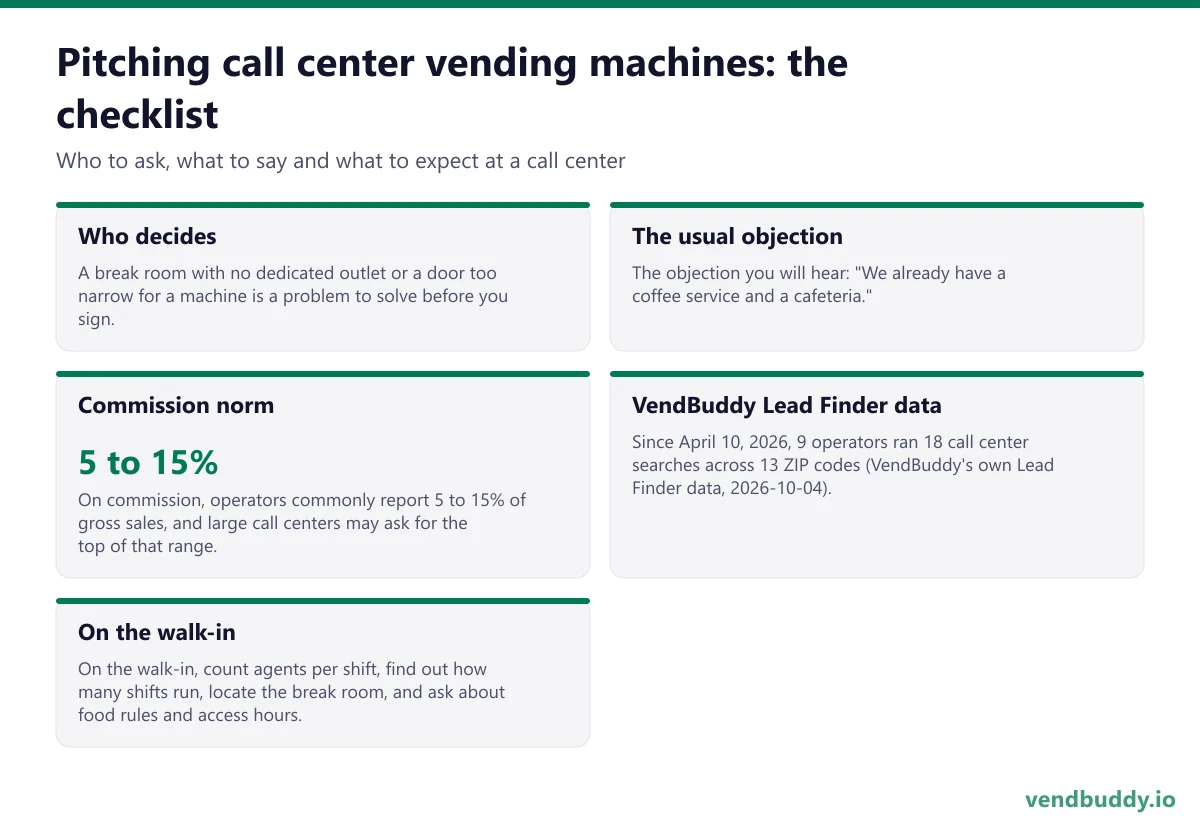
The objection you will hear: “We already have a coffee service and a cafeteria.” Ask what hours the cafeteria runs and whether it covers the night shift and weekends. Most do not.
The angle that wins is morale. A good break room helps keep agents, and agent turnover costs a center real money. You are offering a perk that costs them nothing.
On commission, operators commonly report 5 to 15% of gross sales, and large call centers may ask for the top of that range. Check vending machine commission rates and use the vending ROI calculator to see what you can afford to give up.
On the walk-in, count agents per shift, find out how many shifts run, locate the break room, and ask about food rules and access hours. A break room with no dedicated outlet or a door too narrow for a machine is a problem to solve before you sign.
Keeping the line short
In a call center, the machine has to work during a ten minute window or the break is wasted. A jammed coil or a dead card reader during the 3 pm break creates a line of annoyed agents and a call to HR. Use machines with reliable bill and card readers, and test them on every visit.
On card readers specifically, Nayax is the default for a dull reason: it is the one most machine suppliers pre-wire for. Price the monthly against your slowest machine, not your best one. Affiliate link, so we may earn a commission at no extra cost to you.
Restock on a day and time that avoids the break rush. Most centers prefer early morning, before the first break, or the quiet stretch after the first shift. Ask the manager for a window and stick to it, because a vendor who always shows up on time earns trust fast.
Keep a few extra cases of the top three sellers in your van. Energy drinks and water will sell through first, and a half-empty cooler on a Friday is a lost weekend of sales if the center runs on weekends too. Track what runs out and raise your stock levels.
If the site grows, say so. A center that adds a second shift or a new client program will add machines to your route, and a note from you before the next budget cycle puts you first in line.
How to find call centers near you
Use the quickest route: Find call centers near you in Lead Finder. It lists call centers around a ZIP with a score and the title to ask for.
Two free routes:
- Google Maps. Search “call center near me” and “customer service center” or “contact center”. Look for large buildings with big, full parking lots and no signage out front.
- A drive-by test. Drive past at shift change, around 2:45 or 3:15 pm. A parking lot that empties and refills is a big shift site.
Lead Finder adds the contact, the score and a radius. Our general approach is in how to find vending locations.
Look for the building nobody notices
Call centers hide in plain sight in business parks, and most have never been approached by a decent vending operator. Find call centers near you in Lead Finder, pick the three biggest parking lots and call the site manager on Tuesday morning.
Frequently Asked Questions
Are call centers good vending machine locations?
Yes, for centers with 100 or more agents per shift and no full cafeteria. Agents take short, scheduled breaks, stay on site for long shifts and cannot easily leave, so machines get used at predictable peaks. Overnight shifts increase sales when nothing else is open.
What sells best in a call center vending machine?
Energy drinks, canned coffee, bottled water, electrolyte drinks, jerky, protein bars, instant noodle cups and comfort snacks. Agents talk all day and take quick breaks, so caffeine, hydration and fast calories lead. Add hot or filling items for overnight shifts.
How much commission does a call center expect?
Operators commonly report 5 to 15% of gross sales to the site. Large centers with a big headcount may ask for the higher end. Some accept a lower percentage in exchange for free coffee service or fast restocking. Confirm any exclusive caterer contract before you quote.
If you would rather not draft the contract from scratch, we keep a plain-English walkthrough at get vending machine contracts. It covers term, commission, exclusivity and how either side gets out.
Who approves a vending vendor at a call center?
Usually HR, facilities or the site operations manager. In a large company, a corporate real estate or procurement team may hold the approved vendor list, so ask who can approve a vendor locally. Expect to provide insurance and follow site access rules.
What is selling, which buildings say yes, and the numbers before you buy a machine. Free, confirm from your inbox, unsubscribe in one click. Refer one friend and get 25 VendBuddy credits.
Every operator we talk to wants fewer cold calls. The ones who get there have a Google Business Profile and a simple site a manager can check before replying. AI builders make that an evening job now. Wix is the mature site builder; Base44 also builds working tools like a quote form. Start with the AI website walkthrough or Wix vs Base44.
General information, not legal, tax or financial advice. Rules change, so check the official source. Revenue and income figures are examples, not promises. See our terms.