Almost every search for "vending machine license New York City" lands an operator on a DCWP General Vendor or Mobile Food Vending page — and every one of those pages is about a street cart, not a machine standing in the lobby of 30 Hudson Yards. The machines that actually earn in this city sit where the pushcart rules never reach: Deloitte's 807,000-square-foot floors at 70 Hudson Yards, the customs brokers stacked along Grand Avenue in Maspeth, and the Hunts Point produce terminal at 4 a.m. What gates you here is not a license. It is a certificate of insurance naming the building's ownership entity, a freight-elevator window, and a 32BJ building crew that decides whether your hand truck gets upstairs.
- Vending locations in New York: what the data shows
- What the New York numbers mean for operators and building owners
- Is New York a good place to start a vending machine business?
- New York Vending Market Overview
- Top Industries Driving Vending Demand in New York
- Best Placement Districts in New York
- NY Licenses, Permits, and Sales Tax for Vending in New York
- Commission Rates and Negotiation in New York
Free to search. 5 free contact reveals, no card.
Property owners and managers: tell us about the site and we pass it to an operator who covers New York, if one is in range.
Request a free machine →- Tier-1 market of roughly 20 million people across five boroughs plus the Hudson, Long Island, and Westchester rings — the largest single vending demand pool in North America.
- New York State exempts candy, soft drinks and bottled water sold from a vending machine at $1.50 or less in a coin-and-cash-only machine, or $2.00 or less in a machine that accepts cards — above that line the 8.875% city rate applies to the whole item.
- There is no New York City vending machine operator license for packaged snacks and drinks placed inside a private building; the DCWP licenses everyone keeps finding cover sidewalk carts and tables.
- Manhattan Class A towers, Northwell, NewYork-Presbyterian, Mount Sinai and the university systems are contracted; the open ground is outer-borough last-mile industrial in Maspeth, Sunset Park, Red Hook and Hunts Point.
- Commission asks run 12–15% in Class A Manhattan and 0–5% in outer-borough industrial, but building insurance and access rules cost more than the commission spread does.
Free tools: vending ROI calculator · revenue calculator by property type · route time calculator · State of Vending 2026 report · all free tools
- Is New York a good place to start a vending machine business?
- New York Vending Market Overview
- Top Industries Driving Vending Demand
- Best Placement Districts in New York
- NY Licenses, Permits, and Sales Tax
- Commission Rates and Negotiation
- 3-Day Starter Route in New York
- Competition and Underserved Pockets
- New York Vending FAQ
Vending locations in New York: what the data shows
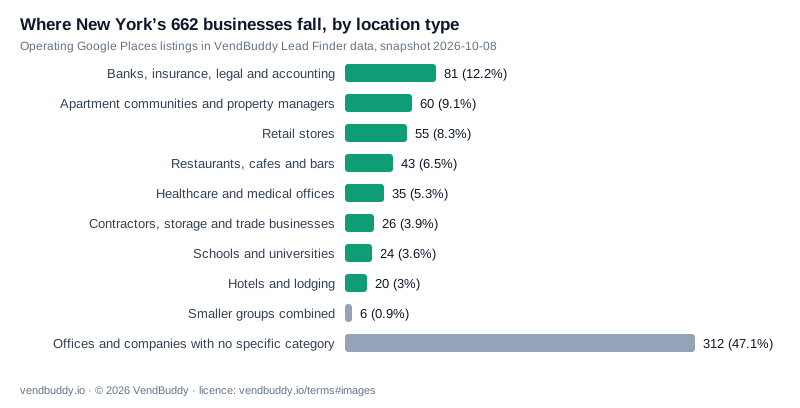
Banks, insurers and law or accounting firms are the largest named group among 662 operating New York businesses in our data, with 81 listings (12.2%). Apartment communities and property managers (60) and retail stores (55) follow, while 47% carry only a generic business tag, mostly offices.
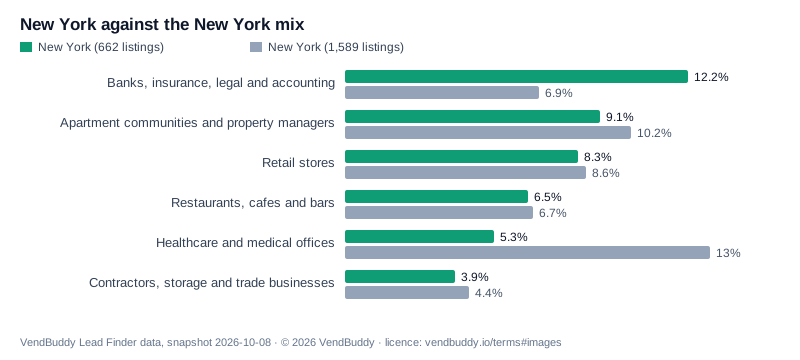
The clearest local tilt is toward banks, insurers and law or accounting firms, 5.3 points above the New York share; the biggest gap the other way is healthcare and medical offices, 7.7 points under it.
Google ratings put the middle New York business at 4.3 stars with 24 reviews; 133 of them are well-reviewed (4.5+, 10+ reviews), which is where an established break room is most likely.
Hours matter for vending: 30% of the 43 New York businesses that publish them run past 9 PM some night, less than the 31% state figure.
| Location type | Listings | Share | New York share |
|---|---|---|---|
| Banks, insurance, legal and accounting | 81 | 12.2% | 6.9% |
| Apartment communities and property managers | 60 | 9.1% | 10.2% |
| Retail stores | 55 | 8.3% | 8.6% |
| Restaurants, cafes and bars | 43 | 6.5% | 6.7% |
| Healthcare and medical offices | 35 | 5.3% | 13% |
| Contractors, storage and trade businesses | 26 | 3.9% | 4.4% |
| Schools and universities | 24 | 3.6% | 3.4% |
| Hotels and lodging | 20 | 3% | 2% |
| Smaller groups combined | 6 | 0.9% | 4.1% |
| Offices and companies with no specific category | 312 | 47.1% | 40.8% |
| Total operating listings | 662 | 100% | 1,589 listings |
How we counted: Google Places listings that VendBuddy’s Lead Finder looked up between May and October 2026 with a New York, NY address, de-duplicated by place ID, operating businesses only, grouped by their Google category. Groups under 5 listings are combined. This is the sample our users searched, not a census of every business. Snapshot 2026-10-08.
Rules before you place a machine: New York vending hub (state permits and sales tax), and the state-by-state vending laws reference.
What the New York numbers mean for operators and building owners
The market read
A workable market if you choose the venue type first. Roughly 72% of the named New York listings are in groups rated primary or good for a snack and drink machine, behind 74% across New York, so the list needs a filter before the first call rather than a blanket mail-out. Evening trade sits in the middle, with 30% of listings open past 9 PM (New York: 31%); a mixed route of daytime offices and a few late sites fits that profile. With 662 listings behind it, New York is one of the deeper city samples in our data, so the shares above are steady.
If you own or manage an office building in New York: 81 banks, insurers and law or accounting firms came up in the Lead Finder searches vending operators ran here (12.2% of the sample, well above the 6.9% New York share), so operators are already looking at offices like yours. The machines the fit matrix rates primary for this kind of site are snacks and drinks, smart coolers, micro markets and coffee. In the standard arrangement the operator buys, stocks and services the machine; tell us about the property and we pass it to an operator who covers New York, if one is in range. Ask for a free machine in New York →
Three venue types to target first in New York
Ranked by how many listings each type has here, how well a standard snack and drink machine suits it, and how over-represented it is against New York.
- Banks, insurance, legal and accounting: 81 listings, 12.2% of the New York sample. That is 1.8 times the New York share of 6.9%. Snack and drink fit: primary (steady daily headcount, nothing to eat nearby while on shift). Rated primary: snacks and drinks, smart coolers, micro markets and coffee.
- Apartment communities and property managers: 60 listings, 9.1% of the New York sample. Close to the New York share of 10.2%. Snack and drink fit: primary (residents want a late-night grab with no store run). Rated primary: snacks and drinks, smart coolers, water vending and pet supplies.
- Hotels and lodging: 20 listings, 3% of the New York sample. That is 1.5 times the New York share of 2%. Snack and drink fit: primary (steady daily headcount, nothing to eat nearby while on shift). Rated primary: snacks and drinks, AI smart machines, smart coolers and massage chairs.
New York rules that apply to a machine in New York
Tobacco and vape vending in New York (N.Y. Public Health Law § 1399-dd, checked 2026-10-01): Tobacco and e-cigarette machines are allowed only in listed restricted locations, such as bars, private clubs and supervised non-public workplaces. The rule reaches vapes and e-liquids as well as tobacco, so a vape machine in New York is held to it.
On top of that, federal rules (21 CFR 1140.14(b)(3) and 1140.16(c)(2)(ii)) allow tobacco and e-cigarette vending only where no one under 21 is present or allowed in.
Snack, drink and coffee machines carry none of that. Their paperwork is the sales tax and permit rules in the New York licensing section below and the New York vending hub.
How New York compares with nearby markets
- Springfield, MA (124 miles away): The mix tilts differently: healthcare and medical offices lead with 17.4% of 333 listings, where New York has 5.3%.
- Woodbridge, VA (225 miles away): The mix tilts differently: healthcare and medical offices lead with 29% of 176 listings, where New York has 5.3%. Fewer listings stay open late (24% past 9 PM, 30% here).
- Richmond, VA (288 miles away): The mix tilts differently: healthcare and medical offices lead with 12.2% of 189 listings, where New York has 5.3%. More of that sample stays open late (57% past 9 PM, 30% here).
Is New York a good place to start a vending machine business?
Yes, with one condition: New York rewards district selection more than raw hustle. The New York, NY metro carries about 700,000 establishments across roughly 20M residents — about 35 business establishments per 1,000 people, right around the roughly 30-per-1,000 national figure, so route quality comes down to which districts you pick. Median household income is $83,000, comfortably above the roughly $75,000 U.S. median, and that number decides more than any other whether a $2.25–$2.75 price point holds or you have to run value pricing to keep vend counts up. Manhattan office leasing swung hard back in 2025–2026 — downtown leasing ran up roughly 138% year over year through mid-2026 and Hudson Yards absorbed the largest single lease since the pandemic — while outer-borough industrial vacancy hit a decade high near 6.4% in late 2025 even as genuine last-mile infill space stayed under 5%. On the supply side, Manhattan south of 59th Street is the most heavily covered vending geography in the country; the Maspeth / Long Island City / Sunset Park last-mile belt is thin enough that many buildings have no machine at all.
Demand here concentrates in Healthcare and Hospital Systems, Finance and Insurance, Last-Mile Logistics and Freight, Higher Education and Research and Media and Professional Services, led by Hospital Systems — and those workers sit in identifiable places, not spread evenly across the metro. The 5 districts mapped below (Hudson Yards and Midtown West; Financial District and Lower Manhattan; Maspeth, Long Island City and the Queens freight belt; Sunset Park, Red Hook and the Brooklyn waterfront; Hunts Point and the South Bronx) are where the captive headcount actually is. Budget for 0–15% of gross in commission — commission expectations run rich, so the split is the deal here, not the product mix. Sales tax on vends runs 8.875%. One local wrinkle to plan around: check the property-level rules before you install.
The catch: Compass Group, Canteen, Aramark and Sodexo hold the hospital systems, the university dining contracts and effectively every Class A Manhattan tower with a managed amenity program. That is the shape of every market this size — the marquee accounts are contracted, and the money for an independent operator is one tier down, in the buildings next door to them.
| Signal | New York | National reference |
|---|---|---|
| Metro population | ~20M | — |
| Business establishments | ~700,000 | — |
| Establishments per 1,000 residents | 35 | ~30 |
| Median household income | $83,000 | ~$75,000 |
| Commission expectation | 0–15% of gross | 10–15% typical |
| Sales tax on vended goods | 8.875% | varies by state |
| Demand sectors driving placements | Healthcare and Hospital Systems, Finance and Insurance, Last-Mile Logistics and Freight, Higher Education and Research and Media and Professional Services | — |
| Placement districts mapped below | 5 | — |
Is New York a good area to start a vending machine business?
Yes, with one condition: New York rewards district selection more than raw hustle. New York carries ~700,000 establishments across a 20M metro — about 35 establishments per 1,000 residents, right around the roughly 30-per-1,000 national figure, so route quality comes down to which districts you pick. Median household income is $83,000, comfortably above the roughly $75,000 U.S. median. Start in Hudson Yards and Midtown West, then Financial District and Lower Manhattan — both are broken out below with named placement targets. The honest constraint: Compass Group, Canteen, Aramark and Sodexo hold the hospital systems, the university dining contracts and effectively every Class A Manhattan tower with a managed amenity program.
Can I start a vending machine business in New York?
Yes. New York issues no state vending operator license. An operator registers a Certificate of Authority with the Department of Taxation and Finance, collects state plus local sales tax where the item is taxable, and meets the food handler expectations of the health authority covering the placement — in the five boroughs that is the NYC Department of Health and Mental Hygiene rather than a county department. Packaged snack and beverage machines inside private buildings do not draw a city license. Sales tax on vended goods: 8.875% in all five boroughs — 4% state, 4.5% New York City and 0.375% for the Metropolitan Commuter Transportation District. Westchester runs about 8.375%, Nassau and Suffolk about 8.625%, so a route crossing the city line changes the rate. Bottle deposits are excluded when testing an item against the vending exemption thresholds. Food handler rules and the local permit quirks are broken out in full further down this page. No NY statute blocks a new operator from placing machines in New York — the real barrier is placement access, not paperwork.
How much do vending machines make in New York?
There is no city-level vending revenue dataset for New York, and any specific New York figure you see quoted is an estimate dressed up as data. What operators report nationally: a healthy snack and drink placement grosses roughly $150–$400 per machine per month, low-traffic placements sit at $75–$150, and high-density captive placements (24/7 warehouses, hospital night shift, 200-plus-person offices) clear $400–$700 or more. Gross margin lands near 50–55% before commission. Demand signals in New York point toward the upper half of that band: median household income is $83,000, demand concentrates in Healthcare and Hospital Systems, Finance and Insurance, Last-Mile Logistics and Freight, Higher Education and Research and Media and Professional Services, and commission expectations run rich, so the split is the deal here, not the product mix at 0–15% of gross. Model your own stops with the free route valuation calculator.
Two free tools do the two jobs this page cannot: one ranks the ZIPs, the other prices a deal. Neither needs an account.
New York Vending Market Overview
New York, NY is a market where Manhattan office leasing swung hard back in 2025–2026 — downtown leasing ran up roughly 138% year over year through mid-2026 and Hudson Yards absorbed the largest single lease since the pandemic — while outer-borough industrial vacancy hit a decade high near 6.4% in late 2025 even as genuine last-mile infill space stayed under 5%. The metro contains roughly 700,000 establishments at a median household income of $83,000, and Manhattan south of 59th Street is the most heavily covered vending geography in the country; the Maspeth / Long Island City / Sunset Park last-mile belt is thin enough that many buildings have no machine at all. The implication for a new or scaling operator: the prospecting addressable market is large, the per-machine economics support a real business, and the gap between operator coverage and underlying demand is real enough that it shows up in routing math, not just marketing copy.
The four sectors that drive vending demand in New York are Healthcare and Hospital Systems, Finance and Insurance, Last-Mile Logistics and Freight, Higher Education and Research, Media and Professional Services. Each has its own access pattern (badge-required vs. open lobby), break-room culture (catered vs. dependent on vending), and product-mix expectation (premium vs. value). The sections below break each down with named employers and the placement targets that actually convert.
Before you commit to a route in New York, work through our location scoring checklist on a sample location — it will save you the cost of a bad first placement, which is usually a year of revenue. If you are still pre-launch, our guide to starting a vending machine business walks through the entity setup, financing, and machine sourcing that comes before the prospecting phase.
Top Industries Driving Vending Demand in New York
The four industries below account for the bulk of high-revenue vending placements in New York, NY. The named employers are anchor tenants — large, captive workforces that drive the local property managers' decisions about whether to install vending at all. Reading these in order also tells you what kind of operator wins which placement: the apparel of a healthcare-pitch deck looks nothing like the apparel of an aerospace-pitch deck, and matching the fit matters more than commission percentage.
Hospital Systems
Northwell Health is the state's largest private employer at over 100,000 people across 28 hospitals and roughly a thousand outpatient sites, headquartered in New Hyde Park rather than Manhattan. NewYork-Presbyterian runs Weill Cornell at 525 East 68th Street, the Columbia campus in Washington Heights, plus Lower Manhattan and Queens. Mount Sinai carries roughly 48,000 people. Inpatient towers are concession-locked, but the outpatient and medical-office satellites those systems keep opening across Queens, Brooklyn and Westchester are leased, fragmented and reachable one landlord at a time.
Last-Mile Logistics and Freight
Maspeth in Queens holds the JFK-adjacent freight forwarder and customs brokerage cluster along with the 1.1 million square foot Grand Logistics Center on Grand Avenue. Amazon's JFK8 at 546 Gulf Avenue on Staten Island runs 855,000 square feet with more than 5,000 workers. Hunts Point in the Bronx moves the region's perishables overnight. These are night-shift buildings with no cafeteria and no nearby storefront open at 3 a.m., which is the single most reliable revenue-per-machine condition in the five boroughs.
Finance and Insurance
JPMorgan Chase, Goldman Sachs, Citigroup, BlackRock and Wells Fargo anchor the Financial District and the Midtown-to-Hudson-Yards spine. BlackRock, KKR, Point72 and Wells Fargo sit inside Hudson Yards itself. Trading floors and executive floors are amenity-catered and closed to outside machines, but the back-office and compliance floors these firms lease in Class B stock along Water Street, Broad Street and Third Avenue frequently have nothing but a broken coffee brewer.
Media and Professional Services
Warner Bros. Discovery, L'Oréal and Tapestry sit in Hudson Yards; Deloitte committed to 807,000 square feet at 70 Hudson Yards in 2025, the largest New York lease since the pandemic. Bloomberg anchors Midtown East near Grand Central. Post-production houses, agencies and law firms occupy hundreds of mid-size floors across Midtown South and Chelsea where headcount is under 200 and no national operator has bothered to bid.
For deeper revenue benchmarks by location type — apartment vs. warehouse vs. medical vs. office — see our vending machine income data and the vending costs and profit breakdown. Both are continuously updated from operator surveys.
Best Placement Districts in New York
The districts below are ranked by daytime worker density and operator-coverage gap, not just by population. A district with 50,000 office workers and three national operators competing already may be a worse target than a district with 20,000 office workers and zero operator presence. New York has a few of each — the named placement targets in each card are the actual employers and properties to prospect, not generic industry categories.
Hudson Yards and Midtown West
The one Manhattan submarket where net absorption actually went positive. BlackRock, KKR, Wells Fargo, Tapestry, Warner Bros. Discovery, L'Oréal and Point72 anchor the towers, with Deloitte's 70 Hudson Yards commitment landing in 2028. Rents near $85 per square foot mean tenants expect a premium mix and cashless hardware, and building ownership controls access tightly.
Named placement targets: the mid-floor tenants and shared amenity floors at 55 and 66 Hudson Yards, the Manhattan West tenant roster, the Hudson Yards construction and facilities contractor trailers, plus the Tenth Avenue back-office floors that spill out of the towers
Financial District and Lower Manhattan
Downtown leasing surged roughly 138% year over year through mid-2026, much of it tenants trading up from Midtown at a discount. The result is a wave of freshly signed leases in older Water Street and Broad Street stock where the previous vending contract lapsed when the building half-emptied.
Named placement targets: the newly leased Water Street and Broad Street floors, the Fulton Center and Brookfield Place back-of-house tenants, NewYork-Presbyterian Lower Manhattan's adjacent medical offices at 170 William Street, plus the municipal and agency floors around Broadway
Maspeth, Long Island City and the Queens freight belt
JFK-adjacent customs brokers, freight forwarders and cold storage, plus the 1.1 million square foot Grand Logistics Center on Grand Avenue and Long Island City's mix of converted industrial and new office. Night and swing shifts run continuously and the nearest open storefront is often a mile away.
Named placement targets: the Grand Avenue freight forwarder and customs brokerage offices, the Maspeth cold-storage operators, the Long Island City creative and light-manufacturing tenants along Jackson Avenue, plus the Northern Boulevard auto and trade shops
Sunset Park, Red Hook and the Brooklyn waterfront
Industry City and the Brooklyn Army Terminal converted millions of square feet of waterfront industrial into a mix of maker tenants, e-commerce fulfillment and studio space. Red Hook holds direct-to-consumer fulfillment operators. Tenant counts are high and average tenant size is small, which is exactly the shape national operators skip.
Named placement targets: the Industry City maker and e-commerce tenants, the Brooklyn Army Terminal light-industrial roster, the Red Hook direct-to-consumer fulfillment floors, plus the Third Avenue auto and trade corridor under the Gowanus Expressway
Hunts Point and the South Bronx
The Hunts Point Cooperative Market and Produce Market run overnight and feed the region's restaurants. Around them sits a dense belt of trucking, refrigerated warehousing and food processing. Shift start times of 1 a.m. to 4 a.m. make this the most food-desert-like commercial geography in the city.
Named placement targets: the Hunts Point produce and meat market tenant operators, the Bruckner Boulevard trucking and refrigerated warehouse yards, the Port Morris light-industrial tenants, plus the Montefiore-adjacent medical offices along Westchester Avenue
Want the list built for you? Pick one New York ZIP and VendBuddy delivers the 50 best-scored locations in it, enriched with the best contact on file, automatically, for $97 once.
If you are weighing whether a specific building inside one of these districts is worth pursuing, run it through our location scoring checklist first. It catches the bad-fit placements (low captive headcount, restricted access hours, existing operator relationship) before you waste a pitch on them.
NY Licenses, Permits, and Sales Tax for Vending in New York
New York issues no state vending operator license. An operator registers a Certificate of Authority with the Department of Taxation and Finance, collects state plus local sales tax where the item is taxable, and meets the food handler expectations of the health authority covering the placement — in the five boroughs that is the NYC Department of Health and Mental Hygiene rather than a county department. Packaged snack and beverage machines inside private buildings do not draw a city license.
Sales tax in New York: 8.875% in all five boroughs — 4% state, 4.5% New York City and 0.375% for the Metropolitan Commuter Transportation District. Westchester runs about 8.375%, Nassau and Suffolk about 8.625%, so a route crossing the city line changes the rate. Bottle deposits are excluded when testing an item against the vending exemption thresholds.
Local permits and licenses: The DCWP General Vendor and Mobile Food Vending licenses that dominate search results govern sidewalk carts and tables, not machines on private property — operators routinely waste weeks chasing the wrong application. Fresh-food machines, refrigerated meal machines and micro markets are the exception: those require a NYC Department of Health and Mental Hygiene food service establishment permit, roughly $300, and a certified Food Protection Certificate holder attached to the operation. Separately, federal FDA calorie-disclosure rules attach once an operator runs 20 or more machines nationally.
Vending tax thresholds: New York's vending rule is a hard price cliff, not a percentage. Candy, soft drinks and bottled water are exempt at $1.50 or less from a machine taking only cash and coin, and at $2.00 or less from a machine that also takes cards. Price a card-reader machine's energy drink at $2.00 and you keep the whole two dollars; price it at $2.25 and 8.875% attaches. Hot coffee, tea and cocoa are exempt at any price. Sandwiches and anything heated are always taxable.
Every researched NY market, plus the state rules in one place: our NY vending hub.
State-by-state vending laws — including license thresholds, sales tax, and food handler requirements — are summarized in our vending laws reference. If you are forming an LLC for the route, our LLC setup and tax deductions guide covers the federal and state-level deductions specific to vending operators.
Commission Rates and Negotiation in New York
Typical commission range in New York: 0–15% of gross.
Manhattan Class A ownership in Hudson Yards, Midtown and the Financial District asks 12–15% and will hold that line because the queue behind you is long. Class B floors downtown settle nearer 8–10%. Outer-borough industrial in Maspeth, Sunset Park and Hunts Point takes 0–5% and frequently zero, because the operator who reliably shows up at 5 a.m. is worth more than a revenue share. The real New York cost line is not commission at all — it is the certificate of insurance a Manhattan managing agent demands, often naming multiple ownership entities at limits well above what a small operator's default policy carries, plus loading-dock and freight-elevator scheduling that can burn a half day per service visit.
Use our vending commission rates by location type for the full negotiation rubric (when to walk, when to counter with product credit, when to accept and renegotiate at renewal). The negotiating vending placements covers the actual scripts.
VendBuddy shows the best contact on file for the properties in this guide (owner or manager when available), with the emails and phone numbers we can find. Plus the contract generator, ROI calculator, and placement scoring tools you need to close.
Launch VendBuddy Free →A 3-Day Starter Route in New York
If you are dropping into New York for the first time and want to walk out with a real prospect list in 72 hours, this is the route experienced operators use. It groups districts by drive efficiency rather than by industry — you cover the most square footage with the fewest miles, which matters more in week one than perfect target prioritization.
Targets: the Grand Avenue customs brokerage and freight forwarder offices, the Maspeth cold-storage operators, the Grand Logistics Center tenant roster, plus the Long Island City light-manufacturing floors
Field note: Start at 6 a.m. and catch shift change. These decision makers are operations managers standing on a dock, not office services coordinators, and they will say yes or no inside four minutes. Bring a service-frequency commitment, not a product catalog.
Targets: the newly signed Water Street and Broad Street tenants, the Brookfield Place and Fulton Center back-of-house occupiers, plus the municipal and agency floors near Broadway
Field note: Pull the recent lease-signing announcements before you walk. A tenant that took space in the last twelve months has no incumbent and an unspent fit-out budget, which is the only condition under which a Manhattan managing agent will let a new vendor into the building.
Targets: the Industry City maker and e-commerce roster, the Brooklyn Army Terminal tenants, the Red Hook fulfillment floors, plus the Third Avenue trade corridor
Field note: One leasing office controls dozens of tenants in each complex. Book with the property management team rather than door-knocking tenant by tenant — a single conversation at Industry City can unlock more placements than a week of cold calls in Manhattan.
Targets: the Hunts Point Cooperative Market operators, the Bruckner Boulevard trucking yards, plus the Port Morris industrial tenants
Field note: Run this one between midnight and 6 a.m. — the buyers you need are on the floor then and unreachable during business hours. Stock heavy on hot beverages and high-calorie savory; this shift is not buying a protein bar.
For the cold-email cadence to send the same evening, see our cold email scripts for property managers. The first email goes out within 24 hours of a pop-in; the second 5–7 days later. Operators who skip the same-day follow-up close at roughly half the rate of operators who do not.
Competition and Underserved Pockets in New York
Compass Group, Canteen, Aramark and Sodexo hold the hospital systems, the university dining contracts and effectively every Class A Manhattan tower with a managed amenity program. A second tier of long-established New York independents — many family-run for three generations — holds the Class B office stock and the outer-borough industrial accounts, and they compete on service response time rather than price. The genuine barrier for a newcomer is not those incumbents. It is building access: a Manhattan managing agent will demand a certificate of insurance naming several ownership and management entities at limits a first-year operator usually cannot produce, and loading-dock rules plus unionized building service staffing turn a fifteen-minute restock into a half-day appointment. That barrier is why Maspeth, Hunts Point, Red Hook and the Bronx industrial belt stay open — those landlords want a signed COI and nothing more.
The lesson, in New York as in every other Tier-1 metro: the high-revenue marquee accounts (Fortune 500 HQs, flagship hospitals, university dining contracts) are locked under multi-year national contracts with Canteen, Five Star, Compass, or Aramark. The opportunity for an independent or regional operator is the second tier — the Class B office down the street, the medical office building two doors down from the main hospital, the apartment leasing office three blocks from a Whole Foods. Those are accessible, profitable, and almost always underserved.
Vending Machine Companies in New York, NY
If you manage a property in New York and want a machine placed, you do not pay for it — the operator buys, stocks, and services the machine and earns from what sells. Instead of calling companies one by one, submit the two-minute request at vendbuddy.io/property-managers and it gets routed to independent operators working the New York area; at most two receive it, and the first to claim it contacts you. How placement deals work, what commission is normal, and the national-versus-local trade-off are all in vending machine companies near me.
New York Vending FAQ
Do I need a vending machine license in New York City?
For packaged snacks and sealed beverages in a machine inside a private building, no city vending license applies. The DCWP General Vendor and Mobile Food Vending licenses that come up first in search results regulate sidewalk carts and tables. What you do need is a New York State Certificate of Authority for sales tax. The picture changes for fresh-food machines and micro markets, which require a Department of Health and Mental Hygiene food service permit and a certified Food Protection Certificate holder.
What sales tax do I charge on vending machine sales in New York City?
The combined rate is 8.875% across all five boroughs, made up of 4% state, 4.5% city and 0.375% for the Metropolitan Commuter Transportation District. But the vending rule is a threshold, not a flat charge: candy, soft drinks and bottled water are exempt at $1.50 or less in a cash-and-coin-only machine and at $2.00 or less in a card-accepting machine. Hot coffee, tea and cocoa are exempt at any price, while sandwiches and heated food are always taxable. Cross into Westchester or Nassau and the rate changes.
How much do vending machines make in New York City?
Revenue here is driven by three things and none of them is the borough: captive headcount within sight of the machine, how far the nearest open storefront is, and whether the building runs a second or third shift. A machine on a Midtown office floor competes with a deli on every corner; the same machine in a Maspeth cold-storage facility at 3 a.m. competes with nothing. Manhattan placements also carry higher costs — insurance limits, dock fees and service time lost to freight scheduling — so gross per machine and net per machine can point in opposite directions.
Where are the best vending opportunities in New York City right now?
The last-mile industrial belt: Maspeth's freight forwarder and customs cluster, Sunset Park's Industry City and Brooklyn Army Terminal tenants, Red Hook fulfillment, and the Hunts Point overnight markets. All of them combine round-the-clock shifts with genuinely absent food retail. Secondarily, the newly signed downtown leases — Lower Manhattan leasing ran up roughly 138% year over year through mid-2026 and those tenants moved into buildings whose vending contracts lapsed years ago.
Can I put a vending machine in a New York City hospital?
Inside the inpatient towers, no — Northwell, NewYork-Presbyterian and Mount Sinai run system-wide food service contracts through national operators, and those cover machine placement. The accessible layer is the ambulatory and specialist real estate those systems keep expanding into: leased medical office floors on York and Madison Avenues, ambulatory surgery centers, and the practices that relocated after Mount Sinai Beth Israel closed in 2025. Those decisions sit with individual practice administrators.
Essential Vending Guides
Other New York and New Jersey metropolitan vending markets: Bridgeport, CT · Bronx, NY
General information, not legal, tax or financial advice. Rules change, so check the official source. Revenue and income figures are examples, not promises. See our terms.