The Bronx is the only New York City borough attached to the mainland, and for a route operator that is not trivia — it means everything can be serviced by van without a bridge toll or a tunnel queue if you base yourself right. It holds roughly 1.4 million people, more than Philadelphia, at a household median near $49,000, the lowest of the five boroughs. The economic weight sits in institutions that cannot relocate: the Montefiore and NYC Health + Hospitals campuses, Fordham and Lehman and half a dozen other colleges, the courts on the Grand Concourse, and Co-op City, which houses more people than most American cities on its own.
- Vending locations in Bronx: what the data shows
- What the Bronx numbers mean for operators and building owners
- Is Bronx a good place to start a vending machine business?
- Bronx Vending Market Overview
- Top Industries Driving Vending Demand in Bronx
- Best Placement Districts in Bronx
- NY Licenses, Permits, and Sales Tax for Vending in Bronx
- Commission Rates and Negotiation in Bronx
Free to search. 5 free contact reveals, no card.
Property owners and managers: tell us about the site and we pass it to an operator who covers Bronx, if one is in range.
Request a free machine →- Bronx County counted 1,472,654 residents at the 2020 census, with recent American Community Survey estimates near 1.42 million and a household median income around $49,000 — the lowest of the five boroughs.
- Every placement carries the New York City combined rate of 8.875 percent, half a point above Westchester, so a route that reaches north into Mount Vernon or New Rochelle changes rate at the county line.
- Healthcare and higher education are the borough's two immovable employers: Montefiore, Jacobi, Lincoln, North Central Bronx and SBH Health System on one side, Fordham, Lehman, Bronx Community College, Hostos, SUNY Maritime and Manhattan University on the other.
- Co-op City in the northeast is among the largest cooperative housing developments anywhere, with roughly three dozen towers and its own building services workforce, community centres and power operation.
- New York licenses no vending trade, but New York City adds a municipal health layer the rest of the state does not have, so classification of your machines with the Department of Health and Mental Hygiene comes before installation.
- About 7,000 acres of parkland sit inside the borough, including Pelham Bay Park, Van Cortlandt Park, the Bronx Zoo and the New York Botanical Garden, all of which employ year-round staff on seasonal peaks.
Free tools: vending ROI calculator · revenue calculator by property type · route time calculator · State of Vending 2026 report · all free tools
- Is Bronx a good place to start a vending machine business?
- Bronx Vending Market Overview
- Top Industries Driving Vending Demand
- Best Placement Districts in Bronx
- NY Licenses, Permits, and Sales Tax
- Commission Rates and Negotiation
- 3-Day Starter Route in Bronx
- Competition and Underserved Pockets
- Bronx Vending FAQ
Vending locations in Bronx: what the data shows
Start with the count: 241 active listings. Healthcare and medical offices make up 24.1% (58), retail stores 9.5% (23) and restaurants and cafes 9.1% (22); generic office and service firms fill 33%.
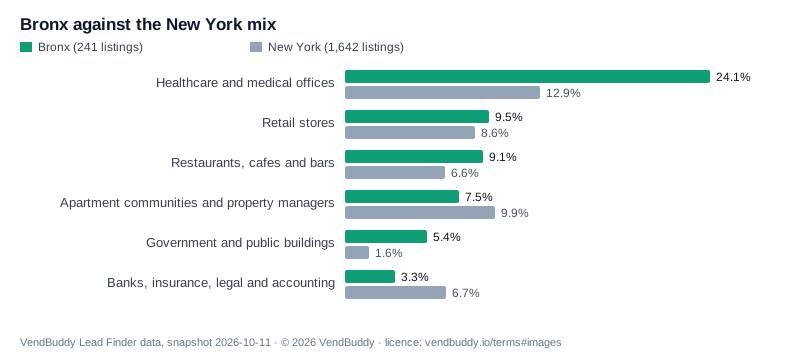
Compared with 1,642 New York listings, healthcare and medical offices are the over-represented group here (24.1% versus 12.9%). Banks, insurers and law or accounting firms trail the state mix, 3.3% to 6.7%.
Quality signal: 24% of listings pair a 4.5+ rating with at least ten reviews, and the median score of 4.2 is below New York’s 4.3.
For night-shift placements, 50% is the number to know, the share of Bronx listings with posted hours (52) that stay open beyond 9 PM; statewide it is 29%.
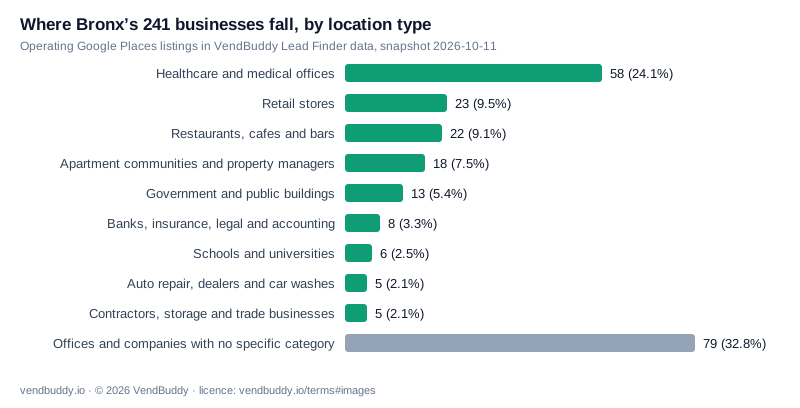
| Location type | Listings | Share | New York share |
|---|---|---|---|
| Healthcare and medical offices | 58 | 24.1% | 12.9% |
| Retail stores | 23 | 9.5% | 8.6% |
| Restaurants, cafes and bars | 22 | 9.1% | 6.6% |
| Apartment communities and property managers | 18 | 7.5% | 9.9% |
| Government and public buildings | 13 | 5.4% | 1.6% |
| Banks, insurance, legal and accounting | 8 | 3.3% | 6.7% |
| Schools and universities | 6 | 2.5% | 3.5% |
| Auto repair, dealers and car washes | 5 | 2.1% | 2.1% |
| Contractors, storage and trade businesses | 5 | 2.1% | 5.1% |
| Offices and companies with no specific category | 79 | 32.8% | 40.9% |
| Total operating listings | 241 | 100% | 1,642 listings |
How we counted: Google Places listings that VendBuddy’s Lead Finder looked up between May and October 2026 with a Bronx, NY address, de-duplicated by place ID, operating businesses only, grouped by their Google category. Groups under 5 listings are combined. This is the sample our users searched, not a census of every business. Snapshot 2026-10-11.
Rules before you place a machine: New York vending hub (state permits and sales tax), and the state-by-state vending laws reference.
What the Bronx numbers mean for operators and building owners
The market read
A workable market if you choose the venue type first. Roughly 72% of the named Bronx listings are in groups rated primary or good for a snack and drink machine, behind 74% across New York, so the list needs a filter before the first call rather than a blanket mail-out. After-hours traffic stands out: 50% of the listings that publish hours keep going past 9 PM (New York: 29%), which favours sites that are open, and staffed, around the clock.
If you own or manage a clinic, hospital or medical office in Bronx: 58 healthcare and medical offices came up in the Lead Finder searches vending operators ran here (24.1% of the sample, well above the 12.9% New York share), so operators are already looking at medical sites like yours. The machines the fit matrix rates primary for this kind of site are snacks and drinks, smart coolers, coffee and hot food. In the standard arrangement the operator buys, stocks and services the machine; tell us about the property and we pass it to an operator who covers Bronx, if one is in range. Ask for a free machine in Bronx →
Three venue types to target first in Bronx
Ranked by how many listings each type has here, how well a standard snack and drink machine suits it, and how over-represented it is against New York.
- Healthcare and medical offices: 58 listings, 24.1% of the Bronx sample. That is 1.9 times the New York share of 12.9%. Snack and drink fit: primary (steady daily headcount, nothing to eat nearby while on shift). Rated primary: snacks and drinks, smart coolers, coffee and hot food.
- Government and public buildings: 13 listings, 5.4% of the Bronx sample. That is 3.3 times the New York share of 1.6%. Snack and drink fit: primary (steady daily headcount, nothing to eat nearby while on shift). Rated primary: snacks and drinks, micro markets, coffee and hot food.
- Apartment communities and property managers: 18 listings, 7.5% of the Bronx sample. The type is less common here than statewide (9.9%), so each one is a scarcer target. Snack and drink fit: primary (residents want a late-night grab with no store run). Rated primary: snacks and drinks, smart coolers, water vending and pet supplies.
New York rules that apply to a machine in Bronx
Tobacco and vape vending in New York (N.Y. Public Health Law § 1399-dd, checked 2026-10-01): Tobacco and e-cigarette machines are allowed only in listed restricted locations, such as bars, private clubs and supervised non-public workplaces. The rule reaches vapes and e-liquids as well as tobacco, so a vape machine in Bronx is held to it.
On top of that, federal rules (21 CFR 1140.14(b)(3) and 1140.16(c)(2)(ii)) allow tobacco and e-cigarette vending only where no one under 21 is present or allowed in.
Snack, drink and coffee machines carry none of that. Their paperwork is the sales tax and permit rules in the Bronx licensing section below and the New York vending hub.
Is Bronx a good place to start a vending machine business?
A qualified yes — Bronx works, but only for an operator who plans the route before buying the first machine. The Bronx, NY metro carries about 25,000 establishments, dominated by healthcare, education, social assistance, retail and food service rather than corporate office tenancy across roughly 1.4M residents — about 17.6 business establishments per 1,000 people, below the roughly 30-per-1,000 national figure, which means fewer doors per mile and a route that has to be planned rather than wandered into. Median household income is ~$49,000 household median with a per-capita figure near $27,000, which puts real downward pressure on acceptable price points across most of the borough, under the roughly $75,000 U.S. median, and that number decides more than any other whether a $2.25–$2.75 price point holds or you have to run value pricing to keep vend counts up. The story is institutional expansion and waterfront-adjacent residential development rather than corporate relocation — the health systems and universities have been the borough's growth engine for two decades and continue to add buildings. On the supply side, the large hospital and campus interiors are contracted; independently leased medical suites, the office park tenants, cooperative and residential building operations and the small institutional support buildings are inconsistently served.
Demand here concentrates in Academic Medicine and Hospital Systems, Higher Education, Senior Care and Social Assistance, Courts and Municipal Government and Residential Building Services, led by Academic Medicine and Research — and those workers sit in identifiable places, not spread evenly across the metro. The 5 districts mapped below (Fordham Road, Belmont and Rose Hill; Morris Park and Pelham Parkway; Co-op City and Baychester; The 161st Street civic corridor; Riverdale and Kingsbridge) are where the captive headcount actually is. Budget for 0–10% of gross in commission — commission expectations are operator-friendly by national standards. Sales tax on vends runs 8.875%. One local wrinkle to plan around: check the property-level rules before you install.
The catch: National operators run the Bronx, but they run the parts of it that look like the rest of their book: the large hospital campuses under health-system agreements, the college dining operations, the biggest retail anchors. That is the shape of every market this size — the marquee accounts are contracted, and the money for an independent operator is one tier down, in the buildings next door to them.
| Signal | Bronx | National reference |
|---|---|---|
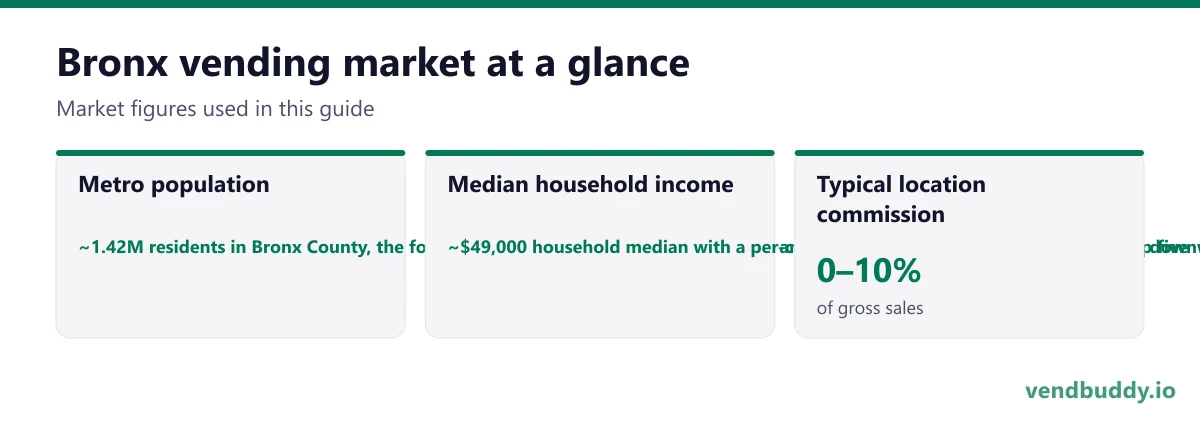
| Metro population | ~1.42M residents in Bronx County, the fourth-most populous of the five boroughs and larger than every US city except the top five | — |
| Business establishments | ~25,000 establishments, dominated by healthcare, education, social assistance, retail and food service rather than corporate office tenancy | — |
| Establishments per 1,000 residents | 17.6 | ~30 |
| Median household income | ~$49,000 household median with a per-capita figure near $27,000, which puts real downward pressure on acceptable price points across most of the borough | ~$75,000 |
| Commission expectation | 0–10% of gross | 10–15% typical |
| Sales tax on vended goods | 8.875% | varies by state |
| Demand sectors driving placements | Academic Medicine and Hospital Systems, Higher Education, Senior Care and Social Assistance, Courts and Municipal Government and Residential Building Services | — |
| Placement districts mapped below | 5 | — |
Is Bronx a good area to start a vending machine business?
A qualified yes — Bronx works, but only for an operator who plans the route before buying the first machine. Bronx carries ~25,000 establishments, dominated by healthcare, education, social assistance, retail and food service rather than corporate office tenancy across a 1.4M metro — about 17.6 establishments per 1,000 residents, below the roughly 30-per-1,000 national figure, which means fewer doors per mile and a route that has to be planned rather than wandered into. Median household income is ~$49,000 household median with a per-capita figure near $27,000, which puts real downward pressure on acceptable price points across most of the borough, under the roughly $75,000 U.S. median. Start in Fordham Road, Belmont and Rose Hill, then Morris Park and Pelham Parkway — both are broken out below with named placement targets. The honest constraint: National operators run the Bronx, but they run the parts of it that look like the rest of their book: the large hospital campuses under health-system agreements, the college dining operations, the biggest retail anchors.
Can I start a vending machine business in Bronx?
Yes. New York State licenses no vending occupation. The registration you cannot operate without is a Certificate of Authority from the Department of Taxation and Finance, which is what permits you to collect and remit sales tax in the first place. New York City then adds a layer the rest of the state does not: food premises permitting for all five boroughs runs through the Department of Health and Mental Hygiene, and machines dispensing potentially hazardous food are treated very differently from equipment holding only sealed shelf-stable snacks and bottled drinks. Get your specific configuration classified by DOHMH before installation, because the answer determines whether a city permit is involved at all. Note that street vending licences are a separate regime entirely and do not apply to machines placed inside private buildings. Sales tax on vended goods: 8.875 percent on every placement in the borough — New York's 4 percent state rate plus the city's 4.5 percent and the 0.375 percent Metropolitan Commuter Transportation District component. Unlike Westchester, there is no internal variation to track: the Bronx is one rate from Riverdale to Throggs Neck. The rate boundary that matters runs along the northern county line, where Mount Vernon and the rest of Westchester drop to roughly 8.375 percent while Yonkers stays at 8.875. One further piece of good news for a Bronx-based operator: the New York City commercial rent tax that catches Manhattan tenants applies only below 96th Street in Manhattan and never reaches this borough. Food handler rules and the local permit quirks are broken out in full further down this page. No NY statute blocks a new operator from placing machines in Bronx — the real barrier is placement access, not paperwork.
How much do vending machines make in Bronx?
There is no city-level vending revenue dataset for Bronx, and any specific Bronx figure you see quoted is an estimate dressed up as data. What operators report nationally: a healthy snack and drink placement grosses roughly $150–$400 per machine per month, low-traffic placements sit at $75–$150, and high-density captive placements (24/7 warehouses, hospital night shift, 200-plus-person offices) clear $400–$700 or more. Gross margin lands near 50–55% before commission. Demand signals in Bronx point toward the lower half of that band: median household income is ~$49,000 household median with a per-capita figure near $27,000, which puts real downward pressure on acceptable price points across most of the borough, demand concentrates in Academic Medicine and Hospital Systems, Higher Education, Senior Care and Social Assistance, Courts and Municipal Government and Residential Building Services, and commission expectations are operator-friendly by national standards at 0–10% of gross. Model your own stops with the free route valuation calculator.
Two free tools do the two jobs this page cannot: one ranks the ZIPs, the other prices a deal. Neither needs an account.
Bronx Vending Market Overview
Bronx, NY is a market where the story is institutional expansion and waterfront-adjacent residential development rather than corporate relocation — the health systems and universities have been the borough's growth engine for two decades and continue to add buildings. The metro contains roughly 25,000 establishments, dominated by healthcare, education, social assistance, retail and food service rather than corporate office tenancy at a median household income of ~$49,000 household median with a per-capita figure near $27,000, which puts real downward pressure on acceptable price points across most of the borough, and the large hospital and campus interiors are contracted; independently leased medical suites, the office park tenants, cooperative and residential building operations and the small institutional support buildings are inconsistently served. The implication for a new or scaling operator: the prospecting addressable market is large, the per-machine economics support a real business, and the gap between operator coverage and underlying demand is real enough that it shows up in routing math, not just marketing copy.
The four sectors that drive vending demand in Bronx are Academic Medicine and Hospital Systems, Higher Education, Senior Care and Social Assistance, Courts and Municipal Government, Residential Building Services. Each has its own access pattern (badge-required vs. open lobby), break-room culture (catered vs. dependent on vending), and product-mix expectation (premium vs. value). The sections below break each down with named employers and the placement targets that actually convert.
Before you commit to a route in Bronx, work through our location scoring checklist on a sample location — it will save you the cost of a bad first placement, which is usually a year of revenue. If you are still pre-launch, our guide to starting a vending machine business walks through the entity setup, financing, and machine sourcing that comes before the prospecting phase.
Top Industries Driving Vending Demand in Bronx
The four industries below account for the bulk of high-revenue vending placements in Bronx, NY. The named employers are anchor tenants — large, captive workforces that drive the local property managers' decisions about whether to install vending at all. Reading these in order also tells you what kind of operator wins which placement: the apparel of a healthcare-pitch deck looks nothing like the apparel of an aerospace-pitch deck, and matching the fit matters more than commission percentage.
Academic Medicine and Research
Morris Park is the densest concentration of medical employment in the borough, holding Albert Einstein College of Medicine, Montefiore's Einstein campus, Jacobi Medical Center and Calvary Hospital within a short walk of each other, with the Hutchinson Metro Center office complex on Waters Place absorbing the administrative and clinical-support overflow. Hospital interiors run under system-level agreements. What sits outside them is substantial: research and administrative buildings, independently leased specialist suites, clinical trial and imaging operations, and the staffing agencies that supply all of it. Overnight and weekend staffing is continuous and on-site food service is not.
Higher Education
Few American counties hold this many campuses. Fordham's Rose Hill campus in Belmont, Lehman College in Bedford Park, Bronx Community College on the University Heights bluff, Hostos in the south, SUNY Maritime at Fort Schuyler and Manhattan University in Riverdale each run their own dining contracts, which an independent will not displace. The reachable market is the same at every one: physical plant and facilities operations, athletics and grounds crews, administrative annexes off the main campus, and the privately owned buildings around the perimeter that lease to student-serving businesses. Campus support staff work summers and evenings when dining is closed.
Senior Care and Residential Building Services
Co-op City alone runs an in-house workforce of maintenance, security, grounds and administrative staff across roughly three dozen towers plus community centres, and Riverdale holds one of the region's larger senior-care campuses along with a long list of cooperative and rental buildings employing superintendents and porters. These are people who work on site all day in buildings with no retail, and almost nobody pitches them. Senior-care facilities add continuous overnight staffing with strict rules about packaging and what may be brought onto a floor, which is a constraint rather than an obstacle once you ask first.
Courts and Municipal Government
The 161st Street corridor on the Grand Concourse concentrates the Bronx County Courthouse, Borough Hall, the district attorney's operation, family and criminal court buildings, and the associated ring of legal, bail, court reporting and process service businesses. Court buildings screen everyone who enters, which means staff and jurors genuinely stay put for the working day, and the small practices around them are ten-person offices with a single decision-maker. Lincoln Medical Center and Hostos Community College sit within the same few blocks, giving the district a mixed institutional daytime population that is unusually dense even by Bronx standards.
For deeper revenue benchmarks by location type — apartment vs. warehouse vs. medical vs. office — see our vending machine income data and the vending costs and profit breakdown. Both are continuously updated from operator surveys.
Best Placement Districts in Bronx
The districts below are ranked by daytime worker density and operator-coverage gap, not just by population. A district with 50,000 office workers and three national operators competing already may be a worse target than a district with 20,000 office workers and zero operator presence. Bronx has a few of each — the named placement targets in each card are the actual employers and properties to prospect, not generic industry categories.
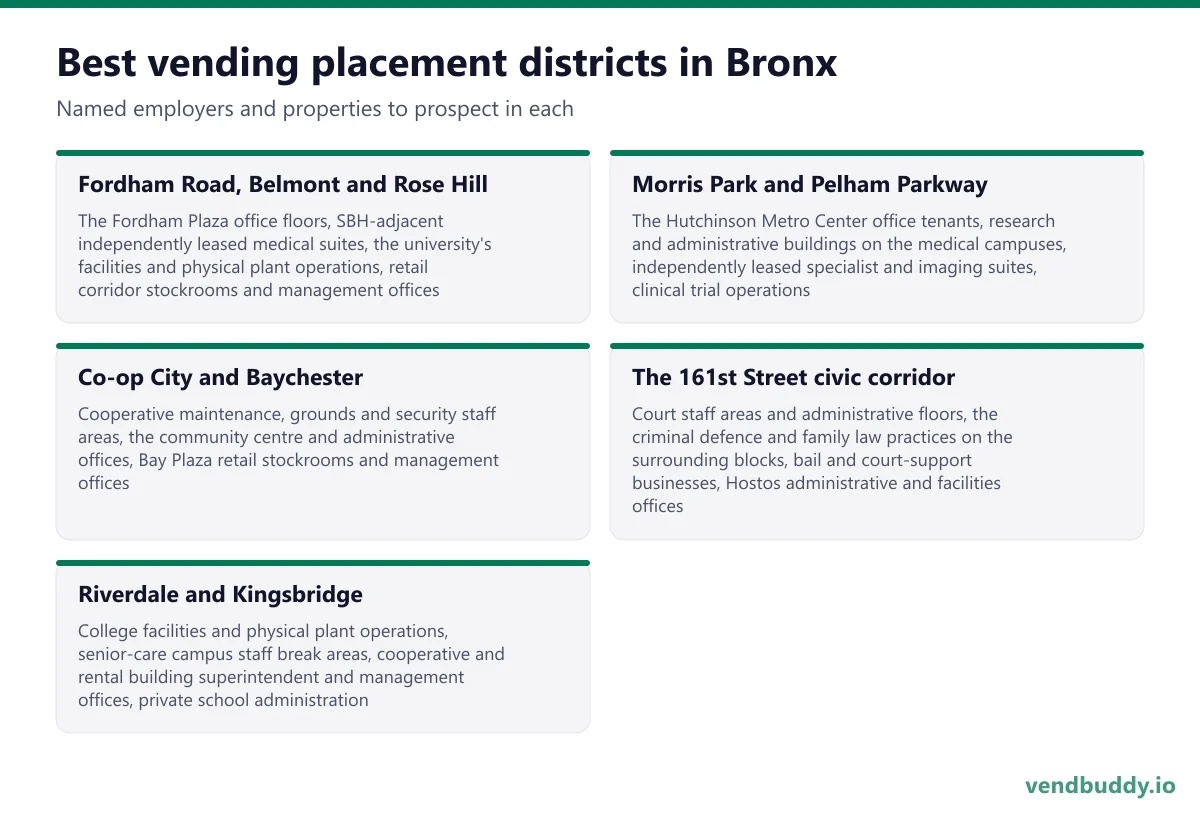
Fordham Road, Belmont and Rose Hill
One of the busiest retail corridors anywhere in New York City, wrapped around Fordham University's Rose Hill campus and the Belmont food district, with SBH Health System nearby and heavy foot traffic from three transit lines.
Named placement targets: the Fordham Plaza office floors, SBH-adjacent independently leased medical suites, the university's facilities and physical plant operations, retail corridor stockrooms and management offices, and the Belmont food wholesalers and commissaries behind the retail market
Morris Park and Pelham Parkway
The borough's academic medical district, running from the Einstein campus through Jacobi Medical Center to Calvary Hospital, with the Hutchinson Metro Center office complex on Waters Place holding the clinical and administrative spillover.
Named placement targets: the Hutchinson Metro Center office tenants, research and administrative buildings on the medical campuses, independently leased specialist and imaging suites, clinical trial operations, and the nurse and allied-health staffing agencies with offices on the corridor
Co-op City and Baychester
A planned cooperative community of roughly three dozen towers in the northeast corner with its own community centres, services and workforce, adjoined by the Bay Plaza retail complex — effectively a self-contained small city inside the borough.
Named placement targets: cooperative maintenance, grounds and security staff areas, the community centre and administrative offices, Bay Plaza retail stockrooms and management offices, restaurant back-of-house teams, and the medical and social service offices serving the development
The 161st Street civic corridor
The Grand Concourse government district holding the county courthouse, Borough Hall, family and criminal court buildings, Lincoln Medical Center and Hostos Community College, all within a few walkable blocks near the stadium.
Named placement targets: court staff areas and administrative floors, the criminal defence and family law practices on the surrounding blocks, bail and court-support businesses, Hostos administrative and facilities offices, and the independently leased medical offices near Lincoln
Riverdale and Kingsbridge
The hilly northwest corner, with private colleges, a large senior-care campus, dense cooperative apartment buildings and a low-rise commercial strip along Broadway that feels more like Westchester than the rest of the borough.
Named placement targets: college facilities and physical plant operations, senior-care campus staff break areas, cooperative and rental building superintendent and management offices, private school administration, and the Broadway auto, trade and service shops
Want the list built for you? Pick one Bronx ZIP and VendBuddy delivers the 50 best-scored locations in it, enriched with the best contact on file, automatically, for $97 once.
If you are weighing whether a specific building inside one of these districts is worth pursuing, run it through our location scoring checklist first. It catches the bad-fit placements (low captive headcount, restricted access hours, existing operator relationship) before you waste a pitch on them.
NY Licenses, Permits, and Sales Tax for Vending in Bronx
New York State licenses no vending occupation. The registration you cannot operate without is a Certificate of Authority from the Department of Taxation and Finance, which is what permits you to collect and remit sales tax in the first place. New York City then adds a layer the rest of the state does not: food premises permitting for all five boroughs runs through the Department of Health and Mental Hygiene, and machines dispensing potentially hazardous food are treated very differently from equipment holding only sealed shelf-stable snacks and bottled drinks. Get your specific configuration classified by DOHMH before installation, because the answer determines whether a city permit is involved at all. Note that street vending licences are a separate regime entirely and do not apply to machines placed inside private buildings.
Sales tax in Bronx: 8.875 percent on every placement in the borough — New York's 4 percent state rate plus the city's 4.5 percent and the 0.375 percent Metropolitan Commuter Transportation District component. Unlike Westchester, there is no internal variation to track: the Bronx is one rate from Riverdale to Throggs Neck. The rate boundary that matters runs along the northern county line, where Mount Vernon and the rest of Westchester drop to roughly 8.375 percent while Yonkers stays at 8.875. One further piece of good news for a Bronx-based operator: the New York City commercial rent tax that catches Manhattan tenants applies only below 96th Street in Manhattan and never reaches this borough.
Vending-specific rules: New York decides taxability from a machine by price rather than by product category, and the applicable ceiling depends on how the equipment takes payment — card and digital-payment machines carry a higher exemption threshold for candy, gum, soft drinks and bottled water than coin-and-currency-only machines, while hot drinks and several other categories are exempt regardless of price. Container deposits are excluded from the price being tested. Because those ceilings decide whether the 8.875 percent applies at all, confirm the current figures with NYS Tax before pricing. Separately, federal law requires operators of twenty or more machines to disclose calorie information for the items sold, which is a threshold a Bronx route can cross faster than an operator expects.
Site access: Access, not paperwork, is what shapes a Bronx route. Court and public safety buildings screen every entry, so service visits need to be scheduled around security rather than around your driving order. Hospital campuses require vendor credentialing that can include background checks and health documentation. Cooperative and rental buildings will want certificates of insurance naming the ownership and management entities before a machine crosses the threshold. And the mundane constraint dominates everything: commercial parking is scarce in the dense corridors, so survey the actual loading and lift access at each site before you commit, because a placement you cannot restock in fifteen minutes will quietly destroy your margin.
Every researched NY market, plus the state rules in one place: our NY vending hub.
State-by-state vending laws — including license thresholds, sales tax, and food handler requirements — are summarized in our vending laws reference. If you are forming an LLC for the route, our LLC setup and tax deductions guide covers the federal and state-level deductions specific to vending operators.
Commission Rates and Negotiation in Bronx
Typical commission range in Bronx: 0–10% of gross.
Institutional buildings — courts, city facilities, the college physical plant operations — pay nothing and were never going to, and they reward a vendor who follows procedure with placements that last. Independently leased medical suites in Morris Park more often want a fixed monthly product credit for staff than a percentage, since the practice paying rent is not the one collecting machine revenue. Retail property management at Bay Plaza and along Fordham Road opens near the top of the band and can bundle several sites under one relationship, which is usually worth more than the extra points. Cooperative and residential building management frequently prefers better staff pricing over cash, and senior-care campuses negotiate on packaging and product restrictions rather than money.
Use our vending commission rates by location type for the full negotiation rubric (when to walk, when to counter with product credit, when to accept and renegotiate at renewal). The negotiating vending placements covers the actual scripts.
VendBuddy shows the best contact on file for the properties in this guide (owner or manager when available), with the emails and phone numbers we can find. Plus the contract generator, ROI calculator, and placement scoring tools you need to close.
Launch VendBuddy Free →A 3-Day Starter Route in Bronx
If you are dropping into Bronx for the first time and want to walk out with a real prospect list in 72 hours, this is the route experienced operators use. It groups districts by drive efficiency rather than by industry — you cover the most square footage with the fewest miles, which matters more in week one than perfect target prioritization.
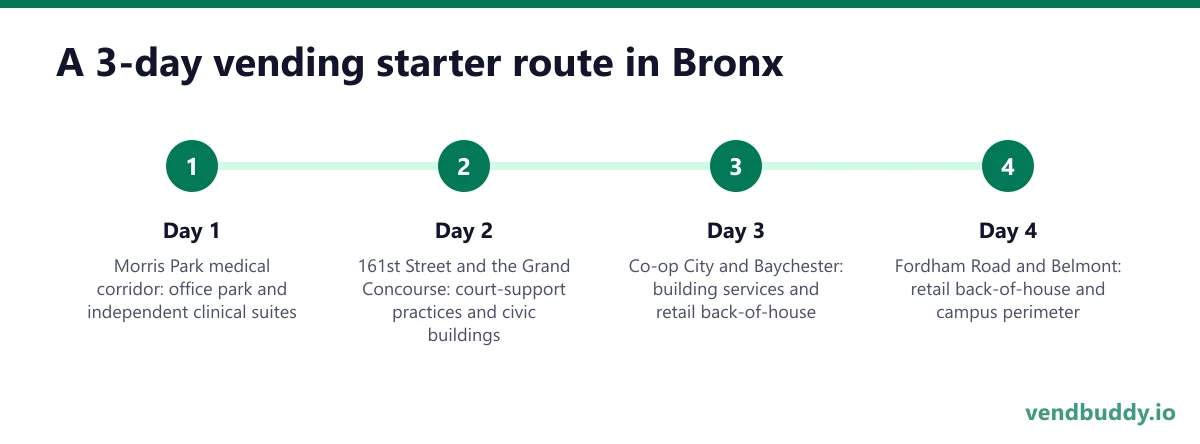
Targets: Hutchinson Metro Center office tenants, research and administrative buildings, independently leased specialist and imaging suites, clinical trial operations, allied-health staffing agencies
Field note: Skip the hospital front doors entirely on day one. The office complex on Waters Place and the independently leased suites around the campuses each make their own decision and have the same round-the-clock staffing without the credentialing wait.
Targets: criminal defence and family law practices, bail and court-support businesses, court administrative floors, Hostos facilities offices, medical offices near Lincoln
Field note: The small practices on the blocks around the courthouse are the fastest decisions in the borough because the person you are talking to owns the firm. Ask about the building's screening procedure before proposing a service day, since it dictates when you can actually get in.
Targets: cooperative maintenance, grounds and security staff areas, community centre and administrative offices, Bay Plaza stockrooms and management offices, restaurant back-of-house
Field note: One conversation at the cooperative's management level can reach a workforce spread across dozens of buildings, which is the highest-leverage meeting available anywhere in the borough. Expect insurance documentation to be requested immediately.
Targets: Fordham Plaza office floors, retail stockrooms and management offices, university facilities and physical plant operations, Belmont food wholesalers and commissaries
Field note: The retail corridor's back rooms are staffed continuously by people who cannot leave the floor, which is a stronger pitch than the crowded sidewalk suggests. Campus dining contracts do not extend to physical plant buildings, and that is the opening on the university side.
For the cold-email cadence to send the same evening, see our cold email scripts for property managers. The first email goes out within 24 hours of a pop-in; the second 5–7 days later. Operators who skip the same-day follow-up close at roughly half the rate of operators who do not.
Competition and Underserved Pockets in Bronx
National operators run the Bronx, but they run the parts of it that look like the rest of their book: the large hospital campuses under health-system agreements, the college dining operations, the biggest retail anchors. Everything structurally awkward is left alone. Court-adjacent law practices are eight-person offices behind a security screening line. Cooperative building services teams are dispersed across dozens of addresses with no single procurement contact until you find the management company. Independently leased medical suites in Morris Park are individually too small to hit a national's account minimum. Meanwhile the borough's density cuts both ways — the parking and loading friction that makes servicing expensive for a driver dispatched from outside is exactly what protects an operator who knows which buildings have a working freight lift and which block clears at ten in the morning. Local knowledge is a durable moat here in a way it simply is not in a suburban office park.
The lesson, in Bronx as in every other Tier-1 metro: the high-revenue marquee accounts (Fortune 500 HQs, flagship hospitals, university dining contracts) are locked under multi-year national contracts with Canteen, Five Star, Compass, or Aramark. The opportunity for an independent or regional operator is the second tier — the Class B office down the street, the medical office building two doors down from the main hospital, the apartment leasing office three blocks from a Whole Foods. Those are accessible, profitable, and almost always underserved.
Vending Machine Companies in Bronx, NY
If you manage a property in Bronx and want a machine placed, you do not pay for it — the operator buys, stocks, and services the machine and earns from what sells. Instead of calling companies one by one, submit the two-minute request at vendbuddy.io/property-managers and it gets routed to independent operators working the Bronx area; at most two receive it, and the first to claim it contacts you. How placement deals work, what commission is normal, and the national-versus-local trade-off are all in vending machine companies near me.
Bronx Vending FAQ
Do I need a license to put vending machines in the Bronx?
New York State does not license vending as a trade, but you do need a Certificate of Authority from the Department of Taxation and Finance before collecting any sales tax. On top of that, New York City runs its own food premises permitting through the Department of Health and Mental Hygiene, and whether a permit applies to your machines depends on what they dispense — sealed shelf-stable snacks and bottled drinks are treated differently from potentially hazardous refrigerated food. Get the classification confirmed by DOHMH before installing anything, because reversing an installation is far more expensive than a phone call.
What is the sales tax rate for vending machines in the Bronx, NY?
8.875 percent everywhere in the borough, made up of the 4 percent New York State rate, the 4.5 percent New York City rate and the 0.375 percent Metropolitan Commuter Transportation District component. There is no internal variation to manage, which is simpler than Westchester. Where it changes is at the northern county line: Mount Vernon and most of Westchester sit at roughly 8.375 percent while Yonkers matches the city at 8.875. Separately, New York taxes machine sales by price threshold rather than product category, so confirm the current ceilings with NYS Tax before setting prices.
How much do vending machines make in the Bronx?
There is no responsible single number, but the drivers are unusually legible in a borough this dense. Revenue follows how many people are captive on site through a shift, whether the location runs overnight, how far the nearest bodega or cafeteria actually is, how well the selection matches that workforce, and your service reliability. Household median income here is the lowest of the five boroughs, which shapes acceptable price points more than in almost any other New York market. A Morris Park clinical suite, a Co-op City maintenance shop and a Fordham Road stockroom will each behave differently.
Can I get machines into Montefiore, Jacobi or the Bronx colleges?
The main campuses are contracted and will stay that way. Hospital refreshment services are procured at health-system level and college dining runs under multi-year agreements that an independent operator does not displace. What is genuinely reachable sits at the edges of those institutions: research and administrative annexes, physical plant and facilities buildings, athletics and grounds operations, staff-only areas that were never in the original scope, and the privately owned buildings ringing each campus that lease to medical practices and student-serving businesses. Those are individual decisions made by individual managers.
Is Co-op City worth approaching as a vending location?
It is arguably the highest-leverage single relationship in the borough. Co-op City is one of the largest cooperative housing developments in the world, with roughly three dozen towers, its own community centres and a substantial in-house workforce of maintenance, grounds, security and administrative staff who spend their entire shift on the property. The decision runs through the cooperative's management rather than building by building, so one meeting can potentially reach many locations. Expect a formal process, certificates of insurance and a longer timeline than a private office would take.
What makes servicing a Bronx route different from a suburban one?
Two things, and both are logistical rather than commercial. First, parking and loading: in the dense corridors you may be circling for a space, carrying stock further than you planned, and depending on a freight lift that another vendor is already using. Survey the actual restock path at every site before you accept it, because a placement that takes forty minutes to service instead of fifteen quietly ruins the economics. Second, screening: courts, hospitals and many institutional buildings control entry, so your route order gets set by other people's security procedures rather than by the map.
Essential Vending Guides
Other New York and New Jersey metropolitan vending markets: Mount Vernon, NY · New York, NY
General information, not legal, tax or financial advice. Rules change, so check the official source. Revenue and income figures are examples, not promises. See our terms.