Mount Vernon packs roughly 73,000 people into 4.4 square miles, which makes it one of the most densely populated cities in New York State outside the five boroughs and, for a vending route, about the tightest geography in Westchester. You can drive the whole city in twelve minutes. The detail that pays for itself sits on the southern boundary: cross South Columbus Avenue into the Bronx and the sales tax rate moves from roughly 8.375 percent to 8.875 percent, so an operator working both sides of that line is running two price schedules on streets that look identical.
- Is Mount Vernon a good place to start a vending machine business?
- Mount Vernon Vending Market Overview
- Top Industries Driving Vending Demand in Mount Vernon
- Best Placement Districts in Mount Vernon
- NY Licenses, Permits, and Sales Tax for Vending in Mount Vernon
- Commission Rates and Negotiation in Mount Vernon
- A 3-Day Starter Route in Mount Vernon
- Competition and Underserved Pockets in Mount Vernon
Free to search. 5 free contact reveals, no card.
Property owners and managers: tell us about the site and we pass it to an operator who covers Mount Vernon, if one is in range.
Request a free machine →- The 2020 census counted 73,893 residents across 4.41 square miles, making Mount Vernon the eighth-largest city in New York State and the largest Black-majority city in the state.
- Four distinct sections organise the place: Downtown around Gramatan and Fourth Avenue, Mount Vernon Heights along Sandford Boulevard, the North Side with Fleetwood and Chester Heights, and the denser South Side against the Bronx line.
- Montefiore Mount Vernon Hospital, a 121-bed acute and ambulatory facility, anchors healthcare, and the Mount Vernon City School District runs eleven elementary schools, two middle schools and two high schools.
- Three Metro-North stations serve the city — Mount Vernon East on the New Haven Line, Mount Vernon West on the Harlem Line, and Fleetwood — alongside Bee-Line bus service, so a large share of the workforce arrives without a car.
- New York licenses no vending trade; you register a Certificate of Authority with the Department of Taxation and Finance and work with the Westchester County health authority on food handling.
- Household median income sits near $77,200, well below the Westchester county figure, which pushes the product mix toward everyday price points rather than premium lines.
Free tools: vending ROI calculator · revenue calculator by property type · route time calculator · State of Vending 2026 report · all free tools
- Is Mount Vernon a good place to start a vending machine business?
- Mount Vernon Vending Market Overview
- Top Industries Driving Vending Demand
- Best Placement Districts in Mount Vernon
- NY Licenses, Permits, and Sales Tax
- Commission Rates and Negotiation
- 3-Day Starter Route in Mount Vernon
- Competition and Underserved Pockets
- Mount Vernon Vending FAQ
Is Mount Vernon a good place to start a vending machine business?
Yes, with one condition: Mount Vernon rewards district selection more than raw hustle. The Mount Vernon, NY metro carries about 2,600 establishments, heavily weighted to healthcare, retail, food distribution, building services and small professional practices across roughly 73K residents — about 35.9 business establishments per 1,000 people, right around the roughly 30-per-1,000 national figure, so route quality comes down to which districts you pick. Median household income is ~$77,200 household median with a per-capita figure near $42,200, both materially below the Westchester averages that surround the city, close to the roughly $75,000 U.S. median, and that number decides more than any other whether a $2.25–$2.75 price point holds or you have to run value pricing to keep vend counts up. Growth here is transit-oriented infill rather than expansion — the city is fully built out, and new activity concentrates around the Metro-North stations and on redevelopment of older industrial parcels in the south end. On the supply side, the hospital and school district interiors run through institutional agreements, while the South Side industrial tenants, the walk-up offices downtown and the apartment building operations are inconsistently served.
Demand here concentrates in Healthcare and Senior Care, Municipal Government and Public Schools, Food Distribution and Light Industry, Retail and Consumer Services and Residential Building Services, led by Healthcare and Senior Care — and those workers sit in identifiable places, not spread evenly across the metro. The 5 districts mapped below (Downtown, Gramatan and Fourth Avenue; South Side and the Canal Street industrial zone; Sandford Boulevard retail corridor; Fleetwood and the North Side; The hospital and senior care corridor) are where the captive headcount actually is. Budget for 0–10% of gross in commission — commission expectations are operator-friendly by national standards. Sales tax on vends runs 8.375%. One local wrinkle to plan around: check the property-level rules before you install.
The catch: Mount Vernon sits inside the service radius of every large operator running Westchester and the north Bronx, so the visible accounts are taken: the hospital, the school district's larger buildings, the Sandford Boulevard chains. That is the shape of every market this size — the marquee accounts are contracted, and the money for an independent operator is one tier down, in the buildings next door to them.
| Signal | Mount Vernon | National reference |
|---|---|---|
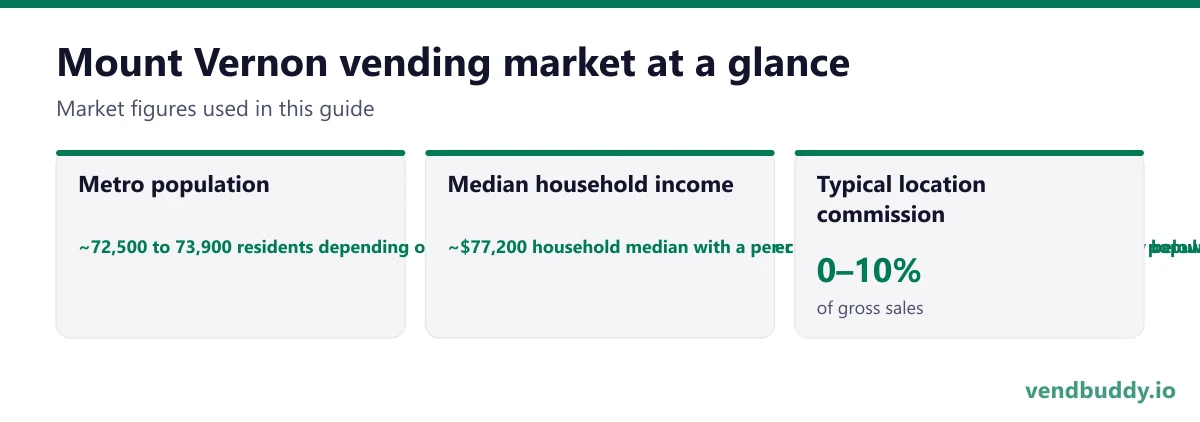
| Metro population | ~72,500 to 73,900 residents depending on the vintage, at roughly 16,700 people per square mile, inside a Westchester County population near 1M | — |
| Business establishments | ~2,600 establishments, heavily weighted to healthcare, retail, food distribution, building services and small professional practices | — |
| Establishments per 1,000 residents | 35.9 | ~30 |
| Median household income | ~$77,200 household median with a per-capita figure near $42,200, both materially below the Westchester averages that surround the city | ~$75,000 |
| Commission expectation | 0–10% of gross | 10–15% typical |
| Sales tax on vended goods | 8.375% | varies by state |
| Demand sectors driving placements | Healthcare and Senior Care, Municipal Government and Public Schools, Food Distribution and Light Industry, Retail and Consumer Services and Residential Building Services | — |
| Placement districts mapped below | 5 | — |
Is Mount Vernon a good area to start a vending machine business?
Yes, with one condition: Mount Vernon rewards district selection more than raw hustle. Mount Vernon carries ~2,600 establishments, heavily weighted to healthcare, retail, food distribution, building services and small professional practices across a 73K metro — about 35.9 establishments per 1,000 residents, right around the roughly 30-per-1,000 national figure, so route quality comes down to which districts you pick. Median household income is ~$77,200 household median with a per-capita figure near $42,200, both materially below the Westchester averages that surround the city, close to the roughly $75,000 U.S. median. Start in Downtown, Gramatan and Fourth Avenue, then South Side and the Canal Street industrial zone — both are broken out below with named placement targets. The honest constraint: Mount Vernon sits inside the service radius of every large operator running Westchester and the north Bronx, so the visible accounts are taken: the hospital, the school district's larger buildings, the Sandford Boulevard chains.
Can I start a vending machine business in Mount Vernon?
Yes. New York issues no vending licence of any kind. The registration that matters is a Certificate of Authority from the Department of Taxation and Finance, which is what allows you to collect and remit sales tax at all, and beyond that you meet the food handling expectations of the health authority covering each placement. For Mount Vernon that authority operates at the Westchester County level, which has a useful consequence for a route: New Rochelle, Yonkers and White Plains all fall under the same health structure even though they do not all charge the same tax rate. Whether Mount Vernon itself asks for a general business registration is a question for the City Clerk, and it is a five-minute call. Sales tax on vended goods: Placements inside Mount Vernon carry the Westchester County combined rate of roughly 8.375 percent — New York's 4 percent state component plus the county share and the Metropolitan Commuter Transportation District piece. The reason that number deserves attention here rather than anywhere else in the county is the geography. Mount Vernon's southern boundary is the Bronx, where the rate is 8.875 percent, and the boundary runs through ordinary residential blocks rather than along a river or a highway. Yonkers, immediately west, is also at 8.875 percent. An operator working all three is changing rate at street corners, so verify every placement address through the Department of Taxation and Finance jurisdiction and rate lookup at www8.tax.ny.gov/JRLA/jrlaStart rather than assuming the county rate applies. Food handler rules and the local permit quirks are broken out in full further down this page. No NY statute blocks a new operator from placing machines in Mount Vernon — the real barrier is placement access, not paperwork.
How much do vending machines make in Mount Vernon?
There is no city-level vending revenue dataset for Mount Vernon, and any specific Mount Vernon figure you see quoted is an estimate dressed up as data. What operators report nationally: a healthy snack and drink placement grosses roughly $150–$400 per machine per month, low-traffic placements sit at $75–$150, and high-density captive placements (24/7 warehouses, hospital night shift, 200-plus-person offices) clear $400–$700 or more. Gross margin lands near 50–55% before commission. Demand signals in Mount Vernon point toward the middle of that band: median household income is ~$77,200 household median with a per-capita figure near $42,200, both materially below the Westchester averages that surround the city, demand concentrates in Healthcare and Senior Care, Municipal Government and Public Schools, Food Distribution and Light Industry, Retail and Consumer Services and Residential Building Services, and commission expectations are operator-friendly by national standards at 0–10% of gross. Model your own stops with the free route valuation calculator.
Two free tools do the two jobs this page cannot: one ranks the ZIPs, the other prices a deal. Neither needs an account.
Mount Vernon Vending Market Overview
Mount Vernon, NY is a market where growth here is transit-oriented infill rather than expansion — the city is fully built out, and new activity concentrates around the Metro-North stations and on redevelopment of older industrial parcels in the south end. The metro contains roughly 2,600 establishments, heavily weighted to healthcare, retail, food distribution, building services and small professional practices at a median household income of ~$77,200 household median with a per-capita figure near $42,200, both materially below the Westchester averages that surround the city, and the hospital and school district interiors run through institutional agreements, while the South Side industrial tenants, the walk-up offices downtown and the apartment building operations are inconsistently served. The implication for a new or scaling operator: the prospecting addressable market is large, the per-machine economics support a real business, and the gap between operator coverage and underlying demand is real enough that it shows up in routing math, not just marketing copy.
The four sectors that drive vending demand in Mount Vernon are Healthcare and Senior Care, Municipal Government and Public Schools, Food Distribution and Light Industry, Retail and Consumer Services, Residential Building Services. Each has its own access pattern (badge-required vs. open lobby), break-room culture (catered vs. dependent on vending), and product-mix expectation (premium vs. value). The sections below break each down with named employers and the placement targets that actually convert.
Before you commit to a route in Mount Vernon, work through our location scoring checklist on a sample location — it will save you the cost of a bad first placement, which is usually a year of revenue. If you are still pre-launch, our guide to starting a vending machine business walks through the entity setup, financing, and machine sourcing that comes before the prospecting phase.
Top Industries Driving Vending Demand in Mount Vernon
The four industries below account for the bulk of high-revenue vending placements in Mount Vernon, NY. The named employers are anchor tenants — large, captive workforces that drive the local property managers' decisions about whether to install vending at all. Reading these in order also tells you what kind of operator wins which placement: the apparel of a healthcare-pitch deck looks nothing like the apparel of an aerospace-pitch deck, and matching the fit matters more than commission percentage.
Healthcare and Senior Care
Montefiore Mount Vernon Hospital sits at the centre, but the reachable market is the ring around it rather than the building itself: independently leased medical and dental suites, dialysis and outpatient clinics, imaging centres, and the home-care and staffing agencies that place aides across the city. Add the senior-care campuses, where staffing is continuous and overnight shifts have no food options whatsoever, and you have a category that runs seven days a week. Night and weekend coverage is the whole argument in this sector, because the cafeteria closes and the workforce does not.
Municipal Government and Public Schools
A city of this density with its own police department, fire department, public works, courts and a school district running fifteen buildings employs a large share of its own residents. School district central administration, transportation depots and maintenance operations work through the summer when the classrooms are empty, which makes them a different placement from the schools themselves. City facilities pay nothing and decide slowly, but a placement in a public works garage or a police administrative building tends to sit undisturbed for years.
Food Distribution and Light Industry
The south end of the city, along the Bronx boundary, holds Mount Vernon's industrial zone: food distributors and commissaries supplying restaurants across the county line, building-trades contractor yards, auto body and fleet shops, and warehouse tenants who chose the location precisely because it is the cheapest industrial land within reach of New York City. These operations start early, employ crews rather than office staff, and sit nowhere near a deli. It is the least glamorous and most consistently underserved category in the city.
Retail and Residential Building Services
Two very different retail pictures coexist here. Sandford Boulevard carries big-box and chain retail with stockrooms, delivery staging and management offices behind the sales floors, while Gramatan Avenue and Fourth Avenue downtown hold small independent storefronts with professional offices stacked above them. Layered onto both is a large stock of pre-war apartment buildings, each with superintendents, porters and management staff who work on site all day. Building services staff are a genuine placement class in a city this dense and are almost never pitched.
For deeper revenue benchmarks by location type — apartment vs. warehouse vs. medical vs. office — see our vending machine income data and the vending costs and profit breakdown. Both are continuously updated from operator surveys.
Best Placement Districts in Mount Vernon
The districts below are ranked by daytime worker density and operator-coverage gap, not just by population. A district with 50,000 office workers and three national operators competing already may be a worse target than a district with 20,000 office workers and zero operator presence. Mount Vernon has a few of each — the named placement targets in each card are the actual employers and properties to prospect, not generic industry categories.
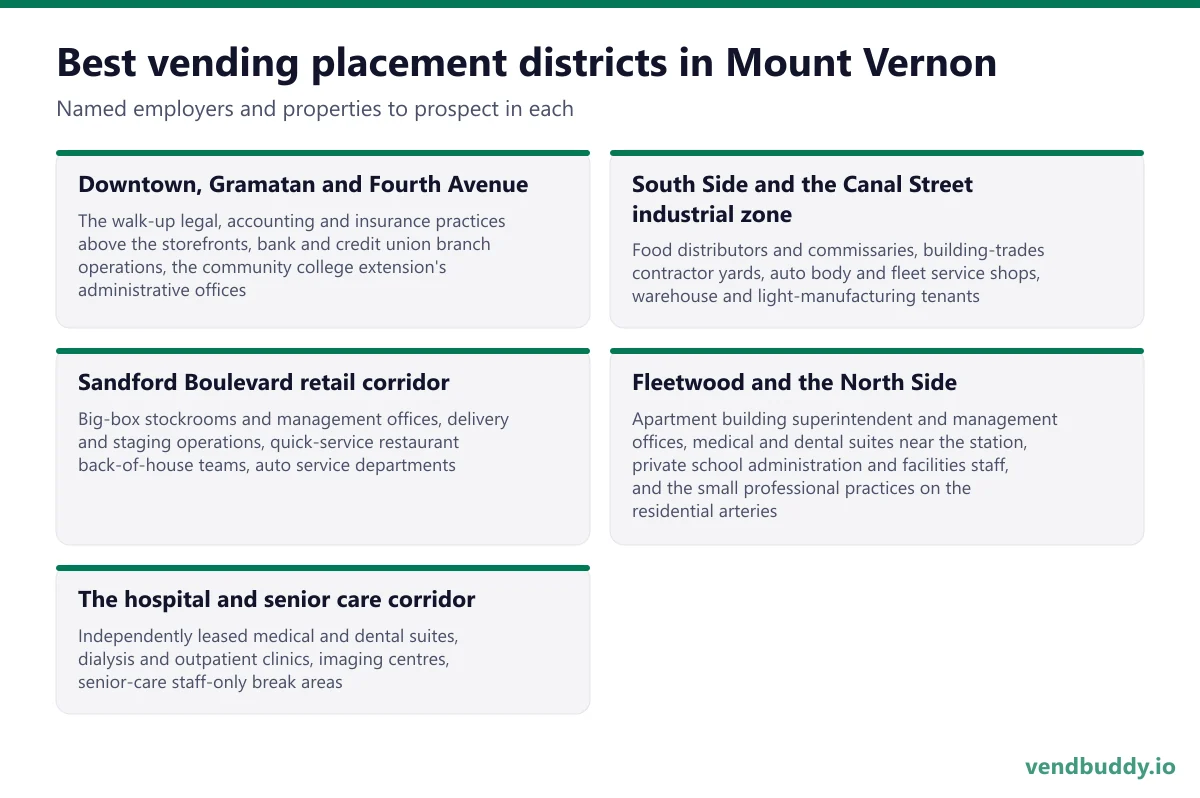
Downtown, Gramatan and Fourth Avenue
The civic and commercial core around city hall, holding the public library, the community college extension, small independent retail at street level and older walk-up office space above it. Everything is within a few blocks and nearly everyone arrives on foot or by bus.
Named placement targets: the walk-up legal, accounting and insurance practices above the storefronts, bank and credit union branch operations, the community college extension's administrative offices, the library's staff areas, and the city hall departments
South Side and the Canal Street industrial zone
The dense southern end running to the Bronx boundary, mixing the city's oldest housing stock with its remaining industrial parcels. Early-start businesses, truck traffic, and land priced below anything on the other side of the city line.
Named placement targets: food distributors and commissaries, building-trades contractor yards, auto body and fleet service shops, warehouse and light-manufacturing tenants, and the small trucking operations working the Bronx market
Sandford Boulevard retail corridor
The Mount Vernon Heights commercial strip, the city's one genuinely car-oriented district, carrying big-box retail and chain service businesses with substantial back-of-house operations behind the sales floors.
Named placement targets: big-box stockrooms and management offices, delivery and staging operations, quick-service restaurant back-of-house teams, auto service departments, and the corridor's fitness and personal-service tenants
Fleetwood and the North Side
The quieter northern sections including Chester Heights and Oakwood Heights, organised around the Fleetwood Metro-North station, with apartment buildings, small professional suites and private schools rather than industry.
Named placement targets: apartment building superintendent and management offices, medical and dental suites near the station, private school administration and facilities staff, and the small professional practices on the residential arteries
The hospital and senior care corridor
The healthcare cluster around Montefiore Mount Vernon Hospital and the city's senior-care campuses, where staffing is continuous and the on-site food options close long before the shift does.
Named placement targets: independently leased medical and dental suites, dialysis and outpatient clinics, imaging centres, senior-care staff-only break areas, and the home-care and nurse staffing agencies with offices nearby
Want the list built for you? Pick one Mount Vernon ZIP and VendBuddy delivers the 50 best-scored locations in it, enriched with the best contact on file, automatically, for $97 once.
If you are weighing whether a specific building inside one of these districts is worth pursuing, run it through our location scoring checklist first. It catches the bad-fit placements (low captive headcount, restricted access hours, existing operator relationship) before you waste a pitch on them.
NY Licenses, Permits, and Sales Tax for Vending in Mount Vernon
New York issues no vending licence of any kind. The registration that matters is a Certificate of Authority from the Department of Taxation and Finance, which is what allows you to collect and remit sales tax at all, and beyond that you meet the food handling expectations of the health authority covering each placement. For Mount Vernon that authority operates at the Westchester County level, which has a useful consequence for a route: New Rochelle, Yonkers and White Plains all fall under the same health structure even though they do not all charge the same tax rate. Whether Mount Vernon itself asks for a general business registration is a question for the City Clerk, and it is a five-minute call.
Sales tax in Mount Vernon: Placements inside Mount Vernon carry the Westchester County combined rate of roughly 8.375 percent — New York's 4 percent state component plus the county share and the Metropolitan Commuter Transportation District piece. The reason that number deserves attention here rather than anywhere else in the county is the geography. Mount Vernon's southern boundary is the Bronx, where the rate is 8.875 percent, and the boundary runs through ordinary residential blocks rather than along a river or a highway. Yonkers, immediately west, is also at 8.875 percent. An operator working all three is changing rate at street corners, so verify every placement address through the Department of Taxation and Finance jurisdiction and rate lookup at www8.tax.ny.gov/JRLA/jrlaStart rather than assuming the county rate applies.
Vending-specific rules: New York taxes machine sales by price rather than by product category, and the threshold depends on how the machine accepts payment: card and digital-payment equipment carries a higher exemption ceiling for candy, gum, soft drinks and bottled water than coin-and-currency-only machines do, and several categories including hot drinks stay exempt regardless of price. Container deposits do not count toward the price being tested. Because those ceilings decide whether tax applies at all, and because you are already juggling two rates across a two-block boundary here, get the current figures from NYS Tax before you set a single price. A few cents either side of a threshold changes the economics of an entire route.
Site access: The practical obstacles in Mount Vernon are physical rather than regulatory. This is a pre-war city with narrow streets, restricted commercial parking and buildings that were never designed for a hand truck, so survey the actual delivery path before you commit to a placement — a fourth-floor walk-up office suite is a very different service proposition from a Sandford Boulevard stockroom with a loading door. Apartment buildings and older commercial properties will ask for certificates of insurance naming the ownership and management entities. Hospital property and school district buildings run through institutional processes rather than a conversation with a manager.
Every researched NY market, plus the state rules in one place: our NY vending hub.
State-by-state vending laws — including license thresholds, sales tax, and food handler requirements — are summarized in our vending laws reference. If you are forming an LLC for the route, our LLC setup and tax deductions guide covers the federal and state-level deductions specific to vending operators.
Commission Rates and Negotiation in Mount Vernon
Typical commission range in Mount Vernon: 0–10% of gross.
The South Side industrial tenants and contractor yards take nothing and want a fixed service day they can plan around, which is the easiest sale in the city. Downtown walk-up practices are similarly uninterested in a percentage; the partner or office manager is buying a solved problem for eight people. Where the number climbs is Sandford Boulevard, where chain retail and the property management behind it will expect a share and can sometimes bundle several sites. Apartment building management often prefers a flat monthly figure or a product credit for staff over a percentage, because the entity collecting is not the entity paying for the space. Senior care campuses negotiate on packaging, portion and product restrictions more often than on money.
Use our vending commission rates by location type for the full negotiation rubric (when to walk, when to counter with product credit, when to accept and renegotiate at renewal). The negotiating vending placements covers the actual scripts.
VendBuddy shows the best contact on file for the properties in this guide (owner or manager when available), with the emails and phone numbers we can find. Plus the contract generator, ROI calculator, and placement scoring tools you need to close.
Launch VendBuddy Free →A 3-Day Starter Route in Mount Vernon
If you are dropping into Mount Vernon for the first time and want to walk out with a real prospect list in 72 hours, this is the route experienced operators use. It groups districts by drive efficiency rather than by industry — you cover the most square footage with the fewest miles, which matters more in week one than perfect target prioritization.
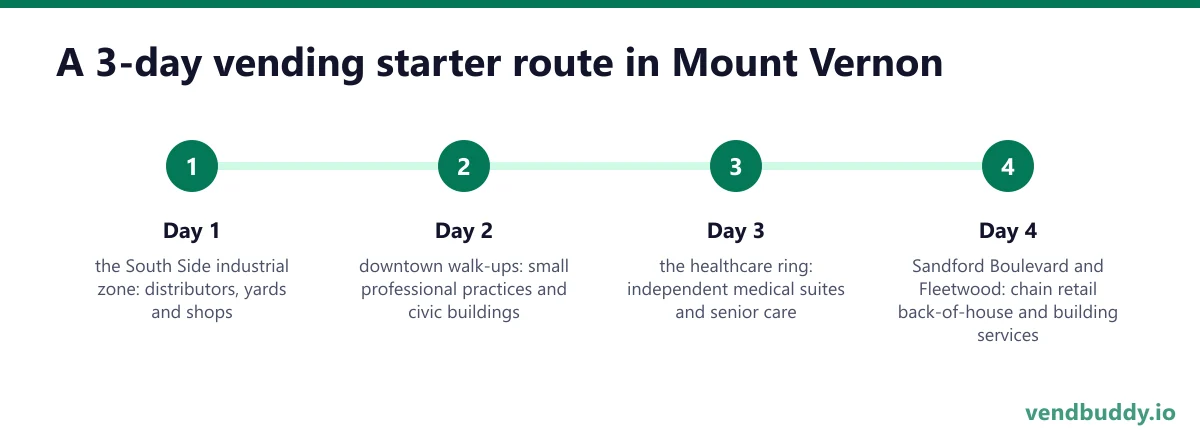
Targets: food distributors and commissaries, contractor yards, auto body and fleet shops, warehouse and light-manufacturing tenants
Field note: Arrive before seven. These crews start early and are gone or unreachable by mid-morning. Nothing sells food within walking distance of most of these addresses, which is the entire pitch and takes about ninety seconds to make.
Targets: legal, accounting and insurance offices above the Gramatan and Fourth Avenue storefronts, bank branch operations, the community college extension, library staff areas, city hall departments
Field note: Check the stairs before you check the interest. Several of these suites have no lift and no loading access, and a machine you cannot service profitably is worse than no placement. Where access works, decisions here take one meeting.
Targets: medical and dental suites near the hospital, dialysis and outpatient clinics, imaging centres, senior-care staff break areas, home-care and staffing agencies
Field note: Lead with overnight and weekend coverage rather than product range. The hospital interior is contracted and will stay that way, but the independently leased suites and the senior campuses around it each decide for themselves and staff them around the clock.
Targets: big-box stockrooms and management offices, delivery staging operations, quick-service back-of-house, apartment building superintendent and management offices near the Fleetwood station
Field note: Retail here will ask for a commission and may need a regional sign-off, so expect a longer cycle. The apartment building operations on the same day are the quick wins nobody else is asking for, and one management company often controls several buildings.
For the cold-email cadence to send the same evening, see our cold email scripts for property managers. The first email goes out within 24 hours of a pop-in; the second 5–7 days later. Operators who skip the same-day follow-up close at roughly half the rate of operators who do not.
Competition and Underserved Pockets in Mount Vernon
Mount Vernon sits inside the service radius of every large operator running Westchester and the north Bronx, so the visible accounts are taken: the hospital, the school district's larger buildings, the Sandford Boulevard chains. What the map does not show is how little of the city that actually covers. The industrial parcels in the south end are full of twenty-to-eighty-person operations that a route driver crossing the county would never stop for, and the walk-up office suites downtown are individually far too small to justify a national operator's minimum. The city's own facilities generate no commission and therefore attract no interest. Density is the local advantage and it is a real one: an operator servicing forty accounts inside four and a half square miles has a cost structure nobody dispatching from White Plains or Mount Vernon's larger neighbours can match, and can be at a jammed machine before the shift ends.
The lesson, in Mount Vernon as in every other Tier-1 metro: the high-revenue marquee accounts (Fortune 500 HQs, flagship hospitals, university dining contracts) are locked under multi-year national contracts with Canteen, Five Star, Compass, or Aramark. The opportunity for an independent or regional operator is the second tier — the Class B office down the street, the medical office building two doors down from the main hospital, the apartment leasing office three blocks from a Whole Foods. Those are accessible, profitable, and almost always underserved.
Vending Machine Companies in Mount Vernon, NY
If you manage a property in Mount Vernon and want a machine placed, you do not pay for it — the operator buys, stocks, and services the machine and earns from what sells. Instead of calling companies one by one, submit the two-minute request at vendbuddy.io/property-managers and it gets routed to independent operators working the Mount Vernon area; at most two receive it, and the first to claim it contacts you. How placement deals work, what commission is normal, and the national-versus-local trade-off are all in vending machine companies near me.
Mount Vernon Vending FAQ
Do I need a vending machine license in Mount Vernon, NY?
New York State does not license vending as an occupation, so there is no state licence to chase. What you must have before collecting a dollar is a Certificate of Authority from the Department of Taxation and Finance, which authorises you to collect and remit sales tax. Food handling requirements come from the Westchester County health authority and depend entirely on what the machines hold. Whether the City of Mount Vernon itself requires a general business registration is worth confirming directly with the City Clerk, since municipal requirements vary across Westchester and the answer is not the same in every city.
What sales tax rate applies to vending machines in Mount Vernon?
Roughly 8.375 percent, the Westchester County combined rate, built from the 4 percent state rate plus the county and Metropolitan Commuter Transportation District components. The reason this needs care in Mount Vernon specifically is that the Bronx boundary runs along ordinary residential streets at the south end of the city and the rate on the other side is 8.875 percent, with Yonkers to the west also at 8.875 percent. Verify each individual placement address through the state's jurisdiction and rate lookup tool instead of applying one figure across a route.
How much do vending machines make in Mount Vernon?
The honest answer is that it depends on a handful of visible factors rather than a headline number. Volume tracks how many people are on site through a full shift, how long the site is occupied each day, how far the nearest food actually is, how well the selection fits that particular workforce, and how reliably you service the machine. A food distributor's warehouse at six in the morning, a downtown law office with eight staff and a senior-care night shift produce completely different patterns. Local competition and household income levels shape pricing on top of that.
Is Mount Vernon a good market for a first vending route?
It has one structural advantage that is unusually valuable early on: everything is close. At 4.4 square miles you can service dozens of accounts without meaningful drive time, which keeps your cost per stop low while you are still learning what sells. The trade-offs are equally real. Median household income sits below the Westchester average, so premium price points meet resistance, and the pre-war building stock creates genuine service access problems that you must survey before committing. Start in the south-end industrial zone where access is easy and decisions are fast.
Can I place machines in Montefiore Mount Vernon Hospital or the public schools?
Both sit behind institutional processes rather than a conversation with an on-site manager. Hospital refreshment services are handled at health-system level under multi-year agreements, and school district vending is governed by procurement rules plus nutrition standards that constrain what may be sold on school property. Neither is realistically reachable by cold call. The version of that market you can reach is adjacent: independently leased medical suites, outpatient clinics, home-care agencies, and the district's transportation and maintenance facilities, which are administrative rather than instructional buildings.
What sells differently in Mount Vernon than in the rest of Westchester?
Price sensitivity is the main variable. Household median income here runs well below the surrounding county, so the premium and better-for-you lines that move in White Plains office towers meet resistance in a Mount Vernon break room, while familiar brands at everyday price points perform. The second factor is shift timing: a large share of the city's employment is early-start industrial, healthcare with overnight coverage, and building services, none of which follow a nine-to-five snack pattern. Test a narrow selection at two contrasting sites before you standardise a planogram across the city.
Essential Vending Guides
Other New York and New Jersey metropolitan vending markets: Bronx, NY · New York, NY
General information, not legal, tax or financial advice. Rules change, so check the official source. Revenue and income figures are examples, not promises. See our terms.