Humana's downtown Louisville HQ employs 12,000+ in a single campus, and the UPS Worldport at Louisville International is the largest fully automated package handling facility in the world with 20,000+ employees. Combined with the Ford Kentucky Truck Plant and the Brown-Forman / GE Appliances corporate ecosystem, Louisville has a corporate base that vending operators routinely undersize.
- Is Louisville a good place to start a vending machine business?
- Louisville Vending Market Overview
- Top Industries Driving Vending Demand in Louisville
- Best Placement Districts in Louisville
- KY Licenses, Permits, and Sales Tax for Vending in Louisville
- Commission Rates and Negotiation in Louisville
- A 3-Day Starter Route in Louisville
- Competition and Underserved Pockets in Louisville
Free to search. 5 free contact reveals, no card.
Property owners and managers: tell us about the site and we pass it to an operator who covers Louisville, if one is in range.
Request a free machine →- Tier-2 metro at ~1.3M, anchor of the I-65 logistics corridor between Cincinnati and Nashville.
- Downtown Louisville, the UPS Worldport / airport corridor, the East End corporate cluster, and the Jeffersontown industrial belt drive the placement market.
- Kentucky requires a state vending machine license through the Department of Revenue.
- Louisville commission norms run 6–9% Class A — moderate by Midwest standards.
- UPS Worldport is the largest single-site logistics employer in Kentucky.
Free tools: vending ROI calculator · revenue calculator by property type · route time calculator · State of Vending 2026 report · all free tools
- Is Louisville a good place to start a vending machine business?
- Louisville Vending Market Overview
- Top Industries Driving Vending Demand
- Best Placement Districts in Louisville
- KY Licenses, Permits, and Sales Tax
- Commission Rates and Negotiation
- 3-Day Starter Route in Louisville
- Competition and Underserved Pockets
- Louisville Vending FAQ
Is Louisville a good place to start a vending machine business?
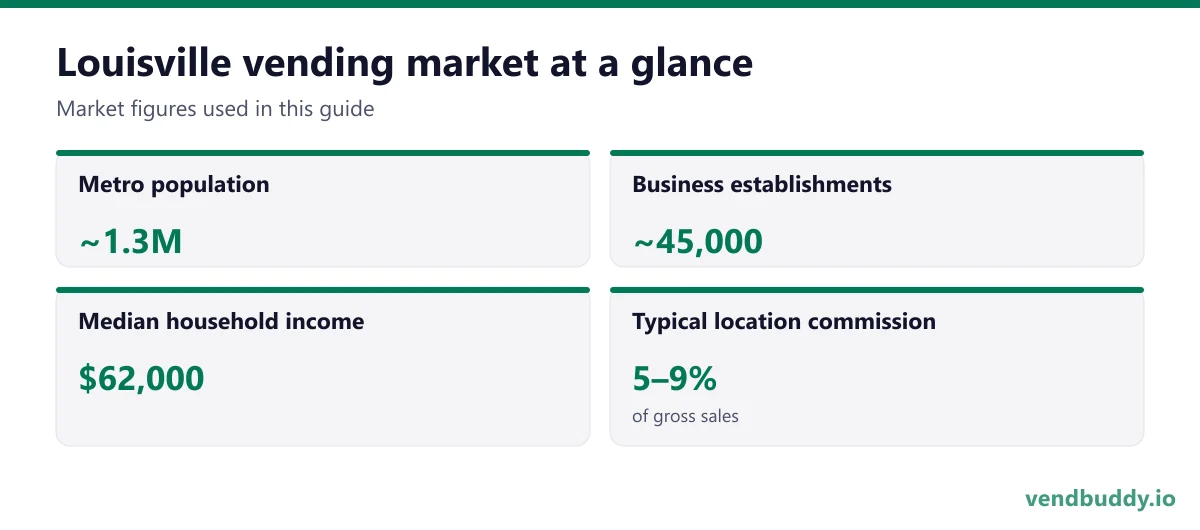
A qualified yes — Louisville works, but only for an operator who plans the route before buying the first machine. The Louisville, KY metro carries about 45,000 establishments across roughly 1.3M residents — about 34.6 business establishments per 1,000 people, right around the roughly 30-per-1,000 national figure, so route quality comes down to which districts you pick. Median household income is $62,000, under the roughly $75,000 U.S. median, and that number decides more than any other whether a $2.25–$2.75 price point holds or you have to run value pricing to keep vend counts up. The metro added 100K+ residents 2014–2024 with corporate growth driven by healthcare and logistics expansion. On the supply side, the East End and Jeffersontown corridor are notably under-vended relative to employer density.
Demand here concentrates in Healthcare and Insurance, Logistics, Manufacturing and Distilling and Hospitality, led by Healthcare and Insurance — and those workers sit in identifiable places, not spread evenly across the metro. The 5 districts mapped below (Downtown Louisville; East End; St. Matthews; UPS Worldport; Jeffersontown) are where the captive headcount actually is. Budget for 5–9% of gross in commission — commission expectations are operator-friendly by national standards. Sales tax on vends runs 6%. One local wrinkle to plan around: Kentucky is one of the small number of states that requires a state-level vending operator license. The administrative load is modest but distinct from sales tax registration — both are required.
The catch: Canteen, Five Star, and Aramark hold the largest Humana, UPS, and major hospital contracts. That is the shape of every market this size — the marquee accounts are contracted, and the money for an independent operator is one tier down, in the buildings next door to them.
| Signal | Louisville | National reference |
|---|---|---|
| Metro population | ~1.3M | — |
| Business establishments | ~45,000 | — |
| Establishments per 1,000 residents | 34.6 | ~30 |
| Median household income | $62,000 | ~$75,000 |
| Commission expectation | 5–9% of gross | 10–15% typical |
| Sales tax on vended goods | 6% | varies by state |
| Demand sectors driving placements | Healthcare and Insurance, Logistics, Manufacturing and Distilling and Hospitality | — |
| Placement districts mapped below | 5 | — |
Is Louisville a good area to start a vending machine business?
A qualified yes — Louisville works, but only for an operator who plans the route before buying the first machine. Louisville carries ~45,000 establishments across a 1.3M metro — about 34.6 establishments per 1,000 residents, right around the roughly 30-per-1,000 national figure, so route quality comes down to which districts you pick. Median household income is $62,000, under the roughly $75,000 U.S. median. Start in Downtown Louisville, then East End — both are broken out below with named placement targets. The honest constraint: Canteen, Five Star, and Aramark hold the largest Humana, UPS, and major hospital contracts.
Can I start a vending machine business in Louisville?
Yes. Kentucky requires a state-level Vending Machine License from the Department of Revenue. Operators register for the state vending license, plus a Kentucky Sales and Use Tax permit, and complete county food handler training. Jefferson County (Louisville) requires basic food safety training for any food service operator. Sales tax on vended goods: Kentucky state rate: 6%. No city or county local sales tax addition — Kentucky is a flat statewide rate state. Vending sales of food are taxable; some non-prepared food categories may qualify for exemption. Food handler rules and the local permit quirks are broken out in full further down this page. No KY statute blocks a new operator from placing machines in Louisville — the real barrier is placement access, not paperwork.
How much do vending machines make in Louisville?
There is no city-level vending revenue dataset for Louisville, and any specific Louisville figure you see quoted is an estimate dressed up as data. What operators report nationally: a healthy snack and drink placement grosses roughly $150–$400 per machine per month, low-traffic placements sit at $75–$150, and high-density captive placements (24/7 warehouses, hospital night shift, 200-plus-person offices) clear $400–$700 or more. Gross margin lands near 50–55% before commission. Demand signals in Louisville point toward the middle of that band: median household income is $62,000, demand concentrates in Healthcare and Insurance, Logistics, Manufacturing and Distilling and Hospitality, and commission expectations are operator-friendly by national standards at 5–9% of gross. Model your own stops with the free route valuation calculator.
Two free tools do the two jobs this page cannot: one ranks the ZIPs, the other prices a deal. Neither needs an account.
Louisville Vending Market Overview
Louisville, KY is a market where the metro added 100K+ residents 2014–2024 with corporate growth driven by healthcare and logistics expansion. The metro contains roughly 45,000 establishments at a median household income of $62,000, and the East End and Jeffersontown corridor are notably under-vended relative to employer density. The implication for a new or scaling operator: the prospecting addressable market is large, the per-machine economics support a real business, and the gap between operator coverage and underlying demand is real enough that it shows up in routing math, not just marketing copy.
The four sectors that drive vending demand in Louisville are Healthcare and Insurance, Logistics, Manufacturing, Distilling and Hospitality. Each has its own access pattern (badge-required vs. open lobby), break-room culture (catered vs. dependent on vending), and product-mix expectation (premium vs. value). The sections below break each down with named employers and the placement targets that actually convert.
Before you commit to a route in Louisville, work through our location scoring checklist on a sample location — it will save you the cost of a bad first placement, which is usually a year of revenue. If you are still pre-launch, our guide to starting a vending machine business walks through the entity setup, financing, and machine sourcing that comes before the prospecting phase.
Top Industries Driving Vending Demand in Louisville
The four industries below account for the bulk of high-revenue vending placements in Louisville, KY. The named employers are anchor tenants — large, captive workforces that drive the local property managers' decisions about whether to install vending at all. Reading these in order also tells you what kind of operator wins which placement: the apparel of a healthcare-pitch deck looks nothing like the apparel of an aerospace-pitch deck, and matching the fit matters more than commission percentage.
Healthcare and Insurance
Humana HQ (downtown campus, 12,000+ Louisville employees — one of the largest single-employer corporate campuses in Kentucky), Norton Healthcare, Baptist Health Louisville, plus the broader UofL Health and Jewish Hospital network.
Logistics
UPS Worldport at Louisville International (the largest fully automated package handling facility in the world, 20,000+ employees), plus the broader I-65 distribution corridor. Louisville Muhammad Ali International is one of the top-5 U.S. cargo airports.
Manufacturing
Ford Kentucky Truck Plant (Super Duty and Lincoln Navigator production, 8,000+ employees), Ford Louisville Assembly Plant (Escape and Corsair, 4,000+), GE Appliances (Park HQ, recently acquired by Haier), plus the broader Kentucky auto-supply ecosystem.
Distilling and Hospitality
Brown-Forman HQ (Jack Daniel's parent), the Bourbon Trail headquarters cluster, plus the surrounding hospitality and tourism ecosystem. Most distilleries' actual production is rural, but corporate offices and visitor centers concentrate in Louisville.
For deeper revenue benchmarks by location type — apartment vs. warehouse vs. medical vs. office — see our vending machine income data and the vending costs and profit breakdown. Both are continuously updated from operator surveys.
Best Placement Districts in Louisville
The districts below are ranked by daytime worker density and operator-coverage gap, not just by population. A district with 50,000 office workers and three national operators competing already may be a worse target than a district with 20,000 office workers and zero operator presence. Louisville has a few of each — the named placement targets in each card are the actual employers and properties to prospect, not generic industry categories.
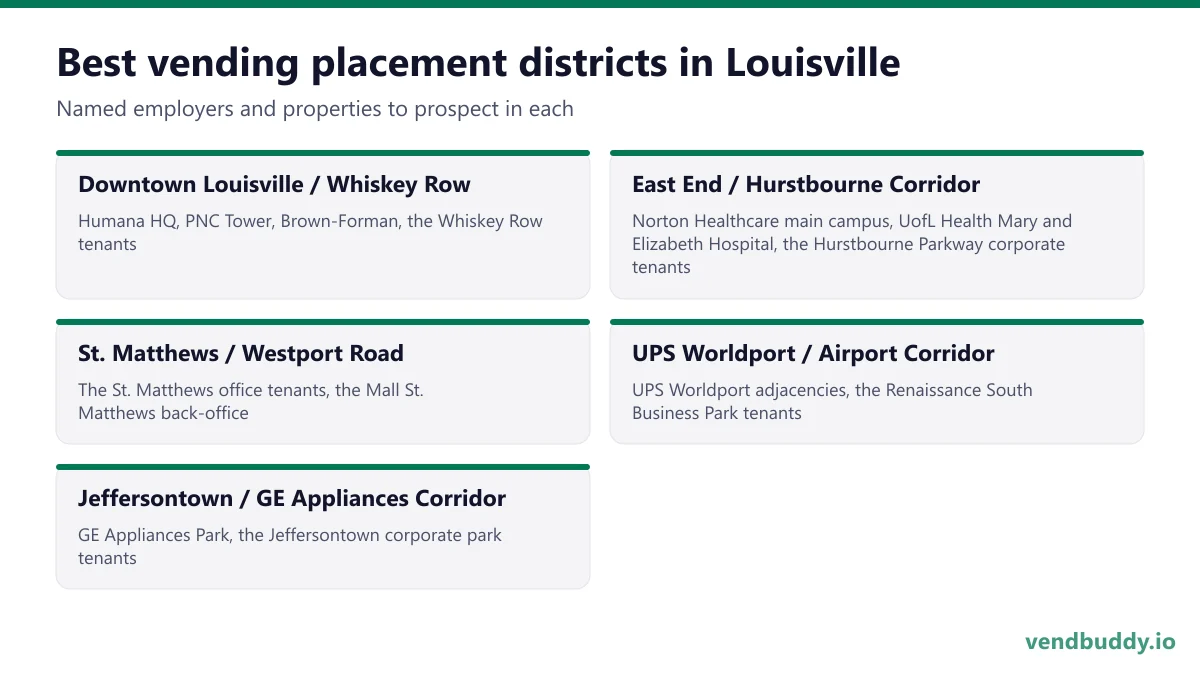
Downtown Louisville / Whiskey Row
Humana HQ campus, the PNC Tower, Brown-Forman corporate offices, plus the Whiskey Row district along Main Street. Walkable urban core with bourbon tourism overlay.
Named placement targets: Humana HQ, PNC Tower, Brown-Forman, the Whiskey Row tenants, plus the downtown federal courthouse and adjacent law firm offices
East End / Hurstbourne Corridor
Louisville's primary suburban office corridor along Hurstbourne Parkway and the Watterson Expressway. UofL Health Mary and Elizabeth Hospital, Norton Healthcare main campus, plus a deep professional services tenant base.
Named placement targets: Norton Healthcare main campus, UofL Health Mary and Elizabeth Hospital, the Hurstbourne Parkway corporate tenants, plus the Watterson Expressway office buildings
St. Matthews / Westport Road
Older Class A office cluster anchored by the St. Matthews retail district. Multiple insurance, professional services, and finance tenants.
Named placement targets: The St. Matthews office tenants, the Mall St. Matthews back-office, plus the surrounding Westport Road and Shelbyville Road professional services cluster
UPS Worldport / Airport Corridor
UPS Worldport's main facility, plus the broader Louisville International cargo and ground operations. The Renaissance South Business Park adds adjacent corporate office.
Named placement targets: UPS Worldport adjacencies, the Renaissance South Business Park tenants, plus the airport hotel cluster and the Logistics Drive corporate park
Jeffersontown / GE Appliances Corridor
GE Appliances Park (one of the largest appliance manufacturing complexes in the U.S.), plus the broader Jeffersontown industrial and corporate ecosystem along the Snyder Freeway.
Named placement targets: GE Appliances Park, the Jeffersontown corporate park tenants, plus the Bluegrass Industrial Park distribution centers and the surrounding I-265 corporate corridor
Want the list built for you? Pick one Louisville ZIP and VendBuddy delivers the 50 best-scored locations in it, enriched with the best contact on file, automatically, for $97 once.
If you are weighing whether a specific building inside one of these districts is worth pursuing, run it through our location scoring checklist first. It catches the bad-fit placements (low captive headcount, restricted access hours, existing operator relationship) before you waste a pitch on them.
KY Licenses, Permits, and Sales Tax for Vending in Louisville
Kentucky requires a state-level Vending Machine License from the Department of Revenue. Operators register for the state vending license, plus a Kentucky Sales and Use Tax permit, and complete county food handler training. Jefferson County (Louisville) requires basic food safety training for any food service operator.
Sales tax in Louisville: Kentucky state rate: 6%. No city or county local sales tax addition — Kentucky is a flat statewide rate state. Vending sales of food are taxable; some non-prepared food categories may qualify for exemption.
Food handler requirements: Jefferson County Public Health and Wellness accepts ANSI-accredited online food handler programs. Surrounding counties (Bullitt, Oldham, Shelby) have similar requirements.
Local quirks worth knowing: Kentucky is one of the small number of states that requires a state-level vending operator license. The administrative load is modest but distinct from sales tax registration — both are required.
Every researched KY market, plus the state rules in one place: our KY vending hub.
State-by-state vending laws — including license thresholds, sales tax, and food handler requirements — are summarized in our vending laws reference. If you are forming an LLC for the route, our LLC setup and tax deductions guide covers the federal and state-level deductions specific to vending operators.
Commission Rates and Negotiation in Louisville
Typical commission range in Louisville: 5–9% of gross.
Downtown Louisville Class A typically asks 7–9%. East End and St. Matthews settle at 6–8%. Medical: 5–7%. Industrial Jeffersontown: 0–4%. Apartments: $30–$60/month product credit. Louisville commission norms are Midwest-moderate — comparable to Indianapolis and Columbus, lower than Chicago's downtown rates.
Use our vending commission rates by location type for the full negotiation rubric (when to walk, when to counter with product credit, when to accept and renegotiate at renewal). The negotiating vending placements covers the actual scripts.
VendBuddy shows the best contact on file for the properties in this guide (owner or manager when available), with the emails and phone numbers we can find. Plus the contract generator, ROI calculator, and placement scoring tools you need to close.
Launch VendBuddy Free →A 3-Day Starter Route in Louisville
If you are dropping into Louisville for the first time and want to walk out with a real prospect list in 72 hours, this is the route experienced operators use. It groups districts by drive efficiency rather than by industry — you cover the most square footage with the fewest miles, which matters more in week one than perfect target prioritization.
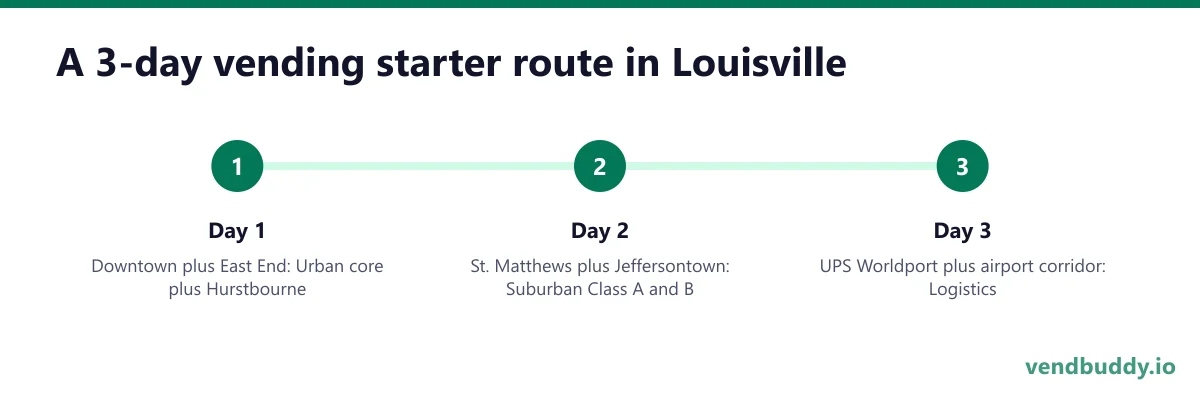
Targets: Humana HQ campus, PNC Tower, Brown-Forman, then Norton Healthcare main, UofL Health Mary and Elizabeth, the Hurstbourne corporate tenants
Field note: Humana's main HQ campus runs national vending contracts; the surrounding downtown and East End office is the accessible target. East End property management is concentrated under several local firms.
Targets: The St. Matthews office tenants, the Westport Road cluster, GE Appliances Park, plus the Jeffersontown industrial park tenants
Field note: St. Matthews is older Class A with rotating tenants — call building managers, not individual companies. Jeffersontown's industrial belt is shift-work-heavy with low commission expectations.
Targets: UPS Worldport adjacencies, the Renaissance South Business Park tenants, the airport hotel cluster, the Logistics Drive corporate park
Field note: UPS itself runs national contracts at the main Worldport. The surrounding airport-area corporate park and hotel cluster are the accessible play — high revenue, 24/7 traffic.
For the cold-email cadence to send the same evening, see our cold email scripts for property managers. The first email goes out within 24 hours of a pop-in; the second 5–7 days later. Operators who skip the same-day follow-up close at roughly half the rate of operators who do not.
Competition and Underserved Pockets in Louisville
Canteen, Five Star, and Aramark hold the largest Humana, UPS, and major hospital contracts. Compass Group covers many GE Appliances and Ford Kentucky Truck Plant contracts. Local Kentucky operators dominate the second tier — the smaller East End and St. Matthews tenants, the Jeffersontown corporate park, the airport-corridor Class B office, and the off-Worldport logistics belt. The biggest underserved zone is the East End / Hurstbourne corridor's smaller tenants and the Jeffersontown corporate park.
The lesson, in Louisville as in every other Tier-1 metro: the high-revenue marquee accounts (Fortune 500 HQs, flagship hospitals, university dining contracts) are locked under multi-year national contracts with Canteen, Five Star, Compass, or Aramark. The opportunity for an independent or regional operator is the second tier — the Class B office down the street, the medical office building two doors down from the main hospital, the apartment leasing office three blocks from a Whole Foods. Those are accessible, profitable, and almost always underserved.
Vending Machine Companies in Louisville, KY
If you manage a property in Louisville and want a machine placed, you do not pay for it — the operator buys, stocks, and services the machine and earns from what sells. Instead of calling companies one by one, submit the two-minute request at vendbuddy.io/property-managers and it gets routed to independent operators working the Louisville area; at most two receive it, and the first to claim it contacts you. How placement deals work, what commission is normal, and the national-versus-local trade-off are all in vending machine companies near me.
Louisville Vending FAQ
What licenses do I need to operate vending in Louisville?
Kentucky requires a state-level Vending Machine License through the Department of Revenue, plus a Kentucky Sales and Use Tax permit and food handler certification from any ANSI-accredited program. Jefferson County does not require additional city-level licensing.
What is the sales tax rate for vending in Louisville?
6% statewide, with no city or county local additions. Kentucky's flat rate makes multi-location operations administratively simple — single tax return per month with no jurisdiction-by-jurisdiction allocation.
Where are the best vending opportunities in Louisville right now?
The East End / Hurstbourne corridor's smaller tenants, the Jeffersontown corporate park (GE Appliances-adjacent and the surrounding Bluegrass Industrial Park), and the airport-area corporate park and hotel cluster. Downtown Louisville is well-served for the marquee tenants; the suburban growth zones are not.
How does the Kentucky state vending license requirement work?
Kentucky is one of a handful of states that requires a state-level vending operator license. Register through the Department of Revenue — the application is online, fees are modest (under $50 annually), and the license is required in addition to sales tax registration. Plan to renew annually.
Can I place vending at UPS Worldport?
UPS itself runs national vending contracts at the main Worldport facility. The accessible play is the surrounding airport-area corporate park (Renaissance South Business Park, Logistics Drive corporate cluster), plus the airport hotels (Marriott, Hilton, plus the smaller properties) and the off-Worldport logistics tenants. Most are 24/7 operations with high revenue per machine.
Essential Vending Guides
Other Mid-South and Midwest metros: Chicago, IL · Nashville, TN · Knoxville, TN · Frankfort, KY
General information, not legal, tax or financial advice. Rules change, so check the official source. Revenue and income figures are examples, not promises. See our terms.