A large share of Woodbridge is not here during the working day. Two Virginia Railway Express stations and the I-95 express lanes carry tens of thousands of residents north toward Washington every morning, so the market an operator actually serves is not the 43,000 residents — it is the businesses that stay behind to serve them. That list is short and legible: Potomac Mills, Sentara Northern Virginia Medical Center, the Route 1 trades corridor, the Northern Virginia Community College campus, and the county administrative complex on Prince William Parkway. There is no Woodbridge town hall, because there is no Woodbridge municipality. And Virginia will tax your machines on what you paid your supplier rather than on what the machine collected, which is the single most consequential thing on this page.
- Vending locations in Woodbridge: what the data shows
- What the Woodbridge numbers mean for operators and building owners
- Is Woodbridge a good place to start a vending machine business?
- Woodbridge Vending Market Overview
- Top Industries Driving Vending Demand in Woodbridge
- Best Placement Districts in Woodbridge
- VA Licenses, Permits, and Sales Tax for Vending in Woodbridge
- Commission Rates and Negotiation in Woodbridge
Free to search. 5 free contact reveals, no card.
Property owners and managers: tell us about the site and we pass it to an operator who covers Woodbridge, if one is in range.
Request a free machine →- Woodbridge is an unincorporated census-designated place in Prince William County, with 44,668 residents at the 2020 census and roughly 43,400 in recent American Community Survey estimates, sitting about 20 miles south of Washington between the Occoquan and Potomac rivers.
- Household median income runs near $100,400, high by national standards and driven largely by residents who commute out of the county to work.
- Virginia registers vending machine dealers separately from ordinary retailers, and you file the Vending Machine Dealer's Return, Form VM-2 with schedule VM-2B, electronically and even in periods with no sales.
- The Northern Virginia region's vending rate is 7 percent calculated on the cost price of merchandise you stock, not on machine takings, while ordinary retail in the same region runs 6 percent combined.
- Anchors that do not leave: Sentara Northern Virginia Medical Center with capacity for 183 patients, Potomac Mills, Stonebridge at Potomac Town Center, and the NOVA Woodbridge campus.
- Marine Corps Base Quantico sits just south, and vending on federal property runs through the Randolph-Sheppard framework rather than a commercial sales call — plan around it rather than into it.
Free tools: vending ROI calculator · revenue calculator by property type · route time calculator · State of Vending 2026 report · all free tools
- Is Woodbridge a good place to start a vending machine business?
- Woodbridge Vending Market Overview
- Top Industries Driving Vending Demand
- Best Placement Districts in Woodbridge
- VA Licenses, Permits, and Sales Tax
- Commission Rates and Negotiation
- 3-Day Starter Route in Woodbridge
- Competition and Underserved Pockets
- Woodbridge Vending FAQ
Vending locations in Woodbridge: what the data shows
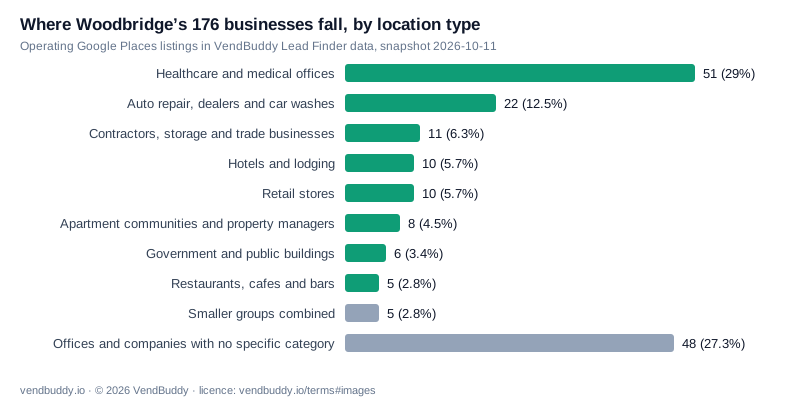
Start with the count: 176 active listings. Healthcare and medical offices make up 29% (51), auto shops and dealers 12.5% (22) and contractors and trade businesses 6.3% (11); generic office and service firms fill 27%.
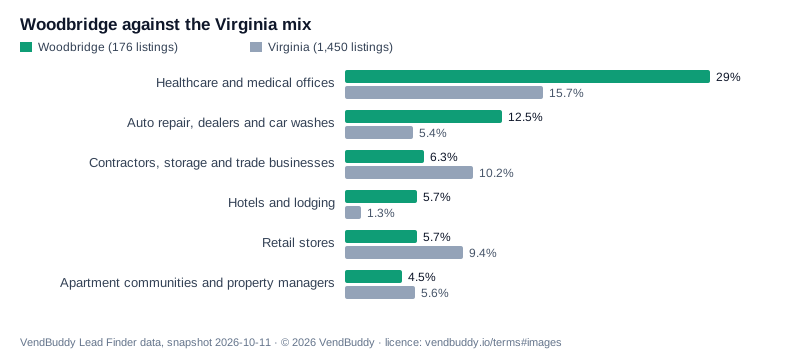
What sets Woodbridge apart inside Virginia: a heavier weight of healthcare and medical offices (+13.3 pts) and a lighter one of restaurants and cafes (-4.6 pts) than the statewide sample of 1,450.
Rated listings here have a median of 4.4 stars, below the Virginia median of 4.5, and 65 (37%) hold 4.5 or better on at least 10 reviews.
Hours matter for vending: 24% of the 85 Woodbridge businesses that publish them run past 9 PM some night, less than the 33% state figure.
| Location type | Listings | Share | Virginia share |
|---|---|---|---|
| Healthcare and medical offices | 51 | 29% | 15.7% |
| Auto repair, dealers and car washes | 22 | 12.5% | 5.4% |
| Contractors, storage and trade businesses | 11 | 6.3% | 10.2% |
| Hotels and lodging | 10 | 5.7% | 1.3% |
| Retail stores | 10 | 5.7% | 9.4% |
| Apartment communities and property managers | 8 | 4.5% | 5.6% |
| Government and public buildings | 6 | 3.4% | 1.2% |
| Restaurants, cafes and bars | 5 | 2.8% | 7.4% |
| Smaller groups combined | 5 | 2.8% | 7.8% |
| Offices and companies with no specific category | 48 | 27.3% | 36.1% |
| Total operating listings | 176 | 100% | 1,450 listings |
How we counted: Google Places listings that VendBuddy’s Lead Finder looked up between May and October 2026 with a Woodbridge, VA address, de-duplicated by place ID, operating businesses only, grouped by their Google category. Groups under 5 listings are combined. This is the sample our users searched, not a census of every business. Snapshot 2026-10-11.
Rules before you place a machine: Virginia vending hub (state permits and sales tax), and the state-by-state vending laws reference.
What the Woodbridge numbers mean for operators and building owners
The market read
Strong ground for a classic snack and drink route. Most named businesses in our Woodbridge sample are places where a standard snack and drink machine earns its floor space: 88% sit in location groups the VendBuddy machine-fit matrix rates primary or good for it, ahead of 73% across Virginia. Evening trade sits in the middle, with 24% of listings open past 9 PM (Virginia: 33%); a mixed route of daytime offices and a few late sites fits that profile.
If you own or manage a clinic, hospital or medical office in Woodbridge: 51 healthcare and medical offices came up in the Lead Finder searches vending operators ran here (29% of the sample, well above the 15.7% Virginia share), so operators are already looking at medical sites like yours. The machines the fit matrix rates primary for this kind of site are snacks and drinks, smart coolers, coffee and hot food. In the standard arrangement the operator buys, stocks and services the machine; tell us about the property and we pass it to an operator who covers Woodbridge, if one is in range. Ask for a free machine in Woodbridge →
Three venue types to target first in Woodbridge
Ranked by how many listings each type has here, how well a standard snack and drink machine suits it, and how over-represented it is against Virginia.
- Healthcare and medical offices: 51 listings, 29% of the Woodbridge sample. That is 1.9 times the Virginia share of 15.7%. Snack and drink fit: primary (steady daily headcount, nothing to eat nearby while on shift). Rated primary: snacks and drinks, smart coolers, coffee and hot food.
- Auto repair, dealers and car washes: 22 listings, 12.5% of the Woodbridge sample. That is 2.3 times the Virginia share of 5.4%. Snack and drink fit: primary (customers wait for service, break room traffic is steady). Rated primary: snacks and drinks, air machines, coffee and car care supplies.
- Hotels and lodging: 10 listings, 5.7% of the Woodbridge sample. That is 4.3 times the Virginia share of 1.3%. Snack and drink fit: primary (steady daily headcount, nothing to eat nearby while on shift). Rated primary: snacks and drinks, AI smart machines, smart coolers and massage chairs.
Virginia rules that apply to a machine in Woodbridge
Tobacco and vape vending in Virginia (Va. Code § 18.2-371.2, checked 2026-10-01): Selling retail tobacco products (which include nicotine vapor products) from a vending machine is prohibited. The rule reaches vapes and e-liquids as well as tobacco, so a vape machine in Woodbridge is held to it.
On top of that, federal rules (21 CFR 1140.14(b)(3) and 1140.16(c)(2)(ii)) allow tobacco and e-cigarette vending only where no one under 21 is present or allowed in.
Snack, drink and coffee machines carry none of that. Their paperwork is the sales tax and permit rules in the Woodbridge licensing section below and the Virginia vending hub.
How Woodbridge compares with nearby markets
- Richmond, VA (78 miles away): Healthcare and medical offices lead there too, at 12.2% of 189 listings against 29% in Woodbridge. More of that sample stays open late (57% past 9 PM, 24% here).
- Pittsburgh, PA (191 miles away): The mix tilts differently: restaurants and cafes lead with 23.6% of 216 listings, where Woodbridge has 2.8%. More of that sample stays open late (78% past 9 PM, 24% here).
- Raleigh, NC (209 miles away): The mix tilts differently: apartment communities and property managers lead with 12.3% of 487 listings, where Woodbridge has 4.5%. More of that sample stays open late (38% past 9 PM, 24% here).
Is Woodbridge a good place to start a vending machine business?
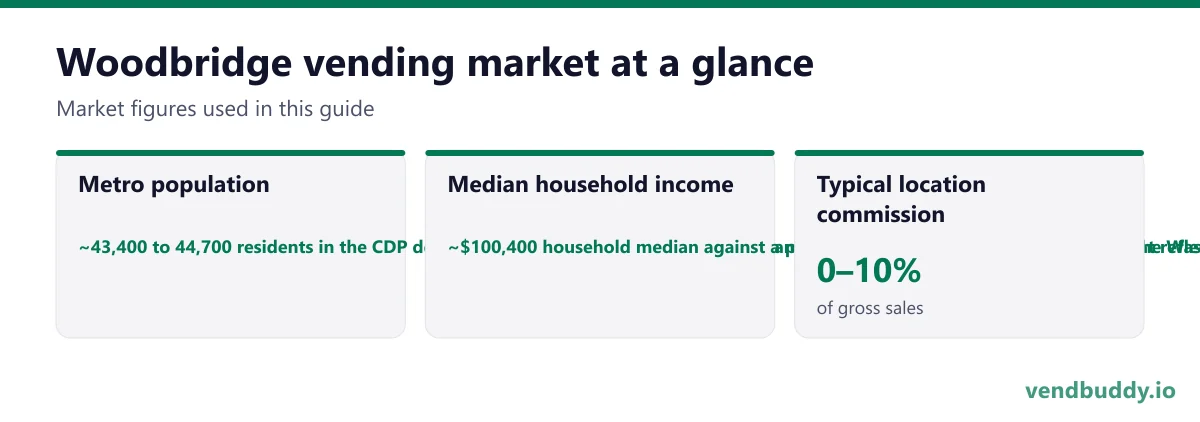
Yes — Woodbridge is one of the stronger starting markets covered in this guide. The Woodbridge, VA metro carries about 3,000 establishments, weighted toward retail, healthcare, food service, construction trades and automotive rather than corporate office tenancy across roughly 43K residents — about 69.1 business establishments per 1,000 people, well above the roughly 30-per-1,000 national figure, so prospecting density is working for you. Median household income is ~$100,400 household median against a per-capita figure near $42,500 — a gap that reflects multi-earner commuting households rather than high local wages, comfortably above the roughly $75,000 U.S. median, and that number decides more than any other whether a $2.25–$2.75 price point holds or you have to run value pricing to keep vend counts up. Prince William County has been one of the faster-growing jurisdictions in Virginia for two decades, and around Woodbridge that growth shows up as riverfront and transit-adjacent residential development plus continued redevelopment along the Route 1 corridor. On the supply side, the hospital interior and the mall's anchor tenants are contracted, while the Route 1 trades corridor, the independently leased medical suites, the smaller office tenants and the community college support buildings are inconsistently served.
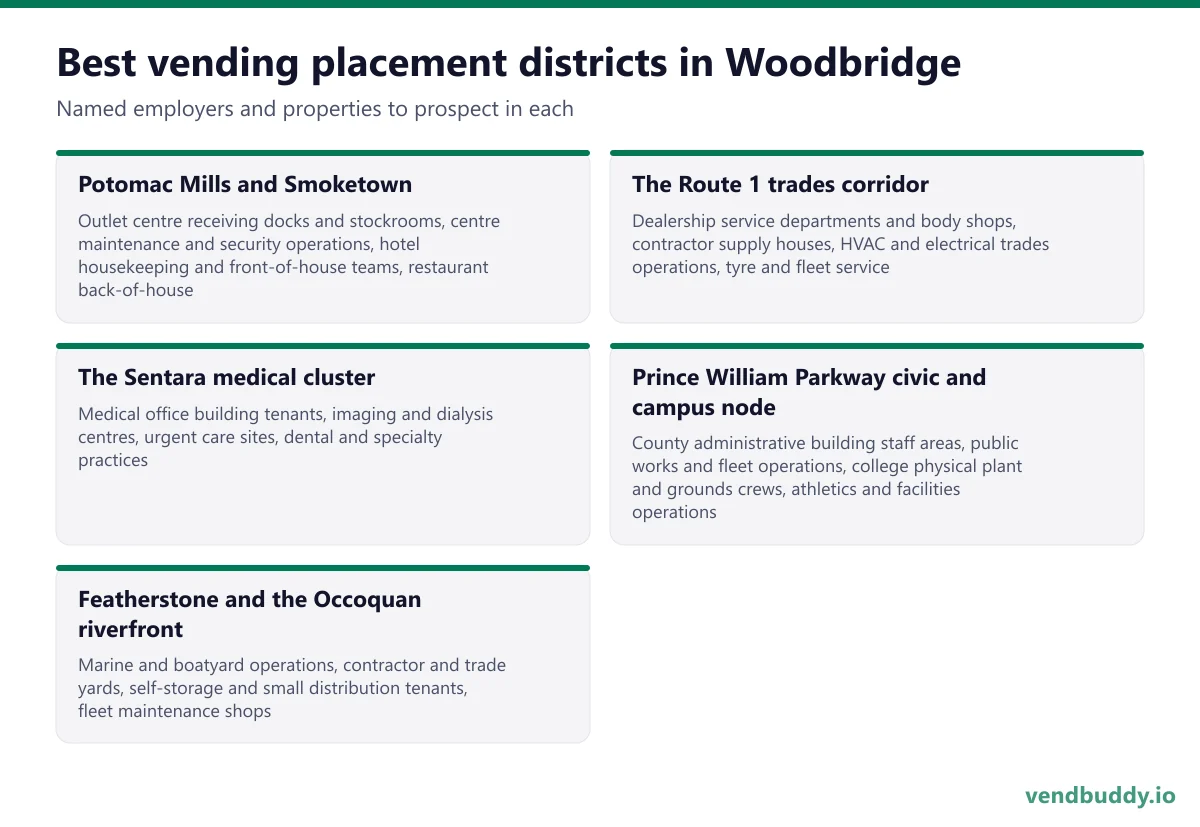
Demand here concentrates in Regional Retail and Hospitality, Healthcare and Outpatient Services, Construction Trades and Automotive, Public Sector and Higher Education and Logistics and Distribution, led by Regional Retail and Hospitality — and those workers sit in identifiable places, not spread evenly across the metro. The 5 districts mapped below (Potomac Mills and Smoketown; The Route 1 trades corridor; The Sentara medical cluster; Prince William Parkway civic and campus node; Featherstone and the Occoquan riverfront) are where the captive headcount actually is. Budget for 0–10% of gross in commission — commission expectations are operator-friendly by national standards. Sales tax on vends runs 7%. One local wrinkle to plan around: check the property-level rules before you install.
The catch: Woodbridge sits inside the service radius of every large operator running the I-95 corridor between Washington and Fredericksburg, which means the accounts that look attractive from a spreadsheet are already held: the hospital, the mall's anchors, the larger hotels. That is the shape of every market this size — the marquee accounts are contracted, and the money for an independent operator is one tier down, in the buildings next door to them.
| Signal | Woodbridge | National reference |
|---|---|---|
| Metro population | ~43,400 to 44,700 residents in the CDP depending on vintage, inside a Prince William County population above 480,000 and the Washington metropolitan area | — |
| Business establishments | ~3,000 establishments, weighted toward retail, healthcare, food service, construction trades and automotive rather than corporate office tenancy | — |
| Establishments per 1,000 residents | 69.1 | ~30 |
| Median household income | ~$100,400 household median against a per-capita figure near $42,500 — a gap that reflects multi-earner commuting households rather than high local wages | ~$75,000 |
| Commission expectation | 0–10% of gross | 10–15% typical |
| Sales tax on vended goods | 7% | varies by state |
| Demand sectors driving placements | Regional Retail and Hospitality, Healthcare and Outpatient Services, Construction Trades and Automotive, Public Sector and Higher Education and Logistics and Distribution | — |
| Placement districts mapped below | 5 | — |
Is Woodbridge a good area to start a vending machine business?
Yes — Woodbridge is one of the stronger starting markets covered in this guide. Woodbridge carries ~3,000 establishments, weighted toward retail, healthcare, food service, construction trades and automotive rather than corporate office tenancy across a 43K metro — about 69.1 establishments per 1,000 residents, well above the roughly 30-per-1,000 national figure, so prospecting density is working for you. Median household income is ~$100,400 household median against a per-capita figure near $42,500 — a gap that reflects multi-earner commuting households rather than high local wages, comfortably above the roughly $75,000 U.S. median. Start in Potomac Mills and Smoketown, then The Route 1 trades corridor — both are broken out below with named placement targets. The honest constraint: Woodbridge sits inside the service radius of every large operator running the I-95 corridor between Washington and Fredericksburg, which means the accounts that look attractive from a spreadsheet are already held: the hospital, the mall's anchors, the larger hotels.
Can I start a vending machine business in Woodbridge?
Yes. Virginia does not license vending as an occupation, but it does put vending in a tax category of its own instead of folding it into general retail, and getting that wrong at registration is the most common Virginia vending error. Operators who place machines register with the Virginia Department of Taxation specifically as vending machine dealers and file the Vending Machine Dealer's Return, Form VM-2 with schedule VM-2B, electronically, monthly or quarterly depending on liability, by the twentieth of the month following the period — and the return is due whether or not there were sales. Registering under an ordinary retail sales permit is far easier to avoid than to unwind afterwards. Sales tax on vended goods: Two figures apply here and they are not measuring the same thing. Ordinary retail in Prince William County runs 6 percent combined: the 4.3 percent state rate, a 1 percent local rate, and the 0.7 percent Northern Virginia regional addition that also covers Fairfax, Arlington, Alexandria and Loudoun. Vending machine dealers inside that same Northern Virginia region are instead assessed at 7 percent on the cost price of the merchandise they stock — what the supplier invoiced you — rather than on what customers put into the machine. Outside the regional areas the vending figure drops to 6.3 percent. Because the base is your purchase cost, your margin discipline and your tax bill are linked in a way they are not in most states. Confirm your current rate and filing frequency with the Department of Taxation. Food handler rules and the local permit quirks are broken out in full further down this page. No VA statute blocks a new operator from placing machines in Woodbridge — the real barrier is placement access, not paperwork.
How much do vending machines make in Woodbridge?
There is no city-level vending revenue dataset for Woodbridge, and any specific Woodbridge figure you see quoted is an estimate dressed up as data. What operators report nationally: a healthy snack and drink placement grosses roughly $150–$400 per machine per month, low-traffic placements sit at $75–$150, and high-density captive placements (24/7 warehouses, hospital night shift, 200-plus-person offices) clear $400–$700 or more. Gross margin lands near 50–55% before commission. Demand signals in Woodbridge point toward the upper half of that band: median household income is ~$100,400 household median against a per-capita figure near $42,500 — a gap that reflects multi-earner commuting households rather than high local wages, demand concentrates in Regional Retail and Hospitality, Healthcare and Outpatient Services, Construction Trades and Automotive, Public Sector and Higher Education and Logistics and Distribution, and commission expectations are operator-friendly by national standards at 0–10% of gross. Model your own stops with the free route valuation calculator.
Two free tools do the two jobs this page cannot: one ranks the ZIPs, the other prices a deal. Neither needs an account.
Woodbridge Vending Market Overview
Woodbridge, VA is a market where Prince William County has been one of the faster-growing jurisdictions in Virginia for two decades, and around Woodbridge that growth shows up as riverfront and transit-adjacent residential development plus continued redevelopment along the Route 1 corridor. The metro contains roughly 3,000 establishments, weighted toward retail, healthcare, food service, construction trades and automotive rather than corporate office tenancy at a median household income of ~$100,400 household median against a per-capita figure near $42,500 — a gap that reflects multi-earner commuting households rather than high local wages, and the hospital interior and the mall's anchor tenants are contracted, while the Route 1 trades corridor, the independently leased medical suites, the smaller office tenants and the community college support buildings are inconsistently served. The implication for a new or scaling operator: the prospecting addressable market is large, the per-machine economics support a real business, and the gap between operator coverage and underlying demand is real enough that it shows up in routing math, not just marketing copy.
The four sectors that drive vending demand in Woodbridge are Regional Retail and Hospitality, Healthcare and Outpatient Services, Construction Trades and Automotive, Public Sector and Higher Education, Logistics and Distribution. Each has its own access pattern (badge-required vs. open lobby), break-room culture (catered vs. dependent on vending), and product-mix expectation (premium vs. value). The sections below break each down with named employers and the placement targets that actually convert.
Before you commit to a route in Woodbridge, work through our location scoring checklist on a sample location — it will save you the cost of a bad first placement, which is usually a year of revenue. If you are still pre-launch, our guide to starting a vending machine business walks through the entity setup, financing, and machine sourcing that comes before the prospecting phase.
Top Industries Driving Vending Demand in Woodbridge
The four industries below account for the bulk of high-revenue vending placements in Woodbridge, VA. The named employers are anchor tenants — large, captive workforces that drive the local property managers' decisions about whether to install vending at all. Reading these in order also tells you what kind of operator wins which placement: the apparel of a healthcare-pitch deck looks nothing like the apparel of an aerospace-pitch deck, and matching the fit matters more than commission percentage.
Regional Retail and Hospitality
Potomac Mills draws shoppers from well beyond the county, and a destination outlet centre of that scale runs an enormous back-of-house operation: receiving docks, stockrooms, centre maintenance and security, plus the hotels, restaurants and service businesses that cluster around it in the Smoketown area. Retail staff on a shift cannot leave the floor, and the hotel housekeeping and operations crews start before any food service opens. Stonebridge at Potomac Town Center adds a grocery-anchored version of the same pattern a short drive north, with overnight stocking crews who have nothing open to them at all.
Healthcare and Outpatient Services
Sentara Northern Virginia Medical Center, expanded to accommodate 183 patients, anchors a healthcare cluster whose reachable portion sits entirely outside the hospital walls. Independently leased medical office buildings, imaging and dialysis centres, urgent care sites, dental and specialty practices, and home-health and staffing agencies all make their own vendor decisions. Because a meaningful share of Prince William residents work outside the county, local healthcare employment is disproportionately important to the daytime economy — these buildings are staffed when much of the rest of Woodbridge is empty.
Construction Trades and Automotive
The Route 1 corridor through Woodbridge is Northern Virginia's working spine here: contractor supply houses, HVAC and electrical trades, auto dealerships with substantial service departments, body shops, tyre and fleet operations, and equipment rental yards. Crews arrive between six and seven in the morning, break as a group, and are nowhere near a lunch option. Decisions are made by an owner or service manager standing in the bay rather than by a facilities committee, and a route built on twelve of these accounts within three miles of each other has almost no drive time between stops.
Public Sector and Higher Education
Prince William County's administrative complex carries a Woodbridge address on Prince William Parkway, and Northern Virginia Community College's Woodbridge campus sits nearby, both employing steady daytime staff in buildings where food options are limited. College dining is contracted, so the target is the physical plant, grounds, athletics and administrative annex operations that dining never covered, plus the summer months when students are gone and facilities staff are not. County facilities pay nothing and decide slowly, but the placements last.
For deeper revenue benchmarks by location type — apartment vs. warehouse vs. medical vs. office — see our vending machine income data and the vending costs and profit breakdown. Both are continuously updated from operator surveys.
Best Placement Districts in Woodbridge
The districts below are ranked by daytime worker density and operator-coverage gap, not just by population. A district with 50,000 office workers and three national operators competing already may be a worse target than a district with 20,000 office workers and zero operator presence. Woodbridge has a few of each — the named placement targets in each card are the actual employers and properties to prospect, not generic industry categories.
Potomac Mills and Smoketown
The regional retail and hospitality node off I-95, built around a destination outlet centre with hotels, chain restaurants and big-box retail spreading out along Smoketown Road and Telegraph Road.
Named placement targets: outlet centre receiving docks and stockrooms, centre maintenance and security operations, hotel housekeeping and front-of-house teams, restaurant back-of-house, and the big-box management offices along the surrounding parkways
The Route 1 trades corridor
Richmond Highway running the length of the CDP, an older commercial artery carrying auto dealerships, contractor supply, trades businesses and small independent retail, with revitalisation projects layered onto a working corridor.
Named placement targets: dealership service departments and body shops, contractor supply houses, HVAC and electrical trades operations, tyre and fleet service, equipment rental yards, and the small independent retail and service tenants along the highway
The Sentara medical cluster
The healthcare node around the regional hospital, holding independently leased medical office buildings, outpatient facilities and specialty practices on their own leases rather than inside the hospital's contracts.
Named placement targets: medical office building tenants, imaging and dialysis centres, urgent care sites, dental and specialty practices, and the home-health and nurse staffing agencies with offices in the cluster
Prince William Parkway civic and campus node
The institutional corridor holding the county administrative complex and the community college campus, low-density and car-dependent with limited food service within walking distance of either.
Named placement targets: county administrative building staff areas, public works and fleet operations, college physical plant and grounds crews, athletics and facilities operations, administrative annex buildings, and the professional offices on the parkway
Featherstone and the Occoquan riverfront
The eastern edge toward the rivers and the VRE stations, mixing light industrial and marine businesses with self-storage, contractor yards and transit-adjacent development.
Named placement targets: marine and boatyard operations, contractor and trade yards, self-storage and small distribution tenants, fleet maintenance shops, and the businesses clustered around the commuter rail stations
Want the list built for you? Pick one Woodbridge ZIP and VendBuddy delivers the 50 best-scored locations in it, enriched with the best contact on file, automatically, for $97 once.
If you are weighing whether a specific building inside one of these districts is worth pursuing, run it through our location scoring checklist first. It catches the bad-fit placements (low captive headcount, restricted access hours, existing operator relationship) before you waste a pitch on them.
VA Licenses, Permits, and Sales Tax for Vending in Woodbridge
Virginia does not license vending as an occupation, but it does put vending in a tax category of its own instead of folding it into general retail, and getting that wrong at registration is the most common Virginia vending error. Operators who place machines register with the Virginia Department of Taxation specifically as vending machine dealers and file the Vending Machine Dealer's Return, Form VM-2 with schedule VM-2B, electronically, monthly or quarterly depending on liability, by the twentieth of the month following the period — and the return is due whether or not there were sales. Registering under an ordinary retail sales permit is far easier to avoid than to unwind afterwards.
Sales tax in Woodbridge: Two figures apply here and they are not measuring the same thing. Ordinary retail in Prince William County runs 6 percent combined: the 4.3 percent state rate, a 1 percent local rate, and the 0.7 percent Northern Virginia regional addition that also covers Fairfax, Arlington, Alexandria and Loudoun. Vending machine dealers inside that same Northern Virginia region are instead assessed at 7 percent on the cost price of the merchandise they stock — what the supplier invoiced you — rather than on what customers put into the machine. Outside the regional areas the vending figure drops to 6.3 percent. Because the base is your purchase cost, your margin discipline and your tax bill are linked in a way they are not in most states. Confirm your current rate and filing frequency with the Department of Taxation.
Local permits and licenses: Woodbridge is unincorporated and has no town government, so there is no municipal business licence and no local vending permit — Prince William County is the entirety of your local government here. Virginia localities are authorised to levy a Business, Professional and Occupational Licence tax, and Prince William County administers one through its Department of Tax Administration, with classification determining the rate and thresholds determining whether a flat fee or a rate-based charge applies. Do not assume the Fairfax County structure carries over; confirm your classification, threshold and filing deadline directly with the county before your first filing year closes.
Federal property: Marine Corps Base Quantico lies just south of the CDP and Fort Belvoir sits across the Occoquan in Fairfax County, and neither is reachable by a commercial sales call. Vending on federal property operates under the Randolph-Sheppard framework, which gives licensed blind vendors priority for vending facilities on federal sites — administered in Virginia through the state agency serving blind and vision-impaired residents — and installation access requires credentialing on top of that. Treat the ring of contractors, suppliers and service businesses outside the gates as the actual addressable market. That distinction saves a new operator weeks of misdirected effort.
Every researched VA market, plus the state rules in one place: our VA vending hub.
State-by-state vending laws — including license thresholds, sales tax, and food handler requirements — are summarized in our vending laws reference. If you are forming an LLC for the route, our LLC setup and tax deductions guide covers the federal and state-level deductions specific to vending operators.
Commission Rates and Negotiation in Woodbridge
Typical commission range in Woodbridge: 0–10% of gross.
The trades corridor along Route 1 is the least percentage-driven market in the county. A service manager with fourteen technicians wants a machine that is full on Monday and fixed within a day when it jams, and will not raise the subject of a revenue share unless you do. Retail and hospitality around Potomac Mills sit at the other end: centre and hotel management expect a percentage, may need a regional sign-off, and can sometimes bundle several properties into one conversation. Independently leased medical suites frequently prefer a fixed monthly product credit for staff, since the practice paying rent is not the one collecting the takings. County and college facilities take nothing at all. One Virginia-specific note: because your tax is assessed on merchandise cost rather than machine revenue, a commission you agree to sits entirely on top of a tax bill that does not shrink when sales do.
Use our vending commission rates by location type for the full negotiation rubric (when to walk, when to counter with product credit, when to accept and renegotiate at renewal). The negotiating vending placements covers the actual scripts.
VendBuddy shows the best contact on file for the properties in this guide (owner or manager when available), with the emails and phone numbers we can find. Plus the contract generator, ROI calculator, and placement scoring tools you need to close.
Launch VendBuddy Free →A 3-Day Starter Route in Woodbridge
If you are dropping into Woodbridge for the first time and want to walk out with a real prospect list in 72 hours, this is the route experienced operators use. It groups districts by drive efficiency rather than by industry — you cover the most square footage with the fewest miles, which matters more in week one than perfect target prioritization.
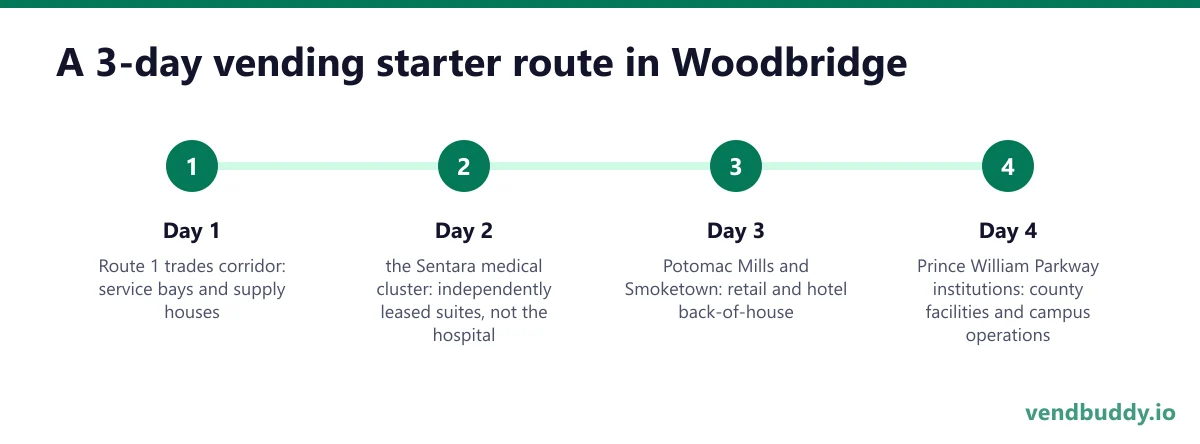
Targets: dealership service departments, body shops, contractor supply houses, HVAC and electrical trades, tyre and fleet operations, equipment rental yards
Field note: Be on the corridor by half past six. These crews are on site before any office opens and gone before most sales calls start. Ask for the service manager and lead with your fill day, because that is the only variable they care about.
Targets: medical office building tenants, imaging and dialysis centres, urgent care sites, dental and specialty practices, home-health and staffing agencies
Field note: The hospital interior is contracted at system level and will not change hands. The buildings around it are leased suite by suite, each with its own practice manager, and they are staffed on days when a commuter town is otherwise empty.
Targets: outlet centre receiving docks and stockrooms, centre maintenance and security operations, hotel housekeeping teams, restaurant back-of-house, big-box management offices
Field note: Approach through receiving rather than the front entrance. Expect a longer decision cycle here than anywhere else on this route, and confirm whether the property manager controls one site or several before discussing terms.
Targets: county administrative building staff areas, public works and fleet operations, college physical plant and grounds crews, athletics and facilities operations, administrative annexes
Field note: These sites generate no commission, which is exactly why nobody is competing for them. Confirm the service access and visitor procedure at the first meeting, and note that facilities staff work right through the summer when campus dining is shut.
For the cold-email cadence to send the same evening, see our cold email scripts for property managers. The first email goes out within 24 hours of a pop-in; the second 5–7 days later. Operators who skip the same-day follow-up close at roughly half the rate of operators who do not.
Competition and Underserved Pockets in Woodbridge
Woodbridge sits inside the service radius of every large operator running the I-95 corridor between Washington and Fredericksburg, which means the accounts that look attractive from a spreadsheet are already held: the hospital, the mall's anchors, the larger hotels. What that leaves is most of the actual market. The Route 1 trades corridor is dozens of ten-to-forty-person operations spread along a highway, individually far below a national's account minimum and collectively dense enough to service in a morning. Independently leased medical suites are the same shape. County and college facilities buildings generate no commission and therefore attract no interest at all. The regional operators are also structurally slow here, because a driver dispatched from Springfield or Fredericksburg loses the argument the moment a machine jams — and in a corridor where the alternative to your machine is a fifteen-minute drive, downtime is the only thing your customer will remember.
The lesson, in Woodbridge as in every other Tier-1 metro: the high-revenue marquee accounts (Fortune 500 HQs, flagship hospitals, university dining contracts) are locked under multi-year national contracts with Canteen, Five Star, Compass, or Aramark. The opportunity for an independent or regional operator is the second tier — the Class B office down the street, the medical office building two doors down from the main hospital, the apartment leasing office three blocks from a Whole Foods. Those are accessible, profitable, and almost always underserved.
Vending Machine Companies in Woodbridge, VA
If you manage a property in Woodbridge and want a machine placed, you do not pay for it — the operator buys, stocks, and services the machine and earns from what sells. Instead of calling companies one by one, submit the two-minute request at vendbuddy.io/property-managers and it gets routed to independent operators working the Woodbridge area; at most two receive it, and the first to claim it contacts you. How placement deals work, what commission is normal, and the national-versus-local trade-off are all in vending machine companies near me.
Woodbridge Vending FAQ
Do I need a vending machine license in Woodbridge, VA?
Virginia does not license vending as an occupation, so there is no operator licence to apply for. What Virginia does require is that you register with the Department of Taxation specifically as a vending machine dealer rather than as an ordinary retailer, and then file the Vending Machine Dealer's Return, Form VM-2 with schedule VM-2B, electronically. Because Woodbridge is unincorporated there is no town licence either, but Prince William County administers a Business, Professional and Occupational Licence tax through its Department of Tax Administration — confirm your classification and thresholds with the county directly.
How is Virginia sales tax calculated on vending machines?
Differently from ordinary retail, and this catches nearly every operator arriving from another state. Rather than collecting tax on what customers pay the machine, Virginia assesses vending machine dealers on the cost price of the merchandise they place in machines — the amount the supplier invoiced you. Inside the Northern Virginia region that includes Prince William County, the vending rate is 7 percent on that cost basis, while ordinary retail in the same region runs 6 percent combined. Outside the regional areas the vending figure is 6.3 percent. Verify the current rates and your filing frequency with the Department of Taxation.
Is there a Woodbridge business license?
No, because Woodbridge is not a municipality. It is an unincorporated census-designated place with no town council and no town hall, governed entirely by Prince William County, which means there is one layer of local government rather than two. Your local obligation is the county's BPOL requirement rather than a town licence, administered through the county's Department of Tax Administration, with the rate depending on how your business is classified and the charge depending on gross receipts. Confirm the current thresholds and deadline with the county rather than assuming another Northern Virginia jurisdiction's structure applies.
How much do vending machines make in Woodbridge?
There is no responsible number to quote, and Woodbridge has one factor that makes generic estimates especially misleading. A large share of residents commute out of the county to work, so residential population overstates the daytime market considerably. What actually drives volume is how many people are on site through a shift, whether the location runs early or overnight, how far the nearest food is, how well your selection fits that workforce, and your service frequency. A dealership service bay at seven in the morning and a medical suite at two in the afternoon are entirely different propositions.
Can I place vending machines at Quantico or Fort Belvoir?
Not through ordinary commercial channels. Vending on federal property falls under the Randolph-Sheppard framework, which gives licensed blind vendors priority for vending facilities on federal sites, administered in Virginia through the state agency serving blind and vision-impaired residents. Installation access adds a credentialing requirement on top of that. The market you can actually reach is the ring of contractors, suppliers, logistics operations and service businesses outside the gates, which share the installation's schedules without any of its access restrictions. Aim there and treat the bases as background rather than as targets.
What is the best first placement type in Woodbridge?
Automotive service and trades operations along the Route 1 corridor, for three converging reasons. The decision-maker is a service manager or owner standing on site who can say yes the same morning. There is genuinely nothing to eat within walking distance of most of those bays, so the pitch takes under a minute. And the accounts are packed along a single highway, which keeps drive time between stops near zero while you are still learning what sells. Medical office suites near Sentara are a reasonable second wave once you have references.
Essential Vending Guides
General information, not legal, tax or financial advice. Rules change, so check the official source. Revenue and income figures are examples, not promises. See our terms.