- Simple is not the same as easy. Simple means few moving parts. Easy means low effort. Almost nothing is both, and confusing them is why people quit in month four.
- Scored on three axes: moving parts, skills required, and time to competence — not on income potential, which every other list already ranks.
- The remote column is honest. Vending is not remote in phase one, and this page says so plainly.
- Phase two is a different story: with a paid route driver, the owner work is purchasing, pricing and reports — genuinely location-independent, and operators do live abroad for months.
- The trade is always the same: portable businesses trade competition for freedom; asset businesses trade time for it.
Almost every “simple business ideas” list is actually a list of businesses with low startup costs, which is a completely different property. Cheap to start and simple to run overlap much less than people expect, and the gap between them is where most first businesses die — not from lack of money, but from discovering in month four that the thing they picked has eleven moving parts and requires a skill nobody mentioned.
So this list is scored on the three things that actually determine whether you can still be running the business in a year: how many moving parts it has, what skills it requires you to already have or acquire, and how long it takes to become competent. Income potential is deliberately not the ranking axis, because a business you abandon has an income potential of zero.
First, the distinction that matters most
Simple means few moving parts. One revenue mechanism, few variables, a short causal chain between what you do and what happens.
Easy means low effort. Not much discomfort, not much work, no unpleasant tasks.
These get used interchangeably and they are almost opposites in practice. A vending route is genuinely simple — a machine, a building, a product mix, a weekly loop — and it is not easy, because acquiring the building means walking in and being told no roughly nineteen times out of twenty. Dropshipping is the reverse: easy to set up in a weekend, and not remotely simple, because it silently depends on advertising skill, supplier reliability, margin management and cash-flow timing, each of which takes a long time to learn and any of which can kill it.
The practical rule: choose simple, and expect not-easy. Simple things are learnable, correctable and survivable. When something is marketed as both simple and easy, something has been left out of the description, and it is usually the part where you have to do something uncomfortable in public.
The simplicity table
Scored one to five, where five is simplest, fewest skills required and fastest to competence. The remote column is answered honestly rather than aspirationally.
| Business | Moving parts | Skills needed | Time to competence | Remote friendly? |
|---|---|---|---|---|
| Vending route | 5 — machine, location, product mix | 4 — a scripted pitch and basic arithmetic | 5 — about 3 months | No in phase 1, yes in phase 2 with a driver |
| Pressure washing / lawn care | 5 — a machine and a customer | 4 — equipment care, quoting | 5 — weeks | No — you are the asset |
| ATM route | 5 — machine, location, cash | 3 — cash handling and compliance | 4 — 3–6 months | No — cash must be loaded in person |
| Self-storage / laundromat | 4 — property, equipment, tenants | 3 — property and maintenance judgement | 3 — 6–12 months | Partly, with on-site help |
| Notary / loan signing | 4 — appointments and paperwork | 3 — certification and precision | 4 — 2–3 months | No — signings are in person |
| Freelance service | 3 — clients, scope, delivery, invoicing | 2 — a marketable craft you already have | 2 — years to a real craft | Yes, day one |
| E-commerce / print on demand | 2 — product, ads, supplier, margin, returns | 1 — advertising is the actual job | 1 — years, and the platform keeps changing | Yes, day one |
| Content / digital products | 3 — but a long, noisy feedback loop | 1 — taste, distribution, consistency | 1 — years, with no guarantee | Yes, day one |
Two patterns fall straight out of the table.
The businesses that are simple are physical and local. Machines, buildings, equipment, in-person work. This is not a coincidence: physical constraints limit the number of variables, and a business with few variables is one you can actually reason about. It also explains why they are less crowded — a business you can start from a laptop anywhere is a business everyone can start from a laptop anywhere.
The businesses that are remote from day one are the hardest to learn. Every one of them scores 1 or 2 on skills and time to competence. Also not a coincidence. When there is no barrier to entry, the barrier moves to skill, and it moves a long way.
Picture the machines paying you while you sleep
That’s the real promise of vending — income that doesn’t cost you your time, and a life on your own terms. VendBuddy turns this guide into a step-by-step plan so you actually build it instead of just reading about it. Start free today.
Start building free →The remote question, answered honestly
This is the section that other lists get wrong, usually by implying that every business on the list can be run from a beach, so it is worth being precise.
Phase one of vending is not remote. At all.
Landing a location requires physically walking into buildings during weekday business hours. Restocking requires being present roughly weekly. Installing a machine requires moving 600 to 800 pounds of steel to a specific address. None of that has a remote version, and anyone telling you it does is selling a locating service, a “done-for-you” package, or a course. The locator-service version of that promise has a well-documented set of failure modes.
For the first year, this is a local business that requires you to be local. That is the honest cost of its simplicity.
Phase two genuinely is location-independent
And this part is real, so it deserves the same precision.
Once a route is large enough to justify paying someone to service it — realistically somewhere north of ten to fifteen machines, depending on density — the physical work is no longer yours. What remains for the owner is purchasing, pricing, reading sales reports, deciding which locations to keep and which to pull, and acquiring new placements. All of that is laptop work, and all of it is asynchronous.
Operators do run routes from other countries for months at a time. The margins support it: a route driver is a real cost, but a mature route has enough gross margin to absorb one and still pay the owner. What a driver costs, how to structure the pay, and how to screen for reliability is here — and the machine count where one person stops being enough is here.
The honest caveats, because this is where the fantasy usually outruns the reality:
- You are now managing a person, which is a different and harder skill than managing machines. Most owners find the first driver harder than the first ten machines.
- Machines break, and a broken machine 5,000 miles away is a phone call to somebody you trust rather than a problem you can look at.
- New locations still require somebody local to walk in, which caps growth while you are away unless you delegate that too.
- Getting to this point realistically takes one to three years of the unglamorous local version first.
So the honest framing is: vending buys location independence on a delay. A freelance business gives it to you on day one and charges you in competition and income volatility instead. Neither is free. They just invoice you differently, and knowing which invoice you would rather pay is most of this decision.
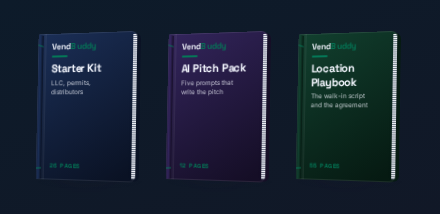
Everything above is free to read and free to do. The operator packs are the same material in fill-in-the-blank form — the 50-state distributor list, the LLC and permit checklist in unblocking order, the word-for-word walk-in script, and the placement agreement you hand a property manager. One-time purchase from $27, nothing renews.
See what is inside →Why vending scores where it does
Since this is a vending site, it is worth showing the working rather than asserting the conclusion.
Moving parts: 5. There are three, and you can hold all of them in your head: a machine, a building, and what goes in the machine. No inventory forecasting across hundreds of SKUs, no clients, no scope creep, no platform whose rules change quarterly. When revenue drops, there is a very short list of possible reasons, and it fits on one page.
Skills required: 4, not 5. Two skills, honestly named. You need to be able to deliver a forty-second pitch to a stranger without dying inside, and you need to be able to read a sales report and act on it. The first one is uncomfortable and gets easier with repetition; the second is arithmetic. What you do not need is a craft, a following, an advertising budget, or design taste.
Time to competence: 5. About three months, and the reason is the feedback loop. You change a product or a price, and three weeks later the sales report tells you whether that was right. Short, unambiguous, cheap. Compare that with advertising, where you change something, results move, and you often genuinely cannot tell whether it was your change or the platform — which is why competence there takes years rather than months.
Where it scores badly, to be fair: it is capital-first rather than sweat-first, at $2,000 to $5,000 for a first machine. It is not remote in phase one. And the first location is genuinely uncomfortable to acquire. If any of those three is a hard no for you, this is the wrong business, and the wider ranked list or the cash-flow comparison of what $10k buys are more useful pages than this one.
How to pick from the table
Three questions, in this order.
1. Do you have capital or time? If you have $3,000 and few spare hours, an asset business is the right shape — the money buys a thing that earns without you. If you have no capital and plenty of hours, a service business is the right shape, because your time is the input. Choosing the wrong shape here is the most common mismatch there is. Startup costs ranked across every popular model is the page for this question.
2. Can you do something uncomfortable in public, repeatedly? Every simple business on the table requires asking strangers for something. If the honest answer is no, the remote and digital options are not a cop-out, they are the correct fit — they trade that discomfort for a much longer learning curve, and that is a legitimate trade to make.
3. Do you want freedom now or freedom later? Now means portable and crowded. Later means local, uncomfortable, less competitive, and location-independent in a year or three. There is no version where it is both, and the lists that imply otherwise are the reason this page exists.
Capital or time, discomfort tolerance, deadline, protected hours — those four inputs decide which row of the table above is actually yours. The readiness quiz scores you on all four in about two minutes, and two of its five outcomes rank something other than vending first. If it points at a route, the Opportunity Map scores your ZIP free with no account.
The bottom line
The simplest businesses in 2026 are the physical, local, few-variable ones — machines, equipment, buildings, routes. They are simple because physical constraints keep the variable count low, and they are less crowded because most people would rather do something they can start from a laptop.
The genuinely remote businesses are the hardest to learn, for exactly the same reason in reverse: no barrier to entry means the barrier moved to skill, and it moved a long way.
And the honest version of the travel question is that an asset business buys location independence on a one-to-three-year delay, once somebody else does the physical work. That is slower than the pitch you have been sold, and it is a real path that real operators are on. Pick the invoice you would rather pay.
Most people working on the pitch start by pulling the list rather than driving the map. The ranks the businesses around your ZIP by type and headcount, and the first five contact reveals are free.
Related reading: the top 10 businesses to start in 2026, the best cash-flow businesses ranked by what $10k buys, side hustle startup costs ranked, realistic passive income ideas, is vending actually passive income, and recession-proof businesses ranked.
Frequently Asked Questions
What is the simplest business to start in 2026?
By moving parts rather than by income potential, the simplest real businesses are the ones with a single revenue mechanism, no clients, no inventory forecasting and no craft to master. A vending route scores well on all four: one machine, one location, one product mix, and competence in about three months. Pressure washing and lawn care are similarly simple but trade the asset for your own labour every single job. The businesses that look simple and are not include dropshipping and print on demand, where the operational work is small but the marketing skill required is large and takes years.
What businesses are easiest to learn?
The ones where the feedback loop is short and the number of variables is small. Vending gives you a result within three weeks of a decision - you changed a product or a price, and the sales report tells you whether it worked - with maybe six variables that matter. Anything dependent on an advertising algorithm or a content platform has a long, noisy feedback loop where you often cannot tell whether a change worked or the algorithm moved, which is why time to competence there is measured in years rather than months.
What are the best remote-friendly businesses in 2026?
Genuinely remote from day one means software, content, digital products, consulting delivered over video, and most e-commerce where fulfilment is outsourced. Those are the honest answers, and they all share a trait worth naming: because they can be started from anywhere by anyone, they are the most competitive categories that exist. Location-based businesses like vending, laundromats and self-storage are not remote in their first phase, but they become location-independent later once a paid operator handles the physical work - a slower path to the same freedom, with far less competition on the way.
Can you run a vending machine business remotely?
Not in phase one, and anyone saying otherwise is selling something. Placing a machine requires walking into buildings, and restocking requires being physically present roughly weekly. Phase two is genuinely different: once a route is large enough to pay a route driver, the owner work becomes purchasing, pricing, location acquisition and reading reports, which can be done from anywhere. Operators do live abroad for months at a time this way. It is harder than it sounds because you are managing a person rather than a machine, and the margins support it but only at scale.
What businesses let you travel?
Two different categories, with different trade-offs. Fully portable businesses - freelancing, consulting, content, software, digital products - let you travel from day one and are correspondingly crowded, because there is no barrier at all to the next person doing the same thing. Asset businesses with a hired operator - vending, laundromats, self-storage, rentals - let you travel from phase two, take one to three years to reach that point, and are far less competitive because most people will not do the unglamorous local work required to get there. The first category trades competition for freedom; the second trades time.
What is the difference between a simple business and an easy business?
Simple means few moving parts. Easy means low effort. Almost nothing is both, and confusing them is the main reason people quit in month four. A vending route is simple - one machine, one location, one product mix - and it is not easy, because getting the first location means being told no about nineteen times. Dropshipping is operationally easy to set up in a weekend and is not simple at all, because it depends on advertising skill, supplier reliability and margin management that take years to learn. Pick simple. Simple is learnable. Easy usually means someone left something out.
What business can I start with no experience?
Any business whose skill can be reduced to a written checklist and learned by doing it wrong a few times cheaply. Vending qualifies: the location criteria fit in a paragraph, the pitch is forty scripted seconds, the product mix is a documented starter planogram, and a mistake costs you a slow month rather than a catastrophe. The businesses that quietly require experience are the ones where the skill is judgement under uncertainty - buying inventory, running ads, pricing services - because there the first ten mistakes are expensive and the feedback is ambiguous.
What is selling, which buildings say yes, and the numbers before you buy a machine. Free, confirm from your inbox, unsubscribe in one click. Refer one friend and get 25 VendBuddy credits.
Walk-ins and cold emails find locations. A small site with your own machine photos and a request-a-machine form lets the next one find you. Around machine three to five, an AI builder drafts it in an evening. Wix is the mature site builder; Base44 also builds working tools like a quote form. Start with the AI website walkthrough or Wix vs Base44.
General information, not legal, tax or financial advice. Rules change, so check the official source. Revenue and income figures are examples, not promises. See our terms.