- Under 86 Ill. Adm. Code 130.310, all food sold through an Illinois vending machine is taxed as groceries except soft drinks, candy and food dispensed hot.
- Since January 1, 2026 the state levies no tax on groceries; towns and counties may add a local 1% grocery tax, and the NITA/RTA transit tax on groceries still applies.
- IDOR issues a free vending machine decal for each machine; Form STS-80 requests more, and decals expire with your Certificate of Registration.
- Chicago requires a Retail Food Establishment license for the vending machine business even for prepackaged snacks, plus a 3% soft drink tax on canned and bottled soft drinks.
- The 2026 minimum wage is $15.00 statewide, $17.05 in Chicago and $15.40 in suburban Cook County from July 1, 2026.
Illinois vending machine laws treat most vended food as groceries, which since January 1, 2026 means no state sales tax at all on chips, crackers and other non-candy snacks, while soft drinks, candy and anything dispensed hot stay at the full 6.25% state rate plus local tax. Add a Department of Revenue registration with a decal for each machine, a City of Chicago food license that applies even to sealed snacks, federal and state tobacco limits, and a $15.00 state minimum wage, and you have the whole Illinois rulebook. Each rule below links to its source, with a worked Chicago example.
Part of our complete guide: how to start a vending machine business.
How does Illinois sales tax apply to food, candy and soft drinks sold from vending machines?
Illinois sorts vended products by what they are, not by the fact that a machine sold them. 86 Ill. Adm. Code 130.310 says food for consumption off the premises includes all food sold through a vending machine, regardless of where the machine sits, except soft drinks, candy and food products dispensed hot. That puts the typical snack coil in the grocery category and leaves three product types at the high rate:
- Soft drinks: non-alcoholic beverages with natural or artificial sweeteners. Drinks containing milk or milk substitutes, or more than 50% fruit or vegetable juice by volume, are not soft drinks.
- Candy: but any product whose label lists flour as an ingredient is not candy. A wafer bar or a cookie-based chocolate bar is grocery food; a solid chocolate bar is candy.
- Hot food from the machine: hot coffee, soup or other items dispensed hot.
Now the 2026 change. The Illinois Department of Revenue (IDOR) Bulletin FY 2026-03 confirms the state eliminated its 1% tax on grocery sales effective January 1, 2026, and authorized municipalities and counties to impose a local grocery tax of exactly 1% by ordinance, filed with IDOR by October 1, 2025 to start on January 1. The same bulletin repeats that soft drinks, candy and prepared food were never groceries, so their 6.25% state rate did not move.
What the repeal did not touch: the transit tax on groceries. IDOR's PIO-115 notes the local tax on grocery food sold inside the Regional Transportation Authority (now the Northern Illinois Transit Authority, or NITA) and Metro-East Mass Transit District still applies. Home rule sales taxes do not reach qualifying food at all; IDOR's home rule tax page says they apply to the general merchandise base excluding qualifying food, drugs and medical appliances. So the grocery-side rate on a vending coil is 0%, 1%, or a transit rate, depending on the address.
What does Illinois sales tax cost on a $1,000-a-month vending machine in Chicago?
Chicago is the useful worked case because it stacks every layer. The general merchandise rate in the city is 10.50% since August 1, 2026: 6.25% state, 1.75% Cook County, 1.25% City of Chicago and the NITA rate, which IDOR Bulletin FY 2026-34 raised to 1.25% on general merchandise and 1.50% on qualifying groceries in Cook County. Chicago did not adopt the optional local grocery tax (WTTW reported the city's 1% grocery tax expired with the state's), so grocery-class snacks there should carry only the 1.50% NITA rate. On top of that, the Chicago Soft Drink Tax adds 3% of gross receipts on canned and bottled soft drinks, and IDOR states that the owner of the soft drinks in a vending machine is liable for it.
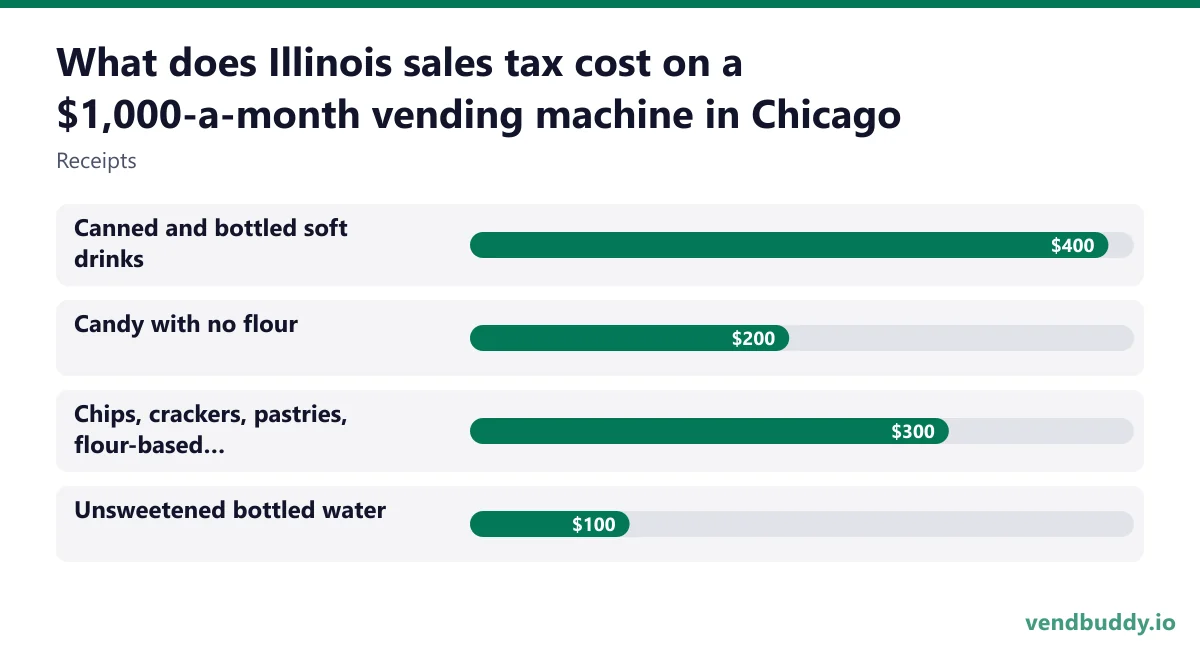
| Category (illustrative mix) | Receipts | Chicago rate, Aug 2026 on | Tax, Aug 2026 on | Tax, Dec 2025 rates |
|---|---|---|---|---|
| Canned and bottled soft drinks | $400 | 10.50% + 3% soft drink tax | $54.00 | $53.00 |
| Candy with no flour | $200 | 10.50% | $21.00 | $20.50 |
| Chips, crackers, pastries, flour-based bars | $300 | 1.50% | $4.50 | $6.75 |
| Unsweetened bottled water | $100 | 1.50% | $1.50 | $2.25 |
| Total | $1,000 | $81.00 | $82.50 |
The December 2025 column uses the old layers: 10.25% general merchandise (the transit share was 1.00%), 2.25% on grocery food (the 1% state grocery rate plus the 1.25% transit rate), and the same 3% soft drink tax. The table treats the $1,000 as receipts before tax; if your coil prices include tax, ask IDOR how to report the tax-included amount. Two lessons fall out. First, the grocery repeal cut about $4 a month from this machine's grocery-side tax, and the August NITA increase added back about $2.50. Second, the planogram drives the bill far more than the repeal did: move $100 from candy to a flour-based bar and Chicago tax on that $100 falls from $10.50 to $1.50.
Chicago also levies a bottled water tax of $0.05 per bottle. Wholesalers are required to collect it, and retailers must collect it only if the wholesaler did not, so for most operators it shows up in the case cost rather than on your return.
Picture the machines paying you while you sleep
That’s the real promise of vending — income that doesn’t cost you your time, and a life on your own terms. VendBuddy turns this guide into a step-by-step plan so you actually build it instead of just reading about it. Start free today.
Start building free →What registration does an Illinois vending machine business need?
Certificate of Registration. Every Illinois retailer registers with IDOR, normally through MyTax Illinois, for Retailers' Occupation Tax. IDOR's registration guide says that if you operate vending machines, it issues a vending machine decal (a sub-certificate) for each machine you sell from, based on the number you give at registration.
More decals: Form STS-80. When you add machines, Form STS-80 requests additional decals. There is no charge, the form asks for your total machine count and the number of decals you want, it goes to IDOR's Central Registration Division by email or mail, and the decals expire when your Certificate of Registration expires.
Filing. Sales are reported on Form ST-1. IDOR assigns frequency by average monthly liability: monthly above $200, quarterly between $50 and $200, annual under $50, with returns due the 20th after the period. The 2026 ST-1 instructions add a vending-relevant wrinkle: grocery receipts from machines inside the transit districts or a local-grocery-tax town go in gross receipts, while grocery receipts at locations with no remaining grocery tax are deducted as exempt. A Chicago route also files Form ST-14 for the soft drink tax.
The national overview of what each license layer means is in our state-by-state permit guide, and the Illinois city guides sit on the Illinois vending hub.
What license does the City of Chicago require for vending machines?
Chicago licenses the vending business, not just risky food. In the city's food establishment code (Municipal Code Chapter 4-8, published by the Chicago Department of Public Health):
- §4-8-066 exempts establishments selling only prepackaged, nonperishable food from the retail food establishment license, then states that the exemption does not apply to persons in the automatic food vending machine business.
- §4-8-032 requires an applicant for that business to list every machine and its location, the commissary or other place the machines are serviced from, the products and machine types, and the number of employees. The Department of Health approves the machine types and inspects the premises, commissary, storage and transport, plus representative machines, before the license issues.
- §4-8-034 requires every machine, including those under the prepackaged exemption, to show the name and business address of the responsible operator, the servicing commissary address and the license number.
- The code also makes it unlawful for a property owner to allow an automatic food vending machine from an unlicensed operator on the premises, which is a point worth raising when you pitch a Chicago building.
The license is a Retail Food Establishment license through the Department of Business Affairs and Consumer Protection. The published fee schedule runs by square footage, from $660 for 0–1,000 sq. ft. to $1,650 above 10,000 sq. ft., on a two-year term. How BACP measures a vending operation (typically your storage or commissary space) is a question to confirm with the department before you apply.
When does an Illinois vending machine need a health permit outside Chicago?
Outside Chicago, the Illinois Food Code (77 Ill. Adm. Code 750) governs, adopting the 2022 FDA Food Code. Its definition of a food establishment includes vending locations but excludes an establishment that offers only prepackaged foods that are not time/temperature control for safety (TCS) foods. In practice, a sealed-snack-and-soda machine usually falls outside food establishment permitting, while refrigerated sandwiches, dairy, salads and fresh-brew coffee bring you under the county or city health department that enforces the code at that address.
Food handler training follows the same line. The Illinois Department of Public Health defines a food handler as someone working with unpackaged food, food equipment or utensils, or food-contact surfaces. A driver who only moves sealed product into coils does not fit that definition; one who fills a coffee canister likely does.
Can you sell tobacco, vapes or nicotine from a vending machine in Illinois?
Illinois allows it in narrow places, and federal law narrows it further. 720 ILCS 675/1 permits tobacco products, electronic cigarettes and alternative nicotine products in a vending machine only if they are not mixed with any non-tobacco product other than matches, and only in places where people under 21 are never permitted, or in places where alcohol is sold and consumed on the premises with the machine under the direct supervision of the owner or manager. The state's minimum sale age is 21.
The bar exception is where federal law bites. 21 CFR 1140.16(c) limits cigarette and smokeless tobacco vending to facilities where no one under 21 is present or permitted at any time, and 21 CFR 1140.14(b)(3) does the same for e-cigarettes and other covered products. A restaurant-bar that admits under-21 diners may satisfy the state wording but not the federal one. Plan them only for strictly 21-and-over venues; see our nicotine vending guide before buying.
What must an Illinois vending operator pay a route driver in 2026?
The Illinois Department of Labor set the state minimum at $15.00 an hour for workers 18 and older beginning January 1, 2025, and it stays there in 2026. Workers under 18 who work fewer than 650 hours a year may be paid $13.00, and non-tipped adults may be paid $14.50 for their first 90 days. Two local floors sit above it:
- Chicago: $17.05 an hour from July 1, 2026 for employers with 4 or more employees, per the city's minimum wage page.
- Suburban Cook County: $15.40 from July 1, 2026 under the county ordinance, except in municipalities that opted out.
Which rate applies depends on where the driver works, so a route that crosses into Chicago needs a payroll provider's answer in writing. Illinois also requires paid leave: under the Paid Leave for All Workers Act, employees earn 1 hour per 40 worked, up to 40 hours a year, usable for any reason. Chicago and Cook County run their own paid leave ordinances, so check which one covers your driver. Budgeting help is in when to hire your first route driver.
First 30 days in Illinois: a state-specific checklist
- Days 1–3: register with IDOR through MyTax Illinois, state your machine count, and note your vending decals.
- Days 1–7: sort every SKU into soft drink, candy (no flour), hot-dispensed, or grocery food. Read the ingredient line on every candy bar.
- Days 7–14: run each placement address through the MyTax Illinois Tax Rate Finder for both rates, and check whether that town adopted the local 1% grocery tax.
- If any machine is in Chicago: apply for the BACP Retail Food Establishment license for the vending business, register for the soft drink tax, and label each machine with operator, commissary and license number.
- Before any fresh food: call the county or municipal health department that covers the address.
- Before hiring: confirm whether the state, Cook County or Chicago wage and paid leave rules apply.
- Days 14–30: build your placement list. Our location finder surfaces properties and the decision-maker contact in any Illinois ZIP.
- Day 30: calendar the first ST-1 (and ST-14 in Chicago) for the 20th after your first period.
Illinois local rates move often: 2026 alone brought the grocery repeal in January and the NITA increase in August. Treat the figures above as a September 2026 snapshot, and confirm any rate against IDOR before you file.
Frequently Asked Questions
Do you need a license to own a vending machine in Illinois?
Illinois has no state vending operator license, but you must register with the Department of Revenue for Retailers' Occupation Tax and carry a vending machine decal on each machine. IDOR issues the decals free based on your machine count, and Form STS-80 requests more. In Chicago you also need a Retail Food Establishment license for the vending machine business, even if you sell only prepackaged snacks.
Did the Illinois grocery tax repeal make vending snacks tax free?
Partly. Vended food other than soft drinks, candy and hot-dispensed items counts as groceries, and the state's 1% grocery tax ended January 1, 2026. But many municipalities and counties adopted their own 1% local grocery tax, and the NITA transit tax on groceries still applies in the six northern Illinois counties. Check each machine's address in the MyTax Illinois Tax Rate Finder.
Is candy taxed differently from chips in an Illinois vending machine?
Yes. Candy is taxed at the full 6.25% state rate plus local tax, while chips and most other snacks are grocery food. Illinois does not treat a product as candy if its ingredient label lists flour, so a wafer or cookie-based chocolate bar is taxed as grocery food. Soft drinks and food dispensed hot are also taxed at the high rate.
What is the sales tax on a vending machine soda in Chicago?
From August 1, 2026, the general merchandise rate in Chicago is 10.50%, made up of 6.25% state, 1.75% Cook County, 1.25% city and 1.25% NITA. The Chicago Soft Drink Tax adds 3% of gross receipts on canned and bottled soft drinks, and the owner of the drinks in a vending machine is liable for it. That puts a vended soda at 13.5% in combined tax.
Can I put a vape vending machine in an Illinois bar?
State law, 720 ILCS 675/1, allows tobacco and nicotine vending in places under-21s never enter, or where alcohol is served on premises and the owner or manager directly supervises the machine. Federal rules at 21 CFR 1140.16(c) and 1140.14(b)(3) are stricter: vending is allowed only where no one under 21 is present or permitted at any time. A bar that admits under-21 diners may not qualify federally.
What is selling, which buildings say yes, and the numbers before you buy a machine. Free, confirm from your inbox, unsubscribe in one click. Refer one friend and get 25 VendBuddy credits.
General information, not legal, tax or financial advice. Rules change, so check the official source. Revenue and income figures are examples, not promises. See our terms.