- Unit count is a trap. Gate entries are the number, and the gate system logs every one of them. Ask for the monthly count and the arithmetic finishes itself.
- Household tenants visit a few times a year. A 500-unit facility can log under 1,000 entries a month, minutes each. That is not a location.
- What flips it is the tenant mix. Contractors, tradesmen and e-commerce sellers visit daily, at 6am, with a truck. Ask what share of units are commercial.
- Skip the national REITs entirely. Public Storage, Extra Space and CubeSmart buy centrally and run remote-managed sites with no local authority.
- Temperature kills more of these than traffic does. A drive-up row is an unconditioned metal corridor. Interior climate-controlled, the office, or pass.
Self-storage looks like free money to an operator who has not run the numbers: thousands of units, gated access, twenty-four hour entry, and nothing to buy for a mile. Two of those four are real advantages. The other two are what makes most storage facilities a bad placement, and the difference between the good ones and the bad ones is a single question you can ask on the phone.
Part of our complete guide: how to find vending machine locations.
If you came here looking for whether to buy a storage facility instead of buying machines, that is a different post and a genuinely different decision — it is in vending versus self-storage. This one is about putting your machine inside somebody else's facility.
The one question that qualifies the site
Ask for the monthly gate entry count.
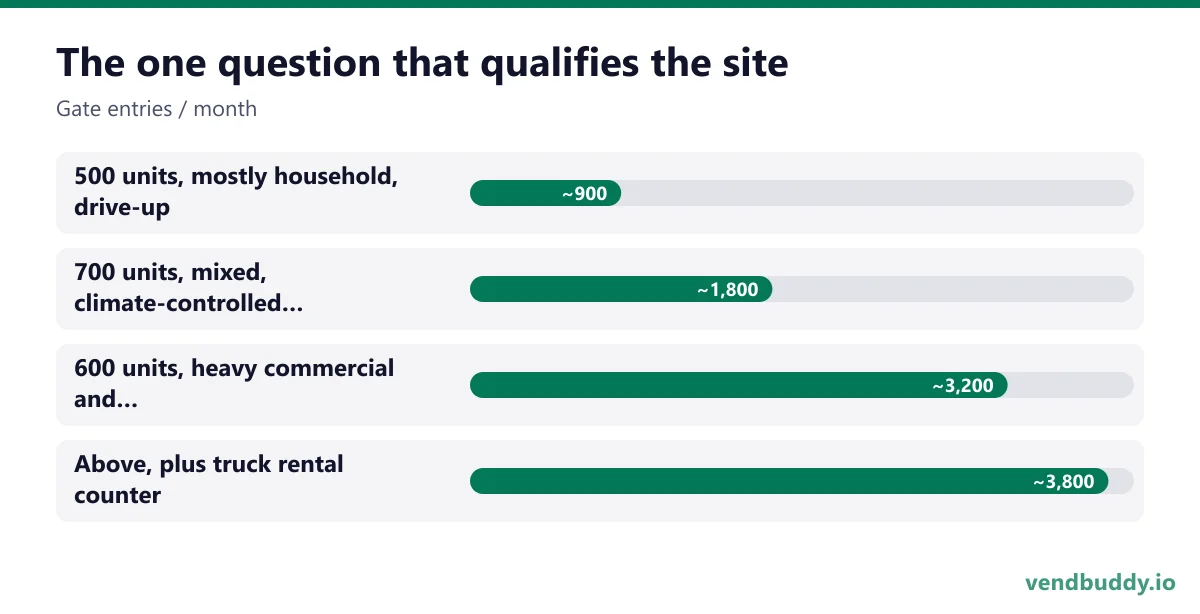
Storage is the only venue in this series where the traffic number is logged automatically and completely. Every tenant enters a code at the gate, the system timestamps it, and the manager can pull a month of it in about a minute. You do not have to estimate, and neither does the owner. Ask for it, and while you are there ask what the daypart split looks like, because a site whose entries cluster at 6am is a commercial site and a site whose entries cluster on Saturday afternoon is a household site.
Here is why that question is the whole post. A household storage tenant visits their unit rarely — the stuff is in there precisely because they do not need it. A facility with 500 units can log under a thousand gate entries in a month, each lasting a few minutes, and half of those are somebody backing a trailer up to a roll door in the rain. Run it:
| Facility | Gate entries / month | Modelled gross, 3–8% capture at $2.25 |
|---|---|---|
| 500 units, mostly household, drive-up | ~900 | $60–$160 |
| 700 units, mixed, climate-controlled building | ~1,800 | $120–$320 |
| 600 units, heavy commercial and contractor mix | ~3,200 | $215–$575 |
| Above, plus truck rental counter | ~3,800 | $255–$685 |
Those are models built on numbers the facility can give you, not benchmarks, and the capture range is deliberately wide because nobody has good published data on capture at a storage gate. The point is the shape rather than the digits: the top row is not a location and the bottom row is a decent small account. The variable that moved between them is not size. It is who rents the units.
The four facilities that actually work
- Heavy commercial and contractor tenancy. This is the one that matters. A plumber storing tools, an HVAC contractor staging equipment, an e-commerce seller running inventory out of a 10x20 — these tenants come every working day, early, often twice. One facility with forty commercial units can out-traffic another with four hundred household ones. It is also the daypart that buys: a contractor loading a van at 6:30am is the single most reliable vending customer in this venue class, and he is the same buyer profile that makes auto repair shops work.
- A staffed rental office with a retail counter. If the site sells boxes, tape, locks and mattress bags at a counter, two useful things are true: somebody is there, and the owner already thinks in terms of ancillary revenue. That is a much shorter conversation than one with an owner who has never sold anything but square feet.
- Multi-storey climate-controlled. Conditioned air, an enclosed corridor, cameras, elevator lobbies where tenants stand with a loaded cart. This is the only building type in the category where a machine sits in an environment it was designed for.
- Truck rental co-location. A facility that is also a U-Haul or Penske dealer has people standing at a counter doing paperwork, and then moving furniture in the heat for four hours. It is the strongest single signal on the list and it is visible from the road.
RV and boat storage with a wash bay is a fifth, smaller case: people spend an hour washing a boat and they are outside doing it. Seasonal, but real in the right market.
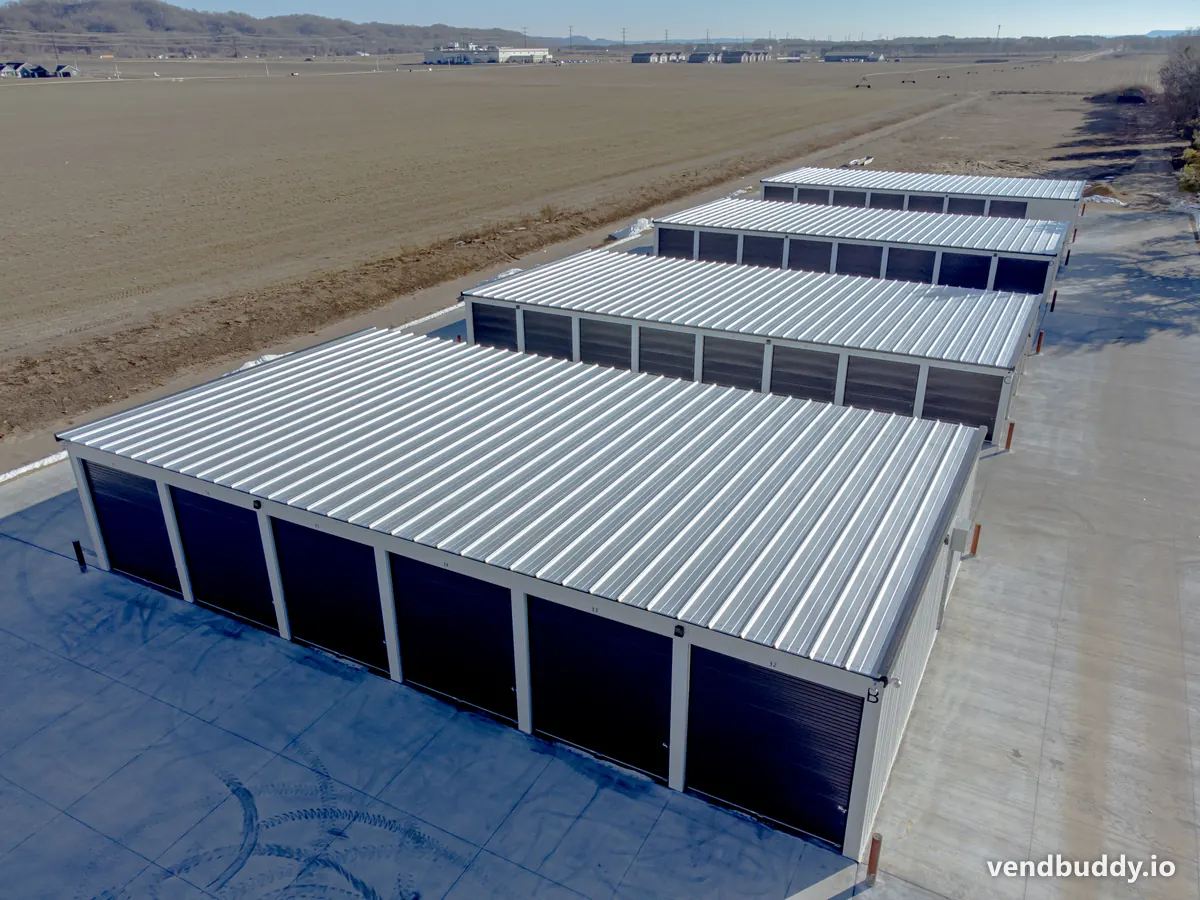
Storage is the one venue where the traffic number is logged automatically. Ask for the monthly gate entry count and the arithmetic finishes itself before you ever drive out.
Picture the machines paying you while you sleep
That’s the real promise of vending — income that doesn’t cost you your time, and a life on your own terms. VendBuddy turns this guide into a step-by-step plan so you actually build it instead of just reading about it. Start free today.
Start building free →Who signs, and who cannot
Throw out the national REITs first. Public Storage, Extra Space and CubeSmart buy centrally, run large numbers of sites with no full-time staff, and have no local authority to give you. The manager, where there is one, will tell you so.
What is left splits three ways, and the opening question is the same for all of them: who owns it and who manages it day to day. Those are frequently two different answers in this industry.
- Owner-operator independent. One or two facilities, often a local investor who also owns other property. Fastest yes in the category.
- Small regional operator. A district manager covering six to fifteen sites, which is the best structure to find, because one yes is potentially several placements and the district manager has route logic of his own.
- Third-party managed. An investor owner with a management company running the property. The manager can usually approve an amenity that costs the property nothing and will tell you when it needs to go to the owner. Ask, in the first conversation, the same way you would at a third-party-managed hotel. The general version of this is the decision-maker map.
What a storage owner actually cares about
- Reviews and occupancy. Storage is rented almost entirely off online listings and Google reviews. Anything that makes the site look cared for helps; anything that generates a complaint hurts more than the amenity helps.
- Not adding a maintenance item. This is the real objection and it is rarely said out loud. At an unstaffed site, a machine that eats a tenant's four dollars at 9pm on a Sunday becomes a one-star review about the facility, not about you. Your entire credibility here rests on answering that before he raises it.
- Commercial tenant retention. Commercial tenants are the best customers in storage: they pay on time, stay for years and rent bigger units. An amenity aimed at them is genuinely interesting to an owner.
- Security. Anything that adds a reason for a non-tenant to be on the property is a question. Machines inside the gate, not outside it.
The pitch
“Before I take any of your time — can you pull your gate entries for last month, and roughly what share of your units are commercial? If the answer is what I think it is at a site with this many contractors, the ask is small: the corridor by the elevator in Building B. Cashless only, so there is no cash box on your property and nothing to break into. If it ever eats somebody's money the refund runs through the reader, and my number goes on the front so your tenants call me and not you.”
That last sentence is the one that closes storage accounts. You have named his actual fear — a machine turning into his problem at a site he does not staff — and removed it before he had to say it. The general mechanics of raising an objection before the prospect does are in what location objections actually mean.
The walk-in and the phone version above, written out in full — how to qualify a site in one question before you drive, the twelve objections operators really hear, and the plain-English placement agreement to leave at the rental counter.
See what is inside →The objections
“Nobody is here to look after it.”
Agree, then make the machine not need looking after. Cashless-only removes the cash box and the coin jam, which between them cause most of what a site manager would otherwise have to deal with. Put your service number on the front. Offer to check in on a fixed weekly day so there is a rhythm the manager can rely on. If telemetry is in your setup, say so plainly — a machine that tells you it is out of Gatorade is exactly the reassurance this owner is asking for.
On telemetry specifically, Nayax is the default for a dull reason: it is the one most machine suppliers pre-wire for. Price the monthly against your slowest machine, not your best one. Affiliate link, so we may earn a commission at no extra cost to you.
“It will get vandalised.”
Inside the gate and inside a camera view, this is much less true than at an unfenced site, and you should say which of those two conditions you need. If the only offered spot is outside the gate, decline it. An operator who declines a bad wall reads as somebody who knows what he is doing, and you will get offered a better one surprisingly often.
“We tried one years ago and it did nothing.”
Ask two questions: where was it, and did it take cards. The answers are almost always the drive-up row and no. A cash-only machine in an unconditioned corridor in 2014 is not evidence about a cashless unit in a climate-controlled lobby, and framing it that way turns a dead objection into a conversation about which building.
“What do I get?”
An amenity, kept clean, at zero cost and zero labour. Do not offer a percentage at these volumes — the arithmetic in the table above shows why a revenue share here is a rounding error attached to a paperwork burden. If he pushes, offer product for the office instead. The general framing sits in commission rates.
Equipment, and the temperature problem
This is where most storage placements really fail, and it has nothing to do with sales.
A drive-up row is an uninsulated metal corridor. In a Phoenix July it runs well over a hundred degrees for hours; in a Minneapolis January it is below freezing for weeks. Chocolate turns, cans freeze and split, condensation gets into a bill validator, and a cooler compressor asked to hold forty degrees against a hundred-and-ten ambient does not last. So:
- Interior climate-controlled corridor or the rental office. Otherwise decline. There is no machine that makes a metal breezeway a good idea, and the operators who learn this learn it with a ruined load and a dead compressor.
- Cashless-first, anchored, in camera view. No cash box at an unstaffed site, ever.
- Check the power before you agree. Drive-up rows frequently have no accessible outlet, and running a dedicated circuit is not a cost this account can carry.
- Product: water and sports drinks lead by a distance, then energy drinks for the early commercial daypart, then salty. Skip everything that melts regardless of the building. The general logic is in best products to stock.
The honest verdict
Storage is a supplement, not a standalone. The good version of this account is a climate-controlled facility with a commercial tenant base, on a route you already drive, taken at zero commission, serviced when you are passing. That is a couple of hundred dollars a month of contribution for almost no marginal drive time, which is a perfectly good thing to own.
What it is not is a category to build a route around, and the failure mode is specific: an operator hears twenty-four-hour gated access and pattern-matches it to a genuine round-the-clock venue like the ones in 24/7 industrial and data centre vending. Those sites have people in them at 3am. A storage facility has a gate that works at 3am and nobody standing at it. Before you take one, run it against the floor in how many people a location needs.
Unit count is on the sign and tenant mix is not, which is why most storage prospecting is wasted driving. VendBuddy scores real storage facilities near you by size and category, flags the independents against the national brands, and hands you the best contact on file for each, so you start with the sites where the arithmetic can work. Free to start, no card.
Frequently Asked Questions
Do vending machines work at self-storage facilities?
Only at a specific minority of them, and the deciding variable is visit frequency rather than unit count. A household tenant visits a storage unit a handful of times a year, so a five-hundred-unit facility can log fewer than a thousand gate entries in a month, each one lasting minutes. That is a fraction of the traffic a machine needs. The facilities that do work are the ones with a heavy commercial and contractor tenant mix, a staffed rental office, or a truck rental counter attached, because all three convert an occasional-visit site into a daily-visit site.
How much traffic does a storage facility actually get?
Ask for the gate entry count, because unlike almost every other venue in this series the number is logged automatically and the manager can pull it. Gate systems record every code entry with a timestamp. That single question replaces all the guessing: if the facility cannot produce more than a couple of thousand entries a month, the arithmetic is already finished and you have saved yourself an install. It also tells you the daypart pattern, which is what decides whether the machine is worth stocking for morning contractors or evening households.
Who do you talk to about putting a vending machine at a storage facility?
The owner at an independent, the district manager at a small regional operator, and nobody at the national REITs, because Public Storage, Extra Space and CubeSmart run centralised vendor programmes and their sites are largely remote-managed with no local authority. A large share of independent facilities are now run by a third-party management company on behalf of an investor owner, so the useful opening question is who manages the property day to day and who owns it, because those are frequently two different answers.
What is the biggest problem with vending at a storage facility?
The buildings are mostly unconditioned and largely unstaffed, and those two facts do more damage than the low traffic does. A drive-up row is a metal corridor that hits well over a hundred degrees in a Phoenix July and goes below freezing in a Minneapolis January, which ruins product, bursts cans and shortens compressor life. Unstaffed means nobody notices a fault, nobody calls you, and a machine that is down for two weeks is generating a bad review on the listing the facility rents from.
Where should a vending machine go at a storage facility?
Inside a climate-controlled building if the site has one, ideally in an elevator lobby or the main interior corridor where tenants are already stopping with a cart. Second choice is the rental office, next to the counter that already sells boxes, tape and locks. Anywhere on a drive-up row is a mistake for temperature reasons before you even reach the security ones. If the only wall on offer is an exterior one, the honest answer is that the site is not a fit rather than that you need a tougher machine.
What commission do storage facility owners expect?
Usually nothing, and you should not volunteer one. At the volumes involved a revenue share is a few dollars a month against a vendor line the property accounting has to process, and the thing the owner actually wants is an amenity that makes the site look better in reviews and gives commercial tenants one more reason to renew. Offer the amenity, offer to keep it clean, and if an owner insists on a percentage at this volume treat that as information about whether the site is worth taking at all.
Related reading: how to find vending machine locations, auto repair shops, laundromats, hotels and motels, 24/7 industrial sites, how to cold call locations, and vending versus buying a storage facility.
What is selling, which buildings say yes, and the numbers before you buy a machine. Free, confirm from your inbox, unsubscribe in one click. Refer one friend and get 25 VendBuddy credits.
Want the free 38-page Ultimate Vending Guide too? Get the guide
Every operator we talk to wants fewer cold calls. The ones who get there have a Google Business Profile and a simple site a manager can check before replying. AI builders make that an evening job now. Wix is the mature site builder; Base44 also builds working tools like a quote form. Start with the AI website walkthrough or Wix vs Base44.
General information, not legal, tax or financial advice. Rules change, so check the official source. Revenue and income figures are examples, not promises. See our terms.