- Dwell time is the whole thesis. A fuel stop is four minutes. A DC fast charge is 20–35 and the driver stays with the car. That is the first genuinely new captive audience in decades.
- Fast charging is a placement; destination Level 2 is not. At a hotel or a mall the driver plugs in and walks inside, so sell inside the building instead of on the pad.
- Your counterparty is the site host, not the network. Ask who owns the parking lot, then ask what the pad agreement says about the footprint.
- Most stations do not clear the arithmetic yet. A four-stall charger models to roughly $100–$225 a month. An 8–12 stall corridor hub models to $550–$1,200.
- Two versions are worth acting on today: interstate corridor hubs with nothing else at the exit, and fleet charging depots — which are really depot accounts wearing a charging badge.
Vending has spent forty years chasing the same captive audiences: break rooms, waiting rooms, lobbies, gyms. Electric vehicle charging created a genuinely new one, and it did it by accident. A petrol stop is four minutes long, which is why nobody ever put a machine at a pump. A DC fast charging session is twenty to thirty-five minutes, and for most of it the driver is standing next to the car in a parking lot with nothing to do.
- The distinction that decides everything: fast versus destination
- Who actually owns the ground
- The dwell-time math, honestly
- The version nobody is working: fleet charging depots
- Fuel stations with no convenience store
- The objections, including the two that are not objections but facts
- The pitch
- What to put in
Part of our complete guide: how to find vending machine locations.
That is the pitch, and it is a good one. What follows is the part the pitch usually leaves out: at today's utilisation most individual charging sites do not produce enough sessions to pay for a machine, the power is harder to get than it looks, and the person you need to sign is not the company whose logo is on the charger. There are two versions of this that work right now. Here is how to tell them from the rest.
The distinction that decides everything: fast versus destination
Before anything else, establish which kind of charging you are looking at, because it changes the answer completely.
| DC fast charging | Level 2 destination charging | |
|---|---|---|
| Session length | 20–35 minutes | 2–8 hours |
| Where the driver goes | Stays with the car | Straight into the building |
| Typical site | Highway exit, fuel retailer, big-box lot | Hotel, office, mall, apartment garage |
| Is the pad a placement? | Yes | No — place inside the host instead |
Longer dwell losing to shorter dwell is counterintuitive and it is the single most useful thing on this page. A driver charging for six hours at a hotel is not a charging customer, he is a hotel guest, and the machine that serves him belongs on the third floor next to the ice machine. A driver charging for twenty-five minutes at a highway exit has nowhere to be and no reason to walk anywhere. Destination charging is a signal to go sell the host business the account you already know how to sell. Only fast charging is a pad placement.
Who actually owns the ground
The most common wasted week in this category is spent emailing a charging network. The networks build and operate the hardware, generally under an agreement with whoever owns the land, and the land is what you need. So the first question is always the same: who owns this parking lot?
- Fuel retailer or travel plaza. The best case. There is an operator on site, there is already a retail mindset, and the site is used to vendors. If there is an indoor store you are probably selling an indoor placement anyway.
- Grocery, big-box or shopping centre. The pad belongs to the landlord or the anchor tenant, and you are into property management with a paperwork burden that is often out of proportion to a two-hundred-dollar account. Qualify hard before you invest time.
- Municipality or utility. Public chargers on public land. Expect a permit, a licence agreement, a council process and a timeline measured in months. Occasionally worth it for a signature corridor site, usually not.
- Private fleet depot. The sleeper, and the best account in the category. See below.
Then ask the second question: whether the network's site host agreement grants it any rights over the pad footprint. Some do. It is a five-minute question in month one and an expensive discovery in month six — the same lesson as the amusement-route exclusivity clause in the bowling and FEC guide. Who signs for which property type is mapped in the decision-maker map.
Picture the machines paying you while you sleep
That’s the real promise of vending — income that doesn’t cost you your time, and a life on your own terms. VendBuddy turns this guide into a step-by-step plan so you actually build it instead of just reading about it. Start free today.
Start building free →The dwell-time math, honestly
The number to ask for is sessions per day. Site hosts get it in a monthly report from the network, and if the host does not have it the network will have told him at some point. Model from that:
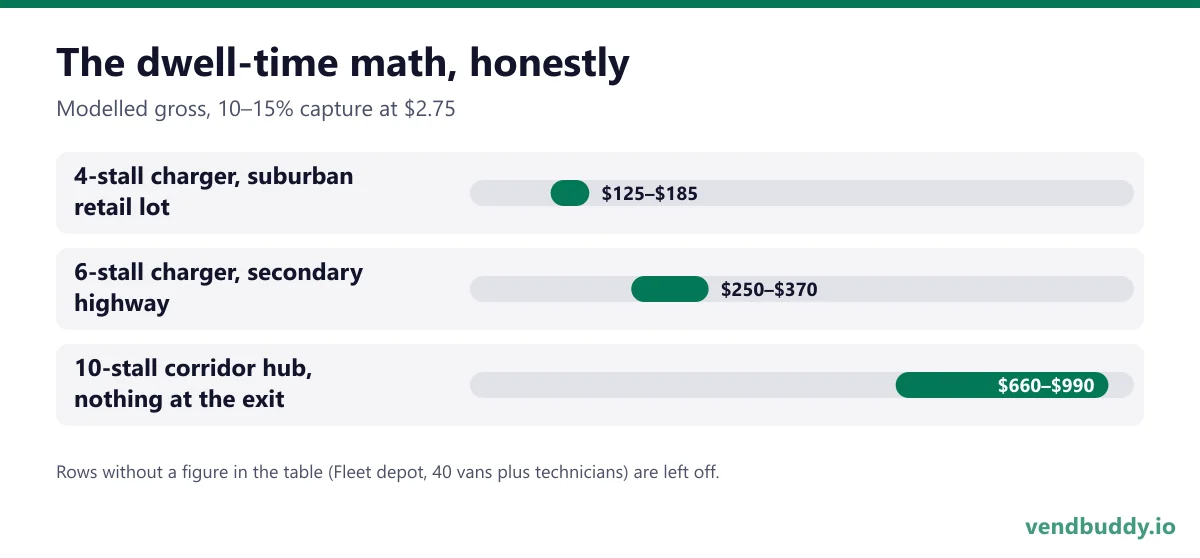
| Site | Sessions / month | Modelled gross, 10–15% capture at $2.75 |
|---|---|---|
| 4-stall charger, suburban retail lot | ~450 | $125–$185 |
| 6-stall charger, secondary highway | ~900 | $250–$370 |
| 10-stall corridor hub, nothing at the exit | ~2,400 | $660–$990 |
| Fleet depot, 40 vans plus technicians | n/a — model on headcount | Model it as a depot, not a pad |
Two honest caveats. The capture range is higher than the one used for storage because the dwell here is real and forced, but it is still an assumption and not a measurement — nobody has good published capture data for a charging pad, which is exactly what a 90-day location test is for. And the top two rows do not clear the bar for a dedicated drive. Only the third and fourth do.
The strategic argument for going early anyway is honest enough to state plainly: utilisation at most sites is low today and the curve is going one direction, so an exclusive on a corridor pad is cheap now and will not be later. That is a real argument. It is also the argument every operator who ever over-placed into an emerging category made, so buy the option with money you can afford to have parked.
A fuel stop is four minutes. A DC fast charge is thirty and the driver stays with the car. It is the first genuinely new captive audience vending has been handed in decades.
The version nobody is working: fleet charging depots
While everybody argues about public charging, delivery companies, transit authorities, school districts and last-mile logistics operators have been building depot charging behind their own fences. A depot with forty electrified vans has an electrical yard, a maintenance bay, drivers arriving before dawn and technicians on site all day.
That is not a charging account. It is a depot and industrial account with a charging story attached, and it should be modelled on headcount and shifts the way any warehouse is — against the working floor in how many people a location needs. What the charging angle gives you is a reason to be talking to a fleet manager in the first place, at a moment when he is rethinking the whole yard. Use it as the door, then sell the break room.
Fuel stations with no convenience store
The adjacent category, and it splits cleanly:
- Unattended commercial cardlock fuel islands. The good one. Fleet drivers and technicians fuelling on account, at predictable hours, at a site with no staff and nothing to buy. Same buyer as the early-morning contractor who makes a commercial-tenant storage site work.
- Rural fuel stops with no store, and marina fuel docks. Seasonal, small, and genuinely uncontested — the kind of account the small-town vending playbook is built around.
- Pump-only stations in built-up areas. Not a location. The problem is not traffic, it is that there is a convenience store within sight, and you lose to it every time for the same reason a lobby machine loses to a front desk pantry.
The qualifying questions and the walk-in above, written out in full — how to establish who owns the ground before you pitch anybody, the twelve objections operators really hear, and the plain-English placement agreement for the sites that clear the bar.
See what is inside →The objections, including the two that are not objections but facts
“There is no outlet.”
This is not an objection, it is usually true, and it ends more of these deals than anything else. A charging site runs high-capacity service into switchgear and DC cabinets; a 120-volt convenience outlet within reach of the machine location frequently does not exist. Adding one means a conduit run, a permit and a metering conversation. At a site modelling two hundred dollars a month, a few thousand dollars of electrical work is the end of the discussion. Confirm the outlet before you confirm anything else.
“It is outdoors.”
Also true, and the same physics that ruins a machine on a storage drive-up row applies on a charging pad. An outdoor-rated unit costs more, and in a genuinely hot or genuinely cold market it will still struggle. If there is a canopy, a covered pad or an adjacent structure, that is the placement. If there is not, be honest with yourself about your climate.
“There is nobody here at night.”
Cashless-only, anchored, lit, in camera view, and your number on the front so a driver calls you rather than leaving a review on the host's listing. Same answer as the unstaffed storage site, and for the same reason: what the host is really asking is whether your machine becomes his problem.
“We would need approval for that.”
Frequently true and frequently worth pursuing, unlike the version of this you get at a national chain. A pad on private commercial land can raise a site-plan or zoning question depending on the jurisdiction, and a leased pad may have an approved-use schedule — the general rules are in can you put a vending machine anywhere legally. Ask who has to approve it and offer to do the paperwork. Almost nobody does, which is why the slot is still open.
Most people rebuild these documents from scratch and then lose them. The kits are the paperwork in fill-in-the-blank form, bought once, no subscription.
The pitch
“Your drivers are standing out there for half an hour with nothing to do and nothing to buy, and there is no store at this exit. I would put one unit under the canopy, cashless only so there is no cash on your property, my number on the front so if it ever eats somebody's four dollars they call me and not you. I own it, I stock it, it costs you nothing. Two questions before I waste your time: how many sessions a month is the site doing, and is there a working outlet within thirty feet of that wall?”
Asking the two disqualifying questions out loud, in the first conversation, is what makes this pitch land. It signals that you are not going to install something that becomes his problem, and it gets you off a bad site in four minutes instead of four weeks. That is the same discipline that sell the meeting, not the machine is built on, and it matters more in an unproven category than in a settled one.
What to put in
Machine: outdoor-rated, anchored, cashless-only, no cash box. A glass-front cooler under a canopy beats a combo in the open, and at a corridor hub with a shop nearby the smarter play is frequently a smart cooler inside the adjacent host business rather than out on the pad at all.
Product: road-trip mix, which is not your office mix. Water and energy drinks lead heavily, then coffee-adjacent, then salty. The driver has been in a car for two hours and is going back into it for three more. Skip anything that melts on a pad in July. The general logic is in best products to stock, and the venue-by-venue comparison is in profit by location type.
The honest verdict
Not yet, for most sites — and specifically yes, now, for two of them.
Take the interstate corridor hub with eight or more stalls and nothing else at the exit, because the sessions are already there and the exclusive is cheap while everybody else is still calling it early. Take the fleet depot, because it is a good industrial account regardless of what is charging in the yard. Leave the four-stall charger in a grocery lot alone until its session count says otherwise, and check it again next year, because this is one of the few categories in vending where the answer genuinely changes with time rather than with effort.
Charging pads and fleet depots do not show up on a normal prospecting list, and the difference between a site worth a machine and one worth nothing is not visible from the road. VendBuddy scores real properties near you by category, size and captivity and hands you the best contact on file for each, so you can qualify a corridor before you drive it. Free to start, no card.
Frequently Asked Questions
Do vending machines work at EV charging stations?
At a small number of them today, and the qualifying variable is the charger type rather than the brand on the canopy. A DC fast charging session runs roughly twenty to thirty-five minutes and the driver almost always stays with the car, which is genuine forced dwell time and the entire reason the category is interesting. Level 2 destination charging at a hotel, workplace or shopping centre runs for hours but the driver walks straight into the building, so the sale happens indoors and the pad itself is worthless. Fast charging is a placement, destination charging is not.
Who do you ask about putting a vending machine at a charging station?
The site host, meaning whoever owns the ground, not the charging network. Electrify America, EVgo, ChargePoint and Tesla generally operate under an agreement with a landowner such as a grocery chain, a shopping centre owner, a hotel, a fuel retailer or a municipality, and that landowner is your counterparty. The first question to ask is who owns the parking lot, and the second is whether the pad agreement gives the network any rights over the footprint, because some of those agreements are drafted broadly enough to matter.
How much can a vending machine make at an EV charging station?
Model it from session counts rather than trusting a figure. A four-stall fast charger running twelve to eighteen sessions a day is roughly four hundred to five hundred and fifty sessions a month, and at a ten to fifteen percent capture and a two seventy-five ticket that models to somewhere around one hundred to two hundred and twenty-five dollars gross. An eight to twelve stall corridor hub doing sixty to a hundred sessions a day models to roughly five hundred and fifty to twelve hundred. The first is not a location. The second is a real small account.
Can you get power for a vending machine at a charging station?
Less easily than the megawatt of electrical equipment thirty feet away would suggest. The service at a charging site feeds switchgear and DC cabinets, and a standard convenience outlet within reach of where you want the machine frequently does not exist. Adding one means a conduit run, a permit and a metering conversation with a site host who is not expecting any of it. Confirm the outlet before you confirm anything else, because at these revenue levels a few thousand dollars of electrical work ends the business case on its own.
What about gas stations that do not have a convenience store?
Fuel-only sites are the smaller half of the same opportunity and they behave differently. The strongest version is an unattended commercial cardlock fuel island serving fleets, because drivers and technicians are there daily at predictable hours with nowhere to buy anything. Rural fuel stops with no store and marina fuel docks are seasonal but real in the right market. A vestigial pump-only station in a town that has a convenience store two hundred yards away is not a location, and the reason is competition rather than traffic.
Is EV charging vending worth getting into now or is it too early?
Too early for most sites and worth acting on for two specific ones. Utilisation at a large share of stations is still low enough that the arithmetic does not clear, and an operator who places broadly across the category will fund a lot of thin machines waiting for a curve to arrive. The two exceptions are interstate corridor hubs with eight or more stalls and nothing else at the exit, and fleet charging depots, which are really depot accounts with a charging story attached. Take those two now and revisit the rest annually.
Related reading: how to find vending machine locations, storage facilities, hotels and motels, car dealerships, 24/7 industrial and depot sites, getting past the gatekeeper, and the small-town vending playbook.
What is selling, which buildings say yes, and the numbers before you buy a machine. Free, confirm from your inbox, unsubscribe in one click. Refer one friend and get 25 VendBuddy credits.
Want the free 38-page Ultimate Vending Guide too? Get the guide
Walk-ins and cold emails find locations. A small site with your own machine photos and a request-a-machine form lets the next one find you. Around machine three to five, an AI builder drafts it in an evening. Wix is the mature site builder; Base44 also builds working tools like a quote form. Start with the AI website walkthrough or Wix vs Base44.
General information, not legal, tax or financial advice. Rules change, so check the official source. Revenue and income figures are examples, not promises. See our terms.