Two addresses shape this city more than anything else, and they sit about four miles apart. Stellantis runs Sterling Heights Assembly at 38111 Van Dyke, 286 acres and roughly five million square feet of Ram pickup production, with the Sterling Stamping plant pressing panels next door since 1965. Four miles west on Mound Road, General Dynamics Land Systems keeps the headquarters where the Army's ground combat vehicles are engineered, which is why the city advertises a defense corridor rather than an automotive one. Then there is the hole in the middle: Lakeside Mall, the retail anchor since 1976, stopped trading in July 2024, and the Hall Road corridor around it turned overnight from a shopping destination into a redevelopment site full of contractor trailers.
- Is Sterling Heights a good place to start a vending machine business?
- Sterling Heights Vending Market Overview
- Top Industries Driving Vending Demand in Sterling Heights
- Best Placement Districts in Sterling Heights
- MI Licenses, Permits, and Sales Tax for Vending in Sterling Heights
- Commission Rates and Negotiation in Sterling Heights
- A 3-Day Starter Route in Sterling Heights
- Competition and Underserved Pockets in Sterling Heights
Free to search. 5 free contact reveals, no card.
Property owners and managers: tell us about the site and we pass it to an operator who covers Sterling Heights, if one is in range.
Request a free machine →- Michigan's fourth-largest city, with 134,346 residents at the 2020 census and roughly 133,500 in recent American Community Survey estimates, and the largest city in Macomb County.
- Stellantis operates two plants inside the city limits: Sterling Heights Assembly, which reported around 7,000 workers in 2022 building the Ram 1500, and the adjacent Sterling Stamping operation.
- General Dynamics Land Systems headquarters here, so the Mound Road belt is a defense engineering cluster with badging and screening rather than an open industrial park.
- Lakeside Mall closed to the public in July 2024 after nearly five decades, which moved the daytime population of the city decisively toward the plants and office suites.
- Michigan charges a flat 6 percent with no local addition and licenses no vending operator, so your filings are a Treasury sales tax registration plus whatever Macomb County requires for what you actually stock.
- Household median income runs near $78,400, and the city holds one of the largest Chaldean and Assyrian communities in the United States, visible in the independent grocery and restaurant sector rather than the chains.
Free tools: vending ROI calculator · revenue calculator by property type · route time calculator · State of Vending 2026 report · all free tools
- Is Sterling Heights a good place to start a vending machine business?
- Sterling Heights Vending Market Overview
- Top Industries Driving Vending Demand
- Best Placement Districts in Sterling Heights
- MI Licenses, Permits, and Sales Tax
- Commission Rates and Negotiation
- 3-Day Starter Route in Sterling Heights
- Competition and Underserved Pockets
- Sterling Heights Vending FAQ
Is Sterling Heights a good place to start a vending machine business?
Yes, with one condition: Sterling Heights rewards district selection more than raw hustle. The Sterling Heights, MI metro carries about 4,500 establishments, weighted toward vehicle assembly, defense engineering, automotive supply, building trades and independent retail across roughly 134K residents — about 33.7 business establishments per 1,000 people, right around the roughly 30-per-1,000 national figure, so route quality comes down to which districts you pick. Median household income is ~$78,400 household median against a per-capita figure near $37,300, the spread you would expect in a multi-earner manufacturing suburb, close to the roughly $75,000 U.S. median, and that number decides more than any other whether a $2.25–$2.75 price point holds or you have to run value pricing to keep vend counts up. Headcount has been broadly flat while composition changed sharply, with Iraqi Chaldean and Assyrian settlement reshaping the retail base and the Lakeside closure shifting the growth story onto redevelopment parcels rather than greenfield. On the supply side, the plant interiors run under contracted refreshment agreements, while the supplier shops, defense subcontractors and trades buildings ringing them are served patchily and change hands often.
Demand here concentrates in Vehicle Assembly and Stamping, Defense Land Systems Engineering, Automotive Supply and Tooling, Building Trades and Light Manufacturing and Independent Grocery and Food Retail, led by Vehicle Assembly and Stamping — and those workers sit in identifiable places, not spread evenly across the metro. The 5 districts mapped below (The Van Dyke assembly spine; Mound Road defense corridor; Hall Road and the Lakeside redevelopment; Utica Road civic core and Dodge Park; Metro Parkway and the Ryan-Dequindre fringe) are where the captive headcount actually is. Budget for 0–7% of gross in commission — commission expectations are operator-friendly by national standards. Sales tax on vends runs 6%. One local wrinkle to plan around: check the property-level rules before you install.
The catch: From the road this looks like fully occupied territory, and in one narrow sense it is. That is the shape of every market this size — the marquee accounts are contracted, and the money for an independent operator is one tier down, in the buildings next door to them.
| Signal | Sterling Heights | National reference |
|---|---|---|
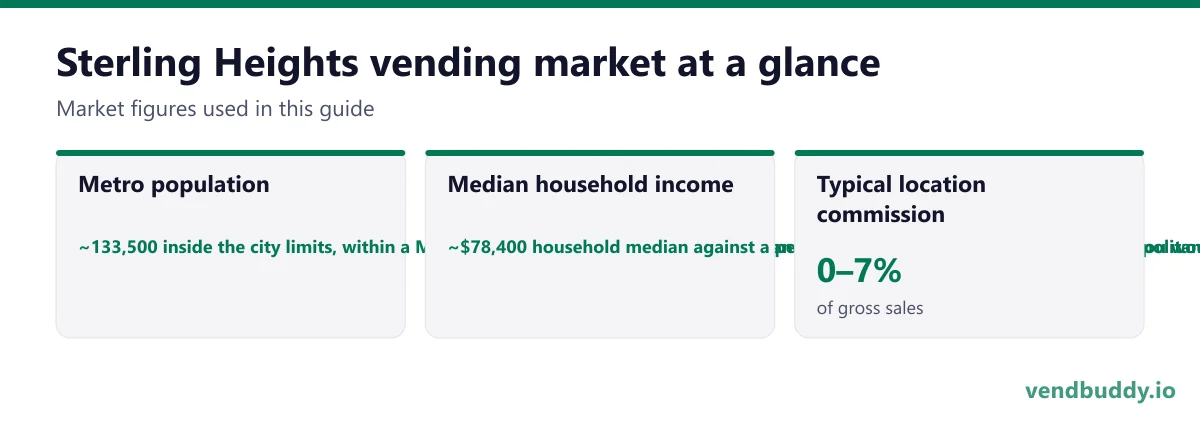
| Metro population | ~133,500 inside the city limits, within a Macomb County population near 875,000 and the roughly 4.3M-person Detroit metropolitan area | — |
| Business establishments | ~4,500 establishments, weighted toward vehicle assembly, defense engineering, automotive supply, building trades and independent retail | — |
| Establishments per 1,000 residents | 33.7 | ~30 |
| Median household income | ~$78,400 household median against a per-capita figure near $37,300, the spread you would expect in a multi-earner manufacturing suburb | ~$75,000 |
| Commission expectation | 0–7% of gross | 10–15% typical |
| Sales tax on vended goods | 6% | varies by state |
| Demand sectors driving placements | Vehicle Assembly and Stamping, Defense Land Systems Engineering, Automotive Supply and Tooling, Building Trades and Light Manufacturing and Independent Grocery and Food Retail | — |
| Placement districts mapped below | 5 | — |
Is Sterling Heights a good area to start a vending machine business?
Yes, with one condition: Sterling Heights rewards district selection more than raw hustle. Sterling Heights carries ~4,500 establishments, weighted toward vehicle assembly, defense engineering, automotive supply, building trades and independent retail across a 134K metro — about 33.7 establishments per 1,000 residents, right around the roughly 30-per-1,000 national figure, so route quality comes down to which districts you pick. Median household income is ~$78,400 household median against a per-capita figure near $37,300, the spread you would expect in a multi-earner manufacturing suburb, close to the roughly $75,000 U.S. median. Start in The Van Dyke assembly spine, then Mound Road defense corridor — both are broken out below with named placement targets. The honest constraint: From the road this looks like fully occupied territory, and in one narrow sense it is.
Can I start a vending machine business in Sterling Heights?
Yes. There is no Michigan vending operator licence to obtain. What you register is a sales tax licence with the Department of Treasury, and then you satisfy the state food law for whatever the machines actually hold. Equipment dispensing potentially hazardous product falls under the Michigan food code administered by the Department of Agriculture and Rural Development with county health departments carrying out inspection; sealed shelf-stable snacks and packaged drinks generally sit outside that regime, while refrigerated fresh food and micro markets clearly do not. We found no Sterling Heights municipal vending licence covering sealed machines inside a private building, and one call to the city clerk settles that before you order anything. Sales tax on vended goods: Six percent, everywhere in Michigan, with municipalities barred from adding a local layer, so a route touching Sterling Heights, Utica, Shelby Township, Clinton Township and Troy prices identically at every stop and never needs an address-level lookup. Taxability, not rate, is where the thinking goes. Food or drink artificially heated above 75 degrees or cooled below 65 degrees before sale is treated as taxable when it comes out of a machine, with carve-outs including milk, non-alcoholic drinks in sealed containers and fresh fruit. Sterling Heights is also not one of Michigan's city income tax jurisdictions, which only matters because Detroit is, and a route that eventually reaches down there acquires a withholding question it does not have here. Food handler rules and the local permit quirks are broken out in full further down this page. No MI statute blocks a new operator from placing machines in Sterling Heights — the real barrier is placement access, not paperwork.
How much do vending machines make in Sterling Heights?
There is no city-level vending revenue dataset for Sterling Heights, and any specific Sterling Heights figure you see quoted is an estimate dressed up as data. What operators report nationally: a healthy snack and drink placement grosses roughly $150–$400 per machine per month, low-traffic placements sit at $75–$150, and high-density captive placements (24/7 warehouses, hospital night shift, 200-plus-person offices) clear $400–$700 or more. Gross margin lands near 50–55% before commission. Demand signals in Sterling Heights point toward the middle of that band: median household income is ~$78,400 household median against a per-capita figure near $37,300, the spread you would expect in a multi-earner manufacturing suburb, demand concentrates in Vehicle Assembly and Stamping, Defense Land Systems Engineering, Automotive Supply and Tooling, Building Trades and Light Manufacturing and Independent Grocery and Food Retail, and commission expectations are operator-friendly by national standards at 0–7% of gross. Model your own stops with the free route valuation calculator.
Two free tools do the two jobs this page cannot: one ranks the ZIPs, the other prices a deal. Neither needs an account.
Sterling Heights Vending Market Overview
Sterling Heights, MI is a market where headcount has been broadly flat while composition changed sharply, with Iraqi Chaldean and Assyrian settlement reshaping the retail base and the Lakeside closure shifting the growth story onto redevelopment parcels rather than greenfield. The metro contains roughly 4,500 establishments, weighted toward vehicle assembly, defense engineering, automotive supply, building trades and independent retail at a median household income of ~$78,400 household median against a per-capita figure near $37,300, the spread you would expect in a multi-earner manufacturing suburb, and the plant interiors run under contracted refreshment agreements, while the supplier shops, defense subcontractors and trades buildings ringing them are served patchily and change hands often. The implication for a new or scaling operator: the prospecting addressable market is large, the per-machine economics support a real business, and the gap between operator coverage and underlying demand is real enough that it shows up in routing math, not just marketing copy.
The four sectors that drive vending demand in Sterling Heights are Vehicle Assembly and Stamping, Defense Land Systems Engineering, Automotive Supply and Tooling, Building Trades and Light Manufacturing, Independent Grocery and Food Retail. Each has its own access pattern (badge-required vs. open lobby), break-room culture (catered vs. dependent on vending), and product-mix expectation (premium vs. value). The sections below break each down with named employers and the placement targets that actually convert.
Before you commit to a route in Sterling Heights, work through our location scoring checklist on a sample location — it will save you the cost of a bad first placement, which is usually a year of revenue. If you are still pre-launch, our guide to starting a vending machine business walks through the entity setup, financing, and machine sourcing that comes before the prospecting phase.
Top Industries Driving Vending Demand in Sterling Heights
The four industries below account for the bulk of high-revenue vending placements in Sterling Heights, MI. The named employers are anchor tenants — large, captive workforces that drive the local property managers' decisions about whether to install vending at all. Reading these in order also tells you what kind of operator wins which placement: the apparel of a healthcare-pitch deck looks nothing like the apparel of an aerospace-pitch deck, and matching the fit matters more than commission percentage.
Vehicle Assembly and Stamping
Sterling Heights Assembly is not a single shift operation and it does not empty out at five o'clock, which changes what a machine has to hold and when it has to be filled. The plant floor and its cafeterias sit inside a contracted refreshment agreement that no independent unwinds, but the surrounding ecosystem does not: sequencing and sub-assembly operations that feed the line, the outside tooling and maintenance vendors, the logistics yards staging inbound parts, and the contractor field offices that appear whenever the plant retools. Sterling Stamping next door runs its own vendor ring on the same logic.
Ground Combat Vehicle Engineering
General Dynamics Land Systems anchoring its headquarters on Mound Road pulls in a distinct professional population: simulation and systems integration firms, survivability and armour engineering consultancies, credentialed staffing agencies, and machine shops holding defense rather than automotive work. These are private companies, so the federal Randolph-Sheppard priority that closes military installations does not apply, but nearly all of them run visitor screening and escorted service access. Budget weeks for onboarding and treat cleared, predictable service as the actual selling point.
Automotive Supply and Tooling
Between Ryan Road, Dequindre and the Metro Parkway fringe sits the second tier of the Macomb supply base: plastics moulders, coatings and plating shops, fixture and gauge builders, print and packaging operations, and the wholesale distributors that keep them running. Headcounts run from fifteen to a couple of hundred, break rooms are small, and the person deciding is usually a plant manager who eats in the same room. Nobody within walking distance sells lunch, which is the whole opportunity.
Independent Grocery and Food Retail
The Chaldean and Assyrian community here is among the largest in the country, and it built a dense independent retail sector along Van Dyke, Ryan and Fifteen Mile: family-run supermarkets, bakeries, party stores, halal butchers and restaurants, plus the wholesale suppliers behind them. Two things follow for an operator. Product expectations differ from a generic suburban planogram, with demand for halal-compliant confectionery, pork-free gelatin, energy drinks and Middle Eastern snack lines. And these owners talk to each other, so one well-run placement travels by word of mouth faster than any cold call.
For deeper revenue benchmarks by location type — apartment vs. warehouse vs. medical vs. office — see our vending machine income data and the vending costs and profit breakdown. Both are continuously updated from operator surveys.
Best Placement Districts in Sterling Heights
The districts below are ranked by daytime worker density and operator-coverage gap, not just by population. A district with 50,000 office workers and three national operators competing already may be a worse target than a district with 20,000 office workers and zero operator presence. Sterling Heights has a few of each — the named placement targets in each card are the actual employers and properties to prospect, not generic industry categories.
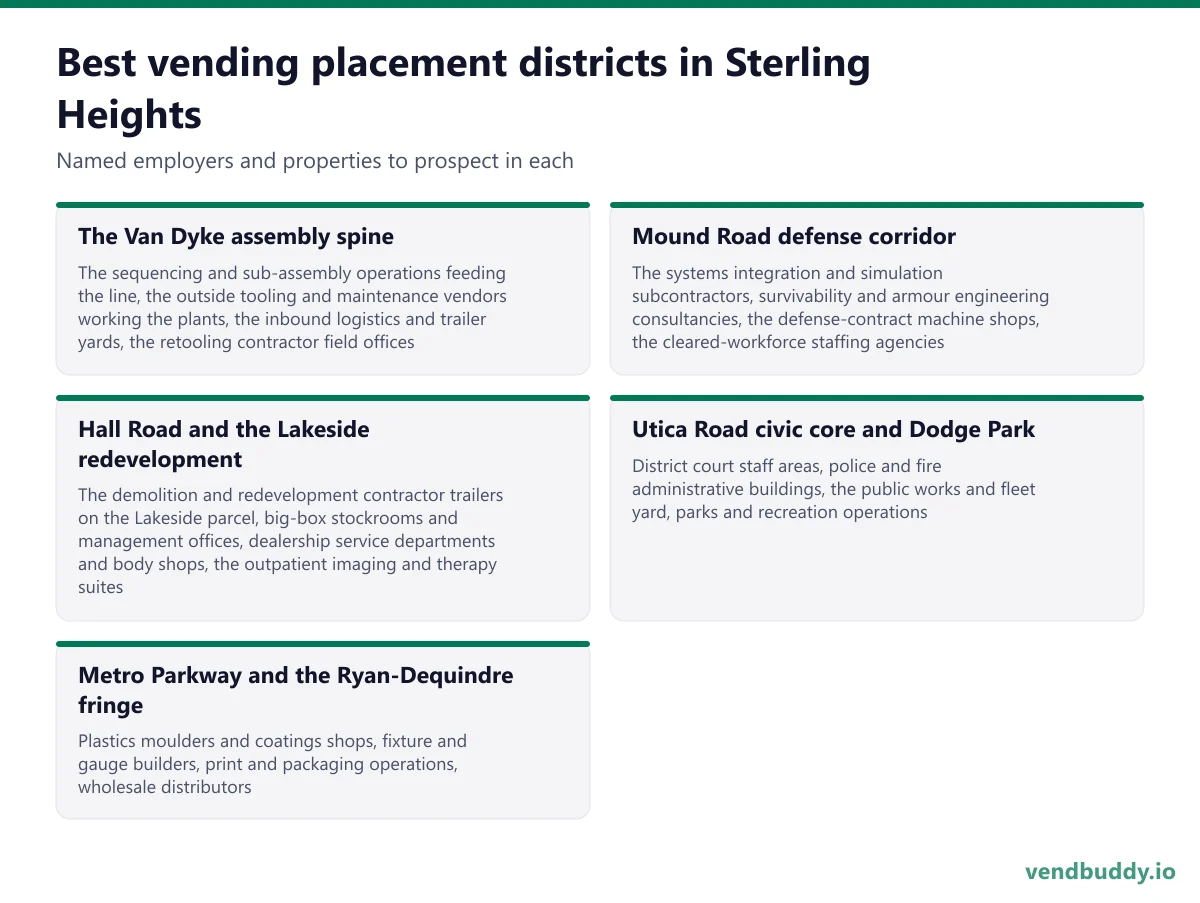
The Van Dyke assembly spine
The M-53 corridor running the length of the city's eastern side, carrying the Stellantis assembly and stamping complexes plus the logistics, sequencing and service operations that exist because those plants exist. Heavy truck traffic, large fenced parcels, and a service-drive economy of shops facing the freeway.
Named placement targets: the sequencing and sub-assembly operations feeding the line, the outside tooling and maintenance vendors working the plants, the inbound logistics and trailer yards, the retooling contractor field offices, and the truck and trailer service shops along the service drive
Mound Road defense corridor
The city's own branding for the industrial belt anchored by General Dynamics Land Systems, holding defense engineering firms, simulation and integration contractors and credentialed staffing operations. Buildings look ordinary from the road and run visitor screening inside.
Named placement targets: the systems integration and simulation subcontractors, survivability and armour engineering consultancies, the defense-contract machine shops, the cleared-workforce staffing agencies, and the technical services firms in the multi-tenant buildings on the corridor
Hall Road and the Lakeside redevelopment
The M-59 retail corridor along the northern edge, reorganising itself around a dead regional mall. Demolition and redevelopment activity sits next to a still-busy strip of big-box retail, dealerships and outpatient medical space.
Named placement targets: the demolition and redevelopment contractor trailers on the Lakeside parcel, big-box stockrooms and management offices, dealership service departments and body shops, the outpatient imaging and therapy suites, and the corridor's hotel operations teams
Utica Road civic core and Dodge Park
The municipal cluster around city hall on Utica Road with the district court, public safety administration, the library and the parks operations along the Clinton River. Steady, unglamorous, and structurally invisible to national operators.
Named placement targets: district court staff areas, police and fire administrative buildings, the public works and fleet yard, parks and recreation operations, the senior centre, and the library's staff and program spaces
Metro Parkway and the Ryan-Dequindre fringe
The western and southern light-industrial edge where Sterling Heights meets Warren and the Oakland County line, full of second-tier shops in older single-storey buildings on short leases.
Named placement targets: plastics moulders and coatings shops, fixture and gauge builders, print and packaging operations, wholesale distributors, trade contractor yards, and the small multi-tenant flex buildings along Metro Parkway
Want the list built for you? Pick one Sterling Heights ZIP and VendBuddy delivers the 50 best-scored locations in it, enriched with the best contact on file, automatically, for $97 once.
If you are weighing whether a specific building inside one of these districts is worth pursuing, run it through our location scoring checklist first. It catches the bad-fit placements (low captive headcount, restricted access hours, existing operator relationship) before you waste a pitch on them.
MI Licenses, Permits, and Sales Tax for Vending in Sterling Heights
There is no Michigan vending operator licence to obtain. What you register is a sales tax licence with the Department of Treasury, and then you satisfy the state food law for whatever the machines actually hold. Equipment dispensing potentially hazardous product falls under the Michigan food code administered by the Department of Agriculture and Rural Development with county health departments carrying out inspection; sealed shelf-stable snacks and packaged drinks generally sit outside that regime, while refrigerated fresh food and micro markets clearly do not. We found no Sterling Heights municipal vending licence covering sealed machines inside a private building, and one call to the city clerk settles that before you order anything.
Sales tax in Sterling Heights: Six percent, everywhere in Michigan, with municipalities barred from adding a local layer, so a route touching Sterling Heights, Utica, Shelby Township, Clinton Township and Troy prices identically at every stop and never needs an address-level lookup. Taxability, not rate, is where the thinking goes. Food or drink artificially heated above 75 degrees or cooled below 65 degrees before sale is treated as taxable when it comes out of a machine, with carve-outs including milk, non-alcoholic drinks in sealed containers and fresh fruit. Sterling Heights is also not one of Michigan's city income tax jurisdictions, which only matters because Detroit is, and a route that eventually reaches down there acquires a withholding question it does not have here.
Health department: The Macomb County Health Department inspects food operations in Sterling Heights under the state food code. A route that crosses Dequindre into Oakland County or drops south into Wayne County changes inspecting jurisdiction without changing a single price, which is worth mapping before you accept placements in three counties. Nationally accredited food handler training is generally recognised, though confirming that a specific certificate is accepted beats assuming it. Anything involving fresh food, sandwiches or a micro market should have its classification agreed with the county before equipment is ordered rather than after.
Site access: The constraint that actually governs your calendar here is industrial site access rather than any permit. Both Stellantis plants and the defense engineering firms on Mound Road run contractor onboarding with background screening, safety orientation and badge issuance, and that process takes weeks rather than days. Some sites require escorted service visits, which means your fill schedule has to match somebody else's staffing. The practical sequence is to start your prospecting in the supplier and subcontractor ring, where a manager can say yes the same week, and let the credentialed sites come later once you have local references.
Every researched MI market, plus the state rules in one place: our MI vending hub.
State-by-state vending laws — including license thresholds, sales tax, and food handler requirements — are summarized in our vending laws reference. If you are forming an LLC for the route, our LLC setup and tax deductions guide covers the federal and state-level deductions specific to vending operators.
Commission Rates and Negotiation in Sterling Heights
Typical commission range in Sterling Heights: 0–7% of gross.
Supplier shops and tooling operations in the Ryan and Metro Parkway belt almost never ask for a percentage. The owner is solving a break room problem for thirty people and wants reliable Tuesday service, not a revenue share. Defense engineering firms on Mound Road behave the same way for a different reason: the decision-maker is a facility or security lead whose measure of a good vendor is one who has already cleared screening. Where percentages do appear is on the Hall Road retail corridor, where regional property management treats vending as a portfolio line and will open near the top of the band. Independent grocers and restaurants along Van Dyke tend to negotiate on product selection instead of money, and the city's own facilities take nothing at all.
Use our vending commission rates by location type for the full negotiation rubric (when to walk, when to counter with product credit, when to accept and renegotiate at renewal). The negotiating vending placements covers the actual scripts.
VendBuddy shows the best contact on file for the properties in this guide (owner or manager when available), with the emails and phone numbers we can find. Plus the contract generator, ROI calculator, and placement scoring tools you need to close.
Launch VendBuddy Free →A 3-Day Starter Route in Sterling Heights
If you are dropping into Sterling Heights for the first time and want to walk out with a real prospect list in 72 hours, this is the route experienced operators use. It groups districts by drive efficiency rather than by industry — you cover the most square footage with the fewest miles, which matters more in week one than perfect target prioritization.
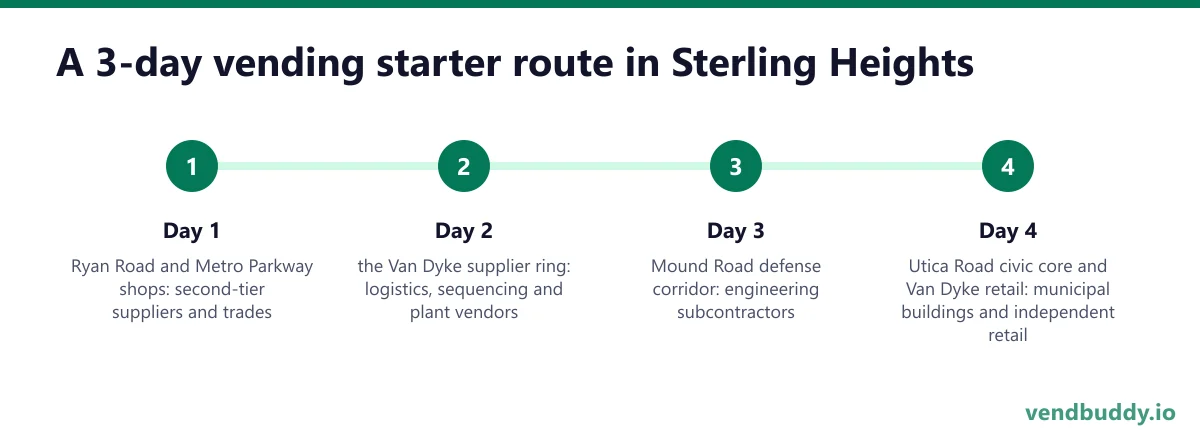
Targets: plastics moulders, coatings and plating shops, fixture and gauge builders, print and packaging operations, wholesale distributors and trade contractor yards
Field note: These are the fastest yeses in the city because the owner is on site and there is no procurement layer. Go before ten in the morning when plant managers are still on the floor, and bring a written service day rather than a percentage proposal.
Targets: sequencing and sub-assembly operations, outside tooling and maintenance vendors, inbound logistics and trailer yards, retooling contractor field offices
Field note: Do not aim at the assembly plant itself on day two. Its interior is contracted and its onboarding runs for weeks. The businesses that exist to serve it have the same shift patterns and none of the gatekeeping.
Targets: systems integration and simulation firms, armour and survivability consultancies, defense-contract machine shops, cleared-workforce staffing agencies
Field note: Ask about the visitor and escort procedure in the first conversation, because it determines whether you can service the site at all. Firms that already escort other vendors will tell you plainly, and that answer is worth more than the meeting.
Targets: district court and public safety administration, public works and fleet yard, parks operations, plus the family-run grocers, bakeries and restaurants along Van Dyke and Ryan
Field note: Municipal sites pay no commission and reward reliability with placements that hold for years. On the retail side, one well-served independent grocer generates referrals through a tightly connected owner community faster than any list you could buy.
For the cold-email cadence to send the same evening, see our cold email scripts for property managers. The first email goes out within 24 hours of a pop-in; the second 5–7 days later. Operators who skip the same-day follow-up close at roughly half the rate of operators who do not.
Competition and Underserved Pockets in Sterling Heights
From the road this looks like fully occupied territory, and in one narrow sense it is. Canteen and the larger regional Detroit-area operators service the assembly plants and the bigger corporate buildings as part of routes that already run down Van Dyke and Mound. What none of them has built is a route around the second tier. Dozens of twenty-to-two-hundred-person shops sit within a few square miles of each other, individually too small to interest a national and collectively dense enough to service with almost no driving between stops. The defense subcontractors are similarly overlooked because screening requirements make them slow to open, which is exactly why they stay open once you are through. Municipal buildings generate no commission and therefore no competitive interest at all. An operator based in Macomb County who can be at a jammed machine within an hour is competing on the one thing a route run out of Wayne County structurally cannot offer.
The lesson, in Sterling Heights as in every other Tier-1 metro: the high-revenue marquee accounts (Fortune 500 HQs, flagship hospitals, university dining contracts) are locked under multi-year national contracts with Canteen, Five Star, Compass, or Aramark. The opportunity for an independent or regional operator is the second tier — the Class B office down the street, the medical office building two doors down from the main hospital, the apartment leasing office three blocks from a Whole Foods. Those are accessible, profitable, and almost always underserved.
Vending Machine Companies in Sterling Heights, MI
If you manage a property in Sterling Heights and want a machine placed, you do not pay for it — the operator buys, stocks, and services the machine and earns from what sells. Instead of calling companies one by one, submit the two-minute request at vendbuddy.io/property-managers and it gets routed to independent operators working the Sterling Heights area; at most two receive it, and the first to claim it contacts you. How placement deals work, what commission is normal, and the national-versus-local trade-off are all in vending machine companies near me.
Sterling Heights Vending FAQ
Do I need a vending machine license in Sterling Heights, MI?
Michigan does not license vending as a trade, so there is no operator licence to apply for. You register for a sales tax licence with the Michigan Department of Treasury, and then you comply with the state food law for whatever the machines hold, which for sealed snacks and packaged drinks is a light obligation and for refrigerated fresh food is not. We found no separate Sterling Heights municipal vending permit covering machines placed inside private buildings, but the city clerk will confirm that in a single phone call, and it costs nothing to ask before you buy equipment.
What is the sales tax on vending sales in Sterling Heights?
Six percent, and it is the same six percent everywhere in Michigan because local governments cannot add their own layer. That makes pricing across Macomb, Oakland and Wayne county placements identical, which is unusual and genuinely simplifies a growing route. The judgment call is what counts as taxable: food or drink artificially heated above 75 degrees or cooled below 65 degrees before sale falls into the taxable category from a machine, with exceptions covering milk, sealed non-alcoholic beverages and fresh fruit. Confirm your specific product configuration with Treasury before you set prices.
Can I put machines inside the Stellantis plant in Sterling Heights?
Realistically, no. Sterling Heights Assembly and Sterling Stamping run refreshment services under agreements negotiated well above the plant level, and an independent operator will not displace them. The productive version of that question points outward. The sequencing operations, tooling vendors, logistics yards and contractor field offices that exist because of those plants share the same shift patterns and the same absence of nearby food, and each of them makes its own decision. That ring is where the reachable volume sits.
How much do vending machines make in Sterling Heights?
Nobody honest gives you a figure, but the variables that decide it are unusually easy to read in this city. What matters is how many people are captive at a site through a shift, whether the site runs one shift or three, how far the nearest food actually is, whether your product mix matches that specific workforce, and how often you service. A twenty-person tooling shop on Ryan Road, a defense engineering office on Mound and a municipal fleet yard behave nothing alike. Local competition and the plant retooling calendar move all of them.
Is the Lakeside Mall area still worth prospecting?
Yes, but for different reasons than five years ago. The mall stopped trading in July 2024, so the tenant break rooms that would once have been the target are gone. What replaced them is a large redevelopment site, and redevelopment sites generate contractor trailers, field offices and site staff who work outdoors with no food nearby. Meanwhile the surrounding Hall Road strip retail, dealerships and outpatient medical suites are all still trading and are now the corridor's stable daytime population. Treat it as a construction market layered on a retail one.
How do I get onto a defense contractor site on Mound Road?
Slowly, and by asking the right question first. These are private companies rather than federal installations, so the Randolph-Sheppard priority that governs vending on military property does not apply, and a commercial conversation is possible. What does apply is contractor onboarding: background screening, safety orientation, badge issuance, and in some cases escorted service visits. That runs to weeks. Ask in the first meeting how existing vendors are escorted and badged, because that answer tells you whether the site is servable on your schedule before you invest any more time.
Essential Vending Guides
General information, not legal, tax or financial advice. Rules change, so check the official source. Revenue and income figures are examples, not promises. See our terms.