San Francisco spent four years as the national cautionary tale for office real estate and then reversed hard: vacancy fell to roughly 29.7% by the second quarter of 2026 from 34.7% a year earlier, the sharpest improvement of any US market, with 53 AI companies hunting space simultaneously. That matters to a vending operator because AI tenants sign leases fast, pack floors densely, and treat a stocked kitchen as table stakes for recruiting. Meanwhile Mission Bay and China Basin — Anthropic's home ground, now past a million square feet — was the tightest submarket in the city at about 10.4% vacancy.
- Vending locations in San Francisco: what the data shows
- What the San Francisco numbers mean for operators and building owners
- Is San Francisco a good place to start a vending machine business?
- San Francisco Vending Market Overview
- Top Industries Driving Vending Demand in San Francisco
- Best Placement Districts in San Francisco
- CA Licenses, Permits, and Sales Tax for Vending in San Francisco
- Commission Rates and Negotiation in San Francisco
Free to search. 5 free contact reveals, no card.
Property owners and managers: tell us about the site and we pass it to an operator who covers San Francisco, if one is in range.
Request a free machine →- Roughly 4.7M across the San Francisco-Oakland-Berkeley metro, with about 810,000 packed into the city's 47 square miles.
- Combined sales tax in San Francisco is 8.625%; several Bay Area jurisdictions repriced during 2026, so confirm the rate per address before you set prices.
- San Francisco is one of very few California cities with a dedicated food vending machine permit — Health Code section 467 requires an application, a fee and a Health Department decal on each machine, layered on top of the state CDPH sticker.
- Mission Bay and China Basin, the Design District and Showplace Square, the Financial District and Jackson Square, Dogpatch, and the Bayview industrial edge are where a first route actually gets built.
- AI and software, life sciences around UCSF Mission Bay, finance and professional services, hospital systems (UCSF, Sutter CPMC, Kaiser, Zuckerberg San Francisco General) and hospitality back-of-house drive the demand.
- Class A landlords quote 8-12%, but venture-funded tenants far more often want a subsidized or fully free curated mix than a commission check.
Free tools: vending ROI calculator · revenue calculator by property type · route time calculator · State of Vending 2026 report · all free tools
- Is San Francisco a good place to start a vending machine business?
- San Francisco Vending Market Overview
- Top Industries Driving Vending Demand
- Best Placement Districts in San Francisco
- CA Licenses, Permits, and Sales Tax
- Commission Rates and Negotiation
- 3-Day Starter Route in San Francisco
- Competition and Underserved Pockets
- San Francisco Vending FAQ
Vending locations in San Francisco: what the data shows
Sorted by Google category, San Francisco’s 203 listings put healthcare and medical offices first at 22 (10.8%), ahead of apartment communities and property managers at 19 and retail stores at 16. The untyped remainder, 54% of the total, is largely office tenants.
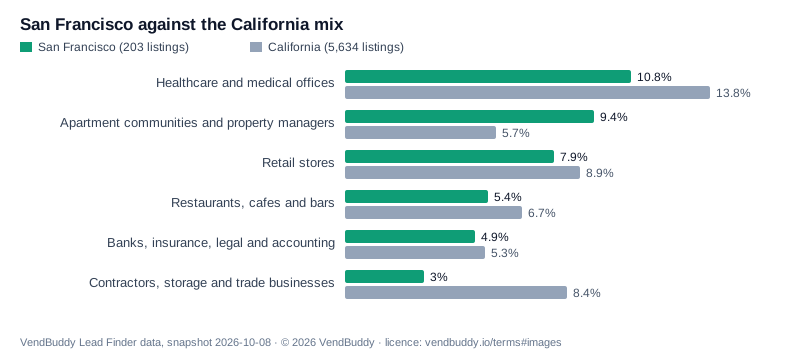
What sets San Francisco apart inside California: a heavier weight of apartment communities and property managers (+3.7 pts) and a lighter one of contractors and trade businesses (-5.4 pts) than the statewide sample of 5,634.
On reviews, the typical San Francisco listing sits at 4.4 stars on 50 ratings, a mixed profile; 29% clear 4.5 stars with a meaningful review count.
36 of the 90 listings with posted hours (40%) stay open past 9 PM on at least one day, against 33% across California.
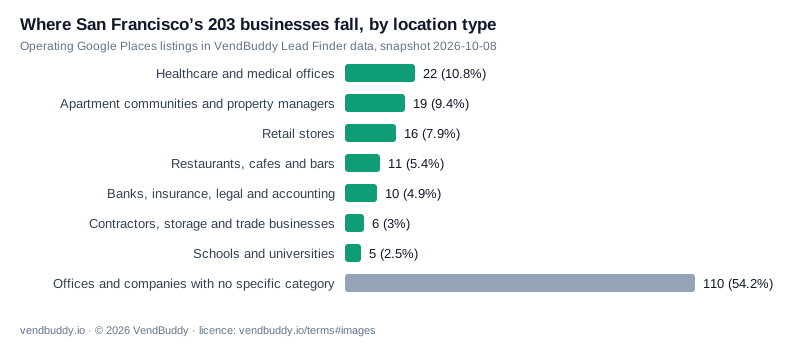
| Location type | Listings | Share | California share |
|---|---|---|---|
| Healthcare and medical offices | 22 | 10.8% | 13.8% |
| Apartment communities and property managers | 19 | 9.4% | 5.7% |
| Retail stores | 16 | 7.9% | 8.9% |
| Restaurants, cafes and bars | 11 | 5.4% | 6.7% |
| Banks, insurance, legal and accounting | 10 | 4.9% | 5.3% |
| Contractors, storage and trade businesses | 6 | 3% | 8.4% |
| Schools and universities | 5 | 2.5% | 1.7% |
| Offices and companies with no specific category | 110 | 54.2% | 39.5% |
| Total operating listings | 203 | 100% | 5,634 listings |
How we counted: Google Places listings that VendBuddy’s Lead Finder looked up between May and October 2026 with a San Francisco, CA address, de-duplicated by place ID, operating businesses only, grouped by their Google category. Groups under 5 listings are combined. This is the sample our users searched, not a census of every business. Snapshot 2026-10-08.
Rules before you place a machine: California vending hub (state permits and sales tax), and the state-by-state vending laws reference.
What the San Francisco numbers mean for operators and building owners
The market read
A workable market if you choose the venue type first. Roughly 71% of the named San Francisco listings are in groups rated primary or good for a snack and drink machine, behind 73% across California, so the list needs a filter before the first call rather than a blanket mail-out. After-hours traffic stands out: 40% of the listings that publish hours keep going past 9 PM (California: 33%), which favours sites that are open, and staffed, around the clock.
If you own or manage a clinic, hospital or medical office in San Francisco: 22 healthcare and medical offices came up in the Lead Finder searches vending operators ran here (10.8% of the sample, below the 13.8% California share), so operators are already looking at medical sites like yours. The machines the fit matrix rates primary for this kind of site are snacks and drinks, smart coolers, coffee and hot food. In the standard arrangement the operator buys, stocks and services the machine; tell us about the property and we pass it to an operator who covers San Francisco, if one is in range. Ask for a free machine in San Francisco →
Three venue types to target first in San Francisco
Ranked by how many listings each type has here, how well a standard snack and drink machine suits it, and how over-represented it is against California.
- Apartment communities and property managers: 19 listings, 9.4% of the San Francisco sample. That is 1.6 times the California share of 5.7%. Snack and drink fit: primary (residents want a late-night grab with no store run). Rated primary: snacks and drinks, smart coolers, water vending and pet supplies.
- Healthcare and medical offices: 22 listings, 10.8% of the San Francisco sample. The type is less common here than statewide (13.8%), so each one is a scarcer target. Snack and drink fit: primary (steady daily headcount, nothing to eat nearby while on shift). Rated primary: snacks and drinks, smart coolers, coffee and hot food.
- Banks, insurance, legal and accounting: 10 listings, 4.9% of the San Francisco sample. Close to the California share of 5.3%. Snack and drink fit: primary (steady daily headcount, nothing to eat nearby while on shift). Rated primary: snacks and drinks, smart coolers, micro markets and coffee.
California rules that apply to a machine in San Francisco
Tobacco and vape vending in California (Cal. Bus. & Prof. Code § 22960, checked 2026-10-01): Cigarette and tobacco vending is generally prohibited, with a narrow exception tied to certain on-sale alcohol premises; cities and counties may ban it outright. By its own terms the rule is about tobacco and does not name vapor products; the federal 21+ rule below still covers e-cigarettes.
On top of that, federal rules (21 CFR 1140.14(b)(3) and 1140.16(c)(2)(ii)) allow tobacco and e-cigarette vending only where no one under 21 is present or allowed in.
Snack, drink and coffee machines carry none of that. Their paperwork is the sales tax and permit rules in the San Francisco licensing section below and the California vending hub.
Is San Francisco a good place to start a vending machine business?
Yes, with one condition: San Francisco rewards district selection more than raw hustle. The San Francisco, CA metro carries about 95,000 establishments in San Francisco County across roughly 4.7M residents — about 20.2 business establishments per 1,000 people, below the roughly 30-per-1,000 national figure, which means fewer doors per mile and a route that has to be planned rather than wandered into. Median household income is ~$141,000 household (city), comfortably above the roughly $75,000 U.S. median, and that number decides more than any other whether a $2.25–$2.75 price point holds or you have to run value pricing to keep vend counts up. The city lost population and office tenants between 2020 and 2023, then reversed on AI leasing — seven straight quarters above 2.0M square feet of leasing activity through mid-2026, including 3.6M square feet in the second quarter alone. On the supply side, the coverage never rebuilt after the 2020-2022 downtown emptying, leaving newly occupied AI floors in SoMa and the Design District with machines that were pulled years ago and never replaced.
Demand here concentrates in AI and Software, Life Sciences and Biotech, Finance and Professional Services, Healthcare and Hospitality and Tourism, led by AI and Software — and those workers sit in identifiable places, not spread evenly across the metro. The 5 districts mapped below (Mission Bay and China Basin; Design District and Showplace Square; Financial District and Jackson Square; Dogpatch and Potrero Hill; Bayview and the Islais Creek industrial edge) are where the captive headcount actually is. Budget for 0-12% of gross in commission — commission expectations sit mid-pack nationally. Sales tax on vends runs 8.625%. One local wrinkle to plan around: check the property-level rules before you install.
The catch: Compass Group and Aramark hold the institutional accounts — UCSF, the major hospital systems, the largest corporate campuses and the convention-center foodservice. That is the shape of every market this size — the marquee accounts are contracted, and the money for an independent operator is one tier down, in the buildings next door to them.
| Signal | San Francisco | National reference |
|---|---|---|
| Metro population | ~4.7M metro; ~810K city | — |
| Business establishments | ~95,000 establishments in San Francisco County | — |
| Establishments per 1,000 residents | 20.2 | ~30 |
| Median household income | ~$141,000 household (city) | ~$75,000 |
| Commission expectation | 0-12% of gross | 10–15% typical |
| Sales tax on vended goods | 8.625% | varies by state |
| Demand sectors driving placements | AI and Software, Life Sciences and Biotech, Finance and Professional Services, Healthcare and Hospitality and Tourism | — |
| Placement districts mapped below | 5 | — |
Is San Francisco a good area to start a vending machine business?
Yes, with one condition: San Francisco rewards district selection more than raw hustle. San Francisco carries ~95,000 establishments in San Francisco County across a 4.7M metro — about 20.2 establishments per 1,000 residents, below the roughly 30-per-1,000 national figure, which means fewer doors per mile and a route that has to be planned rather than wandered into. Median household income is ~$141,000 household (city), comfortably above the roughly $75,000 U.S. median. Start in Mission Bay and China Basin, then Design District and Showplace Square — both are broken out below with named placement targets. The honest constraint: Compass Group and Aramark hold the institutional accounts — UCSF, the major hospital systems, the largest corporate campuses and the convention-center foodservice.
Can I start a vending machine business in San Francisco?
Yes. California issues no vending operator license as such. The obligations are a CDPH operator-identification decal affixed to every food vending machine under Health and Safety Code section 114318, a CDTFA Seller's Permit to collect and remit sales tax, and a California Food Handler Card carried by anyone who restocks food, which costs about $7 online and lasts three years. Sales tax on vended goods: 8.625% combined in San Francisco. Because several Bay Area jurisdictions adjusted rates during 2026, an operator whose route crosses into Daly City, South San Francisco or across the bay should check each city separately rather than assuming the San Francisco figure carries. Food handler rules and the local permit quirks are broken out in full further down this page. No CA statute blocks a new operator from placing machines in San Francisco — the real barrier is placement access, not paperwork.
How much do vending machines make in San Francisco?
There is no city-level vending revenue dataset for San Francisco, and any specific San Francisco figure you see quoted is an estimate dressed up as data. What operators report nationally: a healthy snack and drink placement grosses roughly $150–$400 per machine per month, low-traffic placements sit at $75–$150, and high-density captive placements (24/7 warehouses, hospital night shift, 200-plus-person offices) clear $400–$700 or more. Gross margin lands near 50–55% before commission. Demand signals in San Francisco point toward the upper half of that band: median household income is ~$141,000 household (city), demand concentrates in AI and Software, Life Sciences and Biotech, Finance and Professional Services, Healthcare and Hospitality and Tourism, and commission expectations sit mid-pack nationally at 0-12% of gross. Model your own stops with the free route valuation calculator.
Two free tools do the two jobs this page cannot: one ranks the ZIPs, the other prices a deal. Neither needs an account.
San Francisco Vending Market Overview
San Francisco, CA is a market where the city lost population and office tenants between 2020 and 2023, then reversed on AI leasing — seven straight quarters above 2.0M square feet of leasing activity through mid-2026, including 3.6M square feet in the second quarter alone. The metro contains roughly 95,000 establishments in San Francisco County at a median household income of ~$141,000 household (city), and the coverage never rebuilt after the 2020-2022 downtown emptying, leaving newly occupied AI floors in SoMa and the Design District with machines that were pulled years ago and never replaced. The implication for a new or scaling operator: the prospecting addressable market is large, the per-machine economics support a real business, and the gap between operator coverage and underlying demand is real enough that it shows up in routing math, not just marketing copy.
The four sectors that drive vending demand in San Francisco are AI and Software, Life Sciences and Biotech, Finance and Professional Services, Healthcare, Hospitality and Tourism. Each has its own access pattern (badge-required vs. open lobby), break-room culture (catered vs. dependent on vending), and product-mix expectation (premium vs. value). The sections below break each down with named employers and the placement targets that actually convert.
Before you commit to a route in San Francisco, work through our location scoring checklist on a sample location — it will save you the cost of a bad first placement, which is usually a year of revenue. If you are still pre-launch, our guide to starting a vending machine business walks through the entity setup, financing, and machine sourcing that comes before the prospecting phase.
Top Industries Driving Vending Demand in San Francisco
The four industries below account for the bulk of high-revenue vending placements in San Francisco, CA. The named employers are anchor tenants — large, captive workforces that drive the local property managers' decisions about whether to install vending at all. Reading these in order also tells you what kind of operator wins which placement: the apparel of a healthcare-pitch deck looks nothing like the apparel of an aerospace-pitch deck, and matching the fit matters more than commission percentage.
AI and Software
The single most operator-relevant fact about San Francisco right now is that AI firms are the marginal tenant. Anthropic has expanded around Mission Bay past a million square feet; Databricks, OpenAI and dozens of Series A and B companies are absorbing floors across SoMa, the Design District and Hayes Valley. Together.ai alone signed 149,000 square feet at 2 Henry Adams Street. These tenants are engineer-heavy, work long in-office hours, and treat food and drink as a retention expense rather than a line item to negotiate down.
Life Sciences and Biotech
UCSF's Mission Bay campus anchors a research cluster stretching along Third Street and Illinois Street, surrounded by incubators and small therapeutics companies in converted industrial space. Core UCSF buildings are institutionally contracted, but the surrounding 20-to-150-person biotech tenants in Mission Bay and Dogpatch buy their own break-room service, run late bench hours, and skew heavily toward the premium beverage and better-for-you snack mix.
Finance and Professional Services
The Financial District and Jackson Square still hold the city's law firms, private equity, venture funds and accounting practices, in towers along Montgomery, California and Battery Streets. Headcount per floor has thinned since 2019, which makes single large lobby banks a poor bet — but multi-tenant floors with five or six 15-person firms sharing a common area are exactly the placement that pencils, and property managers here decide for whole portfolios.
Hospitality and City Institutions
Hotels around Union Square and Moscone, the Moscone Center itself, and the city's institutional back-of-house — Muni yards, SFO support operations in the county to the south, Recreation and Parks facilities — employ thousands of shift workers who never see the front of house. Housekeeping and engineering break rooms are a durable, unglamorous category that survives every office cycle the city goes through.
For deeper revenue benchmarks by location type — apartment vs. warehouse vs. medical vs. office — see our vending machine income data and the vending costs and profit breakdown. Both are continuously updated from operator surveys.
Best Placement Districts in San Francisco
The districts below are ranked by daytime worker density and operator-coverage gap, not just by population. A district with 50,000 office workers and three national operators competing already may be a worse target than a district with 20,000 office workers and zero operator presence. San Francisco has a few of each — the named placement targets in each card are the actual employers and properties to prospect, not generic industry categories.
Mission Bay and China Basin
The tightest office submarket in San Francisco at roughly 10.4% vacancy in mid-2026 — UCSF research buildings, Anthropic's expanding footprint, Chase Center, and a ring of biotech and AI tenants in newer mid-rise. Nearly everything here was built after 2005, so loading docks and freight access are genuinely good.
Named placement targets: the Third Street and Illinois Street biotech tenants, the smaller therapeutics companies in Mission Bay incubator space, the China Basin Landing floors, and the Chase Center event-operations back-of-house
Design District and Showplace Square
Converted showroom and warehouse buildings along Henry Adams, Rhode Island and Kansas Streets. Once furniture and interiors trade, now increasingly AI and design tenants taking whole floors of brick-and-timber space. Landlords here move faster than downtown institutional owners.
Named placement targets: the Henry Adams Street floor tenants, the Kansas Street and Rhode Island Street conversions, the remaining furniture and textile showrooms, and the architecture and industrial-design studios along Division
Financial District and Jackson Square
The traditional tower core, still working through elevated vacancy but with multi-tenant floors filling steadily. Jackson Square's low-rise brick buildings hold boutique funds, agencies and law firms of 8 to 30 people, each making its own break-room decision.
Named placement targets: the Montgomery and Battery Street multi-tenant floors, the Jackson Square boutique firms, the California Street building management offices, and the Embarcadero Center tower tenants
Dogpatch and Potrero Hill
Former shipyard and light-industrial fabric now mixed with design studios, small manufacturers, breweries and biotech overflow from Mission Bay. Twenty-second Street and Third Street form the spine. Buildings are small, owners are local, and there is often no incumbent operator at all.
Named placement targets: the Twenty-second Street fabrication and design shops, the Third Street small-manufacturer tenants, the Dogpatch brewery and food-production facilities, and the Potrero Hill office conversions along Seventeenth Street
Bayview and the Islais Creek industrial edge
The city's last real industrial district — recycling, construction supply, food distribution, municipal yards and trucking along Cesar Chavez, Evans and Third. Shift work, limited retail food nearby, and almost no operator competition because the routes are unglamorous.
Named placement targets: the Evans Avenue construction and trade contractors, the Islais Creek food distributors, the municipal maintenance yards along Cesar Chavez, and the Bayview light-manufacturing tenants
Want the list built for you? Pick one San Francisco ZIP and VendBuddy delivers the 50 best-scored locations in it, enriched with the best contact on file, automatically, for $97 once.
If you are weighing whether a specific building inside one of these districts is worth pursuing, run it through our location scoring checklist first. It catches the bad-fit placements (low captive headcount, restricted access hours, existing operator relationship) before you waste a pitch on them.
CA Licenses, Permits, and Sales Tax for Vending in San Francisco
California issues no vending operator license as such. The obligations are a CDPH operator-identification decal affixed to every food vending machine under Health and Safety Code section 114318, a CDTFA Seller's Permit to collect and remit sales tax, and a California Food Handler Card carried by anyone who restocks food, which costs about $7 online and lasts three years.
Sales tax in San Francisco: 8.625% combined in San Francisco. Because several Bay Area jurisdictions adjusted rates during 2026, an operator whose route crosses into Daly City, South San Francisco or across the bay should check each city separately rather than assuming the San Francisco figure carries.
Local permits and licenses: Every business operating in San Francisco needs a Business Registration Certificate from the Office of the Treasurer and Tax Collector, renewed annually and priced on gross receipts. That registration is also a prerequisite document when you file with the Health Department, so do it first.
Health department: This is San Francisco's genuine outlier: Health Code section 467 requires anyone operating a food vending machine in the city to apply to the Department of Public Health, pay the fee set in Municipal Code section 249.12(b), and display a Health Department decal on the machine before it dispenses anything. Most California cities have no such requirement — San Francisco does, and it is enforced. Budget the application time into your first placement, not after.
Every researched CA market, plus the state rules in one place: our CA vending hub.
State-by-state vending laws — including license thresholds, sales tax, and food handler requirements — are summarized in our vending laws reference. If you are forming an LLC for the route, our LLC setup and tax deductions guide covers the federal and state-level deductions specific to vending operators.
Commission Rates and Negotiation in San Francisco
Typical commission range in San Francisco: 0-12% of gross.
Financial District institutional landlords quote 10-12% and want certificates of insurance before the machine leaves the truck. Mission Bay biotech and the AI tenants in the Design District are a different negotiation entirely: many of them subsidize product for staff and will pay you a service fee or take zero commission in exchange for a curated premium planogram — cold brew, sparkling water, protein, better-for-you snacks. Bayview industrial accounts generally take nothing. Hotels and hospitality back-of-house are the one place where a straight percentage is still the default conversation.
Use our vending commission rates by location type for the full negotiation rubric (when to walk, when to counter with product credit, when to accept and renegotiate at renewal). The negotiating vending placements covers the actual scripts.
VendBuddy shows the best contact on file for the properties in this guide (owner or manager when available), with the emails and phone numbers we can find. Plus the contract generator, ROI calculator, and placement scoring tools you need to close.
Launch VendBuddy Free →A 3-Day Starter Route in San Francisco
If you are dropping into San Francisco for the first time and want to walk out with a real prospect list in 72 hours, this is the route experienced operators use. It groups districts by drive efficiency rather than by industry — you cover the most square footage with the fewest miles, which matters more in week one than perfect target prioritization.
Targets: the Third Street and Illinois Street biotech offices, Mission Bay incubator tenants, and the Twenty-second Street design and fabrication shops
Field note: Skip UCSF's own buildings, which are institutionally served. The 20-to-150-person tenants around them are the actual prospects and they buy on product quality, not price.
Targets: the Henry Adams Street floors, the Kansas and Rhode Island Street conversions, and the remaining showroom tenants along Division Street
Field note: This is where recently signed AI leases cluster. Ask which floors turned over in the last eighteen months — new tenants have no incumbent and no habit to displace.
Targets: the Montgomery and Battery Street multi-tenant buildings, Jackson Square boutique funds and agencies, and the Embarcadero Center management offices
Field note: Aim at buildings, not companies. One property manager here can approve placement across four towers, which is worth ten cold calls on individual tenants.
Targets: the Evans Avenue trade contractors, the Islais Creek food distributors, and the municipal maintenance yards off Cesar Chavez
Field note: Unglamorous and largely uncontested. Early morning is the right time — supervisors are on site before six and gone to job sites by nine.
For the cold-email cadence to send the same evening, see our cold email scripts for property managers. The first email goes out within 24 hours of a pop-in; the second 5–7 days later. Operators who skip the same-day follow-up close at roughly half the rate of operators who do not.
Competition and Underserved Pockets in San Francisco
Compass Group and Aramark hold the institutional accounts — UCSF, the major hospital systems, the largest corporate campuses and the convention-center foodservice. A handful of well-established regional operators serve the downtown towers and have done so for decades, and micro-market vendors moved aggressively into the newer Mission Bay and SoMa buildings during the 2010s tech expansion. What nobody rebuilt is the middle: machines pulled out of downtown and SoMa buildings during the 2020-2022 emptying were never replaced, and floors that have since been leased to AI tenants often have an empty alcove where a machine used to sit. Dogpatch, Bayview and the Design District conversions are the least contested ground in the city.
The lesson, in San Francisco as in every other Tier-1 metro: the high-revenue marquee accounts (Fortune 500 HQs, flagship hospitals, university dining contracts) are locked under multi-year national contracts with Canteen, Five Star, Compass, or Aramark. The opportunity for an independent or regional operator is the second tier — the Class B office down the street, the medical office building two doors down from the main hospital, the apartment leasing office three blocks from a Whole Foods. Those are accessible, profitable, and almost always underserved.
Vending Machine Companies in San Francisco, CA
If you manage a property in San Francisco and want a machine placed, you do not pay for it — the operator buys, stocks, and services the machine and earns from what sells. Instead of calling companies one by one, submit the two-minute request at vendbuddy.io/property-managers and it gets routed to independent operators working the San Francisco area; at most two receive it, and the first to claim it contacts you. How placement deals work, what commission is normal, and the national-versus-local trade-off are all in vending machine companies near me.
San Francisco Vending FAQ
Do I need a vending machine permit in San Francisco, CA?
Yes, and this is where San Francisco differs from most of California. Beyond the statewide CDPH machine decal, CDTFA Seller's Permit and Food Handler Card, San Francisco Health Code section 467 requires a separate application to the Department of Public Health, payment of the fee set in Municipal Code section 249.12(b), and a Health Department decal displayed on each machine. You also need a San Francisco Business Registration Certificate from the Treasurer and Tax Collector, which the Health Department will ask to see.
How much do vending machines make in San Francisco?
There is no honest single figure. The variables that move the outcome most in this city are unit price tolerance, which is unusually high, and building access, which is unusually difficult. A machine on a floor of 90 engineers who eat dinner at their desks performs on a completely different curve than one in a half-empty Financial District tower. Weigh headcount actually present in the building on a Tuesday, elevator and freight access for restocking, product mix, and whether the tenant subsidizes purchases for staff.
Is the San Francisco office market recovered enough to start a vending route?
Partially, and the recovery is concentrated rather than broad. Citywide vacancy improved to roughly 29.7% by mid-2026 from 34.7% a year prior, but Mission Bay and China Basin sat near 10.4% while stretches of the Financial District remained soft. The practical implication is to route by submarket, not by city. Buildings absorbing AI and biotech tenants are filling; older commodity towers are not. Ask brokers or building managers which floors leased in the past eighteen months and start there.
What sales tax applies to vending sales in San Francisco?
The combined rate in the city is 8.625%. Several Bay Area jurisdictions changed their rates during 2026, so an operator whose route touches Daly City, Brisbane, South San Francisco or the East Bay should verify each one individually — the difference between neighboring cities can be a full percentage point, which is real money across a route. California taxes vending sales of food with specific carve-outs for certain bottled water and bulk configurations, so confirm your planogram categories with the CDTFA before setting shelf prices.
Do AI startups in San Francisco actually pay vending commission?
Frequently they do not, and that is usually good news rather than bad. Venture-funded tenants tend to treat food and drink as a recruiting and retention cost, so the conversation shifts from what percentage they receive to which products you can keep reliably in stock. Many will pay a flat service fee, subsidize product so staff pay nothing, or simply waive commission in exchange for premium items. The margin math on those accounts is often better than a 12% Class A lobby placement.
Where should a new operator start in San Francisco?
The Design District and Showplace Square, because brick-and-timber floors there turned over quickly to AI and design tenants and many have no machine at all. Then Dogpatch and Potrero Hill, where buildings are small, owners are local and decisions happen in one conversation. Bayview and the Islais Creek industrial edge are the least contested part of the city if you are willing to run an early-morning route. Leave the Financial District towers until you have insurance certificates and references, because institutional property managers ask for both.
Essential Vending Guides
General information, not legal, tax or financial advice. Rules change, so check the official source. Revenue and income figures are examples, not promises. See our terms.