Owings Mills is where the Baltimore Metro SubwayLink stops running, and the entire modern shape of the place follows from that. Metro Centre was built as a transit-oriented district around the terminal station, the old Owings Mills Mall was demolished outright and replaced by the 620,000-square-foot Mill Station, and Foundry Row arrived alongside it. Around that retail churn sit employers that have not moved at all: CareFirst and T. Rowe Price campuses, Maryland Public Television's studios, Stevenson University's Owings Mills campus, and the Baltimore Ravens training facility. There is no town government here, so every filing an operator files runs through Baltimore County — and the counter that issues your machine licences is twenty minutes east in Towson.
- Is Owings Mills a good place to start a vending machine business?
- Owings Mills Vending Market Overview
- Top Industries Driving Vending Demand in Owings Mills
- Best Placement Districts in Owings Mills
- MD Licenses, Permits, and Sales Tax for Vending in Owings Mills
- Commission Rates and Negotiation in Owings Mills
- A 3-Day Starter Route in Owings Mills
- Competition and Underserved Pockets in Owings Mills
Free to search. 5 free contact reveals, no card.
Property owners and managers: tell us about the site and we pass it to an operator who covers Owings Mills, if one is in range.
Request a free machine →- An unincorporated census-designated place in Baltimore County, with 35,674 residents at the 2020 census across about 9.6 square miles and 16.5 percent population growth over the preceding decade.
- Household median income runs near $94,000, materially above the Baltimore regional figure, which supports premium and better-for-you product lines that would stall in most of the metro.
- Corporate anchors include the CareFirst and T. Rowe Price campuses, Maryland Public Television's studios and the Baltimore Ravens training facility, none of which are going anywhere.
- Retail was rebuilt from scratch: the Owings Mills Mall was demolished and replaced by Mill Station, with Foundry Row and Metro Centre adding grocery-anchored and transit-oriented development nearby.
- Maryland licenses machines rather than operators — a Vending Machine License at $2.50 per machine plus a Trader's License, both from the Clerk of the Circuit Court for Baltimore County in Towson.
- Maryland's 6 percent sales tax has no county or municipal layer, and vending operators apply that 6 percent to 94.5 percent of gross receipts rather than to the full figure.
Free tools: vending ROI calculator · revenue calculator by property type · route time calculator · State of Vending 2026 report · all free tools
- Is Owings Mills a good place to start a vending machine business?
- Owings Mills Vending Market Overview
- Top Industries Driving Vending Demand
- Best Placement Districts in Owings Mills
- MD Licenses, Permits, and Sales Tax
- Commission Rates and Negotiation
- 3-Day Starter Route in Owings Mills
- Competition and Underserved Pockets
- Owings Mills Vending FAQ
Is Owings Mills a good place to start a vending machine business?
Yes — Owings Mills is one of the stronger starting markets covered in this guide. The Owings Mills, MD metro carries about 2,000 establishments, weighted toward insurance and financial services, professional offices, retail, flex industrial and education across roughly 36K residents — about 56.2 business establishments per 1,000 people, well above the roughly 30-per-1,000 national figure, so prospecting density is working for you. Median household income is ~$94,000 household median against a per-capita figure near $45,600, a notably affluent profile for a Baltimore County suburb, comfortably above the roughly $75,000 U.S. median, and that number decides more than any other whether a $2.25–$2.75 price point holds or you have to run value pricing to keep vend counts up. One of the faster-growing parts of Baltimore County, adding 16.5 percent between 2010 and 2020, with the growth expressed as transit-oriented and grocery-anchored redevelopment rather than new subdivisions. On the supply side, the large corporate campuses run contracted refreshment programmes, while the multi-tenant office buildings on Red Run and Owings Mills Boulevard, the Painters Mill flex tenants and the retail back-of-house are served unevenly.
Demand here concentrates in Health Insurance and Financial Services, Retail and Grocery Operations, Higher Education and Private Schools, Flex Industrial and Distribution and Media Production and Sports Operations, led by Health Insurance and Financial Services — and those workers sit in identifiable places, not spread evenly across the metro. The 5 districts mapped below (Red Run and Owings Mills Boulevard corporate corridor; Metro Centre at Owings Mills; Mill Station, Foundry Row and Reisterstown Road; Painters Mill and Dolfield flex corridor; The campus belt) are where the captive headcount actually is. Budget for 0–10% of gross in commission — commission expectations are operator-friendly by national standards. Sales tax on vends runs 6%. One local wrinkle to plan around: check the property-level rules before you install.
The catch: Owings Mills reads as well covered because the visible accounts are: national operators service the corporate campuses as part of broader Baltimore County routes, and the big retail anchors sit inside regional agreements. That is the shape of every market this size — the marquee accounts are contracted, and the money for an independent operator is one tier down, in the buildings next door to them.
| Signal | Owings Mills | National reference |
|---|---|---|
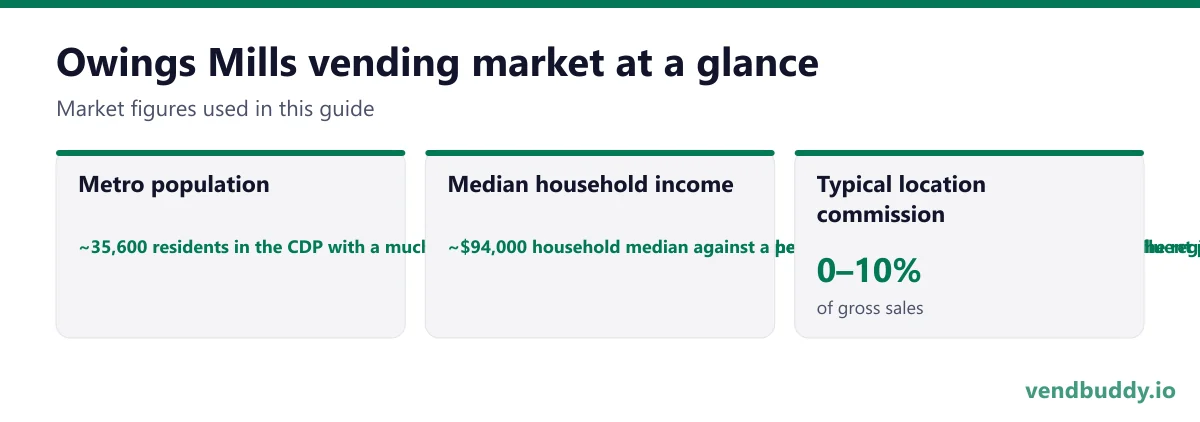
| Metro population | ~35,600 residents in the CDP with a much larger daytime population drawn from the corporate campuses, the university and the regional retail centres | — |
| Business establishments | ~2,000 establishments, weighted toward insurance and financial services, professional offices, retail, flex industrial and education | — |
| Establishments per 1,000 residents | 56.2 | ~30 |
| Median household income | ~$94,000 household median against a per-capita figure near $45,600, a notably affluent profile for a Baltimore County suburb | ~$75,000 |
| Commission expectation | 0–10% of gross | 10–15% typical |
| Sales tax on vended goods | 6% | varies by state |
| Demand sectors driving placements | Health Insurance and Financial Services, Retail and Grocery Operations, Higher Education and Private Schools, Flex Industrial and Distribution and Media Production and Sports Operations | — |
| Placement districts mapped below | 5 | — |
Is Owings Mills a good area to start a vending machine business?
Yes — Owings Mills is one of the stronger starting markets covered in this guide. Owings Mills carries ~2,000 establishments, weighted toward insurance and financial services, professional offices, retail, flex industrial and education across a 36K metro — about 56.2 establishments per 1,000 residents, well above the roughly 30-per-1,000 national figure, so prospecting density is working for you. Median household income is ~$94,000 household median against a per-capita figure near $45,600, a notably affluent profile for a Baltimore County suburb, comfortably above the roughly $75,000 U.S. median. Start in Red Run and Owings Mills Boulevard corporate corridor, then Metro Centre at Owings Mills — both are broken out below with named placement targets. The honest constraint: Owings Mills reads as well covered because the visible accounts are: national operators service the corporate campuses as part of broader Baltimore County routes, and the big retail anchors sit inside regional agreements.
Can I start a vending machine business in Owings Mills?
Yes. Maryland does not license vending as a profession; it licenses the equipment, which is the detail operators arriving from Pennsylvania or Virginia consistently miss. You need a Vending Machine License from the Clerk of the Circuit Court in the county where the machine physically sits, and a Trader's License from the same office alongside it, with the trader fee scaled to the wholesale value of the inventory you carry. For anything in Owings Mills that office is the Baltimore County clerk in Towson. Sales and use tax registration with the Comptroller of Maryland is separate and free. Anyone restocking food should hold a certificate from an ANSI-accredited national programme. Sales tax on vended goods: 6 percent statewide with no county or municipal addition, so a placement in Owings Mills prices identically to one in Baltimore City, Columbia or Annapolis — a genuine advantage when you are quoting a prospect with multiple sites across the region. The vending-specific mechanic is where the money is: Maryland has operators apply the 6 percent to 94.5 percent of gross receipts rather than to the full gross, on the reasoning that machine takings already include tax collected from the customer. Set your bookkeeping up around that factor from the first return rather than restating later, and confirm current treatment with the Comptroller before filing. Food handler rules and the local permit quirks are broken out in full further down this page. No MD statute blocks a new operator from placing machines in Owings Mills — the real barrier is placement access, not paperwork.
How much do vending machines make in Owings Mills?
There is no city-level vending revenue dataset for Owings Mills, and any specific Owings Mills figure you see quoted is an estimate dressed up as data. What operators report nationally: a healthy snack and drink placement grosses roughly $150–$400 per machine per month, low-traffic placements sit at $75–$150, and high-density captive placements (24/7 warehouses, hospital night shift, 200-plus-person offices) clear $400–$700 or more. Gross margin lands near 50–55% before commission. Demand signals in Owings Mills point toward the upper half of that band: median household income is ~$94,000 household median against a per-capita figure near $45,600, a notably affluent profile for a Baltimore County suburb, demand concentrates in Health Insurance and Financial Services, Retail and Grocery Operations, Higher Education and Private Schools, Flex Industrial and Distribution and Media Production and Sports Operations, and commission expectations are operator-friendly by national standards at 0–10% of gross. Model your own stops with the free route valuation calculator.
Two free tools do the two jobs this page cannot: one ranks the ZIPs, the other prices a deal. Neither needs an account.
Owings Mills Vending Market Overview
Owings Mills, MD is a market where one of the faster-growing parts of Baltimore County, adding 16.5 percent between 2010 and 2020, with the growth expressed as transit-oriented and grocery-anchored redevelopment rather than new subdivisions. The metro contains roughly 2,000 establishments, weighted toward insurance and financial services, professional offices, retail, flex industrial and education at a median household income of ~$94,000 household median against a per-capita figure near $45,600, a notably affluent profile for a Baltimore County suburb, and the large corporate campuses run contracted refreshment programmes, while the multi-tenant office buildings on Red Run and Owings Mills Boulevard, the Painters Mill flex tenants and the retail back-of-house are served unevenly. The implication for a new or scaling operator: the prospecting addressable market is large, the per-machine economics support a real business, and the gap between operator coverage and underlying demand is real enough that it shows up in routing math, not just marketing copy.
The four sectors that drive vending demand in Owings Mills are Health Insurance and Financial Services, Retail and Grocery Operations, Higher Education and Private Schools, Flex Industrial and Distribution, Media Production and Sports Operations. Each has its own access pattern (badge-required vs. open lobby), break-room culture (catered vs. dependent on vending), and product-mix expectation (premium vs. value). The sections below break each down with named employers and the placement targets that actually convert.
Before you commit to a route in Owings Mills, work through our location scoring checklist on a sample location — it will save you the cost of a bad first placement, which is usually a year of revenue. If you are still pre-launch, our guide to starting a vending machine business walks through the entity setup, financing, and machine sourcing that comes before the prospecting phase.
Top Industries Driving Vending Demand in Owings Mills
The four industries below account for the bulk of high-revenue vending placements in Owings Mills, MD. The named employers are anchor tenants — large, captive workforces that drive the local property managers' decisions about whether to install vending at all. Reading these in order also tells you what kind of operator wins which placement: the apparel of a healthcare-pitch deck looks nothing like the apparel of an aerospace-pitch deck, and matching the fit matters more than commission percentage.
Health Insurance and Financial Services
CareFirst and T. Rowe Price both maintain substantial Owings Mills operations, and that gravity pulled a wider back-office cluster onto Red Run Boulevard and Owings Mills Boulevard: benefits administrators, third-party claims processors, wealth management and retirement services firms, plus the IT and consulting vendors that support them. The campuses themselves run refreshment programmes negotiated corporately. The multi-tenant buildings around them do not, and they are full of forty-to-three-hundred-person floors where staff are desk-bound for eight hours with a car park between them and any food.
Retail and Grocery Operations
This district demolished a regional mall and rebuilt its retail from zero, which means nearly every back-of-house operation here is recent, purpose-built and reachable. Mill Station, Foundry Row and the Reisterstown Road strip carry grocery, big-box, restaurant and service tenants whose stockrooms, receiving areas and management offices run on schedules the sales floor never sees. Grocery operations in particular staff overnight stocking crews with no food service available to them, which is one of the most reliably underserved placement types in any suburb.
Education and Institutional Campuses
Stevenson University opened its Owings Mills campus in 2004 and it sits alongside two of Maryland's better-known independent schools, McDonogh and Garrison Forest, both on large campuses with substantial year-round staff. Campus dining is contracted at all three, so the target is everything dining does not cover: physical plant and grounds crews, athletics and facilities operations, transportation and maintenance compounds, and administrative annexes. These operations work through the summer when the students are gone and the dining halls are shut, which inverts the usual seasonality problem.
Flex Industrial and Distribution
Behind the retail frontage, the Painters Mill and Dolfield corridors hold the district's working half: light manufacturing, contractor and trade yards, wholesale distribution, fleet and auto service, and small flex tenants in single-storey multi-bay buildings. Crews here start early, break together and are nowhere near a lunch option. Headcounts run from a dozen to a couple of hundred, the person deciding is the owner or plant manager, and a decision takes one conversation rather than a procurement cycle.
For deeper revenue benchmarks by location type — apartment vs. warehouse vs. medical vs. office — see our vending machine income data and the vending costs and profit breakdown. Both are continuously updated from operator surveys.
Best Placement Districts in Owings Mills
The districts below are ranked by daytime worker density and operator-coverage gap, not just by population. A district with 50,000 office workers and three national operators competing already may be a worse target than a district with 20,000 office workers and zero operator presence. Owings Mills has a few of each — the named placement targets in each card are the actual employers and properties to prospect, not generic industry categories.
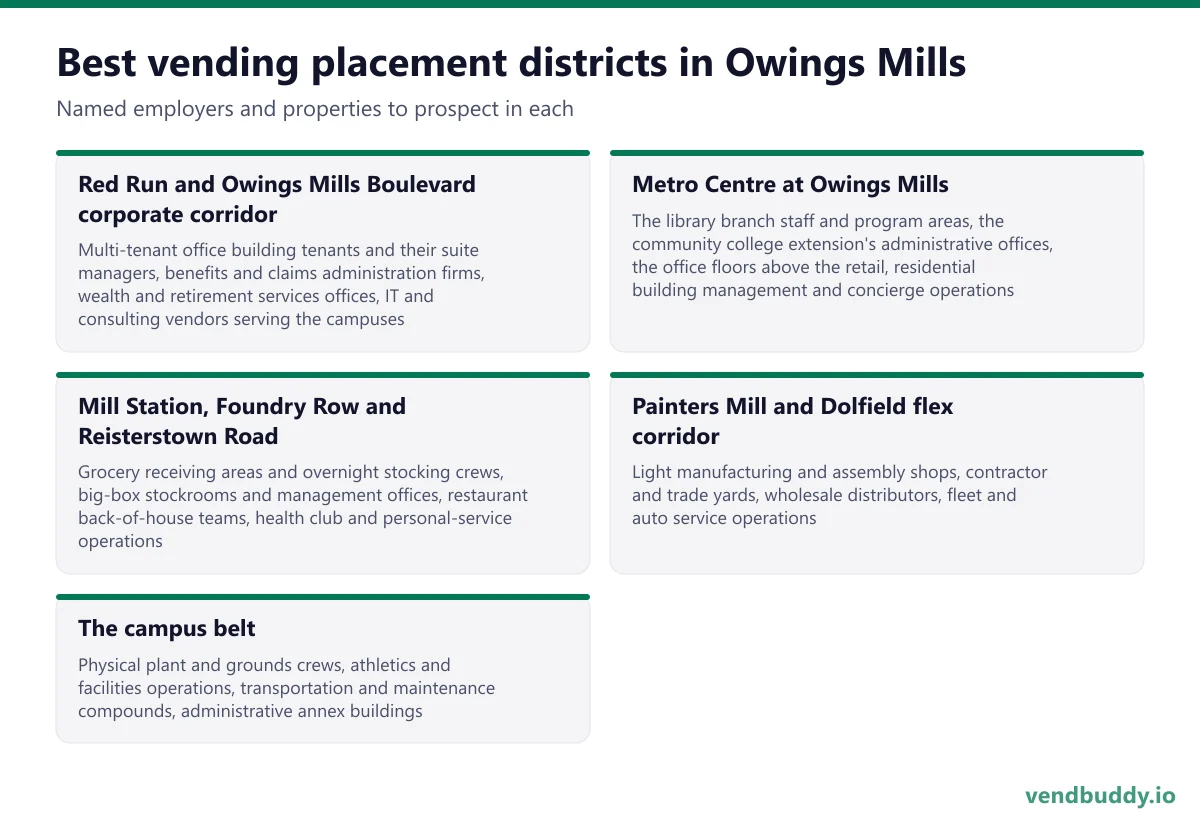
Red Run and Owings Mills Boulevard corporate corridor
The district's office spine, holding major insurance and financial services campuses alongside multi-tenant Class A and B buildings on landscaped parcels. Car-dependent, with no walkable food and long, stable tenancies.
Named placement targets: multi-tenant office building tenants and their suite managers, benefits and claims administration firms, wealth and retirement services offices, IT and consulting vendors serving the campuses, and the building management and janitorial operations
Metro Centre at Owings Mills
The transit-oriented development built around the northern terminus of the Baltimore Metro SubwayLink, mixing residential towers, a public library branch, a community college presence and ground-floor commercial with office space above.
Named placement targets: the library branch staff and program areas, the community college extension's administrative offices, the office floors above the retail, residential building management and concierge operations, and the ground-floor service tenants
Mill Station, Foundry Row and Reisterstown Road
The rebuilt regional retail core, where a demolished enclosed mall was replaced with open-air centres anchored by grocery and big-box tenants, running into the older Reisterstown Road commercial strip.
Named placement targets: grocery receiving areas and overnight stocking crews, big-box stockrooms and management offices, restaurant back-of-house teams, health club and personal-service operations, and the centre management and maintenance staff
Painters Mill and Dolfield flex corridor
The working industrial edge of the district in older single-storey multi-bay buildings, occupied by trades, distribution and small manufacturing with early starts and no nearby food.
Named placement targets: light manufacturing and assembly shops, contractor and trade yards, wholesale distributors, fleet and auto service operations, self-storage and logistics tenants, and the small flex-building tenants on short leases
The campus belt
The western and northern edges holding a university campus and two large independent school campuses on extensive grounds, plus the media production and sports training facilities that share the same low-density setting.
Named placement targets: physical plant and grounds crews, athletics and facilities operations, transportation and maintenance compounds, administrative annex buildings, and the production and technical support staff at the studio and training facilities
Want the list built for you? Pick one Owings Mills ZIP and VendBuddy delivers the 50 best-scored locations in it, enriched with the best contact on file, automatically, for $97 once.
If you are weighing whether a specific building inside one of these districts is worth pursuing, run it through our location scoring checklist first. It catches the bad-fit placements (low captive headcount, restricted access hours, existing operator relationship) before you waste a pitch on them.
MD Licenses, Permits, and Sales Tax for Vending in Owings Mills
Maryland does not license vending as a profession; it licenses the equipment, which is the detail operators arriving from Pennsylvania or Virginia consistently miss. You need a Vending Machine License from the Clerk of the Circuit Court in the county where the machine physically sits, and a Trader's License from the same office alongside it, with the trader fee scaled to the wholesale value of the inventory you carry. For anything in Owings Mills that office is the Baltimore County clerk in Towson. Sales and use tax registration with the Comptroller of Maryland is separate and free. Anyone restocking food should hold a certificate from an ANSI-accredited national programme.
Sales tax in Owings Mills: 6 percent statewide with no county or municipal addition, so a placement in Owings Mills prices identically to one in Baltimore City, Columbia or Annapolis — a genuine advantage when you are quoting a prospect with multiple sites across the region. The vending-specific mechanic is where the money is: Maryland has operators apply the 6 percent to 94.5 percent of gross receipts rather than to the full gross, on the reasoning that machine takings already include tax collected from the customer. Set your bookkeeping up around that factor from the first return rather than restating later, and confirm current treatment with the Comptroller before filing.
Local permits and licenses: Owings Mills has no municipal government, so there is no town business licence, no local vending permit and no city clerk to visit — it is an unincorporated census-designated place administered entirely by Baltimore County. That leaves the county filings and the state machine licence as the complete picture, which is simpler than operating in an incorporated Maryland municipality. The one logistical note is that the Clerk of the Circuit Court counter serving all of Baltimore County sits in Towson rather than locally, on a licence year running 1 May through 30 April at $2.50 per machine. A route that later reaches into Howard, Carroll or Anne Arundel counties files with those clerks separately.
Health department: The Baltimore County Department of Health handles food facility oversight locally under Maryland Department of Health rules. Sealed packaged snack and beverage machines require no facility permit; refrigerated fresh food, sandwich equipment or a micro market changes that answer and should be settled before you order equipment rather than after it is delivered. Two access constraints matter more here in practice than the health question does. The corporate campuses run vendor onboarding with insurance and background requirements that take weeks. The independent school campuses apply their own product and nutrition rules on school property, and those are stricter than anything the county imposes.
Every researched MD market, plus the state rules in one place: our MD vending hub.
State-by-state vending laws — including license thresholds, sales tax, and food handler requirements — are summarized in our vending laws reference. If you are forming an LLC for the route, our LLC setup and tax deductions guide covers the federal and state-level deductions specific to vending operators.
Commission Rates and Negotiation in Owings Mills
Typical commission range in Owings Mills: 0–10% of gross.
Multi-tenant office buildings on Red Run and Owings Mills Boulevard are managed as portfolios, so the property manager will open near the top of the band and may control several buildings at once — the relationship is usually worth more than the extra percentage points. Flex and industrial tenants on Painters Mill take nothing and want a written service day. The rebuilt retail centres will expect a share and often need a regional approval, which lengthens the cycle. Campus facilities and grounds operations pay no commission by policy and reward a vendor who follows the site rules with placements that hold for years. Independent school campuses negotiate on product and nutrition restrictions rather than on money, and the answer to what may be sold on school property comes before any discussion of terms.
Use our vending commission rates by location type for the full negotiation rubric (when to walk, when to counter with product credit, when to accept and renegotiate at renewal). The negotiating vending placements covers the actual scripts.
VendBuddy shows the best contact on file for the properties in this guide (owner or manager when available), with the emails and phone numbers we can find. Plus the contract generator, ROI calculator, and placement scoring tools you need to close.
Launch VendBuddy Free →A 3-Day Starter Route in Owings Mills
If you are dropping into Owings Mills for the first time and want to walk out with a real prospect list in 72 hours, this is the route experienced operators use. It groups districts by drive efficiency rather than by industry — you cover the most square footage with the fewest miles, which matters more in week one than perfect target prioritization.
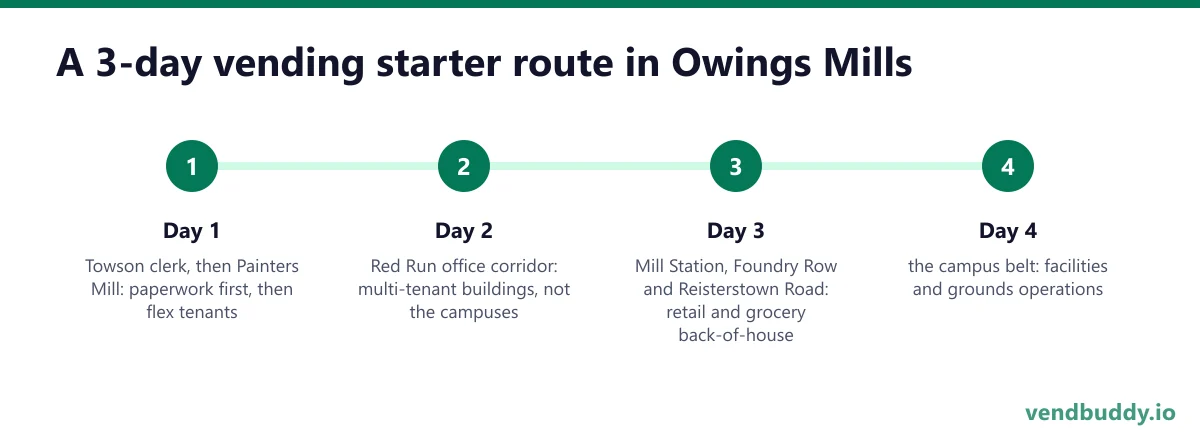
Targets: the Clerk of the Circuit Court counter in Towson, then light manufacturing shops, contractor yards, wholesale distributors and fleet service operations on Painters Mill and Dolfield
Field note: File the Vending Machine License and Trader's License before you canvass anything. Walking into a flex building with the county paperwork already done is a free credibility argument, and these owners decide on the spot.
Targets: office building suite managers, benefits and claims administration firms, wealth and retirement services offices, IT and consulting vendors, building management operations
Field note: Aim at the buildings around the corporate campuses rather than the campuses themselves, whose refreshment programmes are negotiated far above local level. Ask the property manager how many buildings they control before you talk terms.
Targets: grocery receiving areas and overnight stocking crews, big-box stockrooms, restaurant back-of-house, health club operations, centre management and maintenance staff
Field note: Ask for the receiving manager, not the store manager. Overnight stocking crews are the strongest single argument in this district because nothing is open when they take a break, and the person who understands that is standing at the loading dock.
Targets: physical plant and grounds crews, athletics and facilities operations, transportation and maintenance compounds, administrative annexes, studio and training-facility support staff
Field note: Open by asking what may be sold on the property, especially at the independent schools, because that answer defines the placement before any commercial discussion. Facilities staff work summers when campus dining is closed, which is precisely the gap you fill.
For the cold-email cadence to send the same evening, see our cold email scripts for property managers. The first email goes out within 24 hours of a pop-in; the second 5–7 days later. Operators who skip the same-day follow-up close at roughly half the rate of operators who do not.
Competition and Underserved Pockets in Owings Mills
Owings Mills reads as well covered because the visible accounts are: national operators service the corporate campuses as part of broader Baltimore County routes, and the big retail anchors sit inside regional agreements. Underneath that, the district is unusually open. The multi-tenant office buildings around the campuses are leased to firms far too small to interest a national on their own, yet they are stacked in the same few buildings, which is exactly the geometry an independent wants. The Painters Mill flex corridor generates no commission and involves too many small stops for a driver running a county-wide route. Campus facilities buildings sit outside the dining contracts and nobody asks about them. And because there is no town government to add a permitting hurdle, the barrier to entry here is operational rather than bureaucratic — which favours whoever is willing to actually drive Reisterstown Road at seven in the morning.
The lesson, in Owings Mills as in every other Tier-1 metro: the high-revenue marquee accounts (Fortune 500 HQs, flagship hospitals, university dining contracts) are locked under multi-year national contracts with Canteen, Five Star, Compass, or Aramark. The opportunity for an independent or regional operator is the second tier — the Class B office down the street, the medical office building two doors down from the main hospital, the apartment leasing office three blocks from a Whole Foods. Those are accessible, profitable, and almost always underserved.
Vending Machine Companies in Owings Mills, MD
If you manage a property in Owings Mills and want a machine placed, you do not pay for it — the operator buys, stocks, and services the machine and earns from what sells. Instead of calling companies one by one, submit the two-minute request at vendbuddy.io/property-managers and it gets routed to independent operators working the Owings Mills area; at most two receive it, and the first to claim it contacts you. How placement deals work, what commission is normal, and the national-versus-local trade-off are all in vending machine companies near me.
Owings Mills Vending FAQ
Do I need a vending machine license in Owings Mills, MD?
Yes, though it is a county filing rather than a local one. Maryland licenses machines instead of operators, through a Vending Machine License issued by the Clerk of the Circuit Court in the county where the equipment sits — for Owings Mills that is Baltimore County, whose clerk sits in Towson. Budget $2.50 per machine on a licence year running 1 May to 30 April, with certain product categories excluded, plus a Trader's License from the same office priced against the wholesale value of your inventory. Register separately and at no cost for sales and use tax with the Comptroller of Maryland.
Is there an Owings Mills business license?
No, because there is no Owings Mills municipality to issue one. It is an unincorporated census-designated place with no town council, no city hall and no local business licence, governed entirely by Baltimore County. That makes the paperwork simpler than operating inside an incorporated Maryland city. Your obligations are the county-level Vending Machine License and Trader's License from the Clerk of the Circuit Court, and a sales and use tax account with the Comptroller. Confirm current fees with the clerk's office directly, since amounts and exclusions are adjusted periodically.
How is Maryland sales tax applied to vending machine sales?
The headline rate is a flat 6 percent statewide with no county or city addition, so Owings Mills, Towson, Baltimore City and Columbia all price identically — a real simplification when your route crosses jurisdictions. The mechanic that catches new operators is the calculation base: Maryland has vending operators apply the 6 percent to 94.5 percent of gross receipts rather than the full gross, reasoning that machine takings already contain the tax collected from the customer. Build that factor in from the first return and confirm the current treatment with the Comptroller of Maryland before filing.
How much do vending machines make in Owings Mills?
No credible operator quotes a number, but the inputs are easy to read in this district. Volume depends on how many people are on site through a full shift, whether the location runs overnight, how far the nearest food actually is, how well the selection matches that specific workforce, and how often you service. Owings Mills has an unusual combination: household median income near $94,000 supports higher price points and premium lines, while the flex corridor and overnight grocery crews want value and volume. Two placements a mile apart can behave nothing alike.
Can I get machines into the CareFirst or T. Rowe Price campuses?
Not through a local sales call. Corporate campuses of that size run refreshment programmes negotiated at company level, often nationally, and an independent operator will not displace them. The productive move is to work the perimeter. The multi-tenant office buildings along Red Run Boulevard and Owings Mills Boulevard house the benefits administrators, claims processors, consultancies and IT vendors that exist because those campuses are here, and each of those tenants decides for itself. That is where the reachable volume in this corridor actually sits.
What is the best first placement type in Owings Mills?
Grocery and big-box receiving operations, for a specific reason. This district rebuilt its retail from the ground up after the old mall was demolished, so the back-of-house areas are modern, purpose-built and physically easy to service. More importantly, overnight stocking crews take breaks when nothing in the area is open, which makes the pitch obvious to the receiving manager in under a minute. Flex tenants on Painters Mill are a close second: no commission, no procurement, and a decision-maker who is on site at seven in the morning.
Essential Vending Guides
General information, not legal, tax or financial advice. Rules change, so check the official source. Revenue and income figures are examples, not promises. See our terms.