Gresham is the fourth-largest city in Oregon and the second-largest in the Portland metro, and it occupies a tax position nobody outside east county understands: it sits inside Multnomah County, so the county business income tax reaches it, and inside the Metro district, so the supportive housing services business tax reaches it — but it is not Portland, so the City of Portland business license tax does not. On top of that Gresham licenses businesses itself. An operator whose whole route lives east of 122nd is filing in a different combination of places than one working downtown, and almost nobody gets that combination right on the first try.
- Vending locations in Gresham: what the data shows
- What the Gresham numbers mean for operators and building owners
- Is Gresham a good place to start a vending machine business?
- Gresham Vending Market Overview
- Top Industries Driving Vending Demand in Gresham
- Best Placement Districts in Gresham
- OR Licenses, Permits, and Sales Tax for Vending in Gresham
- Commission Rates and Negotiation in Gresham
Free to search. 5 free contact reveals, no card.
Property owners and managers: tell us about the site and we pass it to an operator who covers Gresham, if one is in range.
Request a free machine →- Roughly 114,000 residents, which makes Gresham Oregon's fourth-largest city and the largest single suburb in the Portland metro.
- The city runs its own business licensing program — applications, renewals and payments go through the city, and it maintains rental licensing alongside it.
- Being in Multnomah County means the county business income tax applies here even though the Portland business license tax does not; both are administered from the same revenue office, which is why operators confuse them.
- Rockwood, at the western end of the city around 181st and Burnside, is a documented low-food-access neighborhood — the vending question there is genuinely about access, not convenience.
- The Gresham Vista Business Park, a Port of Portland industrial park of roughly 220 acres built on a former semiconductor campus, is the city's main traded-sector industrial land.
Free tools: vending ROI calculator · revenue calculator by property type · route time calculator · State of Vending 2026 report · all free tools
- Is Gresham a good place to start a vending machine business?
- Gresham Vending Market Overview
- Top Industries Driving Vending Demand
- Best Placement Districts in Gresham
- OR Licenses, Permits, and Sales Tax
- Commission Rates and Negotiation
- 3-Day Starter Route in Gresham
- Competition and Underserved Pockets
- Gresham Vending FAQ
Vending locations in Gresham: what the data shows
Sorted by Google category, Gresham’s 91 listings put restaurants and cafes first at 49 (53.8%), ahead of auto shops and dealers at 14 and retail stores at 8. The untyped remainder, 15% of the total, is largely office tenants.
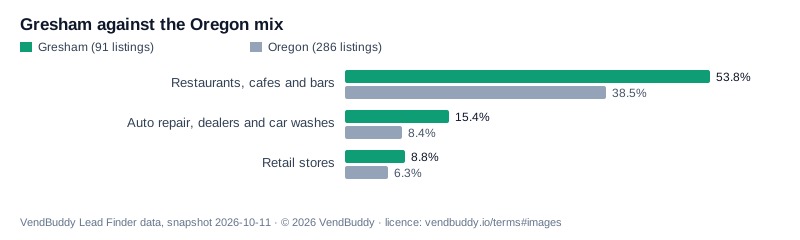
Gresham runs above the Oregon mix (286 listings) in 3 named groups and below it in none by 1.5 points or more. The widest gap is restaurants and cafes, 53.8% here against 38.5%. Also above: auto shops and dealers; retail stores.
31 businesses (34%) score 4.5 stars or more with 10+ reviews. Across 88 rated listings the median is 4.4 (Oregon: 4.4).
Hours matter for vending: 73% of the 84 Gresham businesses that publish them run past 9 PM some night, more than the 67% state figure.
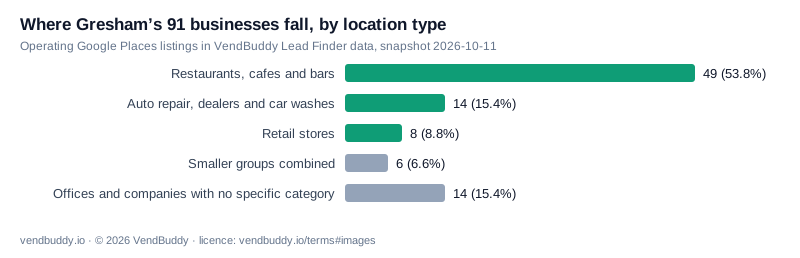
| Location type | Listings | Share | Oregon share |
|---|---|---|---|
| Restaurants, cafes and bars | 49 | 53.8% | 38.5% |
| Auto repair, dealers and car washes | 14 | 15.4% | 8.4% |
| Retail stores | 8 | 8.8% | 6.3% |
| Smaller groups combined | 6 | 6.6% | 14.7% |
| Offices and companies with no specific category | 14 | 15.4% | 26.9% |
| Total operating listings | 91 | 100% | 286 listings |
How we counted: Google Places listings that VendBuddy’s Lead Finder looked up between May and October 2026 with a Gresham, OR address, de-duplicated by place ID, operating businesses only, grouped by their Google category. Groups under 5 listings are combined. This is the sample our users searched, not a census of every business. Snapshot 2026-10-11.
Rules before you place a machine: Oregon vending hub (state permits and sales tax), and the state-by-state vending laws reference.
What the Gresham numbers mean for operators and building owners
The market read
Better suited to specialty machines than to a classic snack route. Only 26% of named listings fall in groups rated primary or good for a standard snack and drink machine, behind 39% across Oregon, because restaurants, cafes and bars, which already sell food and drinks, make up 54% of the sample. The evening weight is real: 73% of listings with posted hours stay open past 9 PM (Oregon: 67%), and with that many restaurants and bars the better fits are machines that do not compete with the kitchen, such as ATMs and bitcoin ATMs. One caution: this read rests on 91 listings, so treat it as a first filter for Gresham, not a census.
If you own or manage a dealership or auto service shop in Gresham: 14 auto shops and dealers came up in the Lead Finder searches vending operators ran here (15.4% of the sample, well above the 8.4% Oregon share), so operators are already looking at service lounges like yours. The machines the fit matrix rates primary for this kind of site are snacks and drinks, air machines, coffee and car care supplies. In the standard arrangement the operator buys, stocks and services the machine; tell us about the property and we pass it to an operator who covers Gresham, if one is in range. Ask for a free machine in Gresham →
Three venue types to target first in Gresham
Ranked by how many listings each type has here, how well a standard snack and drink machine suits it, and how over-represented it is against Oregon.
- Auto repair, dealers and car washes: 14 listings, 15.4% of the Gresham sample. That is 1.8 times the Oregon share of 8.4%. Snack and drink fit: primary (customers wait for service, break room traffic is steady). Rated primary: snacks and drinks, air machines, coffee and car care supplies.
- Restaurants, cafes and bars: 49 listings, 53.8% of the Gresham sample. That is 1.4 times the Oregon share of 38.5%. Skip the snack machine here (a kitchen or bar on site already sells food and drinks); machines rated good instead: ATMs, bitcoin ATMs and claw machines.
- Retail stores: 8 listings, 8.8% of the Gresham sample. That is 1.4 times the Oregon share of 6.3%. A snack machine is only a possible fit here (some traffic, but short stays or competing food nearby). Rated primary: water vending, massage chairs and candy and gumball.
Oregon rules that apply to a machine in Gresham
Tobacco and vape vending in Oregon (Or. Rev. Stat. § 167.780(2), checked 2026-10-01): Prohibited except in establishments permanently and entirely off-limits to people under 21. The rule reaches vapes and e-liquids as well as tobacco, so a vape machine in Gresham is held to it.
On top of that, federal rules (21 CFR 1140.14(b)(3) and 1140.16(c)(2)(ii)) allow tobacco and e-cigarette vending only where no one under 21 is present or allowed in.
Snack, drink and coffee machines carry none of that. Their paperwork is the sales tax and permit rules in the Gresham licensing section below and the Oregon vending hub.
Is Gresham a good place to start a vending machine business?
Yes, with one condition: Gresham rewards district selection more than raw hustle. The Gresham, OR metro carries about 4,500 establishments in Gresham across roughly 114K residents — about 39.5 business establishments per 1,000 people, well above the roughly 30-per-1,000 national figure, so prospecting density is working for you. Median household income is ~$70,000 household — below the Portland metro figure, close to the roughly $75,000 U.S. median, and that number decides more than any other whether a $2.25–$2.75 price point holds or you have to run value pricing to keep vend counts up. Gresham grew fast through the 1990s and 2000s and has since flattened, so the change that matters now is compositional rather than numerical: industrial land at Gresham Vista and the north Gresham employment area is filling in while the older retail strips along Powell and Division turn over tenants, which means the openings come from new industrial occupancy and from small-business churn rather than from population. On the supply side, the community college and hospital are served, but the north Gresham industrial area, the Powell and Division small-business corridors and the Rockwood commercial blocks carry noticeably thin coverage for a city this size.
Demand here concentrates in Advanced Manufacturing and Industrial, Healthcare, Education, Retail and Small Business and Distribution and Logistics, led by Advanced Manufacturing and Industrial — and those workers sit in identifiable places, not spread evenly across the metro. The 5 districts mapped below (Downtown Gresham and Gresham Station; North Gresham industrial and Gresham Vista; Rockwood and the 181st corridor; Mount Hood Community College and the Kane Drive corridor; Powell and Division small-business corridors) are where the captive headcount actually is. Budget for 0–10% of gross in commission — commission expectations are operator-friendly by national standards. There is no state sales tax to collect on vends. One local wrinkle to plan around: Two things, and both are municipal. First, Gresham operates its own business licensing program, with applications, renewals and payments handled through the city, and it runs rental licensing on the same system — so an operator servicing machines inside the city should assume municipal licensing applies and confirm the category with the city rather than relying on the general Oregon pattern. Neighboring Troutdale, Wood Village and Fairview each answer that question for themselves, so an east-county route crosses several licensing regimes within about six miles. Second, and more expensively, there is an income-tax layer that distinguishes Gresham from every other Portland-area suburb an operator might compare it to. Because Gresham sits in Multnomah County, the Multnomah County business income tax applies to business income earned here, and because it sits within the Metro urban district, the Metro supportive housing services business income tax can apply as well once the receipts threshold is met. Both are administered through the Portland revenue office, which is exactly why operators assume they are the Portland business license tax and either overpay or ignore both.
The catch: The national operators reach Gresham from Portland routes rather than basing anything here, which shows up in the pattern of who is covered: the hospital, the community college and the largest business park tenants are on somebody's route, and almost nothing else is. That is the shape of every market this size — the marquee accounts are contracted, and the money for an independent operator is one tier down, in the buildings next door to them.
| Signal | Gresham | National reference |
|---|---|---|
| Metro population | ~114K in Gresham; part of the ~2.5M Portland metro | — |
| Business establishments | ~4,500 establishments in Gresham | — |
| Establishments per 1,000 residents | 39.5 | ~30 |
| Median household income | ~$70,000 household — below the Portland metro figure | ~$75,000 |
| Commission expectation | 0–10% of gross | 10–15% typical |
| Sales tax on vended goods | 0% | varies by state |
| Demand sectors driving placements | Advanced Manufacturing and Industrial, Healthcare, Education, Retail and Small Business and Distribution and Logistics | — |
| Placement districts mapped below | 5 | — |
Is Gresham a good area to start a vending machine business?
Yes, with one condition: Gresham rewards district selection more than raw hustle. Gresham carries ~4,500 establishments in Gresham across a 114K metro — about 39.5 establishments per 1,000 residents, well above the roughly 30-per-1,000 national figure, so prospecting density is working for you. Median household income is ~$70,000 household — below the Portland metro figure, close to the roughly $75,000 U.S. median. Start in Downtown Gresham and Gresham Station, then North Gresham industrial and Gresham Vista — both are broken out below with named placement targets. The honest constraint: The national operators reach Gresham from Portland routes rather than basing anything here, which shows up in the pattern of who is covered: the hospital, the community college and the largest business park tenants are on somebody's route, and almost nothing else is.
Can I start a vending machine business in Gresham?
Yes. Nothing in Oregon licenses vending as a trade. There is no operator permit, no machine registration, no decal — the state-level items are a business identification number from the Secretary of State, which costs nothing, and an Oregon Health Authority food handler card for every person who restocks food, at roughly ten dollars for three years and valid across every county. Multnomah County environmental health handles food facility permitting locally under the state food code, reaching machines that dispense potentially hazardous refrigerated or heated product rather than sealed drinks and packaged shelf-stable snacks. Sales tax on vended goods: Oregon collects nothing on the sale, at state, county or city level, so a machine in Gresham takes the posted price and generates no return. What Gresham does have is income-side local taxation that operators from outside the region consistently miss, and which is described below. Do not confuse the two: the absence of a sales tax says nothing about whether a business income tax reaches you. Food handler rules and the local permit quirks are broken out in full further down this page. No OR statute blocks a new operator from placing machines in Gresham — the real barrier is placement access, not paperwork.
How much do vending machines make in Gresham?
There is no city-level vending revenue dataset for Gresham, and any specific Gresham figure you see quoted is an estimate dressed up as data. What operators report nationally: a healthy snack and drink placement grosses roughly $150–$400 per machine per month, low-traffic placements sit at $75–$150, and high-density captive placements (24/7 warehouses, hospital night shift, 200-plus-person offices) clear $400–$700 or more. Gross margin lands near 50–55% before commission. Demand signals in Gresham point toward the middle of that band: median household income is ~$70,000 household — below the Portland metro figure, demand concentrates in Advanced Manufacturing and Industrial, Healthcare, Education, Retail and Small Business and Distribution and Logistics, and commission expectations are operator-friendly by national standards at 0–10% of gross. Model your own stops with the free route valuation calculator.
Two free tools do the two jobs this page cannot: one ranks the ZIPs, the other prices a deal. Neither needs an account.
Gresham Vending Market Overview
Gresham, OR is a market where Gresham grew fast through the 1990s and 2000s and has since flattened, so the change that matters now is compositional rather than numerical: industrial land at Gresham Vista and the north Gresham employment area is filling in while the older retail strips along Powell and Division turn over tenants, which means the openings come from new industrial occupancy and from small-business churn rather than from population. The metro contains roughly 4,500 establishments in Gresham at a median household income of ~$70,000 household — below the Portland metro figure, and the community college and hospital are served, but the north Gresham industrial area, the Powell and Division small-business corridors and the Rockwood commercial blocks carry noticeably thin coverage for a city this size. The implication for a new or scaling operator: the prospecting addressable market is large, the per-machine economics support a real business, and the gap between operator coverage and underlying demand is real enough that it shows up in routing math, not just marketing copy.
The four sectors that drive vending demand in Gresham are Advanced Manufacturing and Industrial, Healthcare, Education, Retail and Small Business, Distribution and Logistics. Each has its own access pattern (badge-required vs. open lobby), break-room culture (catered vs. dependent on vending), and product-mix expectation (premium vs. value). The sections below break each down with named employers and the placement targets that actually convert.
Before you commit to a route in Gresham, work through our location scoring checklist on a sample location — it will save you the cost of a bad first placement, which is usually a year of revenue. If you are still pre-launch, our guide to starting a vending machine business walks through the entity setup, financing, and machine sourcing that comes before the prospecting phase.
Top Industries Driving Vending Demand in Gresham
The four industries below account for the bulk of high-revenue vending placements in Gresham, OR. The named employers are anchor tenants — large, captive workforces that drive the local property managers' decisions about whether to install vending at all. Reading these in order also tells you what kind of operator wins which placement: the apparel of a healthcare-pitch deck looks nothing like the apparel of an aerospace-pitch deck, and matching the fit matters more than commission percentage.
Advanced Manufacturing and Industrial
North Gresham is the city's industrial engine, anchored by the Port of Portland Gresham Vista Business Park on roughly 220 acres of land that was a semiconductor campus before it was subdivided into general industrial lots. Around it along NE Sandy Boulevard and the 181st and 223rd corridors sit metal fabrication, plastics, food processing and precision machining operations at the fifty-to-four-hundred-employee scale.
Healthcare
Legacy Mount Hood Medical Center on Stark Street is the only hospital between the Portland core and the Cascades, which makes it the referral point for everyone in east Multnomah County and out along the Columbia River Gorge. Around it and along the Kane Drive and Division corridors are dental groups, urgent care, dialysis, behavioral health and elder-care operations that are individually small and collectively substantial.
Education
Mount Hood Community College sits on a large campus off Kane Drive and serves a wide east-county catchment with a strong career-technical program mix, including nursing, automotive, welding and integrated media that keep students in labs on evening and weekend schedules. Below it, the Gresham-Barlow and Reynolds school districts together employ several thousand people across dozens of buildings.
Retail and Small Business
Powell Boulevard, Division Street and Burnside carry the working commercial life of the city — auto shops, medical and dental practices, immigrant-owned groceries and restaurants, trades contractors, and the small professional offices above them. Gresham has a substantially more diverse population than the metro average, particularly in the Rockwood and Wilkes East areas, and product mix that works in a Beaverton office park frequently misreads this market.
Distribution and Logistics
The eastern edge of the metro industrial market runs from north Gresham out through Wood Village, Fairview and Troutdale toward the Columbia, where large distribution and parcel operations sit within a few minutes of Gresham addresses. Those facilities keep round-the-clock staffing and their contractor, staffing agency and trucking suppliers cluster nearby.
For deeper revenue benchmarks by location type — apartment vs. warehouse vs. medical vs. office — see our vending machine income data and the vending costs and profit breakdown. Both are continuously updated from operator surveys.
Best Placement Districts in Gresham
The districts below are ranked by daytime worker density and operator-coverage gap, not just by population. A district with 50,000 office workers and three national operators competing already may be a worse target than a district with 20,000 office workers and zero operator presence. Gresham has a few of each — the named placement targets in each card are the actual employers and properties to prospect, not generic industry categories.
Downtown Gresham and Gresham Station
The historic core around Main Avenue and Powell plus the newer Gresham Station retail and office development to the north. Civic buildings, professional offices, a MAX line terminus, and a walkable center that is genuinely busy at midday and quiet after six.
Named placement targets: the city and county offices, the law, insurance and accounting practices around Main Avenue, the credit union and bank operations space, plus the Gresham Station office and service tenants
North Gresham industrial and Gresham Vista
The city traded-sector heartland along NE Sandy Boulevard and the 181st to 223rd corridors, including the Port of Portland business park on roughly 220 acres of former semiconductor land. Large floor plates, shift work, secured yards, and no food within a walk.
Named placement targets: the Gresham Vista Business Park tenants, the metal fabrication and plastics shops along Sandy Boulevard, the precision machining and food processing plants, plus the freight and contractor yards serving them
Rockwood and the 181st corridor
The dense western end of the city around 181st and Burnside — the most diverse neighborhood in east county, a documented low-food-access area, and the site of the Rockwood Rising redevelopment and market hall. High foot traffic, high transit use, low car ownership.
Named placement targets: the Rockwood Rising and market hall ground-floor businesses, the immigrant-owned groceries and service businesses along Burnside and Stark, the community and workforce organizations, plus the transit-adjacent commercial blocks
Mount Hood Community College and the Kane Drive corridor
The college campus plus the medical and service buildings strung along Kane Drive and Stark toward the hospital. Evening lab schedules on the campus side, continuous clinical staffing on the medical side.
Named placement targets: the community college shop, lab and athletic buildings outside central food service, the dental and specialty practices along Kane Drive, the urgent care and dialysis sites, plus the district administration buildings
Powell and Division small-business corridors
The two long east-west commercial arterials that carry most of the city's everyday business. Auto and truck service, trades contractors, restaurants and groceries, small professional offices — hundreds of businesses at the five-to-fifty-employee scale with fast tenant turnover.
Named placement targets: the auto and collision shops, the trades contractor offices and yards, the veterinary and dental practices, the small professional suites, plus the grocery and restaurant back-of-house along both corridors
Want the list built for you? Pick one Gresham ZIP and VendBuddy delivers the 50 best-scored locations in it, enriched with the best contact on file, automatically, for $97 once.
If you are weighing whether a specific building inside one of these districts is worth pursuing, run it through our location scoring checklist first. It catches the bad-fit placements (low captive headcount, restricted access hours, existing operator relationship) before you waste a pitch on them.
OR Licenses, Permits, and Sales Tax for Vending in Gresham
Nothing in Oregon licenses vending as a trade. There is no operator permit, no machine registration, no decal — the state-level items are a business identification number from the Secretary of State, which costs nothing, and an Oregon Health Authority food handler card for every person who restocks food, at roughly ten dollars for three years and valid across every county. Multnomah County environmental health handles food facility permitting locally under the state food code, reaching machines that dispense potentially hazardous refrigerated or heated product rather than sealed drinks and packaged shelf-stable snacks.
Sales tax in Gresham: Oregon collects nothing on the sale, at state, county or city level, so a machine in Gresham takes the posted price and generates no return. What Gresham does have is income-side local taxation that operators from outside the region consistently miss, and which is described below. Do not confuse the two: the absence of a sales tax says nothing about whether a business income tax reaches you.
Food handler requirements: Multnomah County environmental health is the food facility permitting authority for Gresham, the same program that covers Portland, so a route running the length of the county deals with one health agency even while it crosses several city licensing regimes. Everyone who restocks needs the Oregon Health Authority food handler card, roughly ten dollars and valid three years anywhere in the state. Equipment dispensing potentially hazardous refrigerated or heated product, and any micro market, sits inside food facility permitting; sealed beverages and packaged shelf-stable snacks generally sit outside it.
Local quirks worth knowing: Two things, and both are municipal. First, Gresham operates its own business licensing program, with applications, renewals and payments handled through the city, and it runs rental licensing on the same system — so an operator servicing machines inside the city should assume municipal licensing applies and confirm the category with the city rather than relying on the general Oregon pattern. Neighboring Troutdale, Wood Village and Fairview each answer that question for themselves, so an east-county route crosses several licensing regimes within about six miles. Second, and more expensively, there is an income-tax layer that distinguishes Gresham from every other Portland-area suburb an operator might compare it to. Because Gresham sits in Multnomah County, the Multnomah County business income tax applies to business income earned here, and because it sits within the Metro urban district, the Metro supportive housing services business income tax can apply as well once the receipts threshold is met. Both are administered through the Portland revenue office, which is exactly why operators assume they are the Portland business license tax and either overpay or ignore both.
Every researched OR market, plus the state rules in one place: our OR vending hub.
State-by-state vending laws — including license thresholds, sales tax, and food handler requirements — are summarized in our vending laws reference. If you are forming an LLC for the route, our LLC setup and tax deductions guide covers the federal and state-level deductions specific to vending operators.
Commission Rates and Negotiation in Gresham
Typical commission range in Gresham: 0–10% of gross.
Gresham Station and the downtown professional offices talk in percentages and generally land in the middle of that band. The north Gresham industrial tenants and the Gresham Vista occupants overwhelmingly take zero and negotiate on service frequency and product mix instead, because a facilities manager covering three shifts is buying reliability rather than revenue. Along Powell and Division the businesses are small enough that commission is not really the conversation — a stocked machine that gets serviced when promised is the entire pitch.
Use our vending commission rates by location type for the full negotiation rubric (when to walk, when to counter with product credit, when to accept and renegotiate at renewal). The negotiating vending placements covers the actual scripts.
VendBuddy shows the best contact on file for the properties in this guide (owner or manager when available), with the emails and phone numbers we can find. Plus the contract generator, ROI calculator, and placement scoring tools you need to close.
Launch VendBuddy Free →A 3-Day Starter Route in Gresham
If you are dropping into Gresham for the first time and want to walk out with a real prospect list in 72 hours, this is the route experienced operators use. It groups districts by drive efficiency rather than by industry — you cover the most square footage with the fewest miles, which matters more in week one than perfect target prioritization.
Targets: the business park tenants, the fabrication, plastics and machining shops along Sandy Boulevard, plus the food processing plants and contractor yards nearby
Field note: Arrive before the first shift change and ask for operations rather than the front office. Bring a written service schedule and a plan for the second and third shift, because the shift nobody serves is the reason the account is available.
Targets: auto and collision shops, trades contractor offices, veterinary and dental practices, small professional suites, plus grocery and restaurant back-of-house
Field note: This is a numbers day. Thirty doors in six hours, most of them owner-operated, most decisions made on the spot. Track which ones already have a machine and who put it there, because incumbency here is usually informal and often unserviced.
Targets: the Rockwood Rising and market hall businesses, the groceries and service businesses along Burnside and Stark, the community and workforce organizations, plus the transit-adjacent employers
Field note: Reprice before you pitch. This is a genuinely low food access neighborhood with high transit use, and a machine specified and priced for a suburban office park will underperform and read badly. Ask what people actually want stocked and load that.
For the cold-email cadence to send the same evening, see our cold email scripts for property managers. The first email goes out within 24 hours of a pop-in; the second 5–7 days later. Operators who skip the same-day follow-up close at roughly half the rate of operators who do not.
Competition and Underserved Pockets in Gresham
The national operators reach Gresham from Portland routes rather than basing anything here, which shows up in the pattern of who is covered: the hospital, the community college and the largest business park tenants are on somebody's route, and almost nothing else is. Regional Oregon independents working out of the Portland core do cover parts of the industrial area, but their east-county stops tend to sit at the tail end of a route that started twenty miles west, and service windows reflect that. The genuinely open ground is the second tier of industrial tenants in north Gresham, the small-business density along Powell and Division, and the Rockwood commercial blocks where price sensitivity has kept larger operators away entirely.
The lesson, in Gresham as in every other Tier-1 metro: the high-revenue marquee accounts (Fortune 500 HQs, flagship hospitals, university dining contracts) are locked under multi-year national contracts with Canteen, Five Star, Compass, or Aramark. The opportunity for an independent or regional operator is the second tier — the Class B office down the street, the medical office building two doors down from the main hospital, the apartment leasing office three blocks from a Whole Foods. Those are accessible, profitable, and almost always underserved.
Vending Machine Companies in Gresham, OR
If you manage a property in Gresham and want a machine placed, you do not pay for it — the operator buys, stocks, and services the machine and earns from what sells. Instead of calling companies one by one, submit the two-minute request at vendbuddy.io/property-managers and it gets routed to independent operators working the Gresham area; at most two receive it, and the first to claim it contacts you. How placement deals work, what commission is normal, and the national-versus-local trade-off are all in vending machine companies near me.
Gresham Vending FAQ
Do I need a vending machine license in Gresham, OR?
Oregon itself licenses nothing about vending — no operator permit, no decal, just a free business identification number from the Secretary of State and an Oregon Health Authority food handler card for anyone restocking. Gresham, however, runs its own business licensing program through the city, so an operator servicing machines inside the city limits should treat municipal licensing as applying and confirm the category and fee with the city directly.
Does the Multnomah County business income tax apply to a vending business in Gresham?
It can, and this is the single most common local compliance mistake in east county. Gresham is inside Multnomah County, so business income earned here falls within the county business income tax, and the Metro supportive housing services business tax can apply as well once your receipts cross the threshold. Both are administered from the same revenue office as the City of Portland business license tax, which is why operators assume all three are one thing. They are not, and the Portland city tax specifically does not apply to a Gresham placement.
How much do vending machines make in Gresham?
Rather than a city average, look at the drivers that actually vary between a north Gresham plant and a Division Street auto shop: captive headcount, how many hours a day the building is occupied, whether there is food within a five-minute walk, and how price-sensitive the population is. A three-shift manufacturer with a secured yard and no cafeteria behaves nothing like a fifteen-person office.
What should I stock differently in Rockwood?
Rockwood is one of the most diverse neighborhoods in Oregon and a documented low-food-access area, and both facts should change what goes in the machine. Price points that work in a westside office park will price the machine out of use here, and a default American snack planogram will miss a large share of what people actually want. The productive approach is to ask the site — the community organization, the property, the employer — what their people buy, and to treat the machine as filling a genuine access gap rather than as a convenience add-on.
Where are the best vending opportunities in Gresham right now?
Start with the north Gresham industrial area and the Port of Portland business park, where shift work, secured sites and distance from food combine with the thinnest operator coverage in the city. Second is the medical and elder-care ring around Legacy Mount Hood, which is fragmented across many small managers and staffed continuously. Third is straightforward volume canvassing along Powell and Division, where hundreds of small owner-operated businesses can each say yes in a single conversation and no national route will ever knock.
Essential Vending Guides
General information, not legal, tax or financial advice. Rules change, so check the official source. Revenue and income figures are examples, not promises. See our terms.