- You are not buying a fridge. A vending machine is a refrigeration system, a steel safe, a dispensing robot and a certified payment terminal sharing one cabinet.
- Refrigeration is the single biggest line. Compressor, condenser and a sealed system rated to hold temperature in a hot corridor, with the door opened by strangers all day.
- The steel is a security spec, not styling. The cabinet has to hold cash and inventory unattended in a public space and survive being kicked.
- Payment hardware costs $300–$500 mostly in certification — PCI compliance, card-network approval and the radio, spread across a small production run.
- Volume is the quiet multiplier. Manufacturers build these in thousands, not millions, so none of the scale that makes appliances cheap ever reaches the price.
Stand in front of a $4,000 price tag on a machine that dispenses $1.75 bags of chips and the number feels absurd. It is not. Almost every dollar in a vending machine sticker is doing a specific and fairly boring job, and once you can see the six of them the price stops looking like a markup and starts looking like a bill of materials.
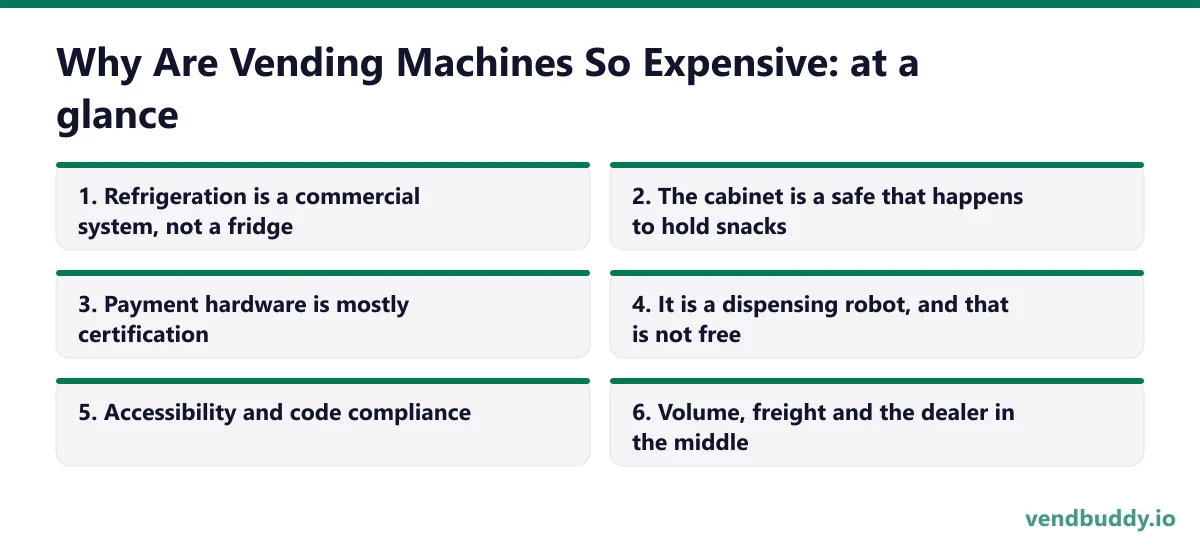
- 1. Refrigeration is a commercial system, not a fridge
- 2. The cabinet is a safe that happens to hold snacks
- 3. Payment hardware is mostly certification
- 4. It is a dispensing robot, and that is not free
- 5. Accessibility and code compliance
- 6. Volume, freight and the dealer in the middle
- What that means when you look at a price tag
- Frequently Asked Questions
Part of our complete guide: how much does a vending machine cost.
This page is the explanation, not the shopping advice. No model recommendations, no buying strategy — just where the money goes.
1. Refrigeration is a commercial system, not a fridge
Anything that has to hold temperature carries a compressor, a condenser, an evaporator and a sealed refrigerant circuit, and in a vending machine that system is specified far harder than the one in your kitchen. It has to hold product temperature in an unconditioned corridor or a warehouse in August, with the door swinging open every few minutes for people who do not care, and it has to do it for a decade of continuous duty rather than a domestic appliance’s intermittent one.
That is why a dry snack machine is meaningfully cheaper to buy than a glass-front drink cooler of the same size, and why compressors are also the thing that fails expensively later — the repair economics are laid out in what vending machine repairs actually cost. Refrigeration is the largest single reason two machines of identical footprint can be $2,000 apart.
2. The cabinet is a safe that happens to hold snacks
A vending machine sits unattended in a public corridor holding both cash and sellable inventory, overnight, with nobody watching. So the enclosure is welded sheet steel, the lock is a T-handle security lock, the glass is laminated or polycarbonate, and the whole thing weighs 600 to 800 pounds partly so that two people cannot walk off with it.
None of that is styling. It is the reason the machine costs what it does to build, costs $200–$400 to move, and needs a doorway measured before it arrives. Strip the security spec out and you get the cheap imports — lighter gauge, weaker locks, thinner glass — which is a real product category with a real trade-off attached rather than a scandal.
A vending machine is a refrigerator, a safe, a robot and a payment terminal in one cabinet - built in thousands, not millions. The price is not a markup, it is a bill of materials.
Picture the machines paying you while you sleep
That’s the real promise of vending — income that doesn’t cost you your time, and a life on your own terms. VendBuddy turns this guide into a step-by-step plan so you actually build it instead of just reading about it. Start free today.
Start building free →3. Payment hardware is mostly certification
The cashless module on the front adds roughly $300–$500, and surprisingly little of that is the plastic and the chip. Anything that touches card data has to meet payment-industry security standards, be certified against the card networks, and stay certified as those standards move — a continuing engineering and audit cost spread across a small production run. Add a cellular or wifi radio, an antenna, and the back end that reports sales and issues refunds when a coil jams.
Then there is the older half of the payment stack, which people forget is there at all: a bill validator that has to recognise and reject counterfeits, and a coin mech that has to identify denominations and pay change reliably. Both are precision devices, both are wear items, and both are in every machine that still takes cash. The card reader comparison covers what the modern half of that stack does for the money.
4. It is a dispensing robot, and that is not free
Selecting item C4 and getting exactly one of it into the tray is mechanical work. Every column is a driven coil or a spiral with its own motor, its own position sensing and its own control line back to the board. A mid-size snack machine has thirty to forty of those. Add the vend sensor that confirms the product actually dropped, the keypad, the controller, the wiring loom, and the software that ties it to the payment system so a failed vend refunds instead of stealing a dollar.
This is the part that has no consumer analogue at all, and it is also why machines have more failure modes than an appliance: thirty-odd small mechanisms, each of which can jam. It is where a lot of the assembly labour goes.
5. Accessibility and code compliance
A machine placed in a space open to the public is subject to accessibility requirements — reach ranges, operable-parts height, controls usable with one hand without tight grasping or twisting. That constrains where the keypad, the coin slot, the reader and the delivery tray can physically go, and it constrains the cabinet layout around them. Manufacturers engineer to those requirements across the whole product line rather than building compliant and non-compliant variants, so the cost is in every unit.
Alongside it sits the ordinary electrical and safety certification any commercial appliance carries, plus, for anything holding food or cold drinks, the sanitation expectations of whatever health authority covers the placement. None of this is dramatic. It is all the unglamorous overhead of selling a regulated machine into a public space.
6. Volume, freight and the dealer in the middle
Here is the multiplier under all five of the above. Consumer appliances are cheap because they are built by the million and every fixed cost — tooling, certification, engineering, warranty reserve — is divided by an enormous number. Vending machines are built in the thousands. The same fixed costs get divided by a much smaller number, so each unit carries a much larger share of them.
Then it has to physically arrive. This is a freight-class item weighing hundreds of pounds, usually shipped on a pallet with a liftgate delivery, and that cost is real whether it is itemised on your invoice or quietly folded into the price. And somebody has to warehouse it, uncrate it, test it, and be reachable when a coil stops turning — which is exactly the gap between a $900 marketplace listing and a $2,400 dealer-refurbished unit with a warranty. You are not paying $1,500 for a better cabinet. You are paying it for the testing, the parts already replaced, and a phone number that answers.
Prices move around more than any guide keeps up with. The machine finder is where we keep the current line-up, sorted by what a location that size can realistically support rather than by what looks impressive.
What that means when you look at a price tag
Two things follow from all of this, and they are the only practical notes on this page.
The first is that a cheap machine is usually cheap in a specific place, and it is worth knowing which. Thinner steel, a lighter-duty compressor, an uncommon parts platform, or no cashless module are all real cost removals with real consequences. Simply being older, from a mainstream manufacturer, with a serviceable parts supply, is not — that is the discount worth taking. Knowing which cost line is real is also what gives you leverage, and whether you can negotiate vending machine prices comes down to which of those lines the seller can actually move.
The second is that the sticker was never the interesting number anyway. The same machine earns wildly different money in two different buildings, which is why the price of the box matters far less to your return than where it ends up standing. When you are ready for the actual figures by machine type, they are all in current vending machine prices.
A $12-a-day location and a $40-a-day location cost the same money to enter, which makes the building the expensive decision and the machine the cheap one. VendBuddy scores real venues near you by traffic, headcount and category, gives you the best contact on file for each, and models what a machine would net there. Five free credits, no card required.
Related reading: what every machine type costs, repair costs and which failures are expensive, how long a machine actually lasts, why smart coolers cost roughly double, and what it costs to run one every month.
Frequently Asked Questions
Why are vending machines so expensive?
Because a vending machine is six expensive things in one cabinet: a commercial refrigeration system, a welded steel enclosure heavy enough to resist theft, certified payment hardware, motor and sensor control electronics, accessibility compliance, and a distribution chain selling a few thousand units a year rather than a few million. Refrigeration alone puts a compressor, a condenser and a sealed system into the price. The steel is a security requirement rather than a styling choice. And every unit is built at industrial volumes measured in thousands, so none of the per-unit cost reduction that makes consumer appliances cheap ever applies.
Why does a vending machine cost more than a refrigerator?
A domestic refrigerator opens for a trusted owner in a home and is built by the million. A vending machine holds cash and inventory in a public corridor, has to survive being kicked, has to dispense a chosen item on command through motors and sensors, has to authorise a card payment to banking standards, and is built in thousands. It is a refrigerator plus a safe plus a robot plus a payment terminal, on a fraction of the manufacturing volume. Only one of those four jobs is in the fridge price.
On card payments specifically, Nayax is the default for a dull reason: it is the one most machine suppliers pre-wire for. Price the monthly against your slowest machine, not your best one. Affiliate link, so we may earn a commission at no extra cost to you.
Why do vending machines with card readers cost more?
A cashless module adds about $300 to $500 to the machine, and the reason is certification rather than components. Anything that accepts card data has to meet payment industry security standards, be certified against the card networks and stay compliant as those standards change, which is a continuing engineering and audit cost spread over a small number of units. There is also a cellular or wifi radio, an antenna, and the back-end that reports sales and processes refunds. That $300 to $500 is largely paying for the parts of the product that are not physical.
Do vending machines get cheaper over time?
Not in the way electronics do, because the bulk of the cost is steel, copper, compressors and freight rather than semiconductors. Those move with commodity and shipping markets rather than downwards on a curve. The part of the machine that has genuinely got cheaper is the intelligence - telemetry and cashless hardware cost a fraction of what the equivalent did fifteen years ago - which is why a modern machine carries far more capability at a broadly similar price rather than the same capability at a lower one.
Is a cheap vending machine a false economy?
Sometimes, and the tell is which cost was removed. A cheaper cabinet that is thinner steel, has a lighter-duty compressor or uses an uncommon parts platform will cost the difference back in repairs and downtime, because a machine that is not vending is earning zero while the location watches. A cheaper machine that is simply older, from a mainstream manufacturer, with a serviceable parts supply and a dealer who has already replaced the wear items, is usually a genuine saving rather than a false one.
What is selling, which buildings say yes, and the numbers before you buy a machine. Free, confirm from your inbox, unsubscribe in one click. Refer one friend and get 25 VendBuddy credits.
Want the free 38-page Ultimate Vending Guide too? Get the guide
General information, not legal, tax or financial advice. Rules change, so check the official source. Revenue and income figures are examples, not promises. See our terms.