- "No credit check" almost always means "not a credit check you would recognise." BNPL platforms approve on bank-account and payment history instead, often with a soft pull.
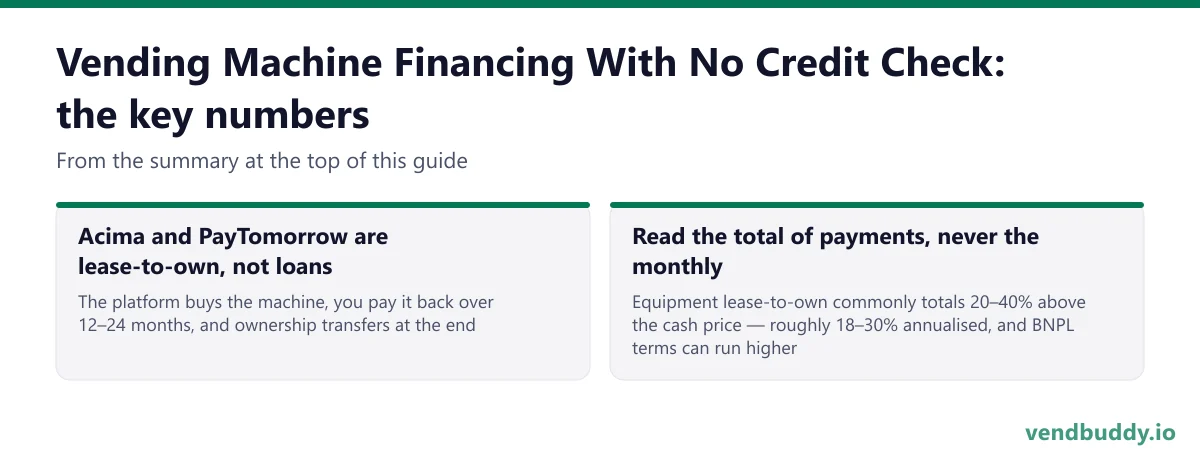
- Acima and PayTomorrow are lease-to-own, not loans. The platform buys the machine, you pay it back over 12–24 months, and ownership transfers at the end.
- Read the total of payments, never the monthly. Equipment lease-to-own commonly totals 20–40% above the cash price — roughly 18–30% annualised, and BNPL terms can run higher.
- The early-purchase option is the whole game. Clearing the balance inside the early window is usually where most of the premium disappears.
- It is rational in exactly one case: a location has already said yes, the machine earns from week one, and waiting three months for cheaper money costs more than the premium.
Search "vending machine financing no credit check" and you will find two kinds of results: dealers advertising instant approval at checkout, and people warning you off it entirely. Both are incomplete. These products are real, they genuinely approve people banks decline, and they are expensive in a way that is deliberately hard to see because the price is never quoted as a rate.
Part of our complete guide: business credit vs personal savings.
Here is what they actually are, what they actually cost, and the one situation where paying that cost is the correct decision. If you want the whole funding landscape instead — loans, credit lines, cards, reinvestment — that is all six vending machine financing options. This page is BNPL only.
What "no credit check" actually means
Almost nothing in equipment finance is truly no-credit-check. What the BNPL platforms — Acima and PayTomorrow are the two that show up most often at vending dealer checkouts — do instead is underwrite on different data: how long your bank account has been open, how much flows through it, whether payments bounce, and your income. Many run a soft inquiry that does not affect your score, or check alternative bureaus rather than the big three.
That is a genuine difference and it matters. An operator with a thin or damaged file who would be declined for an equipment loan can get approved here in minutes, at a dealer counter, with little or nothing down. The approval is real. It is just not free, and the price is where the structure gets interesting.
The structure: it is a lease, not a loan
This is the single most useful thing to understand about these products. They are typically lease-purchase agreements, not credit. The platform buys the machine from the dealer and owns it. You make scheduled payments — commonly weekly or biweekly, on a term of 12 to 24 months — and ownership transfers to you at the end of the schedule, or earlier if you exercise a purchase option.
Because it is a lease rather than a loan, the cost is presented as a total of payments rather than as an APR. Nobody is hiding anything: the number is on the agreement. But a total of payments does not feel like a rate, so it does not get compared against products that quote rates, and that is the entire reason these deals get signed without a comparison. The same dynamic runs through dealer equipment leases, which we pulled apart separately in lease to own a vending machine — the buyout structures and the clause list there apply to BNPL agreements too.
Picture the machines paying you while you sleep
That’s the real promise of vending — income that doesn’t cost you your time, and a life on your own terms. VendBuddy turns this guide into a step-by-step plan so you actually build it instead of just reading about it. Start free today.
Start building free →The math, on a real machine
Take an ordinary purchase: a new combo machine with cashless at a $3,000 cash price, taken on a BNPL agreement at $0 down.
- Equipment lease-to-own structures commonly total 20–40% above the cash price over 24 to 36 months. On $3,000 that is $600–$1,200 of premium, or a total of payments between $3,600 and $4,200.
- Annualised, that lands somewhere around 18–30%. Shorter BNPL terms with the same premium annualise higher still, because you are paying the same extra money over less time.
- The same $3,000 machine on vendor equipment financing is 6–12%. A credit-union equipment loan is 6–9%. An SBA Microloan is 8–13%.
None of that makes BNPL a scam. It is short-term financing extended to a business with no history and no meaningful underwriting, and it is priced exactly the way you would expect that to be priced. The mistake is not using it. The mistake is using it without ever seeing the comparison, because the comparison was never put in front of you.
No-credit-check vending financing is not a loan, it is a lease. That is why it quotes a monthly payment instead of a rate - and why nobody compares it to the products it should lose to.
The clause that decides what you actually pay
Every one of these agreements has an early-purchase option: a window, usually measured in the first weeks or months, during which you can buy the machine outright for the cash price plus a modest fee instead of running the full schedule. That option is where most of the premium lives, and exercising it is the difference between a sensible bridge and an expensive lesson.
Which gives you the strategy, if you go this route deliberately: use BNPL to get the machine placed, then kill the agreement early out of machine revenue. A machine at a decent location grosses $500–$2,000 a month at 40–55% margins. Directing that at the early-purchase figure rather than at the payment schedule is exactly the same discipline as clearing a 0% card before the intro window closes — and it is the only version of this deal that ends well.
Before you sign, get four things in writing: the total of payments, the early-purchase figure and the date it expires, whether payments are weekly or monthly and out of which account, and what happens if the machine fails during the term. That last one matters more than people expect — on a lease you may be paying for a machine you are not currently earning from, and repairs on a dead compressor do not pause the schedule.
When it is the right call, and when it is not
What to price it against first
Run these four before you sign anything at a dealer counter, in roughly this order:
- Vendor or dealer equipment financing, 6–12%. Fast, the machine is the collateral, and often available at the same counter as the BNPL offer — ask for both quotes.
- Credit-union equipment loan, 6–9%. Slower and relationship-dependent, cheapest thing on this list if you qualify.
- SBA Microloan through a CDFI, 8–13%. Two to four weeks, designed for thin files, and it can fund inventory and insurance rather than only the machine.
- 0% intro-APR business credit. Free money if the machine clears the balance inside the intro window, and the most expensive thing here if it does not. If your business credit file is thin, having the applications run across several issuers at once is usually better than applying card by card — 7 Figures Funding specialises in getting new business owners approved for 0% intro business credit lines. Same hard rule either way: the machine has to clear the balance before the window closes.
Affiliate link — VendBuddy may earn a commission at no extra cost to you, and we have no influence over any approval decision. Approval depends on your personal qualification, and any credit line is debt you personally guarantee.
Every version of this decision gets easier when a location has already said yes - it is what makes the premium survivable and the early payoff realistic. VendBuddy scores real venues near you by traffic, headcount and category, gives you the best contact on file for each, and models what a machine would net there. Five free credits, no card required.
Related reading: the dealer lease and its buyout traps, equipment financing versus a credit card, costed, starting with no money and bad credit, what lenders actually ask for, and what the machine should cost in the first place.
Frequently Asked Questions
Can you finance a vending machine with no credit check?
Close to it, but the honest answer is that almost nothing is a true no-credit-check product. Buy-now-pay-later platforms such as Acima and PayTomorrow, which appear at checkout on a lot of vending dealer sites, approve on bank-account history, income and payment behaviour rather than on a traditional credit score, and many run a soft inquiry rather than a hard one. That is why they approve applicants a bank declines. What they are not is free: the approval is paid for in an effective cost that usually lands far above what an equipment loan or a card would charge.
How does Acima or PayTomorrow financing work on a vending machine?
Both are lease-to-own products rather than loans. The platform buys the machine from the dealer, you make scheduled payments over a term commonly running 12 to 24 months, and ownership transfers to you at the end or when you exercise an early-purchase option. Because it is structured as a lease rather than as credit, the pricing is expressed as a total of payments rather than as an APR, which is exactly why the cost is easy to miss. Read the total-of-payments figure and compare it to the cash price.
How much more does BNPL financing cost on a vending machine?
Look at the total of payments against the cash price rather than at the monthly figure. Lease-to-own structures on equipment commonly total 20 to 40 percent above the cash price over 24 to 36 months, which works out to somewhere around 18 to 30 percent on an annualised basis, and some BNPL terms sit higher still over shorter terms. On a $3,000 machine a 40 percent premium is $1,200. The early-purchase option is the lever that matters most - paying the balance off inside the early window often cuts the premium dramatically.
When is no-credit-check vending machine financing actually the right call?
One situation, really. You have a location that has already said yes, the machine will start earning within days of placement, your credit file will not support a cheaper product today, and the premium is smaller than the revenue you lose by waiting three months to fund it a better way. That is a real trade and it is sometimes worth making. What is not worth making is financing a machine at a premium with no location secured, because you have then bought a payment schedule rather than a business.
What are the cheaper alternatives to BNPL for a first vending machine?
Four, roughly in order of cost. Vendor or dealer equipment financing at around 6 to 12 percent, where the machine itself is the collateral. A credit-union equipment loan at 6 to 9 percent if you have a relationship. An SBA Microloan through a CDFI at 8 to 13 percent, which is slower but is designed for thin files. And a 0 percent intro-APR business card, which costs nothing at all if the machine clears the balance before the intro window closes and is the most expensive option on the page if it does not.
What is selling, which buildings say yes, and the numbers before you buy a machine. Free, confirm from your inbox, unsubscribe in one click. Refer one friend and get 25 VendBuddy credits.
Want the free 38-page Ultimate Vending Guide too? Get the guide
General information, not legal, tax or financial advice. Rules change, so check the official source. Revenue and income figures are examples, not promises. See our terms.