To find vending machine locations, list about 20 buildings near you where people stay for hours and have nowhere close to buy a snack, find the person who approves amenities at each one, and ask in person. Then follow up for weeks, because most yeses come on the second or third contact. VendBuddy’s free ZIP search builds and ranks that list for you.
Three facts from our own data (the VendBuddy Location Index, 36,069 businesses our users looked up as possible vending locations):
- Gas stations and convenience stores were the location type most often open past 9 PM: 99% of 276 with posted hours, against 5% for government and public buildings (VendBuddy Location Index, n=7,454 listings with posted hours, October 8, 2026).
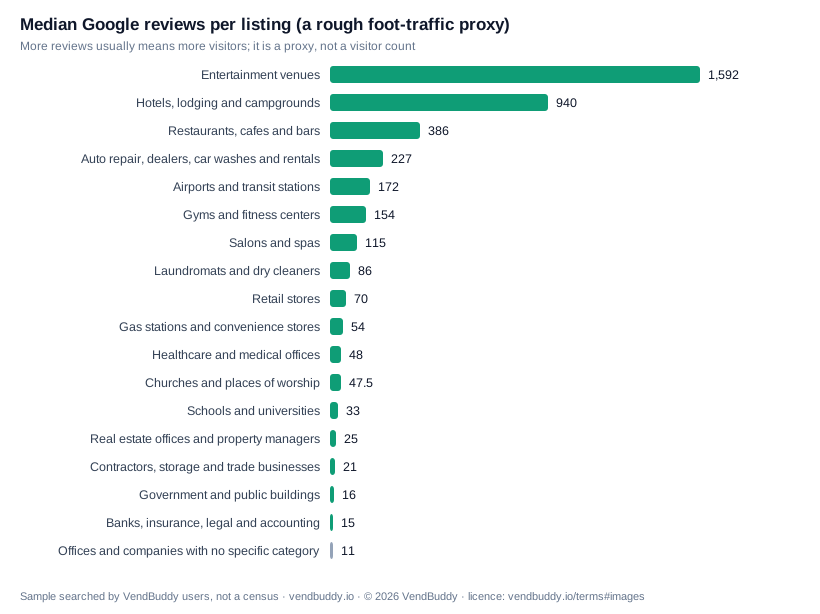
- Using Google review counts as a rough foot-traffic proxy, entertainment venues led with a median of 1,592 reviews per listing, while banks, insurance, legal and accounting had a median of 15 (VendBuddy Location Index, n=36,069 listings, October 8, 2026).
- Government and public buildings had the lowest median Google rating of any location type, 3.7 stars across 434 rated listings, against 4.4 for the whole sample (VendBuddy Location Index, n=33,194 rated listings, October 8, 2026).
Search your ZIP free
One ZIP code, the businesses around it ranked highest first, and the person who decides at each one.
Show me the buildings near me →Free account, no card. 5 credits to start. Searching never costs a credit.
Quick answers
How do I find vending machine locations?
Make a list of about 20 buildings near you where people stay for hours and have nowhere close to buy a snack: warehouses and plants, hospitals, larger apartment communities, hotels and gyms. Find the person who approves amenities at each one, ask in person at a quiet hour, and follow up for several weeks. A free ZIP search builds and ranks that list for you.
How do vending operators get location leads?
Four ways, usually in combination: map searches and driving commercial areas (free), business databases such as Data Axle through a public library card (free), a lead tool that ranks businesses by ZIP and finds the contact (paid per contact), and locator services that pitch for you (paid per placement). Referrals from hosts you already serve come later and are often the best leads of all.
How do I pitch a vending machine to a business?
Walk in during a quiet hour and ask who handles amenities. Do not try to close on the first visit; the goal is a name and a follow-up. When you reach that person, ask how many people are on site, what they wish they had, and where a machine could go, then offer a free installation that you stock and service. The cold pitch script has the exact words.
How do I find property managers who want a vending machine?
Start with apartment communities of roughly 150 units or more and office parks. The on-site property or community manager usually takes the first meeting, and a regional manager or the owner often signs. Search the management company name on the building’s website or leasing sign, then look up the person by title. In the Lead Finder, the Apartment Complex category returns the property manager title to ask for at each building.
What is the best app to find vending machine locations?
It depends on what you want the app to do. A map app is free and shows every building but ranks nothing. Locator marketplaces sell leads or placements. VendBuddy (our product, so weigh that) ranks the businesses in a ZIP for revenue potential, says why, and reveals the best contact on file for 1 credit. Searching is free. ChatGPT and other chat tools can suggest venue types but cannot confirm who decides at a real address.
The 30-day plan for a first location
This is the shortest honest path from no locations to a signed agreement. The days are a guide, not a deadline.
- Days 1–2: pick the area and build the list. Choose a ZIP you could service every week, then list 20 businesses within about 10 miles that keep people on site: plants and warehouses, hospitals, apartment communities, hotels, gyms, offices with a real headcount.
- Days 3–5: first five pop-ins. Dress clean, bring a one-page leave-behind and a card, and ask one question: “Who handles amenities here?” Do not try to close.
- Days 6–10: follow up and add five more. Email the people you met, then visit five new buildings.
- Days 11–20: finish the first 20. Keep the follow-ups going. When someone says yes, get it in writing the same week.
- Days 21–30: sign and order. Draft the agreement with the free placement agreement generator, check it against what the agreement should include, sign, then order the machine.
One thing to settle first: no zoning code publishes a list of approved venues. Every placement comes down to who controls the floor and whether they will put a yes in writing. Where you can legally put a vending machine covers the private, public and right-of-way cases.
Which buildings to ask first
The best locations share two things: people who stay a long time, and no easy alternative. Headcount alone misleads, because an office that empties at 5 PM sells less than a smaller site running two shifts.
- Ask first. Plants, warehouses and distribution centers with 50 or more people on site; hospitals and 24-hour care; apartment communities of about 150 units or more; hotels without room service; schools and transit hubs where vending is allowed.
- Worth a visit. Gyms with a steady membership, mid-size offices, auto dealers and repair shops with a waiting room, laundromats as a second machine on a route.
- Usually skip. Sites with fewer than about 20 people, small professional offices, outdoor spots with no one watching the machine, and any business that sells its own food.
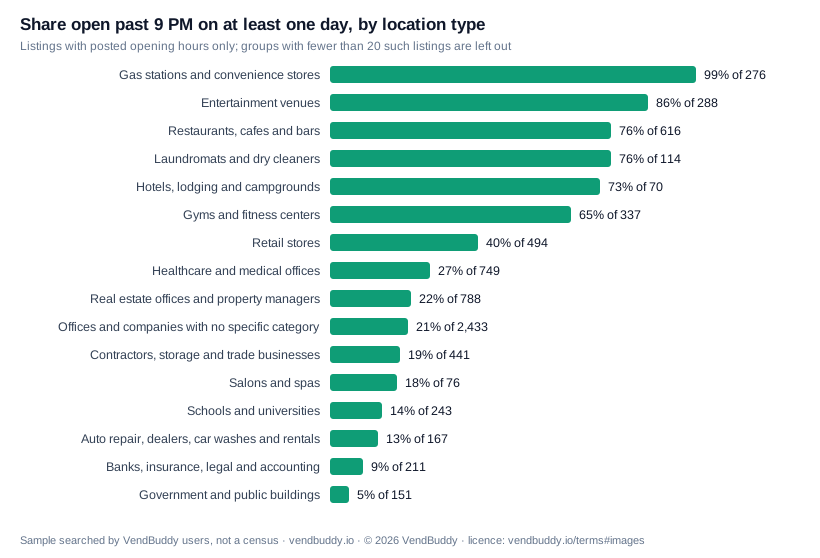
Hours matter for the same reason dwell time does. A site that stays open past 9 PM serves the second shift and the weekend, and the chart above shows how unevenly that is spread across venue types. Warehouses are also a large pool: the Bureau of Labor Statistics counted 23,848 private warehousing and storage establishments in the first quarter of 2026 (BLS, Warehousing and Storage: NAICS 493, preliminary).
Build your Top 20 list before the first visit
A list of 20 keeps you from taking a bad deal out of nerves after three no’s. Pre-check each building before you drive: satellite and Street View for an entrance and a likely spot, reviews for traffic, the website for the management company. Then walk each one with the same short checklist: a place for the machine, an outlet, sight lines, and who runs the building.
Free ways to build it
- Map searches. “Warehouse near me”, “manufacturing”, “apartments”, “gym”. Sort by review count as a rough traffic signal.
- Library business databases. Many public libraries give card holders free access to Data Axle (formerly ReferenceUSA), which filters businesses by employee count, industry and address.
- Driving industrial parks and commercial strips. You will find buildings that never show up online. Note the address, then look up who manages it.
- The Opportunity Map. Free, no account. It scores any US ZIP so you spend driving hours in the right area.
Paid ways to build it
- A ZIP-level lead tool. VendBuddy ranks the businesses in a ZIP and reveals the best contact on file for 1 credit (details below).
- Locator services. They pitch for you and charge per placement or per lead. Fees, and when they are worth it, are in vending locator vs DIY.
- The free Location Scout Chrome extension. On a business website or a Maps listing, it says whether that kind of venue tends to work and opens the matching search.
How the free ZIP search works (methodology)
A vending machine location finder turns a place into a list of businesses worth asking. Ours is a ranked ZIP list rather than a map, because a map shows every building and a ranked list tells you which twenty to walk into first.
1. The search
A 5-digit ZIP resolves to a city and state, and that locality scopes a Google Places text search. Choose from 79 property categories, from Warehouse / Distribution Center and Apartment Complex to VFW / Legion / Fraternal Club, and check up to eight. Each category returns up to 60 venues. Results are cached for 90 days, and a thin sweep widens into up to three nearby localities. Searching is free on every plan.
2. The rating
Revenue potential is judged on the location only. High means a verified on-site size of about 50 people or more, or a high-traffic venue with size data behind it. Medium is a real fit with some evidence. Low covers small offices, sites under about 20 staff and businesses that sell their own food. Limited data means we could not verify size and saw no traffic signal, so we say so instead of guessing. Every rating shows two to four plain reasons, and foot traffic is read from Google review volume.
3. The contact, then the ask
One credit reveals the best contact on file, ranked by title: owner and founder first, then general manager, property or community manager, office, plant and hotel manager, facilities and operations. You get what we find of the name, title, a personal email with its verification result, a mobile or direct phone and a LinkedIn profile. If none of those comes back, the credit is not charged. Two credits write a call script and email for that building, and revealed leads move onto a five-stage pipeline: Contacted, Meeting Set, Contract Sent, Machine Ordered, Live.
What the rating cannot tell you. No dataset records whether a building already has a machine, ours included. The results screen says so: these are cold leads, and some already have an operator. A neglected machine is often a good opening anyway, because the complaint already exists.
Where the data on this page comes from. The Location Index counts the operating businesses VendBuddy users looked up between April 30 and October 8, 2026. It follows where our users searched, so it is a sample, not a census, and it says nothing about sales at any site. Review counts are a rough proxy for foot traffic. The full method, the charts and a CSV are on the Location Index page.
How to pitch in person (the pop-in)
A pop-in is a short, unannounced visit to find the decision-maker. It works better than a cold call for the same reason a face beats a voicemail.
Before you go
- Clean pants and a collared shirt or a branded polo. No suit needed.
- A one-page leave-behind with your name, phone, email, what you offer and a QR code. The Flyer Generator makes one in a few minutes.
- Business cards, and a rough idea of the headcount, unit count or building count.
At the door
“Hi, I run a local vending service. I noticed you have about [X people on site]. Who handles amenities here, and is there a better time to catch them?”
- Do not close on the first visit. Leave with a name, a card or a time to come back.
- Make no easy to say. “Is that something you would be open to, or not really?” People engage more when they have a graceful exit.
- Always leave the one-pager. Managers change jobs, and a leave-behind found six months later still gets calls.
Plenty of placements come on the third or fourth visit. Bring something useful each time: a product list, a photo of a similar install, an answer to the question they asked last time. For the words, use the cold pitch script in person and the cold email scripts when a building will not let you walk in.
Finding the property manager (and who actually signs)
At apartment communities and managed office buildings, the person at the front desk rarely decides. The usual chain is the on-site property or community manager, who takes the meeting, then a regional manager or the owner, who signs. In a condo or townhome community, the HOA board may decide.
- Look for the management company on the leasing sign, the building website or the Google listing.
- Find the person by title on the management company’s site or LinkedIn. How to find property management company contacts and how to find an apartment owner’s contact info go step by step.
- Ask the on-site manager two questions early: who else needs to approve this, and when do they meet?
Property managers can also come to you. Managers who want a machine can ask for one through VendBuddy for property managers. The decision-maker map lists who signs at each venue type.
The follow-up cadence
Vending sits near the bottom of a manager’s list, so silence usually means busy, not no. A simple cadence after the first real conversation:
- Week 1. Day 1: thanks and a one-page proposal. Day 3: any questions? Day 6: something useful, such as a photo of a similar install.
- Week 2. One email.
- Weeks 3–4. One phone call.
- Month 2. One more visit.
- After that. A monthly touch, rotating email, call and visit.
Talking to the decision-maker, and the usual objections
Once you reach the person who can sign, learn their problem before you pitch your machine. How many people are on site, and when is it busiest? Is there vending now, and what is wrong with it? What do people ask for? Where could a machine go? Who else approves? Then answer with their words: “You said the night shift has nothing after 8, so this goes by the break room and runs on card.”
- “We already have a vendor.” Ask how it is going and when their agreement ends. Offer a written proposal for that date.
- “We don’t have the space.” Ask to measure. Many machines need a footprint about the size of a refrigerator and one standard outlet.
- “Who pays for power?” Usually the host, as part of a free amenity. Agree it in writing either way.
- “We would need a commission.” Fine. Agree the rate, the base (gross or net) and how often you report. Large public agencies that bid vending out asked a median 25% (n=7, range 10-52%); small private hosts often take less, a flat fee, or nothing. See the commission research.
- “We’ll think about it.” Ask what would help them decide and book the follow-up before you leave.
The answers to the twelve objections operators hear most are written out in what each objection actually means.
Best app to find vending locations: maps, locators, chat tools or a ZIP list
| Tool | Cost | What it does well | What it does not do |
|---|---|---|---|
| Map apps | Free | Shows every business near you | Ranks nothing; no decision-maker |
| ChatGPT and other chat tools | Free or subscription | Brainstorms venue types and scripts | Cannot confirm who decides at a real address |
| Locator marketplaces and services | Per lead, per month or per placement | Someone else does the asking | You pay for each placement; quality varies |
| VendBuddy Lead Finder (ours) | Search free; 1 credit per contact | Ranks a ZIP with reasons; reveals the best contact on file | Does not walk in for you; cannot see existing machines |
We make the last row, so weigh our view accordingly.
Get it in writing
Never run a placement on a handshake. The agreement should cover the term and renewal, the commission and how it is calculated, your service level, insurance, card readers, equipment ownership and removal, access hours, exclusivity and termination notice. What a vending placement agreement should include goes clause by clause, with what 28 public vending contracts actually require. When you are ready to draft, the free generator fills one in from a short form.
What it costs
- Free account. 5 credits, no card. Searching and ratings are unlimited.
- What Starter includes. 150 credits the moment you subscribe and every feature, including the Contract Creator, 7-day money-back guarantee if no credits used.
- Starter $49 a month for 150 contact credits, Pro $79 for 300, with a 7-day free trial (card required, no charge until day 7). Annual billing takes about 20% off and adds 20 bonus credits a month.
- Credit packs. One-time top-ups from $19 for 25.
See it running
This is the real app, not a video of it. Search a ZIP inside the frame and watch the list come back rated.
Watching the demo never spends a credit. Open it fullscreen.
Search your ZIP free
One ZIP code, the businesses around it ranked highest first, and the person who decides at each one.
Show me the buildings near me →Free account, no card. 5 credits to start. Searching never costs a credit.
Every week: which building types are saying yes, the pitch lines that work, and who to ask for.
Free. One-click unsubscribe. Optional partner newsletters after signup may pay us a small fee.
More questions
How do I find vending machine locations near me?
Enter your own ZIP and the search resolves it to a city and state, then scopes the Google Places query to that locality. It is a locality string, not a mile radius, so two ZIPs in the same metro return overlapping pools. For a market-level read first, the free Opportunity Map sizes up any US ZIP on population, income and employment without an account.
How much does it cost to find vending machine locations?
Doing it by hand costs time, not money. In VendBuddy, searching is free on every plan and a credit is spent only when you unlock a contact, 1 credit per contact. A free account gets 5 credits with no card. Starter is $49 a month for 150 credits, charged when you subscribe, with a 7-day money-back guarantee. Pro is $79 a month for 300 and starts with a 7-day free trial: card required, no charge today. One-time credit packs start at $19 for 25.
Related
How to find businesses that need vending machines covers the signals for an underserved site. The location scoring checklist is the version you use standing in the lobby. Best vending machine locations in 2026 ranks venue types, and how to get vending machine contracts covers the part after the yes. The 90-day location test tells you when to keep, change or pull a machine. The Vending Location Playbook ($47) has the walk-in script and a signable agreement. The 50-lead ZIP list ($97 once) is the list done for you.