A vending machine placement agreement should name both parties and the exact spot, then set the term, the commission and how it is paid, your service commitment, insurance, payment methods, product rules, exclusivity, power and access, equipment ownership, and how either side can end it. Put all of it in writing before the machine arrives.
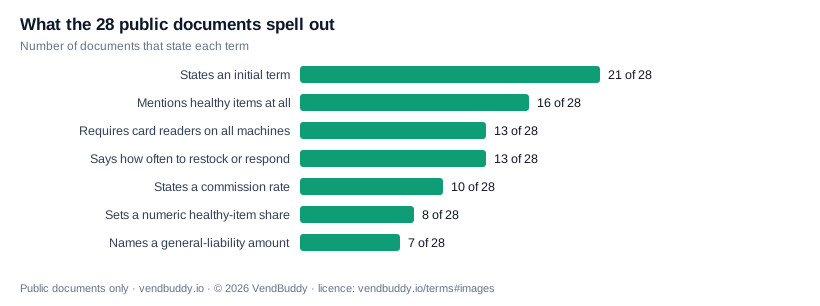
What 28 public vending contracts show (VendBuddy review of public RFPs, agreements and awards, October 8, 2026):
- Commission: a median of 25% of sales, from 10% to 52%, among documents that state one rate for every machine (n=7 documents).
- Insurance: all 7 documents that name a general liability amount ask for $1,000,000 per occurrence, and 4 add a $2,000,000 aggregate (n=7 documents).
- Card readers: required in 13 of the 17 documents that address payment (n=17 documents).
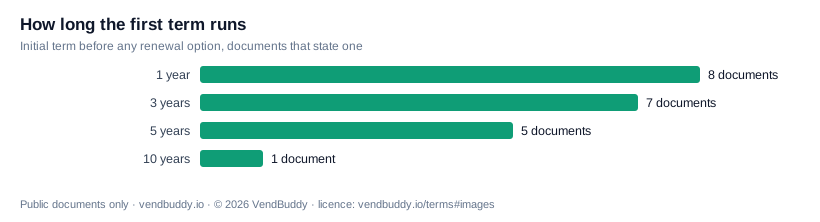
- Term: a median initial term of 3 years (n=21 documents), and 5 years with every renewal (n=17 documents).
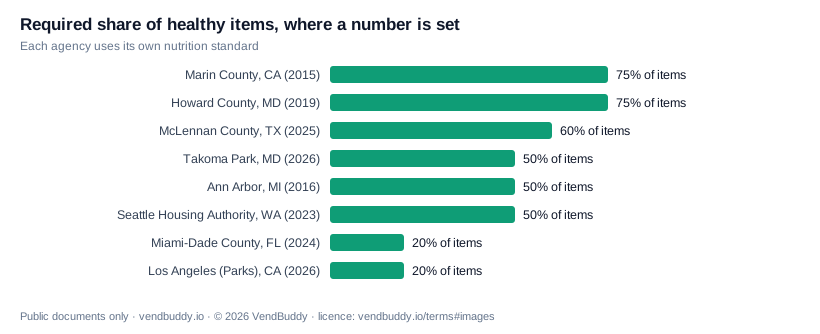
- Healthy items: agencies that set a number asked for a median of 50% healthy items per machine, from 20% to 75% (n=8 documents).
These are public agencies, which tend to be large sites with formal bids. A small private host will often accept simpler terms. The source documents, each linked, are on the commission research page.
The clause checklist
Use this as a checklist when you read a host’s draft or write your own. The right column shows what the public documents we reviewed say. Where it reads “not tracked”, we did not record that term, so treat the clause as something to agree with the host.
| Clause | What to write down | What public contracts show |
|---|---|---|
| Parties and placement | Both legal names, the address, and the exact spot (for example “first-floor break room, north wall”). Who may move the machine. | Not tracked in our review |
| Term and renewal | Start date, length, renewal (automatic or by notice) and the notice window. | Median initial term 3 years (n=21 documents); 5 with renewals (n=17 documents) |
| Commission | Rate, whether it is on gross or net sales, how sales are counted, payment timing and the report you send with it. A flat fee instead is fine; write that down. | Median 25%, range 10–52% (n=7 documents) |
| Service and repairs | How often you restock, how fast you respond to a broken machine, and who the host calls. | 13 of 28 say how often to restock or respond; stated response times ran 8 to 24 hours (n=3) |
| Insurance and indemnity | Your general liability amount, who is named as additional insured, and who covers damage you cause. | $1,000,000 per occurrence in all 7 that name an amount |
| Payment methods | Card and mobile payments, cash, and who pays processing fees. | Card readers required in 13 of 17 |
| Products and pricing | What you may sell, any healthy-item share, and who sets prices and when they can change. | Median 50% healthy items where a number is set (n=8 documents) |
| Exclusivity | Whether you are the only vending operator on site, and for which machine types. | Not tracked in our review |
| Power, space and access | Who pays for electricity, the outlet, and the hours and keys you need to restock. | Not tracked in our review |
| Ownership and removal | That the equipment stays yours, and how many days you have to remove it when the agreement ends. | Not tracked in our review |
| Termination | Notice period for either side, and what counts as cause (for example missed service). | Not tracked in our review |
| Assignment | Whether you can transfer the agreement if you sell the route. This matters for what a route is worth. | Not tracked in our review |
Commission: the clause that causes most disputes
Write down three things, not one: the rate, the base it applies to, and how you prove the number. “15% of gross sales, paid monthly with a sales report from the card reader” leaves little to argue about. “15% commission” leaves gross versus net, cash counting and timing open.
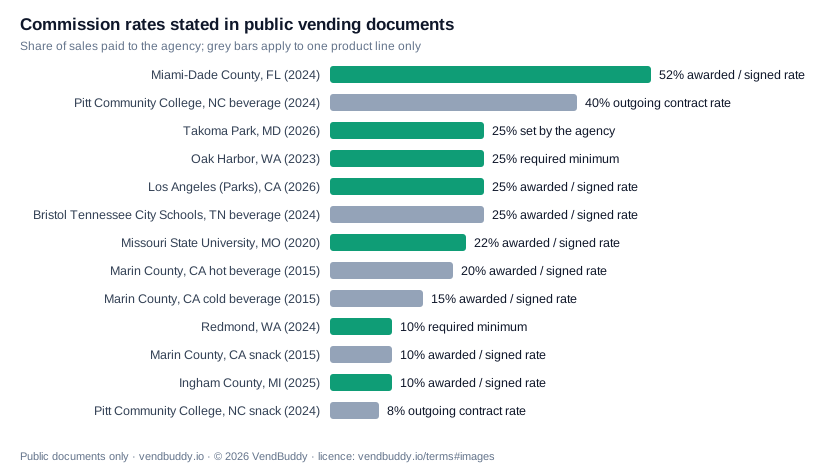
The public median of 25% comes from agencies running formal bids, often at busy sites. A private host may agree to a lower rate, a flat monthly fee, or no commission when the machine is the amenity they wanted. The commission rate checker helps you test a rate against your expected sales before you agree to it.
Term, renewal and termination
A longer term protects the money you spend on the machine and the install. A clear exit protects both sides if it does not work. The usual balance is a fixed first term, renewal by default unless someone gives notice, and a termination clause that lets either side leave with notice, plus a faster exit for cause such as missed service.
Insurance, card readers and product rules
Ask the host early what certificate of insurance they need, because the quote can take a few days. In the public documents that named an amount, it was always $1,000,000 per occurrence. Card readers were required in 13 of the 17 documents that addressed payment, so budget for one. If the host sets a healthy-item share, agree how it is measured (by slot, by item or by sales) and who decides what counts.
Getting it signed
- Send it the same day. A yes cools fast. Have a draft ready before the meeting.
- Check who can sign. The person who said yes may not have authority. Ask who signs for the property.
- Keep it short. Two pages that both sides read beat ten pages nobody reads.
- Keep a signed copy where you can find it at renewal time, and put the renewal date in your calendar.
To draft one now, the free placement agreement generator builds a plain-English agreement from a short form, with a note under every clause. Starter subscribers can also fill one in with the Contract Creator inside the app. Vending machine contracts 101 covers the clauses to push back on, and the termination clause guide goes deeper on exits.
Free guide and the ready-to-sign kit
Free: The Ultimate Vending Guide
Our 26-page guide with the launch plan, the location scoring rubric, pitch scripts and the Pop-In Tracker. Use it with the clause checklist above.
Get the free guide →Placement Agreement + Proposal Kit ($39)
A fill-in placement agreement with notes on each clause, a two-page proposal, a pitch email with three follow-ups, a leave-behind and a commission calculator. One-time purchase.
See the kit →Where the numbers come from
We read 28 public vending RFPs, agreements and awards from 2015 to 2026 and recorded the commission, term, insurance, card-reader and healthy-vending terms each one states. We report a median only when at least 3 documents state the same term, and we never fill a gap from another source. Public documents lean toward large sites with formal bids, so private agreements can look different. The full table, charts and a CSV with a link to every source are on Vending Commission Rates and Contract Terms 2026: What Public Contracts Show.
Questions
What should a vending machine placement agreement include?
At minimum: the parties and the exact spot for the machine, the term and renewal, the commission and how it is calculated and paid, your service and repair commitment, insurance, payment methods, product rules, exclusivity, power and access, equipment ownership and removal, and how either side can end it. The checklist on this page covers each one.
What commission do public vending contracts pay?
Large public agencies that bid vending out asked a median 25% (n=7, range 10-52%); small private hosts often take less, a flat fee, or nothing. Those figures come from documents that state one rate for every machine. Always write down whether the rate applies to gross or net sales.
How long is a typical vending placement agreement?
The median initial term in the public contracts we reviewed was 3 years (n=21), and 5 years once every renewal option is used (n=17).
How much insurance does a vending placement agreement require?
Every public document we reviewed that names a general liability amount asks for $1,000,000 per occurrence (n=7), and 4 of them add a $2,000,000 aggregate. A private host may ask for less, or for nothing, but expect to be asked for a certificate.
Is a free vending agreement template enough?
It is a good start if you read every clause and change it to fit the site. Have a lawyer in your state review the final version before you sign. This page is general information, not legal advice.
Related
How to get vending machine contracts covers the path from list to signature. How to find vending machine locations covers finding the site in the first place, and exclusive vending agreements covers that one clause in depth.