Part of our complete guide: how to find vending machine locations.
- Ask for it when the site is worth defending. 100+ employees, multiple machines, a hospital wing or a campus building. On a 40-person office it is a clause protecting you from nothing.
- Trade for it. Two extra commission points, a written 24-hour service response, a longer term, or a second machine at your cost. Asking and offering nothing reads like a template.
- Name the carve-outs yourself. Cafeteria, office coffee service, micro market. A clause that quietly bans their coffee vendor gets struck rather than negotiated.
- Keep it to the one address. Radius language covering other buildings is the version that gets trimmed, and it invites a matching non-compete against you.
- If they say no, ask for right of first refusal. Thirty days written notice before another operator comes in. Costs them nothing, removes the risk you actually cared about.
An exclusive vending agreement is a clause saying the property will not let another vending operator install machines on the premises while your contract runs. It is worth asking for when the site is big enough to attract a competitor, roughly 100 employees and up or any placement where you are putting in more than one machine, and worth skipping on a small office where the only thing it buys you is a longer negotiation.
What follows is the exclusivity clause and nothing else. For the rest of the document, the term, the commission and the exit terms, read the full vending contract guide. If you would rather see the clause in a finished agreement than in an article, VendBuddy’s Contract Creator drafts one with the scope and carve-outs already filled in for the placement type you choose.
When exclusivity is actually worth asking for
Exclusivity protects you from one specific thing: a second operator installing a machine that eats your volume in a building you already serve. So the question is whether that is likely at this site.
It usually is at:
- Sites with 100 or more people on the floor. That is roughly where a placement becomes visible enough that another operator cold-calling the building will keep pushing. Below it, most operators walk past.
- Multi-machine placements. If you are putting in a snack unit and a cold beverage unit, you have real capital in the building and a competitor taking one category takes a chunk of it.
- Hospitals, campuses and large multifamily. These get pitched constantly. Property managers at larger multifamily buildings commonly field three to five vendor pitches a month, so the second operator is not hypothetical.
- Sites where you spent money to win the placement. A wrap, a new machine, a signing bonus, three months of follow-up. Protect the investment.
It usually is not worth it at a 40-person office, a single machine in a small gym, or any site you took as a test. Nobody else is coming. Asking anyway costs you a bit of goodwill at the exact moment you are trying to seem easy to work with, and it can trigger a legal review that adds three weeks to a deal that was about to close.
What you trade to get it
Exclusivity is a real concession. You are asking a property to give up an option, and the ones who have been in the job a while know that. So bring something.
The things property managers actually take:
- Commission points. Two points on a site doing $2,000 a month gross is $40 a month, which is cheap insurance against losing half the volume to a competitor. The bands by location type are in vending machine commission rates.
- A written service level. Restock weekly, respond to service calls within 24 business hours, refund miscollected money within seven days. This costs you nothing if you were going to do it anyway, and it is the concession property managers value most, because their real fear is an empty machine with their name on the complaint.
- Term length. Three years instead of one, in exchange for exclusivity, is a trade both sides can defend.
- A second machine at your cost. If the site can carry it, this is the strongest offer on the list. You are not asking them to give something up, you are giving them more.
- A product commitment. The specific drink the office keeps asking for, stocked and kept in stock.
What does not work is asking for exclusivity and a top-of-band commission and a long term in the same email. Pick the one that matters and trade the others.
Picture the machines paying you while you sleep
That’s the real promise of vending — income that doesn’t cost you your time, and a life on your own terms. VendBuddy turns this guide into a step-by-step plan so you actually build it instead of just reading about it. Start free today.
Start building free →How a property manager hears the ask
Worth understanding, because the wording changes the answer more than the substance does.
A property manager hears “exclusive” as “this vendor wants to limit what I can do in my own building.” Their job is to keep options open and avoid explaining a restriction to their boss two years from now. Some have been burned by a broad exclusivity clause that blocked a coffee service they wanted, and those managers will not sign one again regardless of how you phrase it.
The framing that lands better is service, not territory. Something like: we are asking to be the only snack and beverage vending on site so we can commit to weekly restocking and a 24-hour service response, because we cannot promise that if a second operator is pulling the same traffic. That is a true statement and it moves the conversation from what they lose to what they get.
The other thing that helps is naming the carve-outs before they ask. It signals you have done this before and that you are not trying to slip anything past them.
The carve-outs that make the clause signable
Exclusivity gets refused mostly because of scope, not principle. “All food and beverage services” sounds tidy and is far too broad: it can be read to cover a catered lunch, a tenant’s own fridge, and the coffee contract the property signed last year.
If you would rather not draft the contract from scratch, we keep a plain-English walkthrough at get vending machine contracts. It covers term, commission, exclusivity and how either side gets out.
Write the clause to cover what you actually sell, and list what it does not touch:
- Staffed cafeteria or food service. A different business entirely. Say so.
- Office coffee service. The one that causes the most refusals. Most properties either have OCS or want the option, and it is not competing with your snack machine.
- Micro markets. Trickier, because an unattended market genuinely does compete with vending. If the site is large enough to justify one, either carve it out or ask for right of first refusal on it, so if they want a market later, you get first crack at building it.
- Tenant-owned equipment. Water coolers, a branded fridge a tenant put in their own suite, the espresso machine in the executive kitchen. None of it is your business and trying to block it is how the whole paragraph gets deleted.
Keep the clause tied to the single address on the agreement. Radius language covering other buildings within a mile is the version that gets trimmed by anyone reviewing it, and asking for one is a good way to end up with a matching non-compete pointed back at you.
An exclusivity clause in plain English
A starting point, not legal advice. Have a lawyer in your state look at your agreement before you use it across a route.
Subsection (d) is the one to keep even if the property strikes (a). A right of first refusal gives you written warning before a competitor arrives, which was the actual risk, and property managers sign it without a legal review because it commits them to a phone call rather than a restriction.
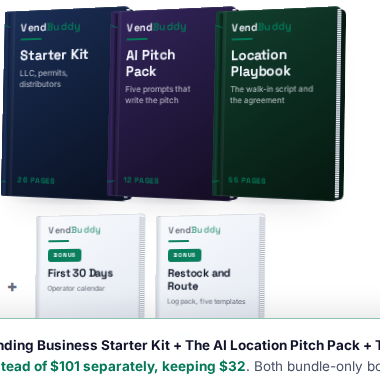
If you get to the end of this and the answer is yes, the kits are the shortcut past the blank page: a 26-page starter kit for the paperwork, a 55-page Location Playbook for the walk-in script and the agreement, and a 12-page AI Pitch Pack. Bought once, from $27, and you keep the files.
Look inside the kits →What to do with this
Before your next placement conversation, decide in advance which sites on your list are exclusivity sites and which are not. Two or three out of ten is a normal answer. Then pick the one thing you are willing to trade for it, so you are not inventing a concession in the doorway.
Draft the agreement in the Contract Creator, check the scope line against the four carve-outs above, and send it as a PDF the same day they ask. If you are earlier than that and still working out whether the placement is worth pursuing at all, the 60-second readiness quiz points you at the right next step.
Frequently Asked Questions
What is an exclusive vending agreement?
It is a clause in a placement agreement saying the property will not let another vending operator put machines on the premises while your contract runs. It is not a separate document and it is rarely more than four lines. What matters is the scope: an exclusivity clause that covers snacks and cold beverages is a different promise from one covering all food and beverage service, and property managers who have signed the broad version once tend to refuse it forever after.
Should a new vending operator ask for exclusivity?
On a small single-machine site, usually not. A 40-person office is not going to attract a second operator anyway, so the clause protects you from a risk that does not exist while costing you goodwill in the negotiation. Ask for it when the site is genuinely worth defending: 100 or more employees, multiple machines, a college or hospital building, or a multifamily property where you are installing more than one unit. That is where a competitor walking in is a real possibility.
What should you trade for a vending exclusivity clause?
Something the property values more than the theoretical right to add a second vendor. The usual currencies are a higher commission rate, a written service level such as a 24-hour response time, a longer term, a second machine at your cost, or a product line the office keeps asking for. Trading is what turns exclusivity from a demand into a deal. Asking for it and offering nothing tends to read as a new operator repeating something they saw in a template.
What carve-outs belong in an exclusive vending agreement?
Name the things you are not trying to block, because that is what makes the clause signable. The standard three are a staffed cafeteria or food service contract, office coffee service, and a micro market. Water coolers and branded refrigerators supplied by a tenant are worth listing too. A property manager reading a clause that quietly bans their coffee vendor will strike the whole paragraph rather than negotiate it.
Is a vending exclusivity clause enforceable?
Generally yes as a contract term between the two parties, and generally not as a way to punish the property harshly. Realistically your remedy is termination and possibly damages, which means the clause works as a deterrent and a conversation starter rather than as a hammer. Radius restrictions covering other buildings are a different animal and much more likely to be trimmed or thrown out, which is one more reason to keep exclusivity tied to the one address on the agreement.
What if the property refuses exclusivity?
Ask for right of first refusal instead. The location agrees that before adding another vending operator, it will tell you in writing and give you 30 days to add the machine or category yourself. Property managers accept this far more often than exclusivity because it costs them nothing and keeps their options open, and in practice it gives you most of the protection: the risk you were worried about was a competitor arriving without warning, and this removes exactly that.
Related reading: vending machine contracts 101, the termination clause, line by line, the free contract template, vending machine commission rates, how to negotiate vending placements, and tiered revenue share agreements.