- Verdict of this HAHA Ultra US-1200CT review: buy it only for a proven site doing $5,000+/month that outruns smaller machines.
- Listings put it at about 53.9 x 28 x 79.5 in and ~379 lb, with capacity quoted at 648, 756 or 864 bottles depending on the listing.
- At 54 inches wide it goes through a 36-inch door only on its side; measure every door and elevator first.
- At 22-32% net it pays back in roughly 4.5-6.5 months at $5,000/month gross and 8-11 months at $3,000.
- Versus two $3,299 US-360s it saves about $2,400 in fees over five years, but loses redundancy and placement flexibility.
The short answer from our HAHA Ultra US-1200CT review: this $7,299 double-door cabinet is the right machine for a proven site doing $5,000 or more a month where you cannot restock a smaller unit fast enough, and the wrong machine for almost everyone else. It is a capacity purchase. Capacity only pays when the demand already exists.
Part of our complete guide: scale a vending machine business.
The Ultra is the most expensive HAHA on Amazon and the one we most often talk buyers out of. It sits last in our Amazon AI vending ranking for a reason: it is a scaling tool, not a starting one. This page covers what the listings say, the delivery problem nobody mentions, the running costs, and the comparison that matters most, which is one Ultra against two smaller machines.
What the Ultra US-1200CT is
Take HAHA’s grab-and-go format and double it. Two glass doors, two sets of cameras, twelve shelves, one cabinet about four and a half feet wide. The customer taps a card or phone, the lock releases, they take what they want, and the cameras bill for what left when the door closes. HAHA pitches it at unmanned stores, factories, warehouses and large gyms. It is not the $3,799 AI Plus, which some cards and listings label “US-1200”; our HAHA AI Plus review untangles that name.
Dealer listings disagree on several numbers, so the table gives the spread.
| Spec | What the listings say |
|---|---|
| Price | $7,299 on Amazon and on HAHA’s own store; US dealers list it between about $6,799 and $7,199, some plus freight |
| Format | Double glass door, 12 adjustable shelves, 4 cameras (2 per door, anti-fog per dealer listings) |
| Footprint | About 53.9 in wide, 27.9-28 in deep, 79.5 in high (three dealer listings agree) |
| Weight | About 379 lb shipping weight |
| Capacity | 864 bottles on Amazon; 756-757 500 ml bottles on dealer pages; 648 on HAHA’s own store |
| Interior | About 42.4 cubic feet |
| Temperature | 32-50°F on most listings; one listing describes a -8°F to 50°F “flexible freezing” range, which we could not confirm for the Amazon unit |
| Power | 110-120V, 60 Hz; two dealer listings rate it at 6.2 kWh per 24 hours, one at 2.0 |
| Payment | PAX card reader: cards, Apple Pay, Google Pay, Samsung Pay. No cash |
| Connectivity | 4G and Wi-Fi |
| Warranty | 1 year parts, lifetime technical support; HAHA’s store lists extended coverage at $200 a year |
The capacity range is not a typo. 864 is the Amazon headline, 756-757 is what dealers quote for standard 500 ml bottles, and 648 is on HAHA’s own store. Bottle size and shelf spacing explain most of it. If a snack-heavy mix is the plan, you will fit fewer units than any of those numbers, and HAHA’s store sells a 12-tier snack pusher set (VS-1200) at $780 that appears to be built for this cabinet, which suggests snacks need extra hardware to merchandise well.
Treat it as a refrigerated cooler. One listing describes a freezing range, but most describe 32-50°F, and if you want frozen product the dedicated DC-550D freezer is the machine built for it.
Getting 379 pounds and 54 inches through the door
This is the part that catches people. The Ultra is about 54 inches wide, so it will not go through a standard 36-inch door facing forward. It goes through on its side, using the 28-inch depth, which means tilting a 379-pound glass-door appliance onto a dolly and walking it through every doorway, corridor turn and elevator on the way in. At 79.5 inches tall it clears an 80-inch door frame by half an inch standing up, and not at all on a dolly.
Before you order, do three things:
- Measure every door, turn and elevator between the loading dock and the final spot, including the elevator’s interior depth and door height.
- Book two or three people and an appliance dolly with straps. This is not a one-person install.
- Confirm the floor and the outlet. You want a dedicated circuit if you can get one.
HAHA’s store lists freight pickup at several US warehouses, and one dealer charges a flat $495 for single-unit shipping. Ask whoever sells it to you exactly what delivery includes: curbside, liftgate, or inside placement. Freight damage on a glass cabinet this size is a real risk. HAHA’s store says equipment is generally non-returnable except for defects, wrong shipments or freight loss, so inspect it before you sign for it, and consider buying through Amazon for its return process.
Picture the machines paying you while you sleep
That’s the real promise of vending — income that doesn’t cost you your time, and a life on your own terms. VendBuddy turns this guide into a step-by-step plan so you actually build it instead of just reading about it. Start free today.
Start building free →What it costs to run each month
- HAHA service fee: $40 a month ($10 POS, $15 SIM, $15 software), the same as the smallest HAHA. That is one of the Ultra’s real advantages, as the comparison below shows.
- Card processing: not published in HAHA’s fee FAQ. Dealer listings for HAHA cabinets state 5.95% of sales, sometimes plus $0.05 per transaction. At $5,000 a month that is roughly $300, so get it in writing.
- Electricity: roughly $22-$33 a month if the 6.2 kWh a day figure is right (about 186 kWh a month at 12-18 cents). One listing says 2.0 kWh, which would be under $11; plan on the higher number.
- Inventory float. Filling 650-860 facings costs real money. A first fill can run $1,000-$2,000 at wholesale depending on the mix, and it sits in the machine as working capital.
Year-one cash before anything comes back: $7,299, $480 in fees, $1,000-$2,000 of stock, freight if it is not included, and sales tax. Roughly $8,800-$10,500.
Payback math, and why the bottom rows matter
Same 22-32% net margin we publish for every smart and AI machine in our AI vending machine revenue breakdown.
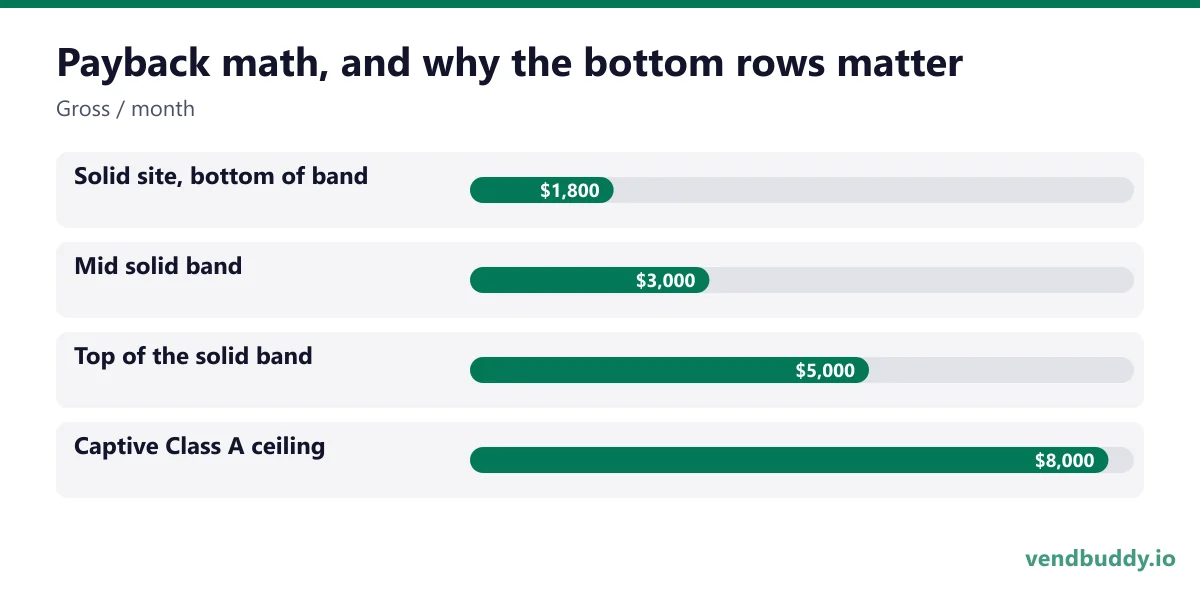
| Site | Gross / month | Net at 22-32% | Months to recover $7,299 |
|---|---|---|---|
| Solid site, bottom of band | $1,800 | $400-$575 | 13-18 |
| Mid solid band | $3,000 | $660-$960 | 8-11 |
| Top of the solid band | $5,000 | $1,100-$1,600 | 4.5-6.5 |
| Captive Class A ceiling | $8,000 | $1,760-$2,560 | 3-4 |
Notice the rows we did not include: there is no weak-site row, because at $1,200 a month the Ultra takes roughly 19 to 28 months to pay back, and nobody should buy it for that. Even at the bottom of the solid band it takes more than a year. The Ultra only looks good in the bottom two rows, which are also the rarest buildings. Our own revenue page is blunt about it: the $5,000-$8,000 months belong to genuinely captive sites, like a multi-shift plant with no cafeteria or a hospital staff area, and those are the exception.
There is a second point hiding in the table. A bigger cabinet does not create demand. If a US-360 at the same site is doing $3,000 and never runs empty, swapping in an Ultra does not turn it into $5,000. It turns a four-to-five-month payback into an eight-to-eleven-month one.
Every figure here is an average, and averages hide the building. The revenue calculator lets you plug in the property you are actually looking at and see the range for that type.
One Ultra or two US-360s?
This is the comparison most buyers skip. Two $3,299 Smart Combos cost less than one Ultra and give you two machines instead of one.
| One Ultra US-1200CT | Two US-360 Smart Combos | |
|---|---|---|
| Machine cost | $7,299 | $6,598 |
| HAHA fees per month | $40 | $80 |
| HAHA fees over 5 years | $2,400 | $4,800 |
| Five-year total, machines plus fees | $9,699 | $11,398 |
| Listed capacity | 648-864 bottles | ~490 bottles (2 x 245) |
| Floor width | ~54 in in one spot | ~46 in, or split between two spots |
| If a compressor fails | Everything is down | Half is down |
| Can serve two floors or buildings | No | Yes |
The Ultra wins on fees and raw capacity. Over five years it saves about $2,400 in HAHA fees against two smaller machines, and it holds more product in one restock stop. At a single high-volume room where the traffic funnels past one wall, like a factory break room or an unmanned store, that is the right answer.
Two machines win on everything else. If one compressor or camera fails, half your revenue keeps going. You can put one on each floor, or one in each of two buildings owned by the same manager. And if the site disappoints, a US-360 is far easier to move and to resell than a 379-pound double-door cabinet.
An illustrative example: Dev (illustrative, not a real customer) runs two US-360s side by side in the break room of a 450-person, three-shift plant. Together they gross about $6,200 a month and both run empty before his twice-weekly restocks. He moves one of them to a smaller office he serves nearby and puts an Ultra in the plant. The plant climbs to about $6,800 because the shelves stop running bare, his HAHA fees on that site drop by $40, and the relocated US-360 starts earning a second income stream. At a 25% net the Ultra’s share of the plant is roughly $1,700 a month, so it pays back in roughly four and a half months. That is the Ultra doing its real job: replacing machines that were already proven, not guessing at demand.
Who should not buy the Ultra
- First-time operators. Full stop. Your first machine should be sized to prove a site, not to serve one you hope is there.
- Any site without a sales history. If you have not seen a smaller machine run out at this address, you do not know the Ultra is needed.
- Sites well short of heavy traffic. Our ranking points it at placements with 500+ daily traffic. Well below that, two smaller machines, or one, will do the same sales for less.
- Buildings you cannot get it into. See the delivery section. Measure first.
- Operators who cannot absorb downtime. One cabinet, one warranty year, self-serve support. If it goes dark, the whole site goes dark.
Alternatives, and buying it
If the site is proven but you are not sure it needs 12 shelves, start with the smaller cabinets below. The DC-542D is the step up for a drink-heavy site; the US-360 is the proof-of-traffic machine.
Machines people on this page actually buy
Amazon is worth using for these because of Prime shipping and a return window you can actually use if the freight arrives dented. Every link below is an affiliate link, so we earn a commission when you buy through one.
HAHA AI Ultra US-1200CT — $7,299View on Amazon →864 bottles. Only worth it at a placement you genuinely cannot restock fast enough on a smaller unit.
HAHA DC-542D AI Pro — $4,999View on Amazon →378 bottles, beverage only, double-glazed glass. The gym and clinic pick when drinks carry the sale.
HAHA Smart Combo US-360 — $3,299View on Amazon →Drinks and snacks in one cabinet. The default first AI machine for a 50–100 person site.
Affiliate links — VendBuddy earns a small commission from qualifying purchases at no extra cost to you. The full Amazon disclosure sits with the gear list elsewhere on this page.
If the reason you are hesitating is warranty and support rather than capacity, the SandStar line we sell directly carries 3-5 years of warranty and an inspected delivery, at a higher monthly fee. It does not match the Ultra’s raw capacity, and we profit either way, so read HAHA vs SandStar before deciding.
Buy the SandStar direct from VendBuddy — $4,995 to $6,995
We are a direct SandStar dealer, so this is the one smart cooler on this page we sell ourselves instead of linking to. Five configurations, $4,995 to $6,995 for the cabinet, plus $65 per machine per month for the software licence. It isn’t the cheapest vision cooler on the internet, and we’d rather say that here than after you have paid.
- We inspect the cooler before it ships and own the freight claim if a carrier dents it.
- Remote training and planogram support cost nothing. An onsite technician is optional at $500 a day, two-day minimum.
- The $65 monthly licence covers the SIM and cellular data, telemetry, device management and remote support, so there’s no second connectivity bill.
- Warranty runs 3 years on the SRK series and 5 years on the VRK series.
Verdict
The HAHA Ultra US-1200CT is a good machine bought at the wrong time by most of the people who buy it. At a proven, captive site doing $5,000 or more a month, it pays back in about four to six and a half months and saves you restock trips and fees against two smaller units. At an unproven site it is $7,299 of capacity waiting for demand that may never show up.
The sites that justify it are rare, which makes finding them the real work. VendBuddy lists manufacturing plants, hospitals, large gyms and office buildings in any ZIP code with the decision-maker’s contact attached. Search your market, prove a site with a smaller machine, and let the Ultra be the upgrade.
Frequently Asked Questions
How many bottles does the HAHA Ultra US-1200CT really hold?
It depends on the listing and the bottle. Amazon says 864, dealers quote 756-757 standard 500 ml bottles across 12 shelves, and HAHA’s own store lists 648. A snack-heavy mix fits fewer units still. Plan your route around the lower figures until you have counted your own facings.
Will the HAHA Ultra fit through a standard doorway?
Only on its side. At about 53.9 inches wide it cannot go through a 36-inch door facing forward, so it has to be tilted onto its roughly 28-inch depth, and at 79.5 inches tall it barely clears an 80-inch frame standing up. With a shipping weight around 379 pounds, measure every door and elevator and plan on two or three people.
Is one HAHA Ultra better than two smaller HAHA vending machines?
At a single high-volume room, often yes: one Ultra costs $40 a month in HAHA fees versus $80 for two US-360s, about $2,400 less over five years, and holds more product per restock. Two machines win on redundancy, since one failure only takes out half your sales, and on flexibility, because you can split them across floors or buildings.
How long does the HAHA Ultra US-1200CT take to pay back?
At our published 22-32% net margin, roughly 3-4 months at $8,000 a month gross, 4.5-6.5 months at $5,000, 8-11 months at $3,000 and 13-18 months at $1,800. It only makes sense in the top rows, which require a proven, captive site with heavy daily traffic.
Should a beginner buy the HAHA Ultra as a first vending machine?
No. The Ultra is a capacity upgrade for a site that is already outselling smaller machines. A beginner does not yet know whether a building will do $1,200 or $5,000 a month, and at $1,200 the Ultra takes roughly 19-28 months to pay back. Prove the site with a $2,999-$3,299 cabinet first.
General information, not legal, tax or financial advice. Rules change, so check the official source. Revenue and income figures are examples, not promises. See our terms.