- Short-horizon trading is roughly zero-sum before costs and negative-sum after. Long-horizon investing is not. Traders and their critics both blur those two, and the argument gets worse for it.
- A boring business has three properties trading does not: cash on a schedule, skill that compounds into an asset, and something a buyer will pay for at the end.
- Trading genuinely wins on four things: liquidity, scaling without headcount, no customers, and a fast feedback loop. Any comparison that skips those is not worth reading.
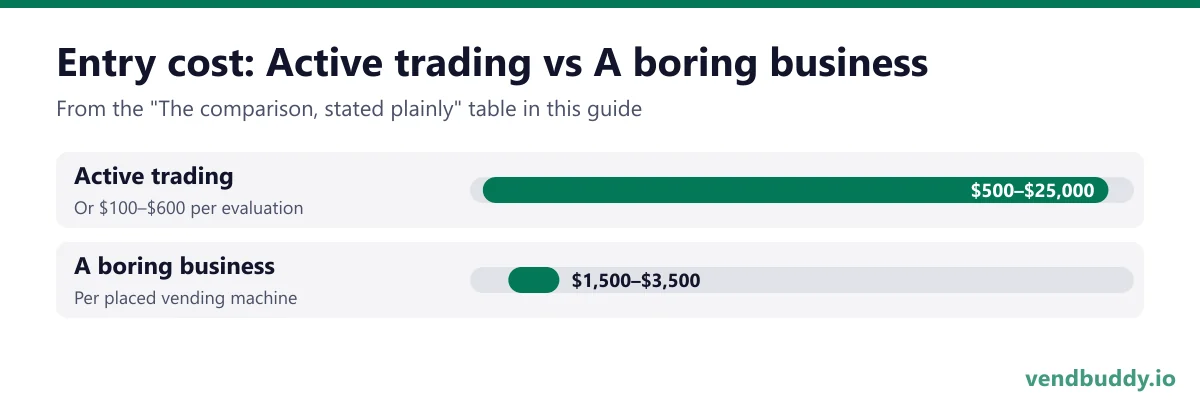
- Vending is the cheapest honest entry into the boring category — $1,500–$3,500 per placed machine against $200,000 for a laundromat — which is why it sits at the bottom of the ladder, not the top.
- The answer is almost always sequencing, not selection. Boring cash flow first, because it is what makes trading small enough to survive.
If you have spent any time in trading communities you have watched the same account arc twice a year: a good month posted, a better month posted, then silence, then a screenshot of a funded-account evaluation being restarted. And if you have spent any time in small-business communities you have watched the opposite arc — somebody quietly reporting their eleventh machine, their fourth truck, their second location, with no screenshots at all. This piece is about why those two arcs look so different, stated in a way that a working trader can read without being insulted.
- Getting the zero-sum argument right
- Four things trading genuinely does better
- The three properties that define a boring business
- The comparison, stated plainly
- Why vending is the entry-level rung of the boring ladder
- The answer is sequencing, not selection
- Who should actually pick which
- Frequently Asked Questions
We sell software to vending operators, so our bias is obvious and worth stating up front. The argument below concedes four specific things trading does better, because a comparison that pretends otherwise is marketing rather than analysis. This sits inside our wider ranking of the best cash-flow businesses, and the model-by-model head-to-heads are linked throughout.
Getting the zero-sum argument right
The lazy version of this argument says trading is zero-sum and therefore pointless. That is wrong, and traders correctly dismiss anyone who says it.
Here is the accurate version. Owning productive assets is positive-sum. A company earns money that did not exist before, and shareholders divide it. Nobody has to lose for an index fund holder to gain over twenty years. That is the equity risk premium and it is real.
Short-horizon speculation among participants is a different activity. Over a day or a week, the underlying earnings barely move; what moves is the price at which participants exchange the same claim. Your gain on that exchange is very close to somebody else’s loss. Before costs it approximates zero-sum. After spread, commission, slippage, financing and, increasingly, evaluation fees, the pool available to participants is smaller than the pool they put in. That is not a moral claim about traders. It is an accounting identity, and it is why brokerage disclosures and academic studies commonly report that a large majority of active retail traders finish a year down. Exact figures vary by market, period and study, so treat any single percentage you see quoted as directional and check the current disclosure yourself. The evaluation fees in that list are a business model of their own, and the cost to start a prop firm trading business itemizes what three or four honest attempts actually run.
The consequence is specific rather than damning: in trading you must be better than the other participants to make anything at all. In a business, you have to be good enough at serving customers, which is a much lower bar and one that does not require anyone else to fail. A mediocre vending operator with well-placed machines makes money. A mediocre trader does not, by construction. The purest version of that construction is the sportsbook hold, and the cost to start a sports betting business works through the bankroll and the 52.4% break-even it implies.
You can run break-even on your own numbers in the revenue calculator instead of borrowing ours. It asks for property type and headcount, which is where nearly all of the difference comes from.
Four things trading genuinely does better
These are not throat-clearing. If you are a trader reading this to see whether we understand your side, this is the section that decides it.
1. Liquidity. Your capital is in an account, and it can be in cash by Friday. A vending route is $30,000 sitting in metal boxes inside other people’s buildings, and converting it back takes weeks and a buyer. That is a genuine cost of the boring path and nobody discloses it clearly enough.
2. Scaling without headcount. Doubling a trading account requires no hiring, no vans, no route density, no commission renegotiation. Doubling a service business means people, and people are the hardest part of every small business ever run. A trader who finds an edge can scale it with a keystroke. That advantage is structural and it is why the theoretical ceiling really is higher.
3. No customers, no hosts, no gatekeepers. Nobody has to say yes. There is no property manager who stops replying, no host who suddenly wants 25%, no location that closes with sixty days notice. For people whose main constraint is that they hate selling, this is not a small thing.
4. A fast, honest feedback loop. A trading journal tells you within a hundred trades whether your process has an edge. Most small businesses take two years to tell you the same thing, and by then the money is spent. Traders learn faster than operators because the market grades them daily, which is brutal and also genuinely useful.
Any of those four being decisive for you is a legitimate reason to weight trading heavily. What follows is what you give up in exchange.
Picture the machines paying you while you sleep
That’s the real promise of vending — income that doesn’t cost you your time, and a life on your own terms. VendBuddy turns this guide into a step-by-step plan so you actually build it instead of just reading about it. Start free today.
Start building free →The three properties that define a boring business
Boring is not a synonym for small, safe or dumb. It is a specific and checkable set of properties, and it is the reason the category outperforms its reputation.
Cash arrives on a schedule, not as a distribution
This is the whole thing, and it is the property people underrate until they have a mortgage. A vending route grossing $6,000 a month grosses roughly $6,000 next month too. Not exactly — a host closes, a summer is slow, a machine goes down — but the variance is measured in tens of percent, not in whether the number is positive. A trading account with an identical annual expectancy delivers it as a distribution: some months large, some months negative, and the sequence is unknowable in advance.
Those two are financially equivalent on a spreadsheet and completely different in a life. Fixed costs are date-certain. Income that is not date-certain has to be buffered with capital you are then not trading with, which quietly lowers your real return. Nobody models this and everybody experiences it.
The skill compounds instead of resetting
Trading skill is real, but it is skill at a game whose rules are rewritten by the other players. Edges decay. A setup that worked in 2021 volatility does not work in a grinding 2026 tape, and the work of finding the next one starts from something close to zero.
Operating skill compounds differently. Knowing which building types convert, what a good host agreement looks like, which products move in a warehouse versus a gym, how to price a route you are buying — none of that decays. It accumulates into judgment that makes machine eleven meaningfully better placed than machine one. Ten years of operating is a bigger advantage than ten years of trading, because ten years of trading mostly buys you the discipline not to blow up, which is enormous but is not compounding knowledge.
There is something to sell at the end
This is the property that gets skipped most often. A profitable trading account is a balance, and it is worth its balance. A profitable route is an asset: routes commonly change hands at roughly one to two times annual net, so a route netting $50,000 a year sells for something in the $50,000 to $100,000 range on top of every dollar it paid you while you owned it. That terminal value is a real component of return that trading has no analogue for. You can walk away from a business and be paid for walking away.
The comparison, stated plainly
| Active trading | A boring business | |
|---|---|---|
| Income shape | A distribution — unknowable sequence | A schedule — roughly the same number monthly |
| Do you need someone else to lose? | Over short horizons, effectively yes | No — customers pay for value received |
| Liquidity | Excellent — cash by Friday | Poor — weeks to sell, needs a buyer |
| Scaling | No headcount, no geography | People, vans, density, negotiations |
| Skill durability | Edges decay as participants adapt | Operating judgment accumulates |
| Terminal value | The account balance | 1–2x annual net, on top of what it paid you |
| Worst realistic outcome | Account to zero, plus fees paid to try again | Sell the machines at a loss, recover most of it |
| Entry cost | $500–$25,000, or $100–$600 per evaluation | $1,500–$3,500 per placed vending machine |
Why vending is the entry-level rung of the boring ladder
Every boring business on the list has the three properties. They do not have the same entry ticket, and that is the practical constraint for almost everyone reading this.
Self-storage is a better business than vending on almost every axis — better margins, lower labour, an appreciating asset, commercial financing, a cleaner exit. It also needs roughly $250,000 to $350,000 in non-financeable cash down. A laundromat is $200,000 to $500,000 to build out, most of it sunk into a leasehold you cannot move. Those are not alternatives for someone with a job and $8,000; they are alternatives for a different stage of life.
Vending sits at the bottom of the ladder on purpose. $1,500 to $3,500 per placed used machine, cash-flowing within days, 40–55% gross margins, one to two hours per machine per month. It has a lower ceiling than everything above it and a genuinely honest floor: the failure mode is a machine in a weak building, which you sell or relocate, not a down payment you cannot recover. The income range is wide and location quality decides where you land, which is the one major risk in the model and also the only one you can measure before spending anything.
The maths that matters for a trader: a 3–5 machine route built over six to twelve months typically nets $700 to $1,500 a month. That is not a get-rich number and it is not supposed to be. It is the number that covers a mortgage payment or a car payment, which is precisely the number that lets you trade a small account calmly. The honest $5,000-a-month version takes 12–20 machines and two to three years, and we say so. For the other side of that ledger, the cost to start a swing trading business itemizes the account size, data and evaluation fees a small trading operation genuinely needs.
VendBuddy scores real buildings near you by foot traffic, headcount and category, hands you the best contact on file for each, and models net profit and payback before any money moves. Five free credits, no card — enough to see whether your ZIP supports the numbers on this page.
The answer is sequencing, not selection
The internet frames this as an identity choice. Operators treat it as an order of operations, and the order is not symmetrical.
Boring first, then trading, works. The route covers fixed costs. Fixed costs covered means the trading account can be small, which means a losing streak is survivable, which means you never take the oversized revenge position that ends accounts. Almost every catastrophic retail-trading story has the same first line: the trader needed a specific number by a specific date.
Trading first, then boring, mostly does not work. Not because trading cannot fund a business — it can, and some operators funded machine one exactly that way — but because the sequence puts the volatile thing in charge of the fixed thing. Savings intended as startup capital become the buffer for a drawdown, and then they become the drawdown.
If you are going to trade, the specific comparisons are worth reading with the same scepticism you would apply to any pitch: vending vs day trading, vending vs swing trading, vending vs options trading, vending vs prop firm trading, vending vs crypto trading, vending vs forex trading and vending vs sports betting. Each one includes the case for the other side, because a reader who trusts the comparison is worth more to us than one who was hyped into the wrong business.
Who should actually pick which
- Pick trading if you have a measurable edge over hundreds of trades, capital you could lose entirely without changing your life, and income from somewhere else. Those three together, not two of them.
- Pick a boring business if the number you need is a monthly one, if you would rather own something than be right about something, or if the buffer required to trade calmly is larger than the capital you have.
- Pick vending specifically if you want the boring category but do not have $200,000, and you are willing to do the unglamorous part — walking into buildings and asking.
- Pick neither if what you actually want is for money to arrive without work. That is an investing question rather than a business question, and passive income ranked by realism is the honest place to start.
The uncomfortable summary: trading is a skill contest with a fast clock and a wide distribution, and a boring business is a patience contest with a slow clock and a narrow one. Most people who need the money choose the first because it is more interesting, and that is the actual mistake — not the model.
Related reading: the best cash-flow businesses ranked by what $10k buys, what happens to trading accounts versus snack sales in a downturn, the honest cost to start day trading, is vending a good business, how much vending machines actually make, and building your own severance.
Frequently Asked Questions
Is day trading actually zero-sum?
Short-horizon speculative trading among participants is close to zero-sum before costs and negative-sum after them: one account’s gain on a trade is another account’s loss, and both sides pay spread, commission and slippage on the way through. Long-horizon investing is a different activity and is genuinely positive-sum, because the underlying companies produce earnings that did not exist before. Conflating the two is the most common error in this debate, and it runs in both directions - traders borrow the equity risk premium to justify day trading, and critics use day-trading statistics to argue against owning index funds.
What is a boring business?
A business with three properties: it produces cash on a predictable schedule rather than a distribution of outcomes, the skill you build in it compounds instead of resetting, and the result is an asset somebody else would buy. Vending routes, laundromats, self-storage, pressure washing, HVAC, self-serve car washes and small service businesses all qualify. None of them are exciting, and none of them are new, which is exactly the point - the absence of hype is a signal about how much money is being made from teaching it versus doing it.
Can trading and a boring business coexist?
Yes, and it is the arrangement most people who do both settle into. The business covers fixed costs, which is what makes trading small enough to survive a losing streak. Almost every catastrophic retail-trading story starts with a trader who needed a specific number by a specific date, because that pressure forces exactly the position sizing that ends accounts. Cash flow that arrives regardless of the market is the cheapest risk management available.
Does a boring business have a lower ceiling than trading?
On paper yes, in practice it is closer than the framing suggests. A trading account compounds without headcount, which is a real structural advantage, and the theoretical ceiling is unbounded. But the ceiling that matters is the one your own results reach, and the distribution of retail trading outcomes is heavily skewed: broker disclosures and academic work commonly report that a large majority of active retail traders lose money over a year. A 15-machine vending route netting $4,000 to $7,000 a month is an unremarkable outcome that most operators who stick with it eventually reach, and it can be sold at the end.
Is vending a good first boring business?
It is the cheapest honest entry into the category, which is its main argument. A used machine placed in a measured location runs $1,500 to $3,500 all in, cash-flows within days, takes one to two hours per machine per month, and resells with the route at roughly one to two times annual net. Compare that to $200,000 for a laundromat or $250,000 down on self-storage. The real risk is singular and measurable in advance: a bad location earns a third of what a good one does for the same money.
What is the honest case for trading over a boring business?
Four things, and they are real. It is fully liquid, so your capital is never stuck in a machine in someone else’s building. It scales without hiring, geography or logistics. It has no customers, no hosts and no commission negotiations. And the feedback loop is fast enough to genuinely learn from, which most small businesses are not. If you have an edge you can measure over hundreds of trades, none of that is hype - it is a better use of your particular skill than restocking a snack machine.
How much money do I need before trading full time?
The question people actually mean is how much they need before they can stop earning elsewhere, and the honest answer is that the amount is large enough that anyone able to reach it usually no longer needs to trade for income. A more useful framing: build the boring income first, size the trading account at what you could lose entirely without changing your life, and let the results decide whether it deserves more capital. That sequence costs nothing if you are wrong about your edge.
What is selling, which buildings say yes, and the numbers before you buy a machine. Free, confirm from your inbox, unsubscribe in one click. Refer one friend and get 25 VendBuddy credits.
Want the free 38-page Ultimate Vending Guide too? Get the guide
General information, not legal, tax or financial advice. Rules change, so check the official source. Revenue and income figures are examples, not promises. See our terms.