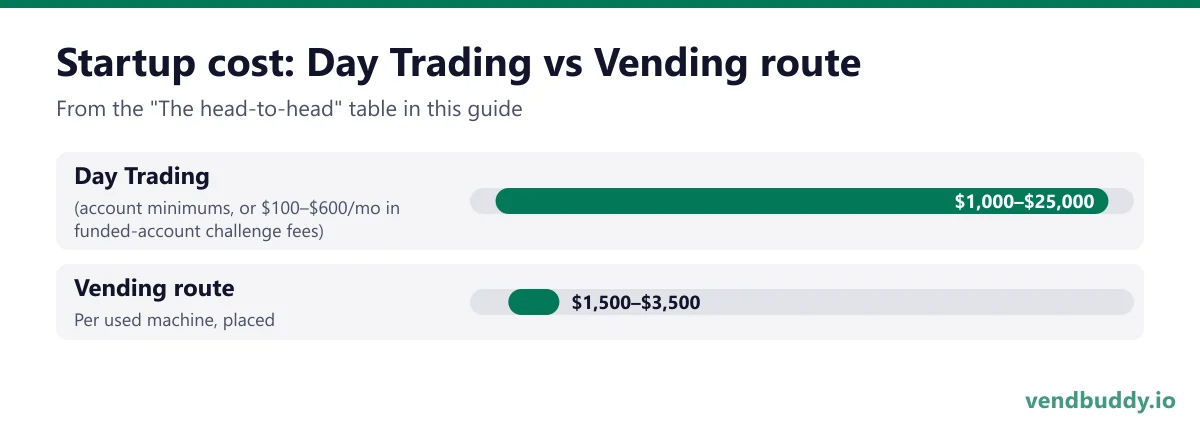
- Day Trading: $1,000–$25,000 (account minimums, or $100–$600/mo in funded-account challenge fees) to start, market hours glued to screens, plus nights studying setups.
- Vending: $1,500–$3,500 per placed machine, 40–55% margins, 1–2 hrs/machine/month — and the machine is a sellable asset.
- What kills day trading: the math itself — you are competing against institutions with faster data and infinite patience.
- The honest answer is usually a sequencing question, not either/or — boring cash flow first, high-variance bets second.
Day Trading is one of the loudest business models on the internet right now. Vending machines might be the quietest. This head-to-head sits inside our wider ranking of the best cash flow businesses, and it is written by people who sell vending software and will still tell you when day trading is the better fit — because a reader who trusts the comparison is worth more than one who was hyped into the wrong business.
The head-to-head
| Day Trading | Vending route | |
|---|---|---|
| Startup cost | $1,000–$25,000 (account minimums, or $100–$600/mo in funded-account challenge fees) | $1,500–$3,500 per used machine, placed |
| First dollar | Any day — and any day can also be your worst loss | Days after placement — cash from day one at the machine |
| Ongoing hours | Market hours glued to screens, plus nights studying setups | 1–2 hrs per machine per month |
| Margins | Not a margin business: study after study finds the large majority of retail day traders lose money over time | 40–55% gross after product cost |
| What kills it | The math itself — you are competing against institutions with faster data and infinite patience; funded-account challenge fees quietly become the real business model; one revenge-trade session can erase months | Bad locations — the one solvable risk (measure before placing) |
| Exit / resale | Usually zero — the "business" is you or the platform | Routes sell in weeks at 1–2x annual net |
The honest case for day trading
A small minority of disciplined traders with real edge and risk management make a living. For everyone else it is entertainment with a subscription fee, and the honest brokerages’ own disclosures say so. If you must trade, trade small and treat it as tuition — never as the income plan.
Picture the machines paying you while you sleep
That’s the real promise of vending — income that doesn’t cost you your time, and a life on your own terms. VendBuddy turns this guide into a step-by-step plan so you actually build it instead of just reading about it. Start free today.
Start building free →The honest case for vending
A vending machine has no red days. The same $10k that funds one trading account buys 3–4 income-producing machines whose worst-case scenario is relocating one of them. Boring compounding beats exciting variance for anyone who needs the money to actually arrive. The catch is identical for every new operator: the income range is wide, and location quality decides which end you land on. Operators who measure foot traffic and pitch the actual decision-maker land the good end; operators who guess, churn out.
The sequencing play most people miss
The internet frames this as a rivalry. Operators treat it as a sequence: a 3–5 machine route built over 6–12 months (the $5k/month math) throws off dependable monthly cash that funds the higher-variance day trading experiment — and still pays the bills if the experiment fails. Boring base first, exciting bets second. The reverse order is how savings accounts die.
VendBuddy scores real locations near you by foot traffic and finds the best contact on file — five free credits, no card, takes about three minutes to see your first scored leads.
Frequently Asked Questions
Is day trading still worth it in 2026?
A small minority of disciplined traders with real edge and risk management make a living. For everyone else it is entertainment with a subscription fee, and the honest brokerages' own disclosures say so. If you must trade, trade small and treat it as tuition — never as the income plan.
Is day trading legit, or a scam?
The business model itself is legitimate - real people run real day trading operations. The scam reputation mostly comes from the marketing around it: courses and gurus selling outlier results as typical while earning their own income from course sales rather than from the model. Judge the model by its unit economics (Not a margin business: study after study finds the large majority of retail day traders lose money over time), not by anyone’s Lamborghini.
Is vending better than day trading?
Different tools: Day Trading has a higher theoretical ceiling; a vending route wins on predictability, ownership of a sellable asset, 40-55% margins, and 1-2 hours per machine per month. Operators who want dependable monthly cash flow pick vending; swing-for-the-fences temperaments pick day trading.
Can I do both?
Yes - it is a common pattern: a small vending route as the boring cash-flow base that pays the bills while the higher-variance day trading bet gets time to work. The route also survives if the bet does not.
More comparisons: vending vs dropshipping, vending vs amazon fba, vending vs ai automation agency (aaa), vending vs ugc content creation, and passive income ranked by realism.
What is selling, which buildings say yes, and the numbers before you buy a machine. Free, confirm from your inbox, unsubscribe in one click. Refer one friend and get 25 VendBuddy credits.
Want the free 38-page Ultimate Vending Guide too? Get the guide
General information, not legal, tax or financial advice. Rules change, so check the official source. Revenue and income figures are examples, not promises. See our terms.