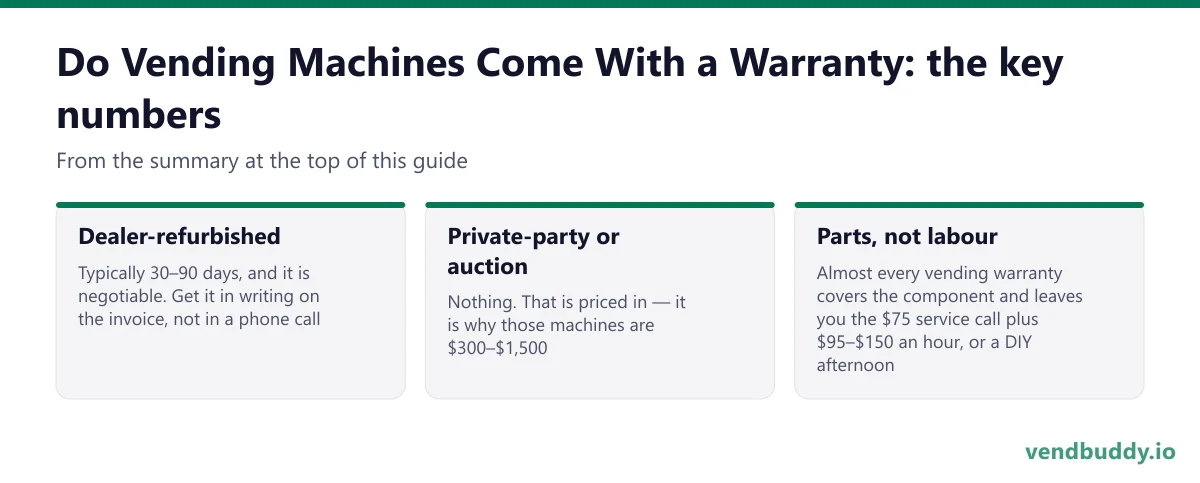
- New from a manufacturer or national seller: normally about a one-year limited parts warranty, sometimes longer on refrigeration.
- Dealer-refurbished: typically 30–90 days, and it is negotiable. Get it in writing on the invoice, not in a phone call.
- Private-party or auction: nothing. That is priced in — it is why those machines are $300–$1,500.
- Parts, not labour. Almost every vending warranty covers the component and leaves you the $75 service call plus $95–$150 an hour, or a DIY afternoon.
- The one clause to read: does it cover the sealed refrigeration system? A warranty that excludes the compressor is covering the cheap failures and leaving you the expensive one.
Nobody asks this question until they are one click from spending three or four thousand dollars, and then it becomes the only question. The honest answer is that vending warranties are real, narrow, and worth much less than buyers assume — but the process of asking about one is the fastest way to find out what kind of seller you are dealing with. Here is what each buying lane actually gives you and what to insist on before you pay.
Part of our complete guide: how much does a vending machine cost.
What you get in each buying lane
There are three genuinely different purchases here, and the warranty is one of the main things separating them. The full supplier breakdown covers the rest.
New, from a manufacturer or national seller
Expect a limited parts warranty in the region of one year, with the sealed refrigeration system sometimes carried longer. This is the closest thing to a real warranty in vending. It is also the lane where the machine costs $3,000–$6,000 with a card reader, and some of that gap over a refurb is exactly this coverage plus somebody who answers the phone.
On card readers specifically, Nayax is the default for a dull reason: it is the one most machine suppliers pre-wire for. Price the monthly against your slowest machine, not your best one.
Dealer-refurbished
The normal term is 30 to 90 days, and this is the lane where the warranty is a live negotiation rather than a fixed policy. A refurbisher at $1,200–$3,000 has already tested the machine and replaced what failed, so they are usually willing to stand behind that work — the question is for how long and on which components. Ninety days is achievable at most dealers if you ask before you agree on price rather than after.
Private party, marketplace and auction
No warranty, no recourse, no phone number. That is the deal, and it is why the same machine is $300–$1,500 here. This lane is not a mistake — plenty of good operators buy exclusively in it — but you are substituting your own inspection for a warranty, which is why the used-machine inspection checklist exists and why nobody experienced buys sight-unseen in this lane.
What a vending warranty actually covers
Two words do most of the work: parts only.
A covered control board means the board arrives free. It does not mean somebody installs it. On a route where you handle your own repairs that is a genuine saving of $400–$1,200. On a route where you call a technician, you are still paying the $75 service call plus $95–$150 an hour, so a covered part might halve the bill rather than eliminate it — the full numbers are in what vending repairs actually cost.
The standard exclusions, which are close to universal:
- Labour and travel. Yours to pay unless the policy explicitly says otherwise.
- Freight and installation damage. That is a carrier claim, and a completely different process.
- Glass, cosmetics and consumables. Including the door glass, which is a common casualty.
- Environment. Install an indoor machine outdoors and you have voided the coverage — see whether a machine can go outside for what that costs you.
- Modification. Retrofit work done badly, especially payment-system wiring, gives an issuer an easy denial.
Picture the machines paying you while you sleep
That’s the real promise of vending — income that doesn’t cost you your time, and a life on your own terms. VendBuddy turns this guide into a step-by-step plan so you actually build it instead of just reading about it. Start free today.
Start building free →The one clause worth arguing about
Ask this question in these words: does this warranty cover the sealed refrigeration system, including the compressor?
Everything else in a vending machine is cheap by comparison. A motor is $15–$80. A coin mech is $150–$300. A bill validator is $200–$400. Those are annoyances. The compressor at $300–$800 plus $150–$250 labour and the control board at $400–$1,200 are the two failures that make a used machine uneconomic to repair, and they are the two that warranties most often carve out.
A dealer who says yes without hesitating has tested the refrigeration. A dealer who gets vague has told you something useful about the machine. Either way you learned it before you paid, which is the actual point of asking.
Extended warranties and service contracts
For a single machine, usually skip it. Price the premium against the two repairs it is really insuring — compressor and board. If the extended coverage costs something close to one of those repairs, you are pre-paying for a failure that may never come, and you keep the money if the machine behaves. A self-funded reserve does the same job and stays yours.
The calculation flips somewhere around ten machines. At that fleet size failures stop being events and become an annual line item you can forecast, and a service contract with a local technician — which is a different product from a manufacturer warranty — starts buying you response time rather than parts. That is a scaling decision, not a first-machine one.
Most first agreements are two pages, not twenty. The contracts walkthrough lays out the clauses that actually matter for the contract, including the termination language operators forget about until they need it.
Before you pay: the four-line warranty check
- Get the term in writing on the invoice. A verbal 90 days is zero days.
- Confirm refrigeration is included. In the document, by name.
- Ask what was replaced during refurbishment. A dealer who can list the parts has actually done the work.
- Inspect and note damage on the delivery receipt before the driver leaves. Freight claims have short windows and a clean signature ends the argument.
None of this takes more than a five-minute conversation, and it is the cheapest due diligence in the entire purchase.
Warranty terms are a spec, and specs are easier to compare than to remember. The free Machine Finder lists current machines by property type with build and support details, so you can shortlist before you start negotiating with sellers.
Frequently Asked Questions
Do vending machines come with a warranty?
It depends entirely on which of the three buying lanes you use. A new machine from a manufacturer or national seller normally carries a limited parts warranty of about one year, sometimes longer on the refrigeration system. A dealer-refurbished machine typically carries 30 to 90 days, and that is negotiable. A private-party or auction machine carries nothing at all, which is a large part of why it costs $300 to $1,500 instead of $3,000 to $6,000.
What does a vending machine warranty actually cover?
Almost always parts, and almost never labour or freight. That distinction decides what the warranty is worth: a covered control board still leaves you paying a technician $75 for the service call plus $95 to $150 an hour, or doing the swap yourself. Consumables, glass, cosmetic damage, damage in transit, and anything caused by installing the machine outside its rated environment are excluded in essentially every policy.
Does a refurbished vending machine warranty cover the compressor?
Only if it says so in writing. This is the single clause worth reading, because refrigeration is the expensive failure: a compressor is $300 to $800 in parts plus $150 to $250 in labour. A refurb warranty that excludes the sealed refrigeration system is covering the cheap failures and leaving you the costly one. Ask the question directly and get the answer in the invoice, not the phone call.
Is an extended warranty on a vending machine worth it?
Rarely, for a single machine. Price the extended coverage against the two failures it is really protecting you from, which are the compressor and the control board. If the premium approaches what one of those repairs costs, you are better off keeping the money and treating it as a self-funded reserve, because you keep it if the machine behaves. The calculus changes on a route of ten or more machines, where failure becomes a predictable annual line item rather than a coin flip.
What should I do if a vending machine arrives damaged?
Note the damage on the delivery receipt before the driver leaves, and photograph everything. Freight damage is a carrier claim, not a warranty claim, and once you have signed a clean receipt you have signed away most of your position. Claim windows are short, often measured in a handful of days, so inspect the cabinet, the glass, the door alignment and the refrigeration line while the truck is still there.
What is selling, which buildings say yes, and the numbers before you buy a machine. Free, confirm from your inbox, unsubscribe in one click. Refer one friend and get 25 VendBuddy credits.
Want the free 38-page Ultimate Vending Guide too? Get the guide
General information, not legal, tax or financial advice. Rules change, so check the official source. Revenue and income figures are examples, not promises. See our terms.