- September and October are placement season. Buildings are back at full headcount, facility managers answer email again, and next-year budgets are being written.
- Work backwards from four to eight weeks. That is a realistic pitch-to-installed timeline, so an early-September conversation is an October machine and a Q4 of actual revenue.
- The honest counter-case is logistics, not demand. Icy lots, slower freight, dead outdoor venues, and a two-week holiday shutdown that takes a corporate breakroom to near zero.
- Miss mid-November and the calculus flips. A machine bought in December spends its first two months in the slowest stretch of the year while insurance and payments run anyway.
- The real answer: the best time is when you have a signed location. Season sets your pitch calendar. It does not decide whether to start.
The question underneath “is fall a good time to start vending” is usually not about weather at all. It is somebody sitting in September wondering whether to move now or wait until the new year, and the answer matters more than it sounds like it should, because the two options are separated by roughly five months of a machine either earning or not existing.
Short version: September and October are the strongest placement window of the year, for reasons that have nothing to do with how much people buy in autumn and everything to do with who is reachable and what happens to a calendar in December.
Why September and October are placement season
Placement is a conversation business, and conversations have a season.
- Buildings are back at full occupancy. Offices thin out badly through July and August. Schools and campuses are empty. A machine you place in August is measured against a headcount that is not there yet, and a property manager evaluating a trial in August is looking at your worst possible month.
- The decision-makers are in the building. The facility manager, office manager or GM you need is back from leave, has cleared the summer backlog, and has not yet entered the December fog. There is a genuine six-to-eight-week stretch where the person who can say yes is at their desk and reachable.
- Next-year budgets are being set. Autumn is when buildings decide what amenities they are adding. Vending usually costs the property nothing, which makes it the easiest thing on that list to approve — but only if you are in the conversation while the list is being written.
- Q4 traffic is coming, and you want to be installed before it. Retail, logistics and manufacturing sites add shifts and seasonal staff from October. Hospitals and 24-hour facilities get busier. That lift lands on whoever already has a machine in the wall, not on whoever is still negotiating.
Work backwards from the install, not forwards from today
The mistake that turns a good autumn into a wasted one is treating “start in the fall” as “buy a machine in the fall”. The sequence runs the other way, and it takes longer than most people plan for.
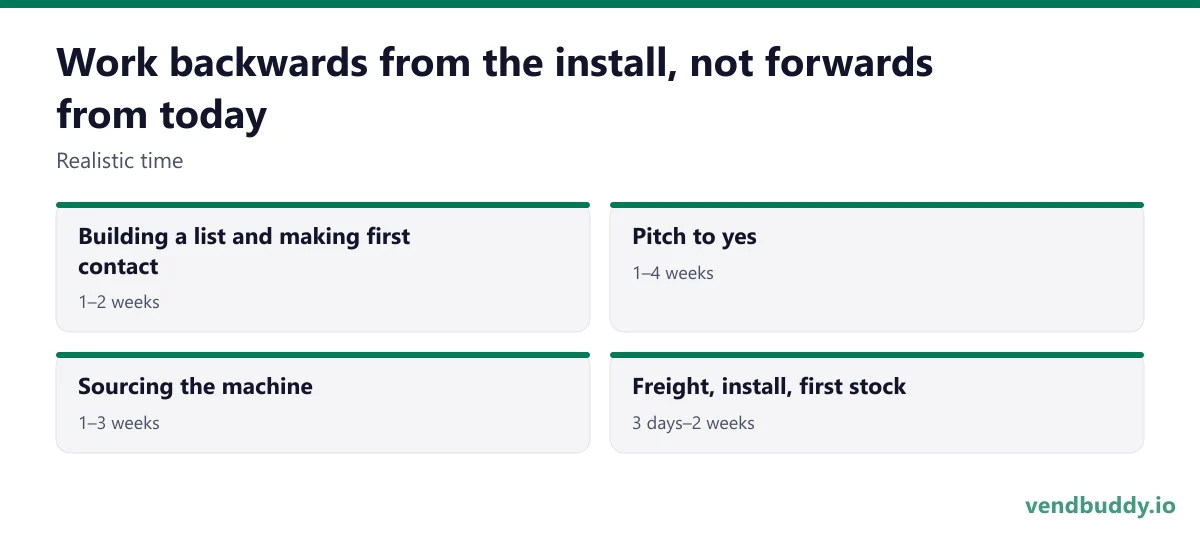
| Stage | Realistic time | What actually eats the time |
|---|---|---|
| Building a list and making first contact | 1–2 weeks | Getting past the front desk to the person who decides |
| Pitch to yes | 1–4 weeks | One decision-maker is fast; a committee or a board is not |
| Sourcing the machine | 1–3 weeks | Finding a clean used unit at the right price, not just any unit |
| Freight, install, first stock | 3 days–2 weeks | Delivery scheduling and getting the machine through the door |
Four to eight weeks, first conversation to first sale. Start the conversations in the first week of September and you are installed in October with a full Q4 ahead of you. Start them in the first week of November and you are installing during the two weeks when nobody is answering, into a building that is about to empty for the holidays. That is the whole argument, and it is a calendar argument rather than a seasonal one. The step-by-step version of the sequence is in how to start a vending machine business.
Fall is not the best time to start vending because autumn sells well. It is the best time because the person who can say yes is at their desk, and in six weeks they will not be.
Picture the machines paying you while you sleep
That’s the real promise of vending — income that doesn’t cost you your time, and a life on your own terms. VendBuddy turns this guide into a step-by-step plan so you actually build it instead of just reading about it. Start free today.
Start building free →The honest counter-case: winter route logistics
Anyone selling you on autumn will stop at the paragraph above. Here is the rest of it, because the second half of a fall start is a winter, and winters are harder to run than the brochures suggest.
- Moving machines in the cold is genuinely worse. Several hundred pounds on a dolly across an icy loading area is how operators hurt themselves and damage equipment. If your install lands in January, pay for a mover or wait for a dry week. This is not a place to be brave.
- Freight slows and gets less predictable. Weather delays on machine delivery are routine from December onward, and a machine sitting on a truck is a machine not earning while your location wonders whether you are serious.
- Outdoor and seasonal venues go quiet. Pools, campgrounds, parks, sports complexes and seasonal attractions drop to near zero. If your first location is one of those, a fall start means five months of nothing.
- The holiday shutdown is real and it is invisible in the averages. A corporate breakroom or a school grosses close to nothing between about December 20 and January 2. Two weeks of zero on a machine that is still costing you insurance and a card-reader fee is not a disaster, but it is a surprise if you budgeted a flat month.
- Cold-weather product shifts. Cold drink sales dip and hot beverage and salty snack sales lift. That is a merchandising adjustment, not a problem, but it is one more thing to learn in your first ninety days.
None of that argues for waiting. It argues for a fall start whose first location is indoor and year-round: an office, a school, a gym, a hospital, a distribution centre. Save the seasonal venue for machine two, in spring, when it is at the top of its cycle instead of the bottom. If you are reading this in December rather than September, the same question at the other end of the calendar is answered in is winter a good time to start vending.
Which venues run counter-seasonal
| Venue | Strong months | Weak months |
|---|---|---|
| Gyms and fitness | January–April, on the membership spike | Late summer |
| Schools and campuses | September–May | June–August, and the holiday weeks |
| Offices and coworking | September–November, January–May | July–August, late December |
| Hospitals and 24-hour facilities | Flat all year | None — this is why they are worth the harder sale |
| Manufacturing and distribution | October–December on seasonal shifts | Varies by industry, rarely severe |
| Pools, parks, campgrounds, attractions | May–September | October–April |
Read that table as a portfolio instruction rather than a ranking. A route made entirely of schools has a dead summer. A route made entirely of pools has a dead winter. Two or three account types that peak in different months is what turns a lumpy side income into something you can plan around, and it is worth deliberately picking your second location to offset your first. The 2026 location rankings and profit by location type both break the categories down further.
So when is the best time to start?
When you have a signed location. That is not a dodge, it is the entire lesson of this business compressed into one sentence, and the operators who lose money to timing almost never lose it to the wrong season — they lose it to buying a machine in the right season with nowhere to put it.
Before you buy anything it is worth seeing the alternatives side by side. The machine finder covers used combos through smart coolers, with the caveat that the machine matters far less than the building it stands in.
What the calendar actually changes is your pitch schedule. If it is September, go now: you have the best six weeks of the year for getting a yes, and enough runway to be installed before the building empties. If it is late November, do not force an install — spend December building the list and booking January conversations, when facility managers come back with a fresh budget year and an unusual willingness to say yes to things. If it is February, that is the second window and it is nearly as good as autumn.
And if you are sitting in July: the summer is for the unglamorous half. Form the entity, learn the equipment, price the machines, build the list of buildings, and be ready to make forty phone calls the first week of September. Payback timing is worth understanding before you commit either way — how long a machine takes to pay for itself covers what the first year actually looks like, and how much vending machines make covers the revenue side by venue.
The whole autumn advantage is a six-week window where the person who can say yes is at their desk. VendBuddy scores real buildings near you by category, size and traffic and hands you the decision-maker title to ask for, so the list takes an evening rather than a month of driving.
Frequently Asked Questions
What is the best time of year to start a vending machine business?
September and October, if you want the machine earning in the same calendar year. The reason is the pitch calendar rather than the weather: facility managers are back from summer, buildings are at full occupancy, next-year budgets are being set, and there is still enough runway to get from a first conversation to an installed machine before the holidays close the decision window. The second-best window is February and March.
Is fall a good time to start a vending business?
Yes, and it is the best window of the year for placement specifically. Schools, offices and campuses are back at full headcount after the summer dip, decision-makers answer email again, and a machine installed in October has November and December to work. The catch is that if you slip past mid-November you have bought a machine that will spend its first two months in the slowest stretch of the year.
How long does it take to go from pitch to an installed vending machine?
Four to eight weeks is normal for a first placement. Finding and pitching takes a couple of weeks, approval can take one to four depending on whether a committee is involved, and sourcing plus freight plus install adds one to two more. Work backwards from that: an October install means starting the conversations in early September.
Is winter a bad time to run vending machines?
Winter is harder on logistics than on revenue for indoor accounts. Moving several hundred pounds of machine across an icy lot is a genuine risk, freight slows, and outdoor or seasonal venues go quiet. Indoor accounts in offices, schools and gyms hold up fine, with the exception of the two-week holiday shutdown when a corporate breakroom grosses close to nothing.
Which vending locations are strongest in winter?
Gyms in January, when new memberships spike. Hospitals and any 24-hour facility, which are flat all year. Indoor manufacturing and distribution, where the shift pattern does not care about the season. Warm drinks and hot beverage sales lift across almost every indoor account. The weak ones are pools, parks, campgrounds, seasonal attractions and anything outdoors.
Should I wait until spring to start instead?
Only if waiting is the difference between a signed location and a guessed one. Season affects your pitch calendar, not the decision itself. A signed placement in December beats an unsigned plan in April every time, and the operators who lose most to timing are the ones who bought a machine in the right season with nowhere to put it.
Related reading: how to start a vending machine business, ROI and payback period, how to find vending locations, the summer heat-wave playbook, and the 90-day location test.
What is selling, which buildings say yes, and the numbers before you buy a machine. Free, confirm from your inbox, unsubscribe in one click. Refer one friend and get 25 VendBuddy credits.
Want the free 38-page Ultimate Vending Guide too? Get the guide
Every operator we talk to wants fewer cold calls. The ones who get there have a Google Business Profile and a simple site a manager can check before replying. AI builders make that an evening job now. Wix is the mature site builder; Base44 also builds working tools like a quote form. Start with the AI website walkthrough or Wix vs Base44.
General information, not legal, tax or financial advice. Rules change, so check the official source. Revenue and income figures are examples, not promises. See our terms.