Start with the part nobody selling a course will say out loud: the people telling you not to start a vending machine business are mostly right. Not about the conclusion — about the reasons. It is not passive, not at the start. The ramp is slow. The first machine will not replace anything. A bad location will quietly take your money for a year before you admit it was a bad location. This post spends its first half agreeing with all of that in detail, because the fastest way to save you three thousand dollars is to talk you out of spending it. If the list still does not scare you off, the second half is the math that rewards the people who show up anyway.
- Reason not to start #1: it is not passive, and year one is the least passive part
- Reason not to start #2: restocking and sourcing runs are the job, not a side effect of the job
- Reason not to start #3: theft and vandalism are real, and they are not evenly distributed
- Reason not to start #4: the ramp is slow, and the first machine is modest for months
- Reason not to start #5: a bad location will not fix itself, and it will not tell you
- If none of that scared you, here is the math
- Who this business filters out, and who it rewards
- FAQ
Every dollar figure below is a typical range, not a promise. Vending results vary enormously by location, product mix, local competition, and how much work you personally put in. Nobody — including us — can tell you what your machine will earn.
Reason not to start #1: it is not passive, and year one is the least passive part
The version you have seen is a machine humming away while somebody sleeps. The version that actually happens in month one is a person in a car with a folding hand truck, a phone full of location notes, and a trunk of candy bought at retail because the wholesale account is not open yet.
Early route work is unglamorous and specific: drive to the machine, count what sold and what did not, haul product in, clear a jam, argue gently with a bill validator, update the spreadsheet, repeat next week. Once a route is dialed in, a couple of hours per machine per month is a fair planning number. While you are still learning what a location actually eats, it is meaningfully more.
The honest counter. The word doing the damage is “passive,” not “vending.” The labor curve falls hard — the second machine costs a fraction of the learning the first one did, and machines clustered in one part of town share a single trip. It never reaches zero hours, and anyone promising zero is selling something. It reaches a few hours a week for a route that pays like a part-time job. That is a real thing, and it is a different thing. We put actual numbers on it in how much time a vending route really takes.
Reason not to start #2: restocking and sourcing runs are the job, not a side effect of the job
Nobody films the sourcing run. It is a warehouse club at 7am, a cart of cases, a receipt you have to reconcile, and product staged in a corner of your garage that your household did not agree to donate. It is comparing a case price against last month, noticing that a supplier quietly raised a unit by fifteen cents, and deciding whether that changes your price on the shelf.
It is also physical. Snack machines are heavy, product is heavy, and a route in July is a route in July.
The honest counter. This is where the margin lives, which is exactly why it is the part that gets skipped in the highlight reel. Operators who treat cost of goods as a monthly discipline rather than an afterthought are the ones whose numbers work — the mechanics are in how vending machine profit margin actually works. If shopping carefully and tracking unit costs sounds tedious, that is useful information about whether this business fits you. If it sounds like a lever, you have just found the main one.
Picture the machines paying you while you sleep
That’s the real promise of vending — income that doesn’t cost you your time, and a life on your own terms. VendBuddy turns this guide into a step-by-step plan so you actually build it instead of just reading about it. Start free today.
Start building free →Reason not to start #3: theft and vandalism are real, and they are not evenly distributed
Machines get pried, tilted, kicked, and occasionally hit by a vehicle. Product walks. A cash box is a target in a way a card reader is not. Unhosted outdoor placements and unsupervised lobbies carry risk that a badge-access warehouse break room simply does not.
It is not constant, and most operators go long stretches without an incident. But the first time it happens, it is a repair bill, a lost weekend, and a conversation with a property manager you would rather not be having.
The honest counter. Nearly all of this is a placement and hardware decision made before the machine ever ships. Supervised interiors, cashless-first payment, anchoring, camera coverage, and choosing hosts who care about their own lobby remove most of the exposure. The playbook is in preventing vending machine vandalism and theft. What it filters out is the operator who wants to place a machine anywhere it fits; what disciplined operators do is refuse placements that fail the security screen even when the host says yes.
If you want the whole sequence in one file rather than a stack of posts, the free Ultimate Vending Guide is the long version. It collects the launch plan, the location scoring rubric and the pitch scripts.
Reason not to start #4: the ramp is slow, and the first machine is modest for months
Here is the number the excited version of this pitch leaves out. A brand-new machine in a decent spot, before you know what that specific building actually buys, commonly nets something in the neighborhood of $50–$150 a month. Not because the business is broken — because your planogram is a guess for the first eight to twelve weeks and roughly a third of your slots are wrong.
That number typically climbs as you replace losers with repeat sellers, fix pricing, and learn the shift patterns of the building. A dialed-in machine in an ordinary placement lands in a typical range of $150–$400 a month net, and genuinely strong placements run higher. But “typically climbs over several months” is a very different sentence from “replaces your income by Q2.”
The honest counter. Slow is not the same as broken, and the two get confused constantly. Most first-machine disappointment traces to a small number of fixable causes — wrong products, wrong prices, wrong building, cash-only payment — which we work through in why your vending machine is not making money. The operators who quit at month three quit at exactly the point where the data finally becomes useful.
Reason not to start #5: a bad location will not fix itself, and it will not tell you
This is the one that actually ends routes. A weak placement does not fail loudly. It produces forty dollars a month, forever, while consuming the same drive time, the same restock labor, and the same mental space as a placement earning five times that. It is a slow leak, and because it is technically making money, it is easy to leave in place for a year.
Foot traffic is not the metric. Captive foot traffic with dwell time and nowhere else to buy is the metric. A building with 300 people and a convenience store across the parking lot is a worse placement than a building with 80 people on a night shift and nothing open within a mile.
The honest counter. Location selection is a screening problem, and screening problems are solvable with a process rather than luck. Employee count, shift structure, competing retail within walking distance, and dwell time do most of the work — the criteria are in how to judge a vending location, and the failure pattern is documented in why most vending operators fail in year one. Disciplined operators also do the unglamorous second half: they pull underperforming machines and move them, instead of hoping.
If none of that scared you, here is the math
Everything above is true. So is this: the same list is why the business stays open to people starting with a few thousand dollars. Barriers that annoy you are barriers that protect you, and a business anybody could run passively from a laptop would have been arbitraged away long ago.
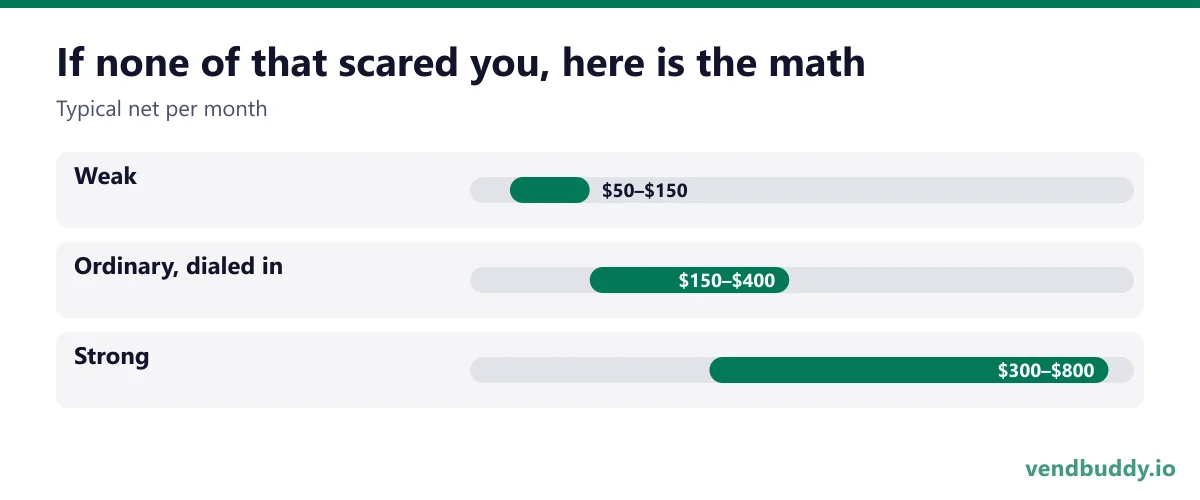
| Placement quality | Typical net per month | What it looks like | Rough payback on a used machine |
|---|---|---|---|
| Weak | $50–$150 | Low headcount, retail nearby, no captive dwell | Years, or never — move the machine |
| Ordinary, dialed in | $150–$400 | Office, gym, apartment building, small plant | Roughly 1–2 years |
| Strong | $300–$800 | Multi-shift warehouse, hospital wing, no alternative on site | Often under a year |
Typical ranges reported by operators, not guarantees. Your results depend on the placement, the product mix, and the work.
The interesting number is not any single row. It is what happens when you stop spending the output. One ordinary machine netting a few hundred a month funds the next machine within a year or so from cash flow alone. Two machines fund the third faster. The route is not the sum of the machines — it is the sum of the machines plus the trips they share plus the location relationships that produce referrals to the building next door. That compounding is worked out machine by machine in the real math behind a ten-machine route.
None of this shows up as a fan of hundred-dollar bills. It shows up as a spreadsheet with more rows than it had last quarter, which is a considerably less exciting artifact and a considerably more reliable one.
Who this business filters out, and who it rewards
| Do not start if | You are the right fit if |
|---|---|
| You need this to replace income inside six months | You are building a second income stream on a two-to-three-year horizon |
| The word “passive” is the whole reason you are here | You want work that stops scaling with your hours after the first year |
| You will not ask a stranger for a placement | You can handle fifteen polite no answers to get one yes |
| Tracking unit costs in a spreadsheet sounds like punishment | You already like the spreadsheet part |
| You would buy the machine before you have the location | You will sign a location first and buy hardware second |
If the right column describes you, the honest full-length version of the tradeoff is in the vending machine business pros and cons, and the broader question of whether the business is worth entering at all is in is vending a good business.
The readiness quiz is built to disqualify people, not flatter them. It asks about your capital, your time, and your tolerance for the unglamorous parts, and it tells you plainly if the answer is no.
Take the readiness quiz →FAQ
Should I start a vending machine business?
Only if you can accept three things: it is not passive in year one, the first machine usually nets a modest amount for the first few months while you learn the location, and a bad placement will slowly drain time without ever failing loudly enough to notice. Operators who accept those and screen locations carefully tend to do well. Operators who came for passive income tend to quit around month three.
Is a vending machine business worth it in 2026?
It depends entirely on placement quality. A dialed-in machine in an ordinary captive location typically nets somewhere in the $150 to $400 a month range, which pays back a used machine in roughly one to two years and then funds the next one. A weak placement can net under $100 a month indefinitely. The business is worth it if you are willing to be selective about locations and move machines that underperform.
What is the most common reason people fail at vending?
Bad locations, by a wide margin. The second most common is buying equipment before securing a placement, which is the same mistake earlier in the sequence. Machine failures and theft are real but they end far fewer routes than a quiet, unprofitable placement that nobody moves.
Related reading: the honest pros and cons list, why most operators fail in year one, and the macro case in vending versus rental real estate on cash-on-cash. When you have a signed location, the free Machine Finder matches your budget to machines that fit that property type.
What is selling, which buildings say yes, and the numbers before you buy a machine. Free, confirm from your inbox, unsubscribe in one click. Refer one friend and get 25 VendBuddy credits.
Want the free 38-page Ultimate Vending Guide too? Get the guide
General information, not legal, tax or financial advice. Rules change, so check the official source. Revenue and income figures are examples, not promises. See our terms.