- You have TWO customers: locations (B2B) decide your revenue ceiling; snack buyers just set the utilization. Market to locations first.
- The core B2B stack: Google Business Profile + referral engineering + professional leave-behinds + a simple one-page site.
- Referrals compound hardest: a $50–$100 thank-you (or 1-month commission bump) per landed referral out-earns any ad budget.
- On-machine marketing (clean machine, owner sticker, price labels, QR for service) lifts existing-location revenue 5–15% for pocket change.
Search “how to market a vending machine business” and you get advice about Instagram aesthetics and flyers — marketing aimed at people who buy a $2 bag of chips. That is not where your growth lives. A vending business grows by winning locations, and locations are a B2B sale to property managers, office managers, and owners. Here is the playbook aimed at the right customer.
Part of our complete guide: how to find vending machine locations.
1. Google Business Profile: the free lead machine
When a facilities manager types “vending machine company near me,” the map pack IS the market. Create a GBP as a service-area business, categorize as Vending Machine Supplier, load real photos of your cleanest installs, and ask every happy location contact for a review. Five 5-star reviews from recognizable local businesses beats any paid ad in this niche — and inbound placement requests are the best leads you will ever get: they already want a machine.
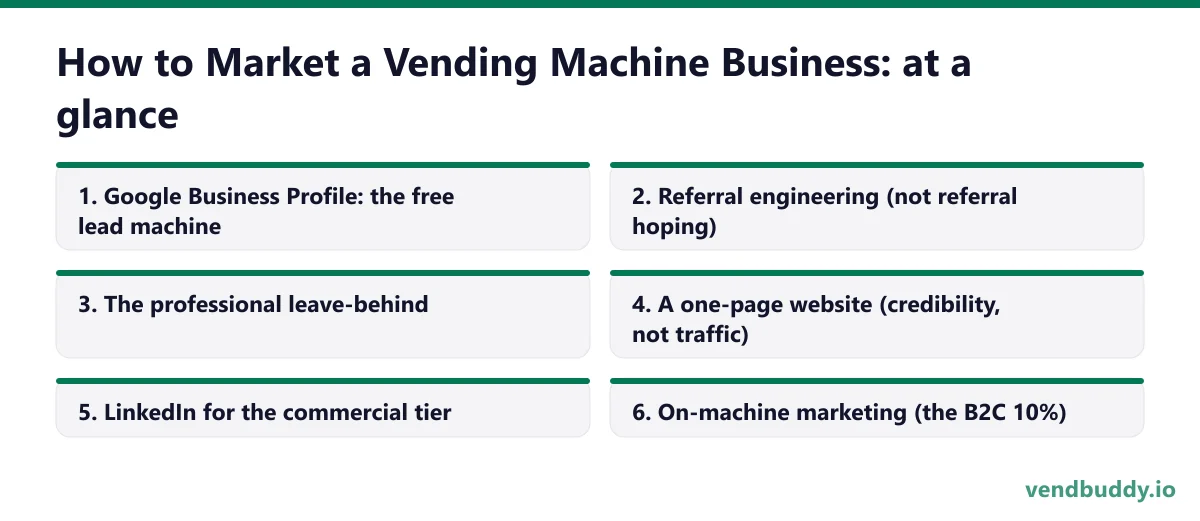
2. Referral engineering (not referral hoping)
Your existing location contacts know other property managers — it is literally their professional network. Make referring you a system: at every restock relationship touchpoint, one line — “know another building that could use this?” — plus a real incentive: $50–$100 gift card or a one-month commission bump per referral that lands. Operators past 20 machines consistently report referrals become their #1 source (it shows up in every scaling story). One landed referral is worth $3,000–$10,000 of lifetime profit; pay the $100 happily.
Picture the machines paying you while you sleep
That’s the real promise of vending — income that doesn’t cost you your time, and a life on your own terms. VendBuddy turns this guide into a step-by-step plan so you actually build it instead of just reading about it. Start free today.
Start building free →3. The professional leave-behind
A one-pager with your name, photo, machine photos, what you provide (machine, stocking, maintenance — free to the location), commission structure, and two references. Laminated — a thermal laminator pays for itself on the first signed placement. This doubles callback rates vs a business card because it makes you look like the professional alternative to the flaky operator they had before — and 40% of locations switch vendors over poor service. Full pitch mechanics in the negotiation guide — the pop-in script and objection responses that turn a leave-behind into a signed placement.
4. A one-page website (credibility, not traffic)
Prospects Google you after the pop-in. One page: who you serve, machine photos, the free-amenity pitch, reviews, phone/email. It does not need SEO glory — it needs to exist and look professional when the office manager checks. Add a “request a machine” form and your GBP links to it.
5. LinkedIn for the commercial tier
For office buildings, industrial parks, and property-management companies, the decision-maker is a facilities or property manager — findable by title + metro on LinkedIn. A short, specific message (“we place and service modern cashless machines in [area] buildings at no cost — happy to send references”) outperforms generic outreach. This is the same decision-maker mapping logic that guides in-person pitching.
6. On-machine marketing (the B2C 10%)
- Clean, lit, stocked — the machine is your billboard to every future referrer walking past.
- “Operated by [name], [phone]” sticker — trust, faster problem reports, and passive advertising to visiting managers from other buildings.
- Clear price labels + a QR code for “machine issue? text us” — complaint recovery is retention marketing.
- Product requests — a small “want something stocked? scan here” note lifts sales and makes the location feel heard.
What NOT to spend on
Broad Facebook/Instagram ads (you cannot target “people who manage breakrooms” efficiently at small budgets), billboards, and SEO agencies pitching national rankings for a 20-mile service business. Every dollar beats those in GBP photos, referral payouts, and gas money for pop-ins.
The fastest way to test this in your own ZIP is the . Search once, see which businesses sit within a few miles, and reveal five contacts for nothing. It will not tell you who says yes, but it saves the afternoon you would spend building the list by hand.
GBP and referrals bring locations to you; VendBuddy tells you which doors to knock proactively — every business in your ZIP, scored by vending potential, with the best contact on file and pitch scripts.
Frequently Asked Questions
How do I advertise my vending machine business?
Aim at locations, not snack buyers: a Google Business Profile with reviews and install photos, a referral incentive for existing location contacts ($50–$100 per landed referral), professional leave-behinds for pop-ins, and a simple one-page website for credibility. Skip broad social ads.
How do vending machine companies get clients?
Four channels, in order of volume for established operators: referrals from existing locations, inbound via Google Business Profile, direct pop-in prospecting, and re-winning locations from underperforming competitors (40% of locations switch vendors over poor service).
Does social media work for a vending business?
As a credibility layer, yes — a feed showing clean installs and restocks reassures prospects who look you up. As a lead engine, rarely: placement decisions are made by property managers responding to referrals, search, and direct outreach, not feed ads.
Related: the location-finding playbook, negotiating the placement once you get in the door, direct-mail prospecting, landing locations without cold calls, and the scaling playbook.
What is selling, which buildings say yes, and the numbers before you buy a machine. Free, confirm from your inbox, unsubscribe in one click. Refer one friend and get 25 VendBuddy credits.
Walk-ins and cold emails find locations. A small site with your own machine photos and a request-a-machine form lets the next one find you. Around machine three to five, an AI builder drafts it in an evening. Wix is the mature site builder; Base44 also builds working tools like a quote form. Start with the AI website walkthrough or Wix vs Base44.
General information, not legal, tax or financial advice. Rules change, so check the official source. Revenue and income figures are examples, not promises. See our terms.