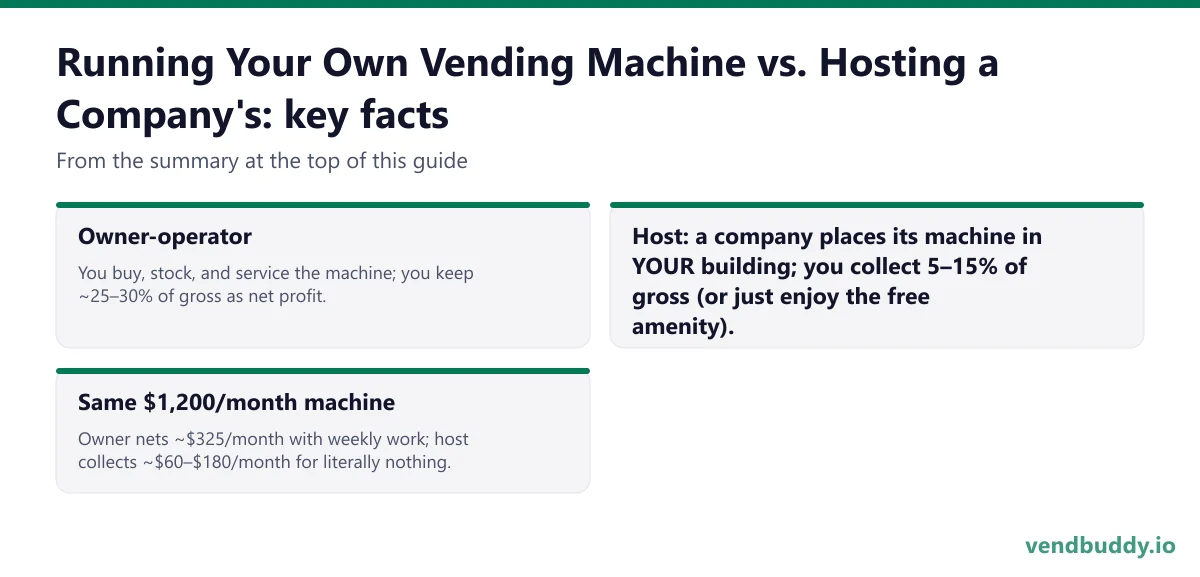
- Owner-operator: you buy, stock, and service the machine; you keep ~25–30% of gross as net profit. It is a business.
- Host: a company places its machine in YOUR building; you collect 5–15% of gross (or just enjoy the free amenity). It is passive real-estate income.
- Same $1,200/month machine: owner nets ~$325/month with weekly work; host collects ~$60–$180/month for literally nothing.
- The deciding question: do you control foot traffic, or are you willing to go find it? Own a building → host. Want income you can grow → operate.
A surprising number of vending questions on Reddit are really this question in disguise: “the vending company keeps most of the money and gives our office 10% — should we just buy our own machine?” Sometimes yes, usually no. The two sides of a placement agreement are two completely different economic positions, and mixing them up is how businesses end up owning a machine nobody wants to restock.
Part of our complete guide: scale a vending machine business.
What the standard deal actually is
In a normal placement, the operator owns the machine, buys the product, restocks weekly, fixes what breaks, and eats the losses if the location is a dud. The host (office, gym, apartment building, shop) provides floor space and an outlet, and in return gets either a commission of 5–15% of gross sales or simply a free amenity for staff and customers. Both sides are rational: the operator is running a business with real margins; the host is monetizing space they already own.
The owner-operator side of the math
A machine at a good location grosses $1,200/month. After product costs (~45%), commission (~10%), card fees (~5.5%), and incidentals, the operator nets roughly $325/month per machine — full breakdown here. Multiply across a route and it becomes real income; that is the entire operator business model. The cost: capital at risk ($1,500–$5,000/machine), weekly service hours, and the business-development grind of finding locations.
Picture the machines paying you while you sleep
That’s the real promise of vending — income that doesn’t cost you your time, and a life on your own terms. VendBuddy turns this guide into a step-by-step plan so you actually build it instead of just reading about it. Start free today.
Start building free →The host side of the math
The same machine pays its host $60–$180/month in commission — or nothing, if the host valued the free amenity over a revenue share. Zero capital, zero labor, zero risk: if sales are bad, the operator pulls the machine and the host loses nothing. For a business with real foot traffic, hosting is among the purest passive income that exists — which is why we tell property managers to request a machine free rather than buy one.
Which side should you be on?
- You own or manage a building with traffic (50+ daily people): host. Your asset is the foot traffic; let an operator bring the capital and labor. Exception below.
- You want income you can scale: operate. Hosting caps at your own square footage; operating scales to every building in your county.
- The break-even exception for hosts: a business with STRONG captive traffic (100+ employees, 24/7 shifts) can justify self-operating one machine — keeping the full ~$325 instead of a $120 commission — IF someone on staff genuinely owns the restocking. Most that try discover the machine sits half-empty by month three; the commission was the better deal all along.
- Employees asking “should our office buy its own machine?”: almost always no. The vending company’s margin is payment for work your office will not reliably do.
Going the operator route? VendBuddy finds and scores the hosts worth pitching in your ZIP. Own the building instead? We match properties with local operators — free.
Frequently Asked Questions
How much do you get paid for having a vending machine in your business?
Hosts typically earn 5–15% of gross sales as commission — $60–$180/month on a $1,200/month machine — or take the machine as a free staff amenity with no revenue share. Strong-traffic locations can negotiate toward the higher end.
Is it better to own the vending machine or let a company put one in?
If you control the foot traffic (you own the business or building), hosting is usually better: zero work and risk for a meaningful commission. Owning only wins with strong captive traffic AND someone who will genuinely service the machine every week.
Why do vending companies keep most of the revenue?
Because they carry all of it: the machine capital, product costs (40–50% of every sale), card fees, weekly restocking labor, repairs, and the risk of a dud location. The operator’s ~25–30% net margin is compensation for running the entire business.
Related: commission rates explained, hiring a management company, what machines actually make, vending as a building amenity, and the operator startup guide.
What is selling, which buildings say yes, and the numbers before you buy a machine. Free, confirm from your inbox, unsubscribe in one click. Refer one friend and get 25 VendBuddy credits.
Walk-ins and cold emails find locations. A small site with your own machine photos and a request-a-machine form lets the next one find you. Around machine three to five, an AI builder drafts it in an evening. Wix is the mature site builder; Base44 also builds working tools like a quote form. Start with the AI website walkthrough or Wix vs Base44.
General information, not legal, tax or financial advice. Rules change, so check the official source. Revenue and income figures are examples, not promises. See our terms.